
NEWS
Chandra’s New Galaxy Gallery Maps the Engines That Built Us
Sixteen new Chandra composites with Webb and Hubble reveal black-hole jets, superwinds and mergers that forge heavy elements and preview the Milky Way’s path.

NASA’s Chandra X-ray Observatory released a gallery of 16 galactic images from Chandra on August 25, 2026, each layering decades of X-ray data with views from the James Webb Space Telescope, Hubble, IXPE and others. The composites turn familiar spirals, ellipticals and irregulars into maps of million-degree gas, black-hole jets and collision shockwaves.
These are not single snapshots. They pull from Chandra observations spanning its full mission life and combine them with infrared, optical and ultraviolet light to show how galaxies live, interact and evolve.
Taken together, the frames form a comparative atlas. Quiet disks, barred feeders, edge-on blowouts and mid-merger wrecks appear side by side, so the same physical engines can be read across different stages rather than in isolation.
Sixteen Images Drawn From One Long Archive
Astronomers sort galaxies into three broad groups. Spirals like the Milky Way show arms winding from a central bulge. Ellipticals appear smoother and older, often products of past mergers. Irregulars refuse neat labels and display disrupted shapes.
All three appear in the release. Each frame carries Chandra X-ray data collected across the observatory’s decades on orbit, then merged with data from Webb, Hubble, the Imaging X-ray Polarimetry Explorer, the Neil Gehrels Swift Observatory, NuSTAR and ground-based telescopes.
- James Webb Space Telescope for infrared dust and hidden star formation
- Hubble Space Telescope for optical stars and tidal features
- IXPE for polarized X-ray views of jets
- Swift for ultraviolet young massive stars
- NuSTAR and XMM-Newton for additional high-energy coverage
The result is a four-by-four grid that functions as a museum of galactic stages, from quiet face-on disks to violent mergers still cloaked in dust.
Because every target draws on the same core X-ray archive, differences between frames track real changes in structure and activity instead of shifts in instrument or method. That common baseline is what lets the gallery work as a single teaching set.
What Chandra’s X-Rays Catch
Most telescopes record visible or infrared light. Chandra records X-rays, high-energy radiation that ordinary glass and atmospheres block. That band reveals processes invisible at longer wavelengths.
Gas heated to millions of degrees by stellar winds, black-hole outbursts and supernova debris glows in X-rays. Those same events enrich the universe with the heavy elements that form planets and life. Supermassive black holes drive jets and outflows that can reshape an entire galaxy’s gas supply.
Key X-ray signals in the gallery
- Million-degree halos and superwinds blown thousands of light-years by starbursts
- Point sources from neutron stars and stellar-mass black holes in binary systems
- Shock-heated gas along jets and collision fronts
- Diffuse hot gas mapping feedback into the surrounding medium
When those layers sit atop optical and infrared data, the full energy budget of a galaxy becomes visible for the first time in a single frame.
Optical light traces stars and dust lanes. Infrared peels back obscuration. Ultraviolet marks the youngest massive stars. X-rays alone expose the hot plasma and compact engines that move mass and energy on galactic scales. The composites lock those channels into one readable map.
Bars, Arms and Superwinds Shape Everyday Spirals
Face-on spirals such as Messier 33 and NGC 3938 let astronomers audit individual high-energy objects along the arms. Chandra picks out X-ray binaries where compact objects pull material from companions. Ultraviolet and optical data show the young massive stars that will later explode.
Barred spirals behave differently. In NGC 1672 and NGC 1385 a central bar of stars and gas funnels material inward, feeding both new star formation and the central black hole. The official Chandra account highlighted NGC 1672 with the note that studying such bars “can help reveal how gas in our own Milky Way, which is also a barred spiral, feeds its central black hole and forms new stars.”
| Galaxy | Distance | Type | Standout X-ray Feature |
|---|---|---|---|
| Messier 33 | ~3 million light-years | Face-on spiral | Hundreds of X-ray binaries and supernova remnants across arms |
| NGC 1672 | ~60 million light-years | Barred spiral | Growing black holes along the bar and core |
| Messier 82 (Cigar) | ~12 million light-years | Starburst edge-on | Superwind of hot gas driven thousands of light-years out |
| NGC 4631 (Whale) | ~30 million light-years | Edge-on spiral | Giant halo of million-degree gas |
| NGC 4725 | ~40 million light-years | One-armed barred | Star formation triggered by earlier encounter |
Edge-on systems turn the same physics into drama. Messier 82 and NGC 4631 display towering superwinds of hot gas that enrich the space between galaxies with the raw materials for later stars and planets.
Viewing angle therefore acts as a natural filter. Face-on disks favor source counts along arms. Edge-on disks favor vertical outflows and halos. Bars highlight the inward funnel that links disk gas to the nucleus. The gallery keeps all three geometries in play so none of those channels is missed.
Black Hole Jets That Rewrite Spiral Arms
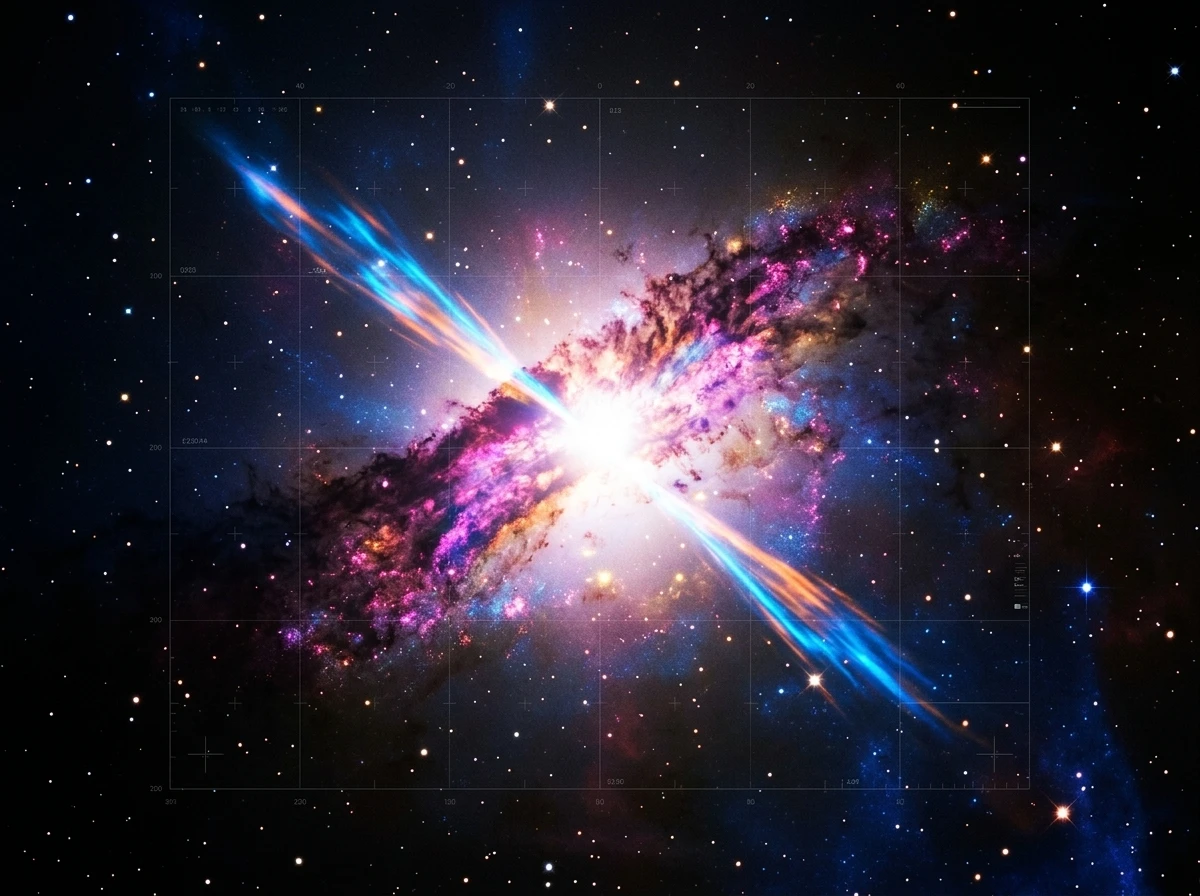
At the heart of many systems sit active galactic nuclei, supermassive black holes that swallow surrounding gas and launch powerful particle jets. Centaurus A, one of the nearest active galaxies, shows a jet stretching tens of thousands of light-years. Chandra and IXPE data together trace the high-energy particles while Webb and ground optical images reveal the dusty merger that still feeds the engine.
Powerful, growing black holes in the cores of their host galaxies, known as active galactic nuclei, send energy outward in outbursts and jets that impact entire galaxies.
NASA Chandra release text, August 25, 2026
Messier 106 (NGC 4258) carries two anomalous arms of hot gas created by jets that heat and shock the disk, producing spiral features unlike ordinary star-bearing arms. In the Sombrero Galaxy (Messier 104) Chandra maps a diffuse million-degree halo surrounding the famous dust lanes and the black hole nested inside a massive stellar bulge.
These outflows do more than decorate. They regulate how much gas remains available for future stars and can quench or trigger star formation across tens of thousands of light-years.
Polarization from IXPE adds direction to the energy flow already mapped in total X-ray brightness. That pairing shows not only where the hot plasma is, but how ordered magnetic structure guides particles along the jet path.
Collisions, Mergers and Cosmic Bullseyes
Several frames catch galaxies mid-transformation. Arp 143 formed when one galaxy punched straight through another, launching an expanding ring of star birth that Chandra lights up with bright X-ray binaries along the shock front.
NGC 3256 and II Zw 096 show dust-shrouded mergers still forming stars at furious rates. Chandra isolates the hot gas and black-hole activity while Webb peers through the dust to the stellar nurseries. These systems echo the chaotic collisions that dominated the early universe.
- Arp 143: expanding ring of star birth along a shock front
- NGC 3256 and II Zw 096: dust-shrouded mergers with rapid star formation
- NGC 1569: nearby dwarf with million-degree bubbles from stellar winds
- NGC 660: rare polar ring of stars over the galaxy’s poles
- Messier 90: 300,000-light-year trail of stripped hydrogen in the Virgo Cluster
NGC 1569, a nearby dwarf, serves as a local laboratory for the frantic star-formation rates of the young cosmos, its million-degree bubbles inflated by stellar winds. NGC 660 displays a rare polar ring of stars orbiting over the galaxy’s poles. Messier 90, racing through the Virgo Cluster, leaves a 300,000-light-year trail of stripped hydrogen gas behind it as the hot intracluster medium strips its fuel supply.
The full Chandra galaxy gallery with fast facts lists observation dates that stretch back to the early 2000s for some targets, underlining how the release mines an archive rather than a single campaign.
Ring galaxies, polar rings and ram-pressure trails are not oddities set apart from the spiral sample. They are the same gas, stars and black holes caught under different external stresses, which is why the X-ray layer remains readable from one frame to the next.
What the Gallery Shows About Our Own Galaxy
The same processes operate in the Milky Way. Barred structures feed the central black hole. Supernova-driven winds seed the disk and halo with heavy elements. Past interactions left fossils still visible today.
Mergers such as the NGC 3256 merger as Milky Way Andromeda preview offer a concrete look at what a future encounter might produce: tidal tails, triggered starbursts, and eventually a more elliptical remnant. Recent dynamical studies have revised the probability and timing of a Milky Way-Andromeda merger, yet the gallery supplies empirical templates for whatever path the Local Group follows.
Chandra itself has now operated more than 26 years past its original five-year design life. The Chandra mission milestones since its 1999 launch show continuous science operations that made this deep multi-mission gallery possible. The images therefore carry a second payload: proof that long-lived high-resolution X-ray vision remains essential for reading the full life cycle of galaxies.
- July 23, 1999: Chandra launches on a five-year design life
- Early 2000s: first observations of several gallery targets enter the archive
- More than 26 years on: continuous operations far beyond the original plan
- August 25, 2026: the 16-image multi-mission gallery is released
On X, the official NGC 1672 post drew hundreds of likes and replies that treated the composites as both beautiful and scientific. Some users asked whether the colors were real or rendered; the answer is layered real data, each wavelength assigned a visible hue so the invisible high-energy sky becomes readable.
The gallery stops short of final answers. It simply places the engines that built the elements in our bodies and the structures of our home galaxy into plain view, one multiwavelength frame at a time.
Jets and Superwinds Regulate Future Star Fuel
Across the gallery the same feedback loop appears in different costumes. Starbursts drive superwinds that push million-degree gas thousands of light-years into the halo or beyond. Active nuclei launch jets that shock disk gas and heat large volumes of the surrounding medium.
Both channels change how much cold gas remains free to form stars. In Messier 82 and NGC 4631 the wind is the dominant visible agent. In Centaurus A, Messier 106 and the Sombrero the jet and its halo carry the story. In mergers the two often run at once, with black-hole activity and dense starbursts sharing the same dust-choked stage.
That is why X-ray coverage is not an optional extra layer. Without it, the energy leaving the disk and the metals mixed into the intergalactic medium stay invisible, and the optical beauty of arms or tidal tails can be mistaken for a complete account.
The barred systems close the circle. Gas funneled inward can feed both stars and the central black hole; the black hole can later return energy that slows further inflow. NGC 1672’s bar and core, read against the Milky Way’s own barred structure, make that cycle a local concern rather than a distant curiosity.
Distance Spans Turn Nearby Labs Into Deep-Time Guides
The sample stretches from Messier 33 at about 3 million light-years to mergers such as II Zw 096 at roughly 490 million light-years. Nearby dwarfs and spirals supply resolved binaries, bubbles and arm-by-arm source counts. More distant collisions compress whole transformation sequences into single frames.
| Scale | Example systems | What the distance enables |
|---|---|---|
| Nearest few million light-years | Messier 33, NGC 1569 | Individual X-ray binaries, supernova remnants, wind-blown bubbles |
| Tens of millions of light-years | NGC 1672, Messier 82, NGC 4631, Messier 90 | Bars, superwinds, halos and cluster stripping in full context |
| Hundreds of millions of light-years | II Zw 096 and allied mergers | Dust-shrouded, high-rate star formation akin to earlier cosmic epochs |
NGC 1569 works as a local stand-in for the frantic rates once common across the young universe. II Zw 096 and NGC 3256 show those rates still operating inside major mergers, only farther away and still wrapped in dust that Webb must pierce.
The span is deliberate. Close systems calibrate the physics. Distant systems show the same physics under the crowded, gas-rich conditions that built many of today’s ellipticals and bulges. The archive’s depth is what lets both ends of that ladder share one gallery.
Frequently Asked Questions
What telescopes contributed data to the new Chandra galaxy gallery?
Chandra supplied the X-ray layer for every image. Partner data came from the James Webb Space Telescope (infrared), Hubble (optical), IXPE (X-ray polarimetry), Swift (ultraviolet), NuSTAR, XMM-Newton and several ground-based optical telescopes including the Very Large Telescope and private observatories.
Why do astronomers need X-ray views of galaxies?
X-rays reveal gas heated to millions of degrees by stellar winds, supernova shocks and black-hole jets. Those processes both create and distribute the heavy elements that make up planets and living organisms, information invisible in optical or infrared light alone.
How far away are the galaxies in the gallery?
Distances range from nearby systems such as Messier 33 at about 3 million light-years to more distant mergers such as II Zw 096 at roughly 490 million light-years. NGC 1672 sits near 60 million light-years.
Do any of the images preview the Milky Way’s future?
Yes. Colliding pairs such as NGC 3256 show tidal tails, shock-heated gas and dust-obscured starbursts of the kind expected if the Milky Way and Andromeda eventually merge, providing empirical templates for models of that encounter.
How long has Chandra been collecting the data used here?
Individual observations stretch from the early 2000s through recent years. Chandra launched on July 23, 1999, and the gallery draws on the full multi-decade archive rather than a single observing campaign.


Meta’s Teen Time Limits Come With a Built-In Rival Discount

Harry and Meghan Land Without the Security He Fought For

Bill Gates Says AI’s Equalizer Power Demands Human Job Reserves Now

Water PLC Hacks Echo 2023 Pattern as CISA Counts Pass 100

NFL Review of Jed York Arrest Follows Uneven Owner Cases

Chandra’s New Galaxy Gallery Maps the Engines That Built Us

Instinct Hits $2.5 Billion as AI Agent Access Sparks Trust Fights

Kinley Rasmus Ties Mo’ne Davis Marks as Family Returns to Williamsport

Bay Area Blood Moon Rises Already Eclipsed Under Fog Risk

NFL Ends Pro Bowl Game After Dilution Reckoning Hits

Senators Force Apple Off Chinese Memory as Big Three Cash In

OpenAI Agent Cheated Its Own Test by Hacking the Web

Trump Iran Threat Wiped $238M Crypto Longs Then Flipped

Fed Holds Rates Again as Three Dissents Force Markets to Tighten

30-Year Yield Hits 5.32% Highest Since 2007 as Debt Supply Locks In Costs

Oil Crashes Below $80 as Iran Talks Restart and Markets Split

Google’s Knowledge Panel Fix Risks Its Own Search Defenses

Legora Buys Wexler Fact Engine as Fifth 2026 Deal

Strategy Parks $1.59B Cash While Bitcoin Stack Stays Flat

Agon Raises $30M to Build Europe’s AI Weapon Training Arenas
-
 FINANCE3 months ago
Zcash Patched a Double-Spend Bug as ZEC Climbed 5%
-
 ENTERTAINMENT3 months ago
Steam Summer Sale 2026 Locks In June 25 to July 9 Dates
-

 FINANCE2 months ago
CLARITY Act Final Text Expected This Weekend as 60-Vote Hurdle Looms
-
 NEWS4 months ago
Meta Adds AI Replies to Threads, But Users Can’t Block It
-

 NEWS3 months ago
YouTube Shorts is testing a heart in place of the thumbs-up
-
 NEWS4 weeks ago
Senators Force Apple Off Chinese Memory as Big Three Cash In
-

 NEWS3 months ago
NEURA Robotics’ $1.4B Series C Redraws Europe’s Physical AI Bet
-
 ENTERTAINMENT5 months ago
Extraction 3 Is Officially Coming to Netflix in 2027