
NEWS
Clouds Cut the Bay Area Blood Moon Down to Peeks
The Bay Area’s advertised blood moon on August 27 was a 96.3 percent partial that rose in shadow and peaked behind clouds.

Earth’s shadow covered 96.3 percent of the full moon over California on August 27, 2026, then Bay Area clouds hid most of the copper glow. Maximum arrived at 9:13 p.m. Pacific, early enough for a weeknight, with a thin sunlit rim still showing. The next total lunar eclipse visible from the Bay is June 2029.
Astronomers had billed the night as a blood moon you could catch without an alarm. What rose over the East Bay was a deep partial already in progress, and the marine layer did the rest.
Earth’s Shadow Covered 96.3 Percent of the Moon
NASA’s Scientific Visualization Studio put 96.3 percent of the Moon’s disk inside Earth’s dark inner shadow at 4:13 a.m. Universal Time on August 28, which is 9:13 p.m. Pacific on the 27th. The leftover 3.7 percent stayed in sunlight, a bright rim that never went dark. Fred Espenak’s NASA decade table lists the same eclipse as a partial in Saros 138, with umbral magnitude 0.930 and a partial phase of 3 hours 18 minutes.
For the Bay Area the clock was awkward in a different way than a 3 a.m. total. Partial shadow began at 7:34 p.m. Pacific, while the moon was still a fraction of a degree below the horizon. Local listings put moonrise at 7:38 p.m., so the first disk people saw was already bitten. Chabot Space & Science Center told ticket holders the first good look would come around 8:15 p.m., with the deepest shadow at 9:13 p.m. Partial shadow ended at 10:52 p.m. The faint outer shadow lasted until 12:01 a.m. on the 28th.
BAY AREA TIMES ON AUGUST 27
| Stage | Pacific time | What was in the sky |
|---|---|---|
| Partial shadow begins | 7:34 p.m. | Moon still below the horizon |
| Moonrise | 7:38 p.m. | Disk rises already in eclipse |
| First good view (Chabot) | 8:15 p.m. | Moon high enough to see the bite |
| Maximum | 9:13 p.m. | 96.3 percent of the disk in shadow |
| Partial shadow ends | 10:52 p.m. | Bright face returns |
| Outer shadow ends | 12:01 a.m. Aug. 28 | Full moon looks normal again |
Worldwide, the 3 hours and 18 minutes of partial shadow sat inside a 5 hour 38 minute event from first outer contact to last. About 987 million people, 12.16 percent of the world, lived where every phase was above the horizon. About 3.34 billion could see at least some of the partial. Western North America was not in that full-show group, because the moon came up late.
Gerald McKeegan, an astronomer at Chabot in Oakland, had told local viewers the moon would look almost entirely red, with “just a little sliver up at the north part of the moon” still light. E.C. Krupp, director of Griffith Observatory in Los Angeles, wrote that the eclipse “just misses totality, and that is its charm,” and that it should look “coppery red with a pearly highlight on top.”
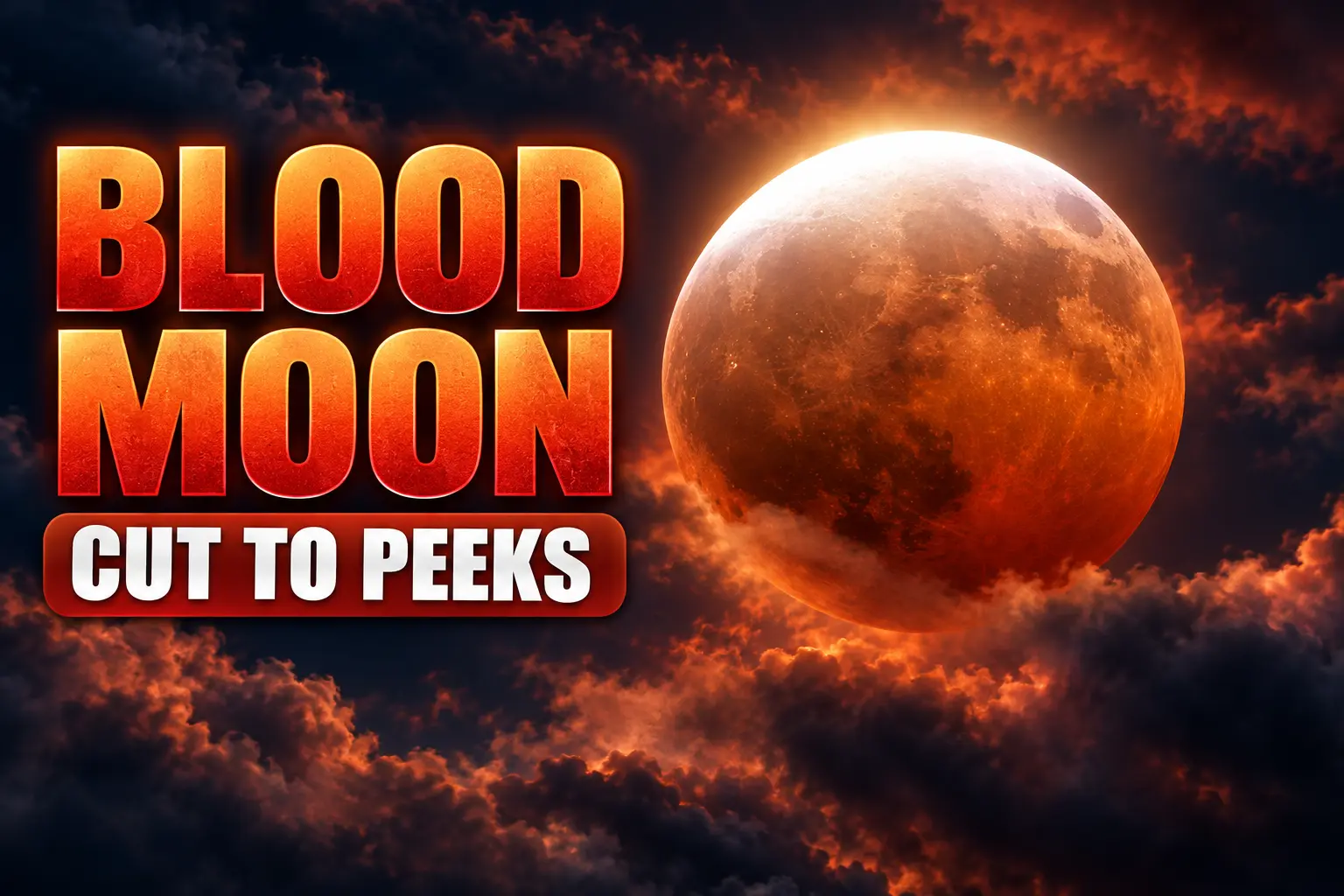
Only Peeks Between the Clouds
The geometry was free. The air was not. Roger Gass, a National Weather Service meteorologist, had said Thursday night would be mostly cloudy, with the usual low fog across much of the Bay, and that Livermore, Concord, San Mateo, and San José might see the deck roll in later. Rachel Kennedy, also with the weather service, was asked about clear skies in San Francisco and said, “You probably will not be happy with the answer.”
That call was right. Photos from Danville the next morning show clouds sliding past a reddish-orange disk, not an open copper globe. San Francisco frames from the same night are holes in the marine layer. One widely shared city shot is the eclipsed moon through a break, with the rest of the sky socked in. A viewer in the San Francisco area said they never saw it at all and had to take a photo a friend sent from Michigan. Los Angeles, Santa Maria, and Orange County got longer looks between breaks, and a few inland pockets in the East Bay caught the same copper the rest of the country saw in the clear.
The split was the same one the region already knows. Coast and hills went under. A few valleys got a window. Weeks out, fog already in the forecast had been the local story, and August 27 did not rewrite it.
WHO GOT THE DISK
- East Bay inland: Danville and similar valleys saw a reddish moon between moving clouds, not a clear peak.
- San Francisco and the coast: Low fog and high cloud turned the hourslong window into brief gaps.
- Southern California: Los Angeles and Santa Maria put the copper disk and its bright rim on cameras between breaks, and one photographer on a rare clear night in Santa Maria had no marine layer at all.
- Livestreams: Chabot started indoors with a feed of the early stages California could not see yet, then tried the deck; Griffith Observatory ran a public stream from Los Angeles.
Chabot sold the night as a watch party from 7 p.m. to 10 p.m., $24 for adults, $19 for kids, and free for members. The plan was an indoor stream then the observation deck once the moon climbed. The center later posted a virtual cut of the same event for people who never got a hole in the cloud.
Why Astronomers Still Called It a Blood Moon
A blood moon, in the usual sense, is a total lunar eclipse. Direct sunlight is cut off, and the only light hitting the moon has skimmed through Earth’s air. NASA’s lunar eclipse primer says that air scatters blue light and lets red and orange through, which is why sunsets look warm and why an eclipsed moon can look copper. The agency’s line is that the glow is all the world’s sunrises and sunsets projected onto the Moon.
It’s as if all the world’s sunrises and sunsets are projected onto the Moon.
NASA Science, The Moon and Eclipses
Andrew Fraknoi, a retired astronomy professor who taught at San Francisco State University, had warned that the exact shade would depend on the “sooty-ness” of the air: fire smoke, dirty air, volcanoes, even cloud. NASA makes the same point. More dust and cloud make a redder moon. On August 27 the Bay’s problem was not the tint. It was whether the disk was visible long enough for anyone to judge the tint.
Ben Burress, a staff astronomer at Chabot, had said the quiet thing out loud before the moon rose: “It’s not quite a total lunar eclipse.” The 96.3 percent figure is coverage by area. A bright rim still poured white light across the rest of the face, which is why cameras that punched through cloud often show a copper body and a hard, overexposed edge. That edge is why the night could look like a blood moon in a still photo and like a partial in the eyepiece.
McKeegan’s other line from the preview still holds, even after the fog. “Nature, every once in a while, likes to put on a little show for us,” he said. “It reminds us that we’re part of a much larger universe.” The show that night was a sliver and a gap in the stratus.
The Uneclipsed Rim Looked Like a Diamond Ring
The pictures that traveled were not the classic full red coin. From Los Angeles, through cloud breaks, the leftover sunlit rim sat on the copper disk the way the diamond ring sits on the sun at the edge of a total solar eclipse. That is the honest specimen of this event: 96.3 percent in shadow, and a scrap of full-moon glare that never quit.
Northern California’s best frames follow the same grammar. A reddish body, a bright chip, and a cloud moving across both. The moon was high enough by 9:13 p.m. for anyone with a hole in the deck to see it without standing on a roof, which is why families and kids were in the pitch. The people who waited on those holes got a partial that looked almost total. The people who did not got a gray ceiling.
No special glasses were required, and binoculars only helped if there was a moon to point them at. The Sturgeon Moon, August’s full moon, did the rest of the naming work for headlines that wanted a blood moon without waiting for totality.
March’s Total Already Came at 3:33 a.m.
The last lunar eclipse over the Bay was not this partial. It was a total on March 3, 2026, with maximum at 3:33 a.m. and totality lasting 58 minutes. NASA’s table gives that eclipse umbral magnitude 1.151. Totality began about 3:04 a.m. Pacific and ended about 4:02 a.m. Plenty of people slept through it, which is the line McKeegan and others used to sell the August evening.
Chabot ran a deck party for that one too. Fog rolled in and hid the peak, and the center pointed people to livestreams from Griffith Observatory and from Maunakea. Inland East Bay again had the cleaner sky. The region’s eclipse weather is not a one-off. Evening moonrises hit the marine layer. Predawn totals hit tired people and, often, the same low cloud.
THREE BAY AREA LUNAR ECLIPSES
| Date | Type | Bay peak | What local viewers actually got |
|---|---|---|---|
| March 3, 2026 | Total (mag. 1.151) | 3:33 a.m. | 58 minutes of totality; many asleep; Chabot lost the peak to fog |
| August 27, 2026 | Partial, 96.3 percent | 9:13 p.m. | Convenient hour, moon already in shadow, clouds over much of the Bay |
| June 25, 2029 (local) | Total (mag. 1.844) | Evening moonrise | Next total for the Bay; listings have the moon rising already in totality |
Jeff Shapiro, a board member with the Fremont Peak Observatory Association, had flagged the August geometry before it happened: the moon would rise already in eclipse, so the first thing in the east would not be a normal full moon. That is the Bay’s repeating trick. The pretty evening slot is also the slot where the moon is low, dim, and easy for fog to erase.
June 2029 Repeats the Moonrise Problem
McKeegan’s calendar point survived the clouds. The next total lunar eclipse visible from the Bay is in June 2029. NASA’s catalog lists greatest eclipse on June 26, 2029, at 3:23 Universal Time, umbral magnitude 1.844, and totality of 1 hour 42 minutes, visible from the Americas, Europe, Africa, and the Middle East. Local listings for the San Francisco Bay Area shift that to the evening of June 25, 2029, and they have the moon rising during totality, with the best local view only a few minutes after moonrise.
Between now and then the calendar is thinner than the blood-moon headlines implied. NASA’s upcoming list has a penumbral eclipse on February 20, 2027, the kind you can miss if you do not know to look. 2028 brings shallow partials, and the total of December 31, 2028, is a New Year event for Europe, Africa, Asia, Australia, and the Pacific. Bay Area listings treat that one as a partial from here, not a total. June 2029 is still the next night when the whole disk goes into the dark inner shadow over California.
Saros 138, the family that produced August’s deep partial, last did this on August 16, 2008, and will do it again on September 7, 2044. That is a bookkeeping fact, not a viewing plan. The viewing plan for the Bay is simpler, and ruder. The convenient evening eclipse was 96.3 percent, not 100, and the air over the water did what it usually does in late August.
Frequently Asked Questions
Do You Need Eclipse Glasses to Watch a Lunar Eclipse?
No. A lunar eclipse is the moon going dark in Earth’s shadow, so you are looking at reflected sunlight that has already been weakened, not at the sun. NASA and observatory staff repeat the same rule every time: naked eyes are enough, and binoculars or a small telescope only add color and crater detail. Solar-eclipse glasses are for the sun, including the total solar eclipse that ran through Greenland, Iceland, and Spain on August 12, 2026, two weeks before this moon.
When Is the Next Lunar Eclipse After August 2026?
The next lunar eclipse of any kind is a penumbral event on February 20, 2027, visible from the Americas, Europe, Africa, Asia, and western Australia. Penumbral eclipses dim the moon so slightly that many people never notice them. Shallow partials follow in 2028. The next total for the Bay Area remains the June 2029 eclipse, not the December 31, 2028, total that favors the Eastern Hemisphere.
What Is the Difference Between 96.3 Percent and Magnitude 0.930?
They measure different things on the same eclipse. NASA’s 96.3 percent is the share of the moon’s area inside the dark inner shadow, which matches what a photo looks like. Magnitude 0.930 is the share of the moon’s width, about 93 percent of the disk from edge to edge. NASA’s visualization studio says magnitude is easier to compute and can exceed 1.0 in a total, while area stays between 0 and 100 percent and tracks the view through a camera.
Why Don’t Lunar Eclipses Happen Every Full Moon?
The moon’s orbit is tilted about 5 degrees relative to Earth’s path around the sun, so the full moon usually passes above or below Earth’s shadow. NASA notes that Earth, moon, and sun line up well enough for some kind of eclipse only four to seven times a year, counting both solar and lunar events. Without that tilt, every full moon would have a lunar eclipse and every new moon a solar eclipse.
Local listings already have the June 2029 total rising in shadow over the Bay, the same low-moon problem August just had, only this time the whole disk will be in the dark. Until then the copper that did make it through on August 27 lives in those cloud-break frames, with one bright rim still lit.

UPI MDR Delay Hands Traders the Calendar After Paytm Falls

Google Messages Builds Nine In-Chat Games After Samsung’s Exit

Anthropic’s $100 Million Academy Trains the Firms That Bill Both Sides

Toyota’s Electric C-HR Leaves the Cheap Twin to Subaru

Markets Bet the Fed Skips October After Hawkish Minutes

The Orchard Bug Forced Zcash to Open an Empty Pool

The $5.99 Game That Won Steam’s 2026 Summer Sale

Don Lee Joins Hemsworth as Extraction 3 Starts Shooting

YouTube Shorts Retires Dislikes and Swaps Likes for Hearts

NEURA Robotics Is Spending Its $1.4B on a Machine Stack
-
 NEWS4 months ago
The Orchard Bug Forced Zcash to Open an Empty Pool
-
 GAMING4 months ago
The $5.99 Game That Won Steam’s 2026 Summer Sale
-
 ENTERTAINMENT6 months ago
Don Lee Joins Hemsworth as Extraction 3 Starts Shooting
-
 NEWS4 months ago
YouTube Shorts Retires Dislikes and Swaps Likes for Hearts
-
 NEWS4 months ago
NEURA Robotics Is Spending Its $1.4B on a Machine Stack
-

 AUTO6 months ago
Kawasaki Bets the New Z1100 Against Its Own Supercharger
-

 BUSINESS5 months ago
Norway’s Export Bank Backs Nscale’s $790 Million Narvik Loan
-

 GAMING4 months ago
Game of Thrones Dragonfire Follows Boston’s Conquest Playbook