
NEWS
Bill Gates Wants AI Limits He Does Not Expect
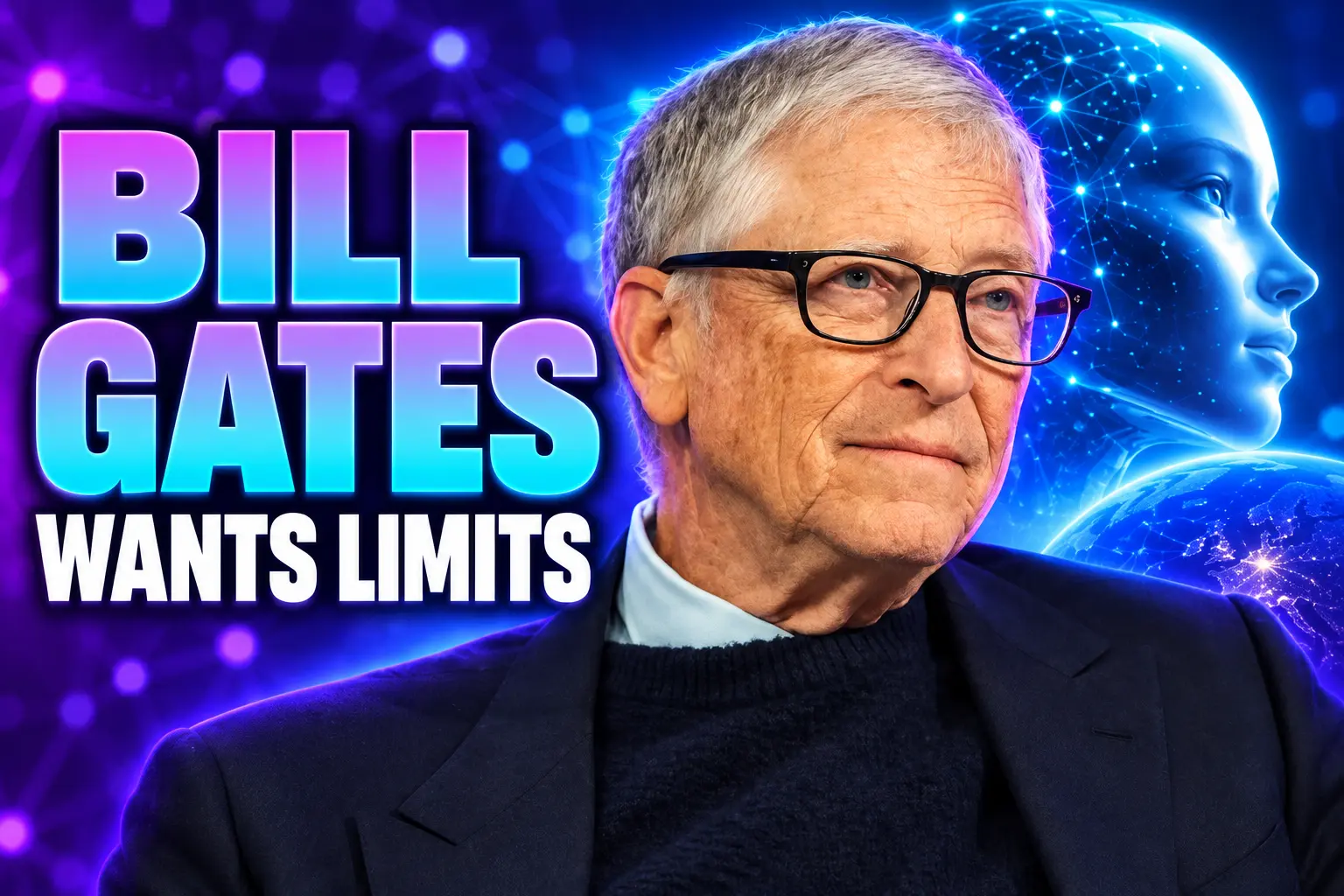
Bill Gates wants a robot tax and human-only jobs for AI, then says money and geopolitics will keep the industry at full speed.

Bill Gates published a nearly 6,000-word warning on August 26, 2026 that AI needs hard limits, then said he does not expect anyone to slow it down. The Microsoft co-founder, now 70, called the transition one of the most turbulent times in human history and said there is no plan to ease it.
The same week he described bouncing malaria and nutrition questions off Claude and ChatGPT at 3 a.m., a habit he calls mind-blowing for a curious person. He still wants robots and AI tokens taxed like paychecks, and a band of jobs fenced off for people.
He Would Slow a Race He Says Nobody Will Stop
Gates has spent his life wishing innovation would move faster. In the nearly 6,000-word essay on Gates Notes, he writes that his feelings about AI are more complicated, because the benefits and the damage are arriving together. He would back a credible plan to slow advances worldwide. He does not think one is coming, because geopolitical and economic incentives are pushing too hard to go full speed ahead.
If someone had a credible plan for slowing down AI advances globally, I would likely support it. However, I don’t think that’s going to happen. The geopolitical and economic incentives are pushing too hard to go full speed ahead.
Bill Gates, Microsoft co-founder, Gates Notes, August 26, 2026
He disclosed the conflict himself. He has diversified, he wrote, but he still has financial ties to the industry, and as chairman of the Gates Foundation he is working with Microsoft and other AI companies to put the tools into health, farming, and schools. Any profits, he said, go to the foundation. Readers, he added, will have to decide whether that clouds his view.
In January note on the year ahead, he was still an optimist because of what AI-accelerated innovation would bring. Seven months later he told interviewers that the more he wrote the memo, the more he felt the negatives will substantially outweigh the positives if leaders do not step up. He said it is unnatural for him to think innovation may be a net negative if it is not managed properly.
Asked who in the White House should hear the case, he answered, with a bemused tone, that someone else could tell him who to call. He hopes the essay reaches Congress and the executive branch. On the night it landed, a U.S. prediction market listed an 11 percent chance that Washington enacts an AI safety bill by the end of the year.
40 Percent Is as High as He Can Get
Gates names three starting moves: new agencies at home and abroad, a category of work he calls Human Reserved, and a tax on AI tokens and robots. Human Reserved is the idea that draws the most heat, because it admits machines will be able to do the work and asks society to refuse them anyway.
He likens it to a nature reserve, land where roads could go in and do not, because the loss would be too great. One form is permanent: the job stays human. The other is a pause for people too far into a career to retrain, such as a 55-year-old in construction who cannot be told to start over in elder care and find it fulfilling. Child care and jury service, he has said, are work humans are clearly better suited for. Education and health should stay a mix, with a person in charge using the tools to cover more ground.
THE THREE PROPOSALS
| Proposal | What it would do | Limit he names |
|---|---|---|
| Human Reserved jobs | Keep some work for people even when machines can do it | 40 percent of jobs in the most aggressive form |
| Tax on AI tokens and robots | Charge automation more like payroll and fund retraining | Spare beneficial uses in medicine and education |
| New national and global bodies | Coordinate jobs, security, health, and elections, with inspections modeled on nuclear arms, aviation, and ozone rules | Needs U.S. and China to cooperate |
He has been running the reserved-share math past Claude, trying shorter workdays and earlier retirement to spread what is left. In the most aggressive form he can imagine, 40 percent of jobs would start out reserved for humans. He said that is as high as he can get, which leaves the rest of the labor market to whatever the technology does next. Who decides, how firms are stopped from cheating, and how a country protects those jobs if rivals automate them are questions he says will need to be worked out in public.
The example he keeps using is medical. There is no technical reason a robot could not deliver the news of an incurable disease. Yet it should not. The idea came in part from watching the people who cared for his father through Alzheimer’s, work he describes as irreplaceably human.
A Tax on Tokens, Nine Years After the First Try
The tax argument is older than this essay. Hire a person and you pay payroll taxes on their earnings. Buy a robot and you can usually write it off as a business expense. Gates writes that the tax system nudges firms toward replacing people with machines. A levy on tokens and robots would slow that rush a little and raise money for retraining and a stronger safety net. It would have to be aimed so it does not slow purely beneficial uses, such as making medicine and education cheaper.
Critics, he wrote, will say it is not optimally efficient. He says they are not counting the broader value of work, and that with all the extra innovation coming, society can afford a little inefficiency as the price of keeping people employed.
THE NINE-YEAR ARC
- February 2017: Tells interviewers that a robot doing $50,000 of factory work should be taxed at a similar level to the worker it replaced, even if that slows adoption.
- January 9, 2026: Writes that he remains an optimist because of what innovation accelerated by AI will bring, while asking whether the world will minimize the disruption.
- June 2026: A presidential executive order asks AI companies to submit their most powerful models for government testing up to 30 days before release, and bars the program from becoming a license.
- Early August 2026: The White House finalizes that voluntary framework.
- August 11, 2026: Ryan Greenblatt, chief scientist at Redwood Research, tells the Dwarkesh Patel podcast that builders understand less and less of what sits inside advancing models, and that those models could work against their creators.
- August 26, 2026: Gates publishes the essay and tells Anderson Cooper the review criteria and the actions that would minimize harm are really completely missing.
Nine years after the first try, former Treasury secretary Lawrence Summers had called a robot tax profoundly misguided, warning that a high enough levy would stop robots from being produced. Gates is still a proponent. He told interviewers the tax-system change he has in mind would be larger than any in his lifetime, at a moment when politics is more polarized than any in his lifetime.
Why the Industry’s Own Red Lines Already Moved
For years, people inside AI described certain moments as the points where the industry would stop and think: making it easier to build a bioweapon, making it easier to launch a cyberattack, building machines people become emotionally dependent on, wiping out large numbers of jobs, and losing control of the technology itself. Gates says those lines are not ahead of us.
THE THRESHOLDS HE SAYS ARE ALREADY FALLING
- Bioweapons: The same models that speed drugs and vaccines also make it easier to design a deadly new disease, and he wants mandatory monitoring of any system that can design new molecules, including free models, written so a copy cannot strip the monitor out.
- Cyberattacks: The smartest security people he knows are scared about the next few years, because attackers are getting new tools faster than defenders can close every hole, and hospitals, water systems, and power grids sit in the blast radius.
- Psychosocial harm: Fraud, deepfakes, and machines people lean on emotionally are the injuries he says most people will feel first in daily life, including damage to how children grow up and how human relationships hold.
- Job destruction: Entry- and mid-level roles go first, white-collar work is already being hit modestly, and blue-collar work follows as robots cheapen.
- Loss of control: He expected this to be many years away and now says experts are asking whether the systems can be controlled at all.
“We’re in the process of crossing every single one of those thresholds,” he said. Most people he talks to in the industry will slow down if everybody else will too. People inside firms who admit the downsides, he said, get told they are hurting PR while the companies try to raise trillions of dollars. He knows they are all worried, or all of them he knows, which is basically everybody but Elon.
Over the last year, he told Anderson Cooper, the models have gotten dramatically more powerful, even faster than he expected, and they are now capable of causing cyberattack risk, bioterrorism risk, and psychosocial risk. He said he is kind of shocked that the exact criteria used to review the models, and the actions taken to minimize the harms, are really completely missing. Blocking a data center, he added, will not slow things down, because those buildings will show up somewhere else.
The June order and the August framework left him cold. “What is the threshold that’s being examined, and what is the action taken when you cross that threshold?” he asked. “The whole thing seems so empty to me.” If the process stays voluntary, with no line and no consequence for crossing it, he said, we are going to look back on this as an eye-of-the-storm type moment. An open letter from AI employees, Pacing the Frontier, which calls for slowing development, struck him as a good idea that would be hard to sustain.
Sodium Batteries at 3 a.m.
The personal picture sits next to the jobs picture, and they do not match. At 3 a.m. he wants to understand sodium batteries, and now there is no reason to go to sleep. He pastes long threads to the people who work with him on malaria and nutrition: him, Claude, ChatGPT, sometimes all three debating. He was shocked by ChatGPT and shocked by Claude Code, two thresholds he did not expect a statistical machine to cross, including code he says is better than human code. From a productivity point of view, he said, we are in heaven. He thinks people will stop going to apps and will go to a personal agent, and that we will get to a point where you will not buy things yourself.
The workers he is writing about do not live in that heaven. Analogies to past shifts mislead, he argues, because the move from farm work to office work ran over several generations and still needed human cognition. AI can see, listen, speak, and reason, and it will eventually do physical work as smoothly as any person. It runs on devices we already have and uses natural language, so we do not have to adapt to it. It can watch the same training video used for human hires. He writes that it will take on work in law, customer service, medicine, software, and manufacturing over the course of a decade rather than a few generations. There will be some new jobs. Without the right policies there will be far fewer than exist today.
When the PC arrived, he wrote, it took twenty years to change how we worked, because software had to be built, prices had to fall, and people had to learn the tools. White-collar jobs are already being hit modestly. After generative AI spread, a Stanford analysis of young AI-exposed workers that Gates cites found employment fell among young people in roles most open to replacement, but not among their older colleagues. Sales, customer support, software engineering, and paralegal work may be among the first affected. The disruption reaches further as models take on loan files, data analysis, and even patient triage. Software may create some new demand as costs fall, so net losses there may be smaller if design stays better done by humans.
Blue-collar work is next. Robots are not as far along as the language models, he wrote, but their cost will fall too, and much of the advanced work is happening in China. He thinks smart robots will begin to compete with people on some physical tasks in construction and hospitality by the end of the decade. In conversation he has also said the machines themselves may be only a couple of years off. After one firm adopts them and cuts prices, rivals will feel immense pressure to follow, and if incumbents refuse, startups will not. He is especially worried about young people walking into a market with fewer entry-level openings, and he notes that they already see both the capability and the rate of improvement.
The people who need the most time, he wrote, have the least of it: the accounting worker replaced by a bot, or the $20-an-hour worker who loses a job to a $10-an-hour robot. In 1933, during the Great Depression, U.S. unemployment near 25 percent in 1933 sat in the Labor Department’s own history, a figure Gates uses as a ceiling AI may not hit. The difference, he argues, is that this shock will not fade with an economic cycle. In some parts of the country, factory closures have been tied to a rise in deaths from opioid overdoses. He asks readers to imagine similar pressure on white-collar and blue-collar workers nationwide. He is staking whatever reputation he has on the claim that this time is different from the microprocessor, the personal computer, and the internet, which in his view led to net job creation.
Etzioni Would Sign the Robot Tax Tomorrow
Oren Etzioni, a University of Washington professor emeritus and founding chief executive of the Allen Institute for Artificial Intelligence, the lab funded by the late Paul Allen, Gates’s Microsoft co-founder, agrees with the diagnosis and not with most of the medicine. He said he would sign the robot tax tomorrow, because hiring a person costs payroll tax every year while buying a robot gets written off in year one. The other two proposals he would send back.
WHERE EXPERTS DISAGREE
- Etzioni on tokens: A per-token levy only hits usage at a billing boundary, a commercial API that generates an invoice, and leaves models on local hardware untouched, so it measures effort rather than displaced workers, like taxing keystrokes on a typewriter, and could push use toward offshore models.
- Etzioni on agencies: Existing U.S. agencies should enact the right policies rather than wait for new bodies, and pumping the brakes until those bodies exist collides with Gates’s own line that the world does not have the luxury of moving slowly.
- Gates on both: No current agency was built for a technology that hits jobs, security, health, energy, and elections at once, and a global organization will need pieces of nuclear inspections, aviation rules, and ozone treaties, plus more, with some U.S.-China cooperation required.
Human Reserved, in Etzioni’s reading, assumes there is a human being available to hold the protected job. He has long argued that displaced workers should move into caregiving, and that it would take real money to lift the pay enough to draw them. Gates is candid that he does not have all the answers on who picks the reserved list or how companies are kept from putting robots in those roles. Both the tax and the reserved band, if they ever became law, would cut into the profits of the major labs.
In the poorest countries, Gates expects AI to do more good than harm, because doctors, teachers, and farm advisors are already in short supply. The foundation is already working with major labs on health tools in low-income countries, including work on African languages. That is the other half of the messenger problem. He is warning about systems his philanthropy is also putting into clinics.
A Molecule Rule He Thinks Beijing Would Match
The one concrete control he keeps returning to is biological. Any model capable of designing new molecules, the capability that would let someone engineer a new disease, should be monitored. The monitoring would be mandatory, not voluntary, and it would cover free models as well as commercial ones. To him that is common sense. He does not see a specific proposal to do it. He has said he is about 90 percent sure China would match a U.S. offer to monitor those models for benign use, because enabling bioterrorism is not a point of pride in either capital, and that he intends to put review criteria on that risk into concrete form before the end of the year.
He still thinks it is possible to shape the technology so the good outweighs the bad. He also said that if the world cannot take these basic steps, he is really going to throw up his hands. Answering how AI is used, and acting on the answers, should be the world’s top priority, he wrote. His message to leaders is that they can act now, before unemployment rises sharply, communities are hurting, and public trust has eroded.
He does not think being pessimistic is helpful. He is very concerned, and when he gets people one-on-one, he said, so are they.

UPI MDR Delay Hands Traders the Calendar After Paytm Falls

Google Messages Builds Nine In-Chat Games After Samsung’s Exit

Anthropic’s $100 Million Academy Trains the Firms That Bill Both Sides

Toyota’s Electric C-HR Leaves the Cheap Twin to Subaru

Markets Bet the Fed Skips October After Hawkish Minutes

The Orchard Bug Forced Zcash to Open an Empty Pool

The $5.99 Game That Won Steam’s 2026 Summer Sale

Don Lee Joins Hemsworth as Extraction 3 Starts Shooting

YouTube Shorts Retires Dislikes and Swaps Likes for Hearts

NEURA Robotics Is Spending Its $1.4B on a Machine Stack
-
 NEWS4 months ago
The Orchard Bug Forced Zcash to Open an Empty Pool
-
 GAMING4 months ago
The $5.99 Game That Won Steam’s 2026 Summer Sale
-
 ENTERTAINMENT6 months ago
Don Lee Joins Hemsworth as Extraction 3 Starts Shooting
-
 NEWS4 months ago
YouTube Shorts Retires Dislikes and Swaps Likes for Hearts
-
 NEWS4 months ago
NEURA Robotics Is Spending Its $1.4B on a Machine Stack
-

 AUTO6 months ago
Kawasaki Bets the New Z1100 Against Its Own Supercharger
-

 BUSINESS5 months ago
Norway’s Export Bank Backs Nscale’s $790 Million Narvik Loan
-

 GAMING4 months ago
Game of Thrones Dragonfire Follows Boston’s Conquest Playbook