
NEWS
Intel’s October CPU Hike Puts Cheap Industrial Chips at Risk
Intel may lift PC CPU prices 10% on October 5 while reviewing Small Core chips that factories and IoT vendors bought for decade-long supply.

Intel is preparing to raise PC CPU prices by about 10% on October 5, according to supply-chain sources, and it has not confirmed the move. The same review puts low-margin Small Core chips used in factory PCs, IoT gateways, and embedded boards on an end-of-life watch.
Those industrial parts are the cheap Atom-class and Celeron-class SKUs Intel has long sold with multi-year supply, not the efficiency cores inside a gaming Core Ultra chip. A 10% list step hits DIY builders and laptop makers. A Small Core cull hits plants that already qualified a board for a decade.
Intel CPU Prices Are Set to Rise on October 5
Supply-chain sources said Intel plans to lift PC processor prices by about 10% on October 5, 2026. They did not name the families, and they did not say whether desktop and notebook chips move together. Intel has issued no public statement on the date, the rate, or the Small Core review.
The leak lands 26 days before that date and a month after Qualcomm’s own chip prices moved on September 1. Memory, substrates, and leading-edge wafers are all tight, which is the cost story Intel’s finance team has already been telling investors. The product story is narrower: CEO Lip-Bu Tan is reviewing CPU prices, gross profit, and manufacturing cost, and low-margin lines are on the table if they miss his bar.
WHAT WE KNOW
- The date: Supply-chain sources put the next PC CPU increase on October 5, 2026, at about 10%.
- The pattern: PC CPU prices have been climbing since late 2025, with a Q1 2026 round of about 10% and a July rewrite of Core Ultra 200S Plus list prices.
- The July proof: Intel’s own pages now show the Core Ultra 7 270K Plus at $339 to $349, up from a $299 launch price.
- The industrial line: The Small Core review points at Atom-class and Celeron-class chips in industrial PCs, IoT, and embedded systems, not at mainstream desktop E-cores.
WHAT IS UNCONFIRMED
- Intel’s sign-off: The company has not confirmed the October 5 action or any end-of-life notice.
- The SKU list: No source has published which Core Ultra or older families would move on that date.
- The job cut: The same account said Intel may cut another 5 to 10% of staff while still hiring into other roles.
Until Intel posts new recommended customer prices, the October figure is a plan described by people in the supply chain, not a signed price book. July already showed how a quiet page change can move a chip that launched as a bargain.
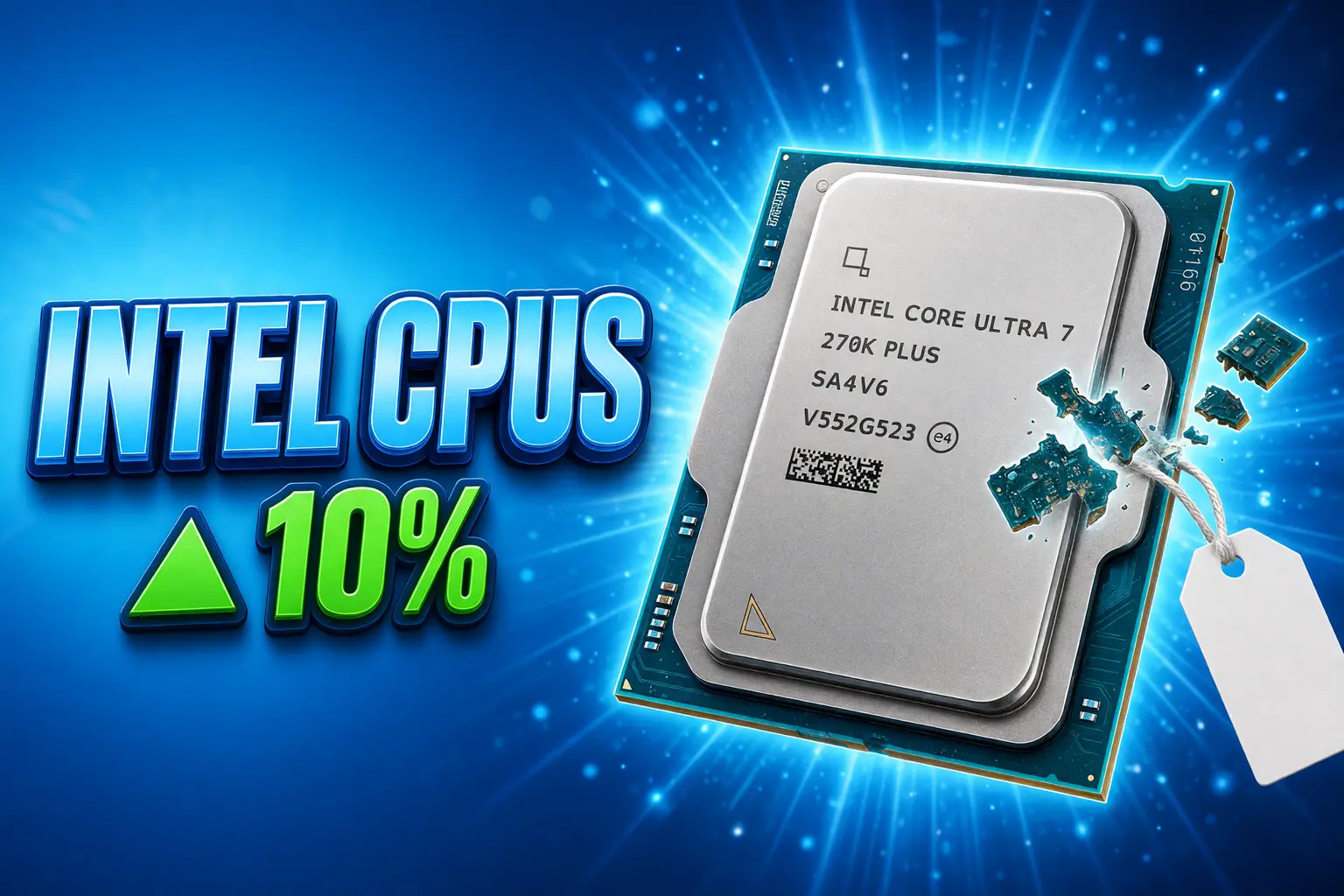
Three Hikes Have Already Rewritten the Price List
The 2026 path is three discrete waves, not one rumor. Q1 took PC CPUs up about 10%. July rewrote two of Intel’s freshest desktop parts. October 5 would add another 10% on top of that stack.
THE THREE 2026 PRICE WAVES
| Wave | Timing | What moved |
|---|---|---|
| First 2026 lift | Q1 2026 | About 10% on PC CPUs, per supply-chain sources |
| July list rewrite | July 2026 | Core Ultra 7 270K Plus RCP moved to $339 to $349 from a $299 launch price |
| Planned October step | October 5, 2026 | About 10% on PC CPUs; Intel has not confirmed |
On March 11, 2026, Intel unveiled the Core Ultra 7 270K Plus and Core Ultra 5 250K Plus and set a suggested price starting from $299 for the 270K Plus and $199 for the 250K Plus, with retail listed from March 26. Robert Hallock, who runs Intel’s enthusiast channel, called the parts a value that is hard to beat. Intel’s spec sheet now lists a recommended customer price of $339 to $349 for the 270K Plus. The boxed end of that range is $50 above the $299 launch price. The 250K Plus, launched at $199, was revised higher in the same July pass.
Supply-chain notes on the July round also described selected server processors moving by more than $1,000, which is a different buyer and a different bill. The consumer proof is the 270K Plus page. Street prices still undercut that list in sales events, which is why a lot of builders have not felt the full July step. A broader October lift is harder for retailers to eat.
Lip-Bu Tan Put Gross Margin First
Tan has spent 2026 telling the Street that demand is running ahead of supply and that pricing is part of the fix. On the July 23 earnings call he put the shortage in one line, and he did not call it short-lived.
The industry is facing one of the most severe supply constraints in its history, across leading-edge logic silicon wafers, memory, and substrates. These shortages will persist for the foreseeable future.
Lip-Bu Tan, chief executive officer, Intel Q2 2026 earnings call
CFO Dave Zinsner tied the quarter’s margin beat to mix and list prices, not only to volume. Q2 revenue was $16.1 billion, $1.8 billion above the $14.3 billion midpoint of Intel’s $13.8 billion to $14.8 billion guide. Non-GAAP gross margin landed at 41.8%, 280 basis points above guidance. Zinsner said the upside came from higher revenue, better yields, and higher ASPs due to mix and pricing actions. Non-GAAP earnings were $0.42 a share against a $0.20 guide. Tan called it the strongest revenue growth in more than 15 years.
INTEL’S Q2 CLIENT MIX
- Client revenue: The Client Computing and Physical AI Group took in $8.9 billion, up 15% from the prior quarter.
- AI PC share: AI PC revenue grew 26% sequentially and now makes up two thirds of client revenue.
- Edge slice: Edge deployments are now roughly 10% of that group’s revenue.
- Design wins: Intel counted 130 Series 3 design wins for edge AI, including robotics control.
Those figures show why Tan can raise PC CPU prices while still talking up the edge. The client group is not a dead business. Datacenter and AI revenue was $6.3 billion in the quarter, up 24% sequentially and 59% from a year earlier, and that franchise now competes with PCs for wafers. A company that is short of output will sell the wafer to the socket that pays. Low-margin Small Core is the first line that fails that test.
Memory is the other squeeze on every bill of materials. Deloitte’s technology practice said AI server DRAM roughly doubled in the first quarter of 2026 and sketched a fourfold increase for the full year. It put memory sales on a path from $230 billion in 2025 to more than $1 trillion in 2027, with hyperscaler capex set to exceed $1 trillion in 2026. Samsung, SK Hynix, and Micron have steered wafer capacity toward high-bandwidth memory and enterprise SSDs. Consumer DRAM and NAND are what got left behind, which is why RAM kits, SSDs, GPUs, consoles, and now CPUs have all been repriced in the same cycle.
The Atom-Class Chips Intel Sold for a Decade
Small Core is a product-line label, not a core type inside Arrow Lake. The chips in the review are the low-power Atom-class and Celeron-class parts that industrial PC makers, IoT vendors, and embedded board houses design into kiosks, gateways, panel PCs, and factory boxes. Typical draw sits under 15 watts. The sales pitch has been platform stability, long supply, and a price that leaves room in a sealed chassis, not a 5.5 GHz gaming turbo.
Intel’s Atom x7000RE series is the current face of that pitch: a 6W to 12W BGA part sold for industrial edge work with long-life availability of up to 10 years and extended temperature use. Premio brought Atom x7000 fanless boxes, panel PCs, and single-board computers to Embedded World in March 2026 at 9W to 12W, and it sold them on Intel’s 10-year lifecycle support. That is the customer who loses if the line goes end-of-life. A gamer can switch SKUs in a weekend. A factory OEM cannot.
Intel is not walking away from every industrial socket. The company renamed the PC group to Client Computing and Physical AI, it is shipping Core Ultra and Core Series 3 parts into edge designs, and it still advertises up to 10-year availability on those higher-tier edge processors. The review is a margin gate on the cheap floor. If Small Core cannot clear Tan’s gross-profit test, the path Intel prefers is an upsell onto those newer, dearer chips. The path a cost-sensitive OEM may take is Arm.
What a 10-Year Intel Socket Costs to Replace
A certified industrial PC is not a DIY tower. Once an OEM locks an Atom or N-series chip, the board, the drivers, the thermal envelope, and often a safety or security file all sit on that socket for seven to 15 years of field life. Pulling the chip means a new layout, a new image, and a new test pass. In regulated plants that work can run more than a year, which is why a rumor of end-of-life lands harder than a 10% list bump on a Core Ultra 7.
WHO LOSES THE CHEAP SOCKET
- Factory box builders: Fanless industrial PCs and panel PCs that were costed around Atom x7000-class silicon and a 10-year buy.
- IoT and gateway vendors: Low-power x86 designs that need long driver support more than they need extra cores.
- Embedded board houses: COM and SBC vendors who promised customers a stable Intel part through the 2030s.
- The upsell path: Intel still wants those accounts on Core Ultra and Series 3 edge chips, which carry a fatter bill of materials.
Tan’s client group already books edge as roughly 10% of its revenue and as a future growth line it says can match the PC total over time. That is the tension. Intel wants the physical-AI socket. It may not want the historical price of that socket. An OEM that cannot pay Core Ultra money has to requalify on Qualcomm or MediaTek Arm silicon, and that is a software project, not a line-item swap.
Qualcomm and MediaTek Already Price the Gap
The same supply-chain account that described Intel’s October plan said Qualcomm and MediaTek are already aiming at industrial PC and IoT sockets Intel may leave. They have a head start on the calendar. Qualcomm told customers its chip prices would rise on anything shipped after September 1, 2026, and CEO Cristiano Amon confirmed the direction on the company’s July 29 earnings call.
Cost went up, prices are going to go up.
Cristiano Amon, chief executive officer, Qualcomm fiscal Q3 2026 earnings call
Amon called the margin hit a short-term cost problem the company was fixing with price increases. TrendForce’s supply-chain notes put the steepest increases of 10 to 15 percent on premium flagship chips, with 5 to 7% on mainstream parts and 0 to 2% on entry silicon. That spread matters for the industrial buyer. Entry Arm may still undercut a forced jump from Atom to Core Ultra even after Qualcomm’s own lift.
This is not a clean gift to Arm. Qualcomm is raising prices for the same memory and foundry reasons Intel is. MediaTek still has to prove decade-long industrial support at the volume Intel used to guarantee. The opening is real only if Intel actually ends Small Core instead of squeezing it. The review, as described, is a test of gross margin, not a published last-time-buy notice.
Street Prices Catch Up When Promos Die
PC builders have been living in a gap between Intel’s list and the street. The 270K Plus still appeared well below $200 in sales events after the July page change, which is why the first two 2026 waves felt abstract in shopping carts. An October wholesale step of about 10%, stacked on RAM and SSD inflation, is the point where those promotions get thinner. Waiting for a seasonal cut is a weaker plan when processors, memory, and storage are being repriced in the same direction.
The rest of the box is already moving. Sony has raised PlayStation 5 prices more than once. Microsoft has done the same on Xbox Series X and S. Nintendo has raised the Switch 2. GPU boards have been climbing since late 2025 as board partners passed through memory and component cost. A CPU that was the last cheap part in a $700 build is the part Intel now wants to treat like a margin product.
Tan can live with fewer units if each chip pays. Zinsner already booked higher ASPs in Q2. Hallock’s March line about unbeatable value sits on a spec sheet that is $40 to $50 above the launch number, with another 10% plan dated October 5. Factory buyers who were promised Atom supply into the 2030s have a colder problem: requalify on a dearer Intel edge chip, jump to Arm, or hope the Small Core review ends in a stay. Intel has not confirmed the hike or the cull.


Replit Opens Its London Office Inside an AI Crowd

Straight Circle Trailer Lands Without a U.S. Date

Anemo Labs Bets £700,000 on an AI Sense of Smell

Nintendo Prices the Zelda 40th Switch 2 at $519

Copilot Capital Buys the Autopilot Already Running 90 GW

Ground A Raises €9.1 Million for a Pallet Laser

Gibney’s Musk Film Opens in Venice Without Its Subject

Torvalds Blames AI for a Full-Fat Linux 7.3-rc2

Dexter Returns Sharper, Older, and Stuck Between Killers

Meta’s Muse Agent Can Spend Before the Privacy Lock

Walter’s TWG Insists No Fraud as Insurer Probes Force Cleanup

30-Year Yield Hits 5.32% Highest Since 2007 as Debt Supply Locks In Costs

PCE Stays at 3.7% as Gas and Tariffs Outrun Coming Revisions

Evernorth S-4 Clears Path for Active XRP Treasury on Nasdaq

Astute’s $1.2M bet makes B2B creator deals feed AI discovery

Strategy Parks $1.59B Cash While Bitcoin Stack Stays Flat

CLARITY Act Cloture Opens a Door Ethics Still Blocks

Instinct Hits $2.5 Billion as AI Agent Access Sparks Trust Fights

Oracle’s 2.8 GW Bloom Deal Exposes the AI Power Bypass

AI data centers win as RAM kits jump nearly 500 percent
-
 FINANCE3 months ago
Zcash Patched a Double-Spend Bug as ZEC Climbed 5%
-
 ENTERTAINMENT3 months ago
Steam Summer Sale 2026 Locks In June 25 to July 9 Dates
-

 FINANCE2 months ago
CLARITY Act Final Text Expected This Weekend as 60-Vote Hurdle Looms
-
 NEWS4 months ago
Meta Adds AI Replies to Threads, But Users Can’t Block It
-
 ENTERTAINMENT5 months ago
Extraction 3 Is Officially Coming to Netflix in 2027
-

 NEWS3 months ago
YouTube Shorts is testing a heart in place of the thumbs-up
-

 NEWS1 month ago
Senators Force Apple Off Chinese Memory as Big Three Cash In
-

 NEWS3 months ago
NEURA Robotics’ $1.4B Series C Redraws Europe’s Physical AI Bet