
ENTERTAINMENT
Gibney’s Musk Film Opens in Venice Without Its Subject
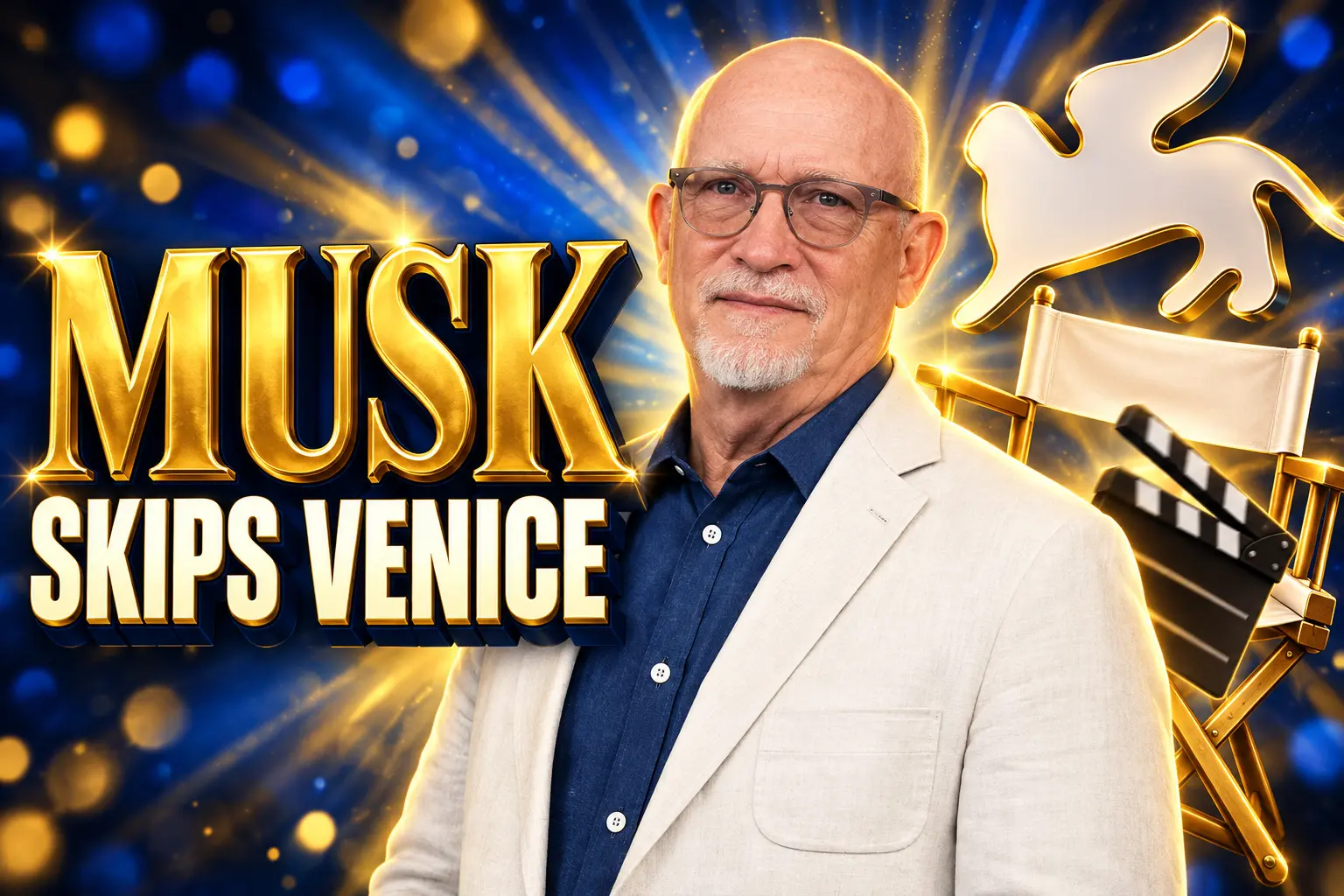
Alex Gibney’s four-hour Musk film premiered at Venice without an interview, built on a $40 million silence offer, frightened colleagues, and an AI avatar.

Alex Gibney’s Musk documentary premiered at Venice on September 8 without Elon Musk in the chair. The Tesla, SpaceX, and X owner had refused a sit-down years earlier. Gibney, 72, still finished a four-year portrait that runs 225 minutes plus a 10-minute intermission.
On September 9, Musk offered a seven-word verdict. The people who actually talk in the film are the ones he could not keep off camera.
Musk Shut the Interview With One Word
Gibney began the project in late 2022 and went public in March 2023. Musk called the unfinished film a hit piece. Gibney asked how he would know. Later that year Musk called him a douche on X. Gibney answered, “Douché.”
That was the interview. Festival artistic director Alberto Barbera, unveiling the 83rd Venice lineup, told the room to look at the duration: four hours. The film screened out of competition on September 8 in the Sala Grande. Public shows were listed for September 9 at Sala Volpi and Astra 2.
Bleecker Street dropped a 49-second teaser on September 7. Voices call Musk the greatest living inventor and the real-life Iron Man, then chaotic, cruel, a man who has lost his mind, a fascist, a nuke. Rockets rise and break up under the lines.
Gibney has said he started as an admirer and wanted the conversation. He also said the man now repeats himself like a script. The archive is huge. The chair stayed empty.
The $40 Million Offer That Bought Nothing
Ashley St. Clair sat in the Venice press seats beside Gibney and tech journalist Zoë Schiffer. She is a former conservative influencer who says she gave birth to Musk’s 13th child. She told the room she could talk because she had refused to sign away the right.
I was offered the opportunity not to speak for $40 million. When you’re offered something like that, it causes a debate in your head about what your speech means and how valuable that is. Why do they want to offer me this amount of money not to speak?
Ashley St. Clair, Venice press conference
She said she wanted to set an example for her kids, that being comfortable should not beat telling the truth. In the film she also describes a night after the 2024 vote. She says Musk left the Mar-a-Lago party early with a certainty about the result she had not seen before. She told him she did not want to know more, because she did not want to be deposed. She says he told her that was wise.
Justine Musk, his first wife and the mother of five of his children, is the other personal witness who gives the cut a pulse. She talks about the death of their infant son, Nevada, and about grief that the film treats as foreign to him. Gibney quotes her word for how the women were recast after they had children: breeders. Grimes, mother of three, declined to take part.
Why So Few People Would Talk
Gibney said a tremendous, almost existential fear of talking followed the production, among critics, colleagues, and friends. People inside the companies asked for Musk’s permission first. Many never sat down. He called the ones who did brave, and he called Musk extremely dangerous to democracy, then said it again: very dangerous.
There was a tremendous sense of fear of talking, really almost existential fear, both among people who were his critics, people who were his business colleagues and people who are his friends.
Alex Gibney, director, Venice press conference
The official cast list is short for a life this public. The names that did go on camera are the film’s real leverage, because Musk’s own voice was already everywhere.
WHO GOES ON THE RECORD
| Speaker | Why they are in the film |
|---|---|
| Justine Musk | First wife; five children; the death of infant Nevada |
| Ashley St. Clair | Former partner who refused the alleged $40 million NDA |
| Errol Musk | Father; the South Africa childhood |
| Martin Eberhard | Tesla co-founder |
| Geoffrey Hinton | AI scientist, on data and political risk |
| Kara Swisher and Zoë Schiffer | Tech journalists on X and the public myth |
Reid Hoffman, Sam Harris, and former U.N. ambassador Samantha Power also appear, along with former staff from Tesla, SpaceX, and the Department of Government Efficiency. The Venice synopsis is one sentence: an incisive look behind the legend of the inventor-entrepreneur who exerts enormous influence on the world in which we all live.
A Two-Hour Cut Grew After the Election
The running time is the plot. Gibney has said he had a two-hour film before Musk tied himself to Donald Trump. After the campaign, the donation fight, and Musk’s turn through the now shuttered Department of Government Efficiency, the cut kept growing. The question shifted from how a founder got rich to how an unelected operator moved into the state.
Jigsaw Productions made the film with Closer Media, Anonymous Content, and Double Agent. Michael J. Palmer edited and shares the script credit. Daniel Pemberton wrote the score. Black Bear is selling the world. HBO holds North American television and streaming rights. Universal took international. Bleecker Street will open in U.S. theaters on October 16 and expand nationwide on October 23. CEO Kent Sanderson called it the most epic film Gibney has made.
HOW THE FILM GREW
- Late 2022: Gibney starts reporting, months before the public announcement.
- March 2023: The project goes public. Musk calls it a hit piece. Gibney asks how he would know.
- October 2, 2023: Musk calls Gibney a douche. Gibney replies, “Douché.”
- Late 2024: A two-hour cut exists, then the Trump alliance blows the story open.
- August 2025: Bleecker Street takes U.S. theatrical rights. HBO already has the later window.
- September 8, 2026: World premiere, Venice, out of competition.
- October 16, 2026: U.S. theaters, with a wider run a week later.
The film splits into 13 chapters. Early on, in a stretch Gibney labels Wiz Kid, a still-balding Musk puts the Yellow Pages online with Zip2, then takes the PayPal payday that funded SpaceX. Twelve chapters later the same man is the public face of DOGE, after the Twitter purchase and the turn to Trump. Gibney’s own question, spoken in voice-over, is the spine: how did one man get this much power, and why did we give it to him?
An Avatar in a Gaming Chair
Denied the sit-down, Gibney did not leave a hole. He had MakeMake, Kaleida Studio, and Mighty Oak build a digital Musk in a gaming chair, in a cyberpunk palette, and used AI to lock old audio to the mouth. The lines are things Musk has already said, including podcasts that never had a picture. Lawyers signed off before the team went far down that road.
HOW THE AVATAR WAS BUILT
- The chair: A gamer’s seat, on purpose, because Musk likes to talk as if life is a simulation and a game.
- The words: Only public statements. No invented answers. The puppet recites the man.
- The AI: Used to sync voice to picture, not to write new Musk.
- The precedent: Gibney has hidden faces before, with an actress in Client 9 and a constructed stand-in in Zero Days.
- The theme: He says AI belongs in the film because it belongs in Musk’s power.
In his Venice director’s statement, Gibney writes that Musk has learned to craft his own master shots, the modern Leonardo sold to fans and favored biographers. Musk forgoes that master and treats him as the 21st century confidence man, a Game Master out of Ready Player One, filmed from Toto’s height in The Wizard of Oz, looking at the feet under the curtain. He told an interviewer in Venice that he wanted Robert Caro’s questions: does power corrupt, and what does power reveal?
Some first-look notices found the avatar grating beside the archive, a trick that repeats what the real man already says more sharply on tape. Gibney calls the unreality the point. He has a history of this kind of substitute, and he argues the device is the form of the accusation, not a cute extra. The cut still keeps returning to dashcam wreckage and then to chiptune, a bright console laid over a fatal Tesla crash. That whiplash is the argument in images, whether the puppet helps it or not.
Rocket People Call the Confidence-Man Frame a Category Error
Gibney places Musk next to Enron and Elizabeth Holmes, with a difference he admits in the same breath. Holmes sold a machine that did not work. You can drive a Tesla, and a lot of people like theirs. His charge is that the genius is stock pumping, Harold Hill with better engineers, old wine in a new bottle. He says wealth came from inflated paper, and that longtermism, the habit of privileging a huge future population over the people in front of you, gives cruelty a story.
That is the fight the film walks into. Landed orbital boosters and mass-market electric cars are not a blood-test fraud. If those products are only costumes for a con, the four hours will play as a sermon to anyone who watches a Falcon come back. If the products are the alibi, Gibney’s file on frightened staff and a partner offered a fortune to stay quiet still sits on the table.
WHERE THE FRAME SPLITS
- Gibney’s case: Musk is a confidence man whose hardware hides a political project, a global right-wing bet, and a habit of bending truth until the room agrees.
- The hardware reply: Reuse and EV volume are measured in steel and sales, not in a Venice edit, and an Enron template cannot hold a company that ships.
- The silence file: Neither launch nor delivery explains a $40 million offer not to speak, or colleagues who would talk only with permission.
Calling him dangerous is the film’s political close. It is also the easiest line to flip: dangerous to agencies, to censors, to a press that no longer sets the terms. That flip does not touch St. Clair’s price or Justine’s dead child. It does not touch Gibney’s claim that Musk tweaked X to boost vitriol over a town square, a charge his camp answers by pointing at open-source code. The argument will not be settled by a standing ovation.
Venice Stood Up, Then Musk Answered
The Sala Grande stood. Someone shouted thank you. The length and the tone also wore people out. Gibney had already said, over a cappuccino in Venice, that this is a bleak moment, that these people gained power in broad daylight while everyone watched. He said we allowed it.
Musk was not in the building. A day later he was on X anyway.
https://x.com/elonmusk/status/2097567146989793501
“Dogshit is worth more respect than Gibney.” That is the subject’s review, posted on September 9. The film still has to face an audience that did not go to the Lido. It opens in U.S. theaters on October 16 without him, with the people who would not take the money, and with a copy of his voice sitting in a chair he would not occupy.


Replit Opens Its London Office Inside an AI Crowd

Straight Circle Trailer Lands Without a U.S. Date

Anemo Labs Bets £700,000 on an AI Sense of Smell

Nintendo Prices the Zelda 40th Switch 2 at $519

Copilot Capital Buys the Autopilot Already Running 90 GW

Ground A Raises €9.1 Million for a Pallet Laser

Gibney’s Musk Film Opens in Venice Without Its Subject

Torvalds Blames AI for a Full-Fat Linux 7.3-rc2

Dexter Returns Sharper, Older, and Stuck Between Killers

Meta’s Muse Agent Can Spend Before the Privacy Lock

Walter’s TWG Insists No Fraud as Insurer Probes Force Cleanup

30-Year Yield Hits 5.32% Highest Since 2007 as Debt Supply Locks In Costs

PCE Stays at 3.7% as Gas and Tariffs Outrun Coming Revisions

Evernorth S-4 Clears Path for Active XRP Treasury on Nasdaq

Astute’s $1.2M bet makes B2B creator deals feed AI discovery

Strategy Parks $1.59B Cash While Bitcoin Stack Stays Flat

CLARITY Act Cloture Opens a Door Ethics Still Blocks

Instinct Hits $2.5 Billion as AI Agent Access Sparks Trust Fights

Oracle’s 2.8 GW Bloom Deal Exposes the AI Power Bypass

AI data centers win as RAM kits jump nearly 500 percent
-
 FINANCE3 months ago
Zcash Patched a Double-Spend Bug as ZEC Climbed 5%
-
 ENTERTAINMENT3 months ago
Steam Summer Sale 2026 Locks In June 25 to July 9 Dates
-

 FINANCE2 months ago
CLARITY Act Final Text Expected This Weekend as 60-Vote Hurdle Looms
-
 NEWS4 months ago
Meta Adds AI Replies to Threads, But Users Can’t Block It
-
 ENTERTAINMENT5 months ago
Extraction 3 Is Officially Coming to Netflix in 2027
-

 NEWS3 months ago
YouTube Shorts is testing a heart in place of the thumbs-up
-

 NEWS1 month ago
Senators Force Apple Off Chinese Memory as Big Three Cash In
-

 NEWS3 months ago
NEURA Robotics’ $1.4B Series C Redraws Europe’s Physical AI Bet