
NEWS
Anemo Labs Bets £700,000 on an AI Sense of Smell
Anemo Labs raised £700,000 to push a 12-odour test score toward a urine disease screen, a jump electronic noses have not made in clinic.

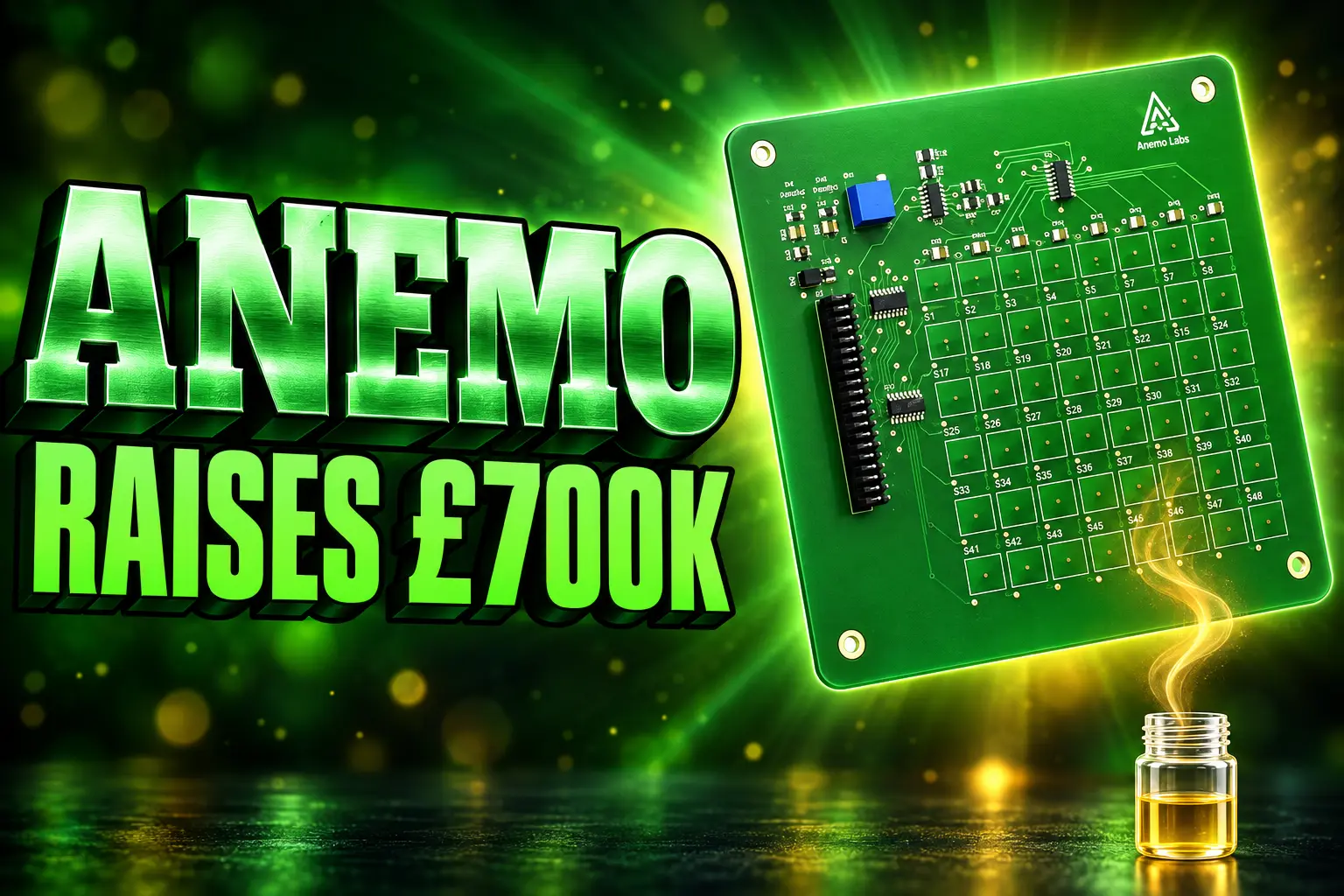
Anemo Labs has raised £700,000 in pre-seed funding to build an electronic nose that reads disease in urine vapour. Zinc and SFC Capital led the round, with extra support from Innovate UK. The London company, founded in 2025 by Koye Sodipo, wants its sensors and in-house models to classify volatile organic compounds, the molecules that carry smell, and to flag illness before symptoms show.
The only accuracy figure the company has put on that claim is 84.15% on a 12-category scent test. The new money is for sensor chemistry, more labelled smells, and checks with clinical partners, not a finished diagnostic.
Zinc and SFC Put £700,000 on Medical Smell
The pre-seed is small even by London deep-tech standards, and it lands on a company that was still called OdorPi when Zinc first wrote about it on 24 November 2025. SFC Capital, a UK early-stage investor that also lists Anemo in its portfolio as an electronic nose for cancer screening, has now come in alongside. Innovate UK is in the round as well, though neither side has said whether that support sits inside the £700,000 or on top of it.
THE PRE-SEED AT A GLANCE
- The cheque: £700,000, described as a pre-seed round.
- The leads: Zinc and SFC Capital, with Innovate UK support.
- The spend: sensor chemistry, smell collection and labelling, and clinic validation.
- The kit: an olfactory chip that reads dozens of VOCs in parallel, paired with Anemo’s own models.
Sodipo’s public line is broader than a single cancer test. He wants a screen that can run without a needle and without a wait for symptoms.
Olfaction provides a non-invasive, passive and continuous medium to screen for a number of diseases. Our mission is to enable clinicians and individuals catch disease even before symptoms appear
Koye Sodipo, founder, Anemo Labs
The company site puts urine first, then sweat and other fluids, and it sells the work as cheap, repeat biomarker checks rather than a one-off lab assay. Longer-term uses named in the round include urinary tract infections and certain cancers. That is still a plan. It is not a cleared test.
WHAT WE KNOW
- The round: £700,000 pre-seed, led by Zinc and SFC Capital, with Innovate UK support.
- The sample: urine vapour is the first matrix, with sweat listed as a later fluid.
- The public score: 84.15% correct on 12 Sniffin’ Sticks scent categories.
- The data line: an in-house platform built to collect and label up to 5,000 smells a day.
WHAT IS UNCONFIRMED
- Disease accuracy: no public figure yet on cancer, UTI or any clinical label.
- Trial dates: Zinc said two UK trials were planned for 2026; start dates have not been posted.
- Grant split: Innovate UK’s cash is not broken out from the £700,000.
On 10 July 2026 the company said it had filed a patent on olfactory sensing technology. That filing is a marker of work in progress, not a granted right and not a clinical result.
What the 84.15% Score Does Not Measure
Sniffin’ Sticks are felt-tip pens loaded with known odours, used in clinics to test whether a person can smell. The 12-item screen is a four-choice naming test on everyday scents, so a random pick is right 25% of the time. Anemo says its models hit 84.15% across 12 categories on that protocol. That is a sensor-and-model proof on labelled pens, not a finding on tumours, infection or any patient sample.
The everyday set is the point. One commercial 12-stick pack uses 12 sniffing sticks of everyday odours such as peppermint, fish, banana and leather, and the person (or, here, the model) must pick the right name from four options. Matching a healthy nose on orange versus leather is a different task from reading a faint disease signature in wet urine headspace, where water, diet, drugs and collection kit all shout louder than the signal.
WHAT THE PUBLISHED NUMBERS ACTUALLY TEST
| Who | What was tested | Result |
|---|---|---|
| Anemo models | 12 Sniffin’ Sticks scent categories | 84.15% correct |
| Four-choice guess | Same identification format | 25% by chance |
| Taverna 2015 dogs | Prostate cancer vs control urine | 99.3% sensitivity, 98.2% specificity |
| 2004 UK trial dogs | Bladder cancer urine, 6 animals | 41% detection vs 14% chance |
The dog papers are why this category keeps getting cheques. They are also why the 84.15% figure is easy to over-read. A 2015 Milan study with two German Shepherds reported 99.3% sensitivity and 98.2% specificity on urine from 162 prostate-cancer patients and 310 controls. A 2004 UK study trained six dogs on bladder-cancer urine and got 41% detection, with a 23 to 58% confidence interval, against 14% expected by chance. Those are animal noses on disease labels. Anemo has not published the matching table for its chip.
Lab e-nose papers have posted high scores on breath and plasma for years, and those figures still sit next to the same clinic pathway of blood tests and biopsies. Factories are the place where smell sensors actually ship in volume. Hospitals are not.
Prostate Cancer Is the Opening Clinical Target
When Zinc announced its investment on 24 November 2025, it named prostate cancer as the first clinical focus because current screening tests have well-known limits. The same note said the handheld unit should read the chemical mix of air or a body sample in under a minute, and that two UK trials, one clinical and one not, were planned for the year ahead. From there Zinc listed tuberculosis, pancreatic cancer and lung cancer as later targets if the chemistry holds.
Urine is a practical first matrix. Collection is already routine, and the headspace above a sample is a closed, repeatable smell source in a way that room air is not. A May 2025 PLOS One paper on machine olfaction for prostate cancer diagnosis from urine volatiles put the same bet in academic form: PSA and biopsy leave too many men in the wrong queue, and VOC patterns in urine might cut that load if the models survive de-biasing. That paper used gas chromatography-mass spectrometry, a lab instrument, not a handheld e-nose, and it was funded in part by RealNose, another machine-olfaction startup. The scientific traffic is crowded. The clinic door is still shut.
Anemo’s own first public post, on 1 September 2025, went back further. It cited Hippocrates smelling diabetes, then a company meta-analysis of detection-dog papers, and argued that dogs often match or beat standard tools while making a call in under 10 seconds per sample. The post also drew a hard line against two other boxes: this is not a single-gas alarm, and it is not a GC-MS box that names each molecule. The product thesis is a pattern-recognising nose.
Electronic Noses Stayed in the Lab for Decades
The electronic nose is not a new object. Sensor arrays for odour have been sold into food plants, waste sites and fragrance labs for a long time, under names such as Alpha MOS, Aryballe and the Cyranose 320. Medical use has been “promising” in reviews since the 1990s. Breath work on lung cancer showed up in 2002. A 2006 St George’s Hospital study in London was later summarised at around 85% at separating lung-cancer breath from healthy samples. Devices such as the Aeonose and Owlstone Medical’s breath platforms have spent years in clinical studies. None of that became a standard screen.
THE LONG ROAD TO A CLINICAL NOSE
- 1989: A dog’s interest in a spot on its owner’s hand leads to a melanoma diagnosis at King’s College Hospital, the case that opened the modern literature.
- 1990s: Medical groups start running metal-oxide and polymer e-nose arrays on breath VOCs.
- 2002: Researchers show an e-nose can separate lung-cancer breath samples from controls.
- 2004: Six UK-trained dogs detect bladder cancer from urine at 41%, against 14% by chance.
- 2015: Two German Shepherds in Milan post 99.3% sensitivity and 98.2% specificity on prostate-cancer urine.
- 2025: Sodipo’s company leaves stealth as OdorPi, then Anemo Labs; Zinc invests in November.
- 10 July 2026: Anemo files a patent on olfactory sensing technology.
- 9 September 2026: The £700,000 pre-seed with Zinc, SFC Capital and Innovate UK is announced.
Humidity, drift, batch effects and tiny patient cohorts are the usual reasons those papers die in translation. A model that looks sharp on 50 samples from one clinic often folds on the next site’s pots. Anemo’s answer to that history is not a new claim about receptors. It is a labelling factory.
The Sampler Built to Label 5,000 Smells a Day
Central to the pitch is an in-house sampling platform designed to collect and label up to 5,000 smells a day. In the November 2025 Zinc note, that engine was still at hundreds of samples a day, with the hardware prototype coming after the data. By the September 2026 round the stated capacity had moved to 5,000. If the line actually runs at that rate, the bet is that volume and labels, not a magic sensor material, are what previous e-noses lacked.
Human noses use hundreds of receptor types. Anemo’s chip is built to pick up dozens of VOCs at once and hand the pattern to a model trained on those labelled smells. That is a compression. It only works if the training set is wide enough to survive diet, drugs, collection time and clinic-to-clinic noise. Five thousand labels a day is how the company proposes to buy that width. The round’s spend list puts “expand its smell data collection and labelling capabilities” next to the chemistry work, which is a tell: the moat they want is the dataset.
The company also says clinical advisers are already on the validation work. It has not named the hospital sites, the inclusion criteria, or whether the first disease labels will be prostate cancer, UTI or something else. Until those protocols are public, the 5,000-a-day line is an engineering claim, and the diagnostic claim is still downstream of it.
Koye Sodipo’s Path From a Jaw Tumour
Sodipo is a second-time founder who came up through computer-vision research, then consulting and product roles, most recently at Microsoft. Zinc’s November note ties the company to a seven-year fight with a jaw tumour, which it says made early diagnosis personal and sparked the idea. That is the founder story the investors bought. The build is now a small London team of engineers and clinicians, listed on LinkedIn as 2-10 people, still early enough that two scientist hires were news.
WHO IS BUILDING THE NOSE
- Koye Sodipo: founder, software and product background, including Microsoft, with a stated aim of catching disease before symptoms.
- Dr Matas Petreikis: electronics lead from UCL sensor work, after a Cambridge MRes in 2019 and a UCL doctorate on oxygen sensors for healthcare; he owns analog design and sensor tuning.
- Dr Molly Parry: lead research scientist, Imperial doctorate in advanced molecular synthesis, hired for new sensor materials after work on making polyethylene break down.
- Professor Sergey Piletsky: scientific adviser from 24 February 2026; he leads the Biotechnology Group at the University of Leicester, with decades in molecular sensing, and Anemo says he co-founded a diagnostics spin-out that raised over $18 million. The company wants his help on synthetic olfactory receptors.
On 7 April 2026 Anemo said it had joined the CRL Accelerator. A later company note also put it in a Plus X Innovation hardware programme. Those are build-stage rooms, the sort of places a 2025 sensor startup goes when the next problem is making ten devices that agree with each other, not writing another paper.
Zinc’s 2025 note set a hard calendar item: put the electronic nose into external hands within 12 months, a window that runs to 24 November 2026. That date is still ahead. The same note said the team wanted medical olfaction as common in pathways as a blood test or a stethoscope, and later in the home. The £700,000 is the cash for chemistry, labels and partner checks on the way to that hand-off. It is not the cash for a national screen.
The Same Funds Also Backed a Breath Test
Zinc and SFC Capital are not making a one-off smell wager. In July 2026 they led a £1 million pre-seed for Respiro Diagnostics, a Leeds company building a breath test for lung cancer that captures DNA, RNA and proteins rather than odour. Amadeus Capital Partners, the Conception X angel syndicate, KQ Labs through the Francis Crick Institute, angels and Innovate UK joined that round. Respiro had finished early work in mesothelioma and said it would start a lung-cancer study at Aalborg University Hospital in Denmark in September 2026.
The two bets sit side by side. Respiro is trying to pull molecular cargo out of breath. Anemo is trying to pull a smell pattern out of urine. Both sell themselves as a way off late diagnosis, and both are still in the proof stretch where a clever sample kit has to survive a clinic. Innovate UK appearing in both rounds is consistent with a public-money push into non-invasive tests, not a verdict on either method.
Anemo’s site still leads with a blunt line, that nearly half of cancers are found too late. That is the company’s framing, and it is why a £700,000 e-nose round gets written up as if AI has grown a nose. The work that would make the line true is the unglamorous part: pots of urine, labelled vapours, sensors that do not drift, and a trial that still has to be run. Zinc wanted a device in someone else’s hands by late 2026. The new money is what Anemo will use to try to meet that date.
Disclaimer: This article is news reporting on a private company’s funding round and stated research plans. It is for information only and is not medical advice, a diagnostic claim, or an invitation to invest. Anemo Labs has not published clinical accuracy on cancer, urinary tract infection or any other disease, and an electronic nose is not a substitute for tests ordered by a clinician. Readers who are worried about symptoms or screening should speak to a qualified doctor, and anyone considering a stake in early-stage health companies should take independent financial advice. Figures, trial plans and company status are those given by the firms and investors named here as of 9 September 2026 and may change.


Replit Opens Its London Office Inside an AI Crowd

Straight Circle Trailer Lands Without a U.S. Date

Anemo Labs Bets £700,000 on an AI Sense of Smell

Nintendo Prices the Zelda 40th Switch 2 at $519

Copilot Capital Buys the Autopilot Already Running 90 GW

Ground A Raises €9.1 Million for a Pallet Laser

Gibney’s Musk Film Opens in Venice Without Its Subject

Torvalds Blames AI for a Full-Fat Linux 7.3-rc2

Dexter Returns Sharper, Older, and Stuck Between Killers

Meta’s Muse Agent Can Spend Before the Privacy Lock

Walter’s TWG Insists No Fraud as Insurer Probes Force Cleanup

30-Year Yield Hits 5.32% Highest Since 2007 as Debt Supply Locks In Costs

PCE Stays at 3.7% as Gas and Tariffs Outrun Coming Revisions

Evernorth S-4 Clears Path for Active XRP Treasury on Nasdaq

Astute’s $1.2M bet makes B2B creator deals feed AI discovery

Strategy Parks $1.59B Cash While Bitcoin Stack Stays Flat

CLARITY Act Cloture Opens a Door Ethics Still Blocks

Instinct Hits $2.5 Billion as AI Agent Access Sparks Trust Fights

Oracle’s 2.8 GW Bloom Deal Exposes the AI Power Bypass

AI data centers win as RAM kits jump nearly 500 percent
-
 FINANCE3 months ago
Zcash Patched a Double-Spend Bug as ZEC Climbed 5%
-
 ENTERTAINMENT3 months ago
Steam Summer Sale 2026 Locks In June 25 to July 9 Dates
-

 FINANCE2 months ago
CLARITY Act Final Text Expected This Weekend as 60-Vote Hurdle Looms
-
 NEWS4 months ago
Meta Adds AI Replies to Threads, But Users Can’t Block It
-
 ENTERTAINMENT5 months ago
Extraction 3 Is Officially Coming to Netflix in 2027
-

 NEWS3 months ago
YouTube Shorts is testing a heart in place of the thumbs-up
-

 NEWS1 month ago
Senators Force Apple Off Chinese Memory as Big Three Cash In
-

 NEWS3 months ago
NEURA Robotics’ $1.4B Series C Redraws Europe’s Physical AI Bet