
NEWS
The Arspura F1 Sells Speed Under 400 CFM
Arspura’s F1 range hood now sells 16 m/s capture and sub-400 CFM exhaust, a bet that velocity can beat the U.S. makeup-air rule.

Arspura put the F1 30-inch range hood on U.S. sale July 1 with a specific pitch: 1,000-CFM-class smoke capture at under 400 CFM of exhaust. That under-400 figure is the line in U.S. mechanical code that forces a makeup-air system. The company’s site lists the 30-inch at $1,299.99 and cuts it to $949 with code ARSPURAF1.
CES coverage in January treated the F1 as a quiet, filter-free gadget. The live product is a ducted retrofit sold on a code workaround, and that claim is still the company’s own lab work.
The Code Tripwire Sits at 400 CFM
A big hood does not only pull grease. It also pulls air out of a tight house, and that can backdraft a water heater or furnace that still uses indoor air to burn. U.S. model codes drew a hard line for that risk years ago, and it has not moved.
Exhaust hood systems capable of exhausting in excess of 400 cfm (0.19 m3/s) shall be provided with makeup air at a rate approximately equal to the exhaust air rate. Such makeup air systems shall be equipped with a means of closure and shall be automatically controlled to start and operate simultaneously with the exhaust system.
International Mechanical Code 2024, Section 505.4
The residential code uses the same 400 CFM trigger. Open a window does not count. The damper or fan has to open with the hood, and the replacement air has to match the exhaust. A 900 CFM chimney over a pro-style range does not only cost more on the appliance invoice. It can add a second mechanical job, often a powered and tempered supply, before an inspector will sign the kitchen.
Arspura’s June 29 statement, issued two days before retail, leaned on that math. High-CFM hoods in U.S. houses “may require makeup air considerations, additional installation planning, or costly home upgrades,” the company said, and it offered the F1 as another path. Nansen Wang, head of global business, put the argument in one line.
For years, the industry has treated higher CFM as the default answer to better smoke capture. With the F1, we wanted to change that logic by focusing on air velocity, pressure, and control, capturing smoke before it spreads.
Nansen Wang, Head of Global Business, Arspura, June 29, 2026 statement
The 2024 IMC text on makeup air above 400 cfm is what makes that sentence a sales tool rather than a slogan. Stay under the line on the rating plate and the second system can stay off the permit. Cross it, and the hood is only half the job.
High Velocity Is the Workaround
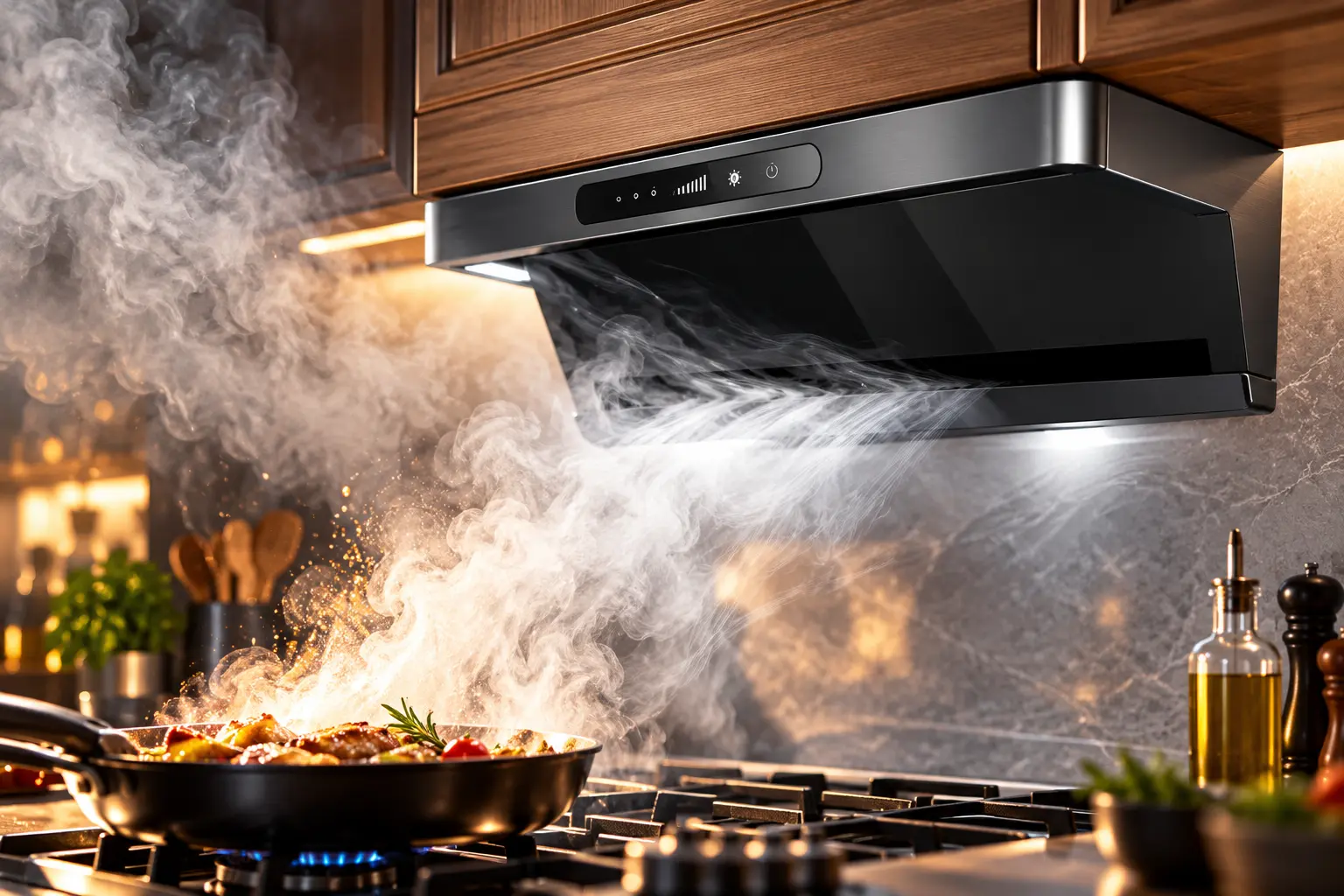
The F1 is still a ducted, wall-mount or under-cabinet hood with a 6-inch round outlet. It is not a recirculating box. The bet is that a fast, small jet can trap a plume so a modest exhaust volume can finish the job. The company calls the lower intake 16 m/s, which its own draft-test video describes as about a 35 mph wind at the cooktop, with the top intake at 8 m/s.
THE THREE-STEP CAPTURE PATH
- Lower intake: A pressurized slot along the canopy is meant to lock fumes at the pan before they spread across the cooktop.
- Upper intake: A second path, described as Coanda-guided, is meant to catch the fraction that still rises.
- Air curtain: Dual curtains around the cooking zone are meant to keep leftover smoke from drifting into an open kitchen.
Taken together, the product page claims 1,000-plus CFM-level smoke control while keeping exhaust airflow under 400 CFM, a result it tags to internal testing. A footnote on the launch statement says actual performance varies with installation, ductwork, and the cooking load. That is the entire product, compressed: sell capture that feels like a 1,000 CFM hood without printing a number that trips makeup air.
The official top-and-side draft test is the clip the company wants a buyer to watch before the spec sheet.
Lab work on ordinary hoods still ties capture to volume. Studies using tracer gas have found capture efficiency rising with airflow, with a cluster of models clearing 80 percent once flow reached about 300 CFM, and front burners needing more help than back ones. Geometry and mounting height moved the numbers, which is the gap Arspura is trying to drive a 30-inch hood through. Independent HVI airflow figures for this chassis were not on the public listing.
What the F1 Spec Sheet Lists
The 30-inch F1 is model CXW-165-CJC7501-US, powder-coated gray only, listed at 29 1/2 by 16 by 30 5/8 inches and 24 kg. It carries ETL, CE, and FCC marks, a 165 W BLDC motor (171 W with the 3 W lamp), three speeds, and a U.S. three-prong plug. Max air volume is listed as 18 m³/min. Noise is listed at 58 dB(A) on high. Static pressure on the comparison table is 750 Pa, which is the F1 figure this piece uses; the June statement’s 1,200 Pa figure is not repeated here.
Shoppers comparing the 30-inch F1 with Arspura’s wider P-series hoods are not looking at a shrink-ray of the same machine. The F1 is the top-and-side chassis without a PM2.5 monitor, on the Tuta Smart app, at the lowest noise claim in the lineup.
ARSPURA HOOD LINE, COMPANY FIGURES
| Model | Suction | Max speed | Static pressure | Noise | PM2.5 sensor |
|---|---|---|---|---|---|
| F1 30-inch | Top and side | 16 m/s | 750 Pa | 58 dB(A) | No |
| P1 36-inch | Side | 13 m/s | 1,000 Pa | 67 dB(A) | Yes |
| P2 36-inch | Top | 15 m/s | 1,100 Pa | 64 dB(A) | Yes |
A 36-inch F1 Plus lists on Amazon at $1,299.99, a separate SKU from the 30-inch that CES made famous. Advanced installation on the company site is offered at $399, marked down from $999, which is a reminder that a “no makeup air” hood can still need cabinet cutting, an outlet move, or a first-floor wall vent. Standard swap-out is listed at $199.
How a buyer should read CFM at all is its own mess. HVI-certified hoods are rated at 0.1 inches of static pressure, a stand-in for real duct runs, and Broan-NuTone’s explainer on how range hood CFM is measured is blunt that many brands skip that program. The F1’s public marks are safety and radio listings, not an HVI airflow line. An inspector who asks for the rated exhaust volume is asking a question the comparison table does not answer in cubic feet per minute.
A 120,000-RPM Cycle Replaces Mesh Filters
The other half of the CES pitch was maintenance. There is no mesh baffle to soak in a sink. Oil is supposed to ride the airflow into a 1 L cup, and a 3-minute dry-clean spins the fan past 120,000 RPM to throw film off the impeller at a claimed 500G. The inner chamber has a high-temperature silicone coat so grease is less likely to stick. Arspura says that package cuts manual cleaning by up to 90 percent.
Filter-free is not clean-free. Someone still empties the cup. The self-clean is a reverse-spin cycle, not a dishwasher rack, and the company still ships a hanging plate, foil sheets, an oil cup, and a smoke pipe in the box. Gesture control and the app are the features that show up in early owner notes, because greasy fingers on a capacitive strip are a real annoyance on cheaper hoods.
Delay-off is listed at 1 minute, which is short next to the 5- or 15-minute rundown many cooks use to clear a wok. Three speeds are the whole map. The F1 is the compact, sensor-free member of the family, sold as the 30-inch that fits a standard U.S. cabinet without the P-series’s air-quality readout.
CES Promised April, Retail Arrived in July
The chassis on sale in July is the same 30-inch gray hood that collected CES hardware stickers in January, after a slower spring than the preorder page advertised.
FROM IFA TO U.S. RETAIL
- September 4, 2025: Arspura, the export brand of CleaDeep, takes the IFA Next Dream Stage in Berlin and puts IQV (Inclined Quad-Vortex) on a European stage.
- January 6-8, 2026: The F1 appears at CES. Company materials credit it with AH Best of CES, Yanko Design Best of Tech, and Techaeris Best of CES, three of five awards the brand listed for that show.
- April 2026: CES-era product copy said consumer shipping would start this month, with preorders at $899 against a $1,299 list, a $400 cut.
- June 29, 2026: Arspura announces a U.S. launch built around velocity and the 400 CFM line.
- July 1, 2026: The 30-inch goes up through Arspura and Amazon as a ducted retrofit for common U.S. layouts.
Shoppers first saw the hood in the CES 2026 30-inch preorder launch, when April was still the ship window and $899 was the teaser. The $949 code now on the product page is $351 off the $1,299.99 list, not a rerun of that $400 preorder math. Free shipping is limited to the 48 contiguous states. Alaska, Hawaii, territories, P.O. boxes, and foreign addresses are out.
The person behind the brand is Dr. Ray Ren, founder and CEO, who introduced IQV into household kitchens after industrial ventilation work and who has tied the project to cooking PM2.5. Parent company CleaDeep listed a Sacramento address on its U.S. notices. Brand pages claim 10-plus years of R&D, 700-plus patents, and more than a million families on IQV products; those are company counts, not a third-party census of F1 owners.
Early Kitchens Like the Pull More Than the Proof
By late summer the Amazon 30-inch page was showing a 4.5-star average on about a dozen ratings, a sample too small to treat as a verdict and padded with Vine units sent for free. Verified buyers still described a strong pull. Cansu Sahinkaya, writing on July 6, said the suction “clears smoke, steam, and cooking odors much faster than my previous range hood” and called it quiet for the power. Chris Blue, on August 11, said he was “really impressed with how well it pulls smoke.”
The more useful note sat inside a five-star Vine review. Emma M. still told readers to size the duct, avoid kinks, and not underestimate makeup air, because “a strong range hood removes air from your house, and that air has to come from somewhere.” Antonio, at four stars, flagged install effort. Those are not lab results. They are the sound of people meeting a 24 kg chimney that still needs a 6-inch pipe through a wall.
WHAT WE KNOW
- On sale: The 30-inch F1 has been a U.S. retail hood since July 1, ducted, gray, gesture- and app-controlled.
- The code line: Exhaust rated above 400 CFM requires makeup air under IMC 505.4 and the parallel IRC rule.
- Company tests: Arspura’s own figures are 16 m/s at the lower intake and 1,000-CFM-class capture at under 400 CFM of exhaust.
WHAT IS UNCONFIRMED
- HVI airflow: No public HVI rating at 0.1 in. static pressure was found for this model.
- Capture class: The 1,000-plus CFM-level claim is internal testing, not a published tracer-gas study of the F1.
- Long wear: The 120,000 RPM clean and 90 percent cleaning cut have not been measured across a heating season of stir-fry grease.
A rating plate that actually stays under 400 CFM is what keeps an inspector from asking for a makeup-air damper. A marketing line that says “Non Make-Up Air Needed” is not that plate. Until an HVI number or an equivalent third-party curve exists, the code bet is a claim a builder has to defend with the company’s test packet.
Makeup Air Work Gets Left Off the Invoice
If the exhaust volume holds, the people who lose a line item are the crews who sell interlocked dampers and tempered supply fans for 600-to-1,200 CFM chimneys. Tight, energy-code houses are exactly where that second system gets expensive, because replacement air in January cannot arrive as a 400 CFM ice draft next to the range. A 30-inch hood that truly stays under the tripwire is a way to keep a permit simple on a cabinet swap.
If the volume does not hold once the 6-inch run is long, offset, or flex-kinked, the homeowner has bought a $949 (with code) canopy and still owes the makeup-air conversation. Static pressure on the F1 table is 750 Pa, which is the company’s answer to real duct friction, and it is still a number from the maker. The F1 does not delete physics. It tries to move the capture work to velocity so the exhaust number can sit on the safe side of a 400 CFM statute.
That is the product that left CES. Not a magic silent box, a 30-inch gray chimney with a 1 L cup, a 3-minute spin-clean, and a sales page that treats the makeup-air code as the competitor.
Frequently Asked Questions
Does the Arspura F1 Require Makeup Air?
Arspura sells the F1 as staying under the 400 CFM exhaust threshold that triggers makeup air, so the company says a separate supply system is not required. The trigger in code is the hood’s rated capacity, not the speed you happen to use, so a 600 CFM hood still needs makeup air on low. Some jurisdictions, including Washington State and parts of California, write stricter local amendments, which is why the rating plate and the local building department both matter more than the product title.
What Duct and Power Does the F1 Use?
The spec sheet lists a 6-inch round duct, a double-layer sealed air path, and a grounded NEMA 5-15P three-prong plug on a 39.4-inch cord. It is a 171 W appliance at full input, not a hard-wired 240-volt unit, which is why a standard outlet relocation shows up as a paid extra on the advanced install option.
How Long Is the Arspura F1 Warranty?
Coverage is five years, with parts and labor in years 1 and 2 and parts only in years 3 through 5. Unused units in original condition have a 45-day return window, which the company calls up to three times a typical appliance return; buyers who return for size or looks pay return freight, and damage has to be reported within 48 hours of delivery.
Is the Arspura F1 Ducted or Recirculating?
It is a ducted hood only, with oil-fume exhaust described as going out through a pipeline, and the boxed kit includes a smoke pipe and air outlet pipe rather than a charcoal recirculating pack. Orders ship inside the 48 contiguous states and are not sent to Alaska, Hawaii, U.S. territories, or abroad, so a recirculating workaround is not something the current listing even offers as a fallback.

UPI MDR Delay Hands Traders the Calendar After Paytm Falls

Google Messages Builds Nine In-Chat Games After Samsung’s Exit

Anthropic’s $100 Million Academy Trains the Firms That Bill Both Sides

Toyota’s Electric C-HR Leaves the Cheap Twin to Subaru

Markets Bet the Fed Skips October After Hawkish Minutes

The Orchard Bug Forced Zcash to Open an Empty Pool

The $5.99 Game That Won Steam’s 2026 Summer Sale

Atlantic City Turned WWE’s Return Into a Civic Night

Don Lee Joins Hemsworth as Extraction 3 Starts Shooting

YouTube Shorts Retires Dislikes and Swaps Likes for Hearts
-
 NEWS5 months ago
The Orchard Bug Forced Zcash to Open an Empty Pool
-
 GAMING5 months ago
The $5.99 Game That Won Steam’s 2026 Summer Sale
-
 NEWS6 months ago
Atlantic City Turned WWE’s Return Into a Civic Night
-
 ENTERTAINMENT7 months ago
Don Lee Joins Hemsworth as Extraction 3 Starts Shooting
-
 NEWS5 months ago
YouTube Shorts Retires Dislikes and Swaps Likes for Hearts
-

 NEWS5 months ago
NEURA Robotics Is Spending Its $1.4B on a Machine Stack
-

 BUSINESS6 months ago
Norway’s Export Bank Backs Nscale’s $790 Million Narvik Loan
-

 GAMING5 months ago
Game of Thrones Dragonfire Follows Boston’s Conquest Playbook