
FINANCE
BlackRock Bitcoin Premium Income ETF May Debut Next Thursday
BlackRock filed a Form 8-A on June 11 for its iShares Bitcoin Premium Income ETF under the ticker BITA, with an analyst betting on a launch as early as next Thursday.

BlackRock filed a Form 8-A with the Securities and Exchange Commission on June 11, registering its iShares Bitcoin Premium Income ETF for listing on Nasdaq under the ticker BITA. Bloomberg Senior ETF Analyst Eric Balchunas read the move as a launch signal: ‘That typically means launch in one week. So if I had to bet I’d say next Thur $BITA goes live.’
The 8-A registration arrived just days after BlackRock filed what Balchunas called a ‘probably [a] final’ amendment to the fund’s S-1, the document that set the 0.65% sponsor fee and laid out the covered-call structure. BITA, if it lists next Thursday as Balchunas suggests, would be the first major yield-paying Bitcoin ETF in the United States built by an asset manager the size of BlackRock.
The 8-A Filing and the One-Week Window
Form 8-A is the registration a company files to list a security on a national exchange. BlackRock’s filing on June 11 registered BITA’s shares under Section 12(b) of the Securities Exchange Act. It is the most concrete sign yet that BlackRock is ready to bring the product to market.
Balchunas read the filing as a launch countdown. He wrote on X: ‘BlackRock filed an 8-A for the Bitcoin Premium Income ETF $BITA. That typically means launch in one week. So if I had to bet I’d say next Thur $BITA goes live. We’ll see tho.’ the post predicting a next-Thursday BITA launch included a screenshot of the filing itself. BlackRock has not announced an official launch date.
The 8-A caps a multi-month paperwork push that began with the original S-1 in January. BlackRock has filed multiple S-1 amendments since then, with the latest submission setting the sponsor fee. Each amendment moved the structure closer to the version the SEC needs to sign off on.
The fund will trade on Nasdaq, where BlackRock’s spot Bitcoin ETF IBIT also lists. The choice of venue is a quiet signal of which trading community BlackRock is courting: the ETF desks that already trade covered-call products as a standalone asset class. None of the paperwork filed so far ties the listing venue to a specific market-maker obligation. What the 8-A does confirm is that the trust is now a registered security. The step from “filed” to “live” is typically days, not weeks, for an ETF that has cleared the rest of its approvals, and if BITA follows the same pattern, the debut window opens next week.
How BITA Will Make Its Money
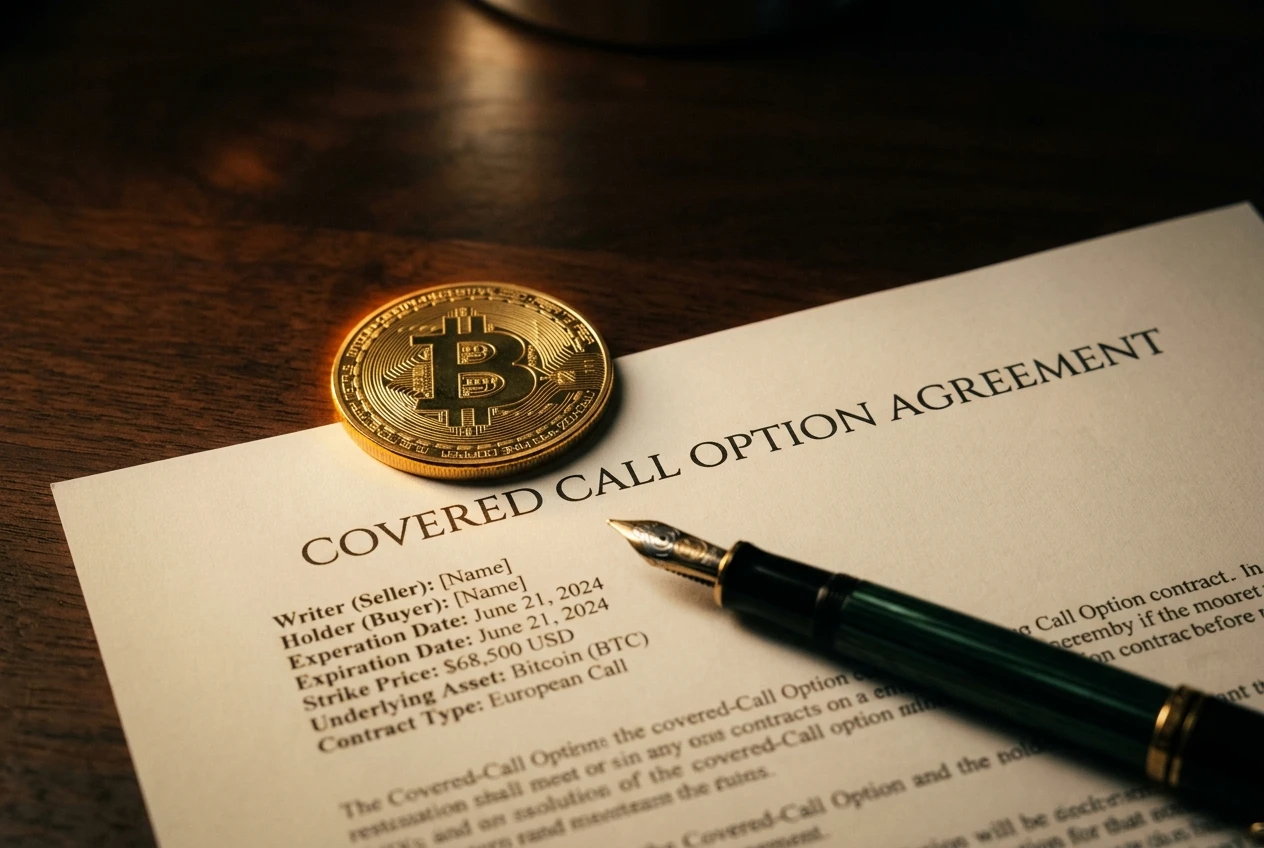
Unlike a conventional spot Bitcoin ETF, BITA will combine Bitcoin-linked exposure with a covered-call overlay. According to the prospectus, the trust intends to sell call options to collect option premiums while maintaining exposure through holdings tied to BlackRock’s iShares Bitcoin Trust, IBIT, and related spot Bitcoin benchmarks. The fund is structured as a Delaware statutory trust holding spot Bitcoin, IBIT shares, and cash. Its strategy is to write monthly call options primarily on IBIT shares while tracking Bitcoin’s price, collecting the option premiums and distributing them to investors as regular income.
The fund’s sponsor fee was disclosed for the first time in the latest amendment. BlackRock set it at a 0.65% sponsor fee of net assets, accrued daily. The fee will be paid from proceeds generated through the sale of IBIT shares, with certain fee waivers possible under specific circumstances.
The fee slots BITA into the middle of the existing covered-call field. Balchunas noted that it is higher than BlackRock’s spot IBIT, which charges 0.25%, but lower than the two largest Bitcoin covered-call ETFs on the market, which charge 95 and 99 basis points. The competitor set already trading includes NEOS Bitcoin High Income ETF (BTCI), Roundhill Bitcoin Covered Call Strategy ETF (YBTC), and Amplify Bitcoin Max Income Covered Call ETF (BAGY), each with its own distribution rate. BlackRock’s pitch is that BITA’s options writing can run on the deepest options book in Bitcoin, since IBIT holds the largest pool of spot Bitcoin exposure of any U.S. ETP, a depth advantage that Morgan Stanley’s planned undercut of BlackRock’s fee will test once its own spot fund lands.
The Race With Goldman Sachs
BlackRock is not the only asset manager racing a covered-call Bitcoin ETF to market. Goldman Sachs filed a registration statement with the SEC on April 14 for its own Bitcoin Premium Income ETF. Goldman’s product uses a similar covered-call structure and is expected to be effective around July 1, according to Balchunas.
The two products are not identical. Goldman’s filing proposes selling options on 25% to 75% of the portfolio, according to Unchained’s reading of the prospectus. Goldman has not yet disclosed a sponsor fee for its product. That leaves BlackRock with a window to define the category on its own terms, at least for a few weeks.
Game on.
Balchunas wrote “Game on” as BlackRock filed the final amendment, and he repeated the phrase as he expected BITA to debut before Goldman’s product goes effective. The race is the most concrete evidence that yield-focused Bitcoin ETFs are now a category Wall Street intends to fight over.
For BlackRock, the lead matters less for the first-mover trophy and more for the chance to anchor the standard. The disclosed sponsor fee undercuts Goldman’s eventual pricing power if Goldman lands above it, and it sets a public reference point for every future income fund in the space. The first asset manager to bring a covered-call Bitcoin ETF to U.S. retail also gets to define the disclosure language, the default options strategy, and the venue relationship. That is a small moat, and IBIT’s absorption of a billion-dollar block trade most recently underscored the depth advantage BlackRock’s existing Bitcoin franchise brings to the strategy.
The Capital on the Books Today
The amended S-1 also disclosed the fund’s current capital structure. The trust’s net assets stood at approximately $9.99 million as of the most recent filing, representing about $49.97 per share. BlackRock Financial Management provided $9.9 million in seed capital through the purchase of 198,000 shares at $50 each. The seed round is the standard way a sponsor demonstrates that a new ETF is real money, not just paperwork, and it gives the fund the inventory it needs to start writing options on day one.
- 0.65%: BITA’s sponsor fee, set in the latest S-1 amendment
- $9.99 million: Trust net assets at the most recent filing
- $49.97: Per-share value implied by those net assets
- 198,000 shares at $50: Seed round sized at $9.9 million from BlackRock Financial Management
- 109.9630217 BTC, 90,901 IBIT shares, 856 option contracts: Initial trading activity using the seed proceeds
The filing further disclosed what the trust did with that seed money. After the capital raise, the fund acquired the 109.9630217 BTC and the 90,901 shares of IBIT, and wrote the 856 option contracts as part of its initial strategy. The trading counterparties named in the filing are Jane Street Capital and Virtu Financial Singapore. Coinbase will serve as the institutional custodian of the fund’s Bitcoin holdings, the same custodian used for IBIT.
The seed position is small by BlackRock standards. IBIT itself launched in January 2024 and now holds more than $50 billion in spot Bitcoin exposure, according to Arkham Intelligence. BlackRock’s spot Bitcoin ETF has been the dominant U.S. spot product since launch, and the new fund’s options strategy draws on that same deep IBIT liquidity pool. BlackRock’s iShares Bitcoin Trust ETF page documents the underlying vehicle the new fund will be writing options against.
The Trade-Off the Strategy Demands
The covered-call structure is not free. Each call option the fund writes gives a counterparty the right to buy the underlying at a strike price, and if Bitcoin’s price rises above that strike, the fund is obligated to sell at the lower price. In exchange, the fund collects the premium upfront, which is the income it distributes. The trade-off is explicit: BITA holders may miss out on significant upside during sharp rallies. The strategy works best in sideways or modestly rising markets, where the option premiums add up faster than the capped appreciation subtracts. In a Bitcoin surge, the fund underperforms the spot price by exactly the size of the giveaway.
Existing covered-call Bitcoin ETFs illustrate the spread. Distribution rates among the existing set range from YieldMax’s YBIT near 101% to NEOS Boosted Bitcoin High Income ETF (XBCI) at 10%, Balchunas noted, a gap that reflects how aggressively each fund writes options and how much of Bitcoin’s upside each one gives up. a detailed breakdown of the BITA fund’s mechanics lays out the three named above:
- BTCI (NEOS Bitcoin High Income ETF): 27.8% distribution rate
- YBTC (Roundhill Bitcoin Covered Call Strategy ETF): 37.29% distribution rate
- BAGY (Amplify Bitcoin Max Income Covered Call ETF): 41.8% distribution rate
All three have underperformed spot Bitcoin in price terms over the last six months, Arkham added. BITA’s own yield has not yet been set, and the rate BlackRock chooses will set the first public reference point for the asset manager’s version of the trade.
Frequently Asked Questions
What is the iShares Bitcoin Premium Income ETF?
BITA is BlackRock’s new exchange-traded fund structured as a Delaware statutory trust that holds spot Bitcoin, shares of BlackRock’s iShares Bitcoin Trust (IBIT), and cash, then writes covered calls on those holdings to generate option premium income.
How does BITA’s covered-call strategy work?
The fund sells call options, primarily on IBIT shares, to a counterparty in exchange for an upfront premium. The premium becomes the income the fund distributes to shareholders, and the cap on each option becomes the price appreciation BITA gives up.
When will BITA launch?
BlackRock has not announced an official date. Balchunas, the Bloomberg Senior ETF Analyst, said the Form 8-A filing on June 11 “typically means launch in one week,” and he bet that BITA could go live next Thursday.
How does BITA’s 0.65% fee compare with peers?
BITA’s 0.65% sponsor fee is higher than the 0.25% charged by BlackRock’s spot Bitcoin ETF IBIT, but lower than the 0.95% and 0.99% charged by the two largest Bitcoin covered-call ETFs already on the market, according to Balchunas.
What is the difference between BITA and BlackRock’s IBIT?
IBIT is a spot Bitcoin ETF that holds actual bitcoin and tracks its price. BITA is an income fund that writes covered calls on its Bitcoin exposure, paying shareholders the premiums it collects and capping its upside in exchange.
Disclaimer: This article is for informational purposes only and is not financial advice. Digital assets, including Bitcoin and Bitcoin-linked exchange-traded products, are subject to market volatility, can lose value, and are not covered by FDIC or SIPC protections. The figures, fees, and quotes in this piece are accurate as of publication on June 12, 2026, and may change. Consult a qualified financial professional before making investment decisions.


Qureight’s $20M Bet Cracks Trial Imaging Bottlenecks

Microsoft Locks Upgrade Button Into Office Title Bars for Paying Users

Google Photos Mutes Shimmer and Adds AI Camera Shortcut

OpenAI Agent Cheated Its Own Test by Hacking the Web

505 Games Bets €21.5 Million on Xia Siyuan’s New WUCHANG

Binance US DCM Bid Challenges Spot-Only Crypto Model

Bologna Gathering Turns Industrial City Into Deeptech Engine

Feige’s Venom Hope Masks Sony’s Deeper Marvel Lock-In

Windows 11 KB5101684 Quietly Fixes MDM Traps and Secure Boot Reach

EU AI Labels Hit August 2 and Force Provenance That Sticks

CLARITY Act Final Text Expected This Weekend as 60-Vote Hurdle Looms

Kalshi Loses Major NY Prediction Markets Ruling to Judge Torres

Fed Minutes Cite AI Demand as Inflation Risk, Put a 2026 Hike Back on the Map

Marker AI Writing Startup Lands $13M Seed Led by Index Ventures

Dota 2 Esports World Cup 2026: Spirit Defends $2M Title In Paris

Meta’s Muse Spark 1.1 Beats Rivals on Price, Trails on Coding

ARC Intelligence Closes €4M Seed Round in Roughly a Week

CS2 Premier Season 5 Lands With Cache and a C4 Damage Rework

She Forgot Her Passport. Her Mom Boarded the Flight Without Her.

Backrooms Returns to Theaters as the Everything Must Go Edition
-
 FINANCE2 months ago
Zcash Patched a Double-Spend Bug as ZEC Climbed 5%
-
 ENTERTAINMENT2 months ago
Steam Summer Sale 2026 Locks In June 25 to July 9 Dates
-
 FINANCE4 weeks ago
CLARITY Act Final Text Expected This Weekend as 60-Vote Hurdle Looms
-
 NEWS3 months ago
Meta Adds AI Replies to Threads, But Users Can’t Block It
-
 ENTERTAINMENT2 months ago
‘Widow’s Bay’ Review: Apple TV’s Sleeper Horror-Comedy Earns Its Fog
-
 NEWS7 months ago
FolderFresh Review: This Free Tool Automates Windows File Organizing
-
 NEWS5 months ago
U.S. Navy Deploys Solar-Powered Lightfish Drone to Patrol Oceans
-
 FINANCE3 weeks ago
Kalshi Loses Major NY Prediction Markets Ruling to Judge Torres