
BUSINESS
Buy Now, Pay Later Faces Growing Scrutiny in 2026

The checkout button looks harmless. Four easy payments, zero interest, and your item ships today. But behind that clean promise, millions of Americans are quietly slipping into a debt spiral that regulators, senators, and even the Federal Reserve are now scrambling to address. Buy now, pay later is no longer just a checkout convenience. It is becoming a consumer finance crisis hiding in plain sight.
The Real Allure Behind BNPL’s Rapid Rise
The numbers behind BNPL’s growth are staggering. The global BNPL market hit an estimated $560 billion in 2025, growing 13.7% year over year, and is projected to nearly double to $911.8 billion by 2030. In the U.S. alone, the total transaction value of BNPL loans grew roughly 20% per year since 2021, reaching an estimated $70 billion in 2025.
About one in three U.S. adults has used a BNPL service for at least one purchase. The JD Power 2026 U.S. Buy Now Pay Later Satisfaction Study found that 37% of consumers made a BNPL purchase within the past 90 days, a five-percentage-point jump over the prior year. Sean Gelles, senior director of banking and payments at JD Power, called it “the fastest-growing payment method that we track.”
The appeal is easy to understand. BNPL splits a purchase into four interest-free installments over six weeks. No hard credit check. No revolving debt. Just a simple payment schedule shown right at checkout. For younger shoppers especially, it feels like a smarter way to buy. Nearly 41% of BNPL users in 2024 were between the ages of 16 and 24. Among consumers under 40, the shift is unmistakable.
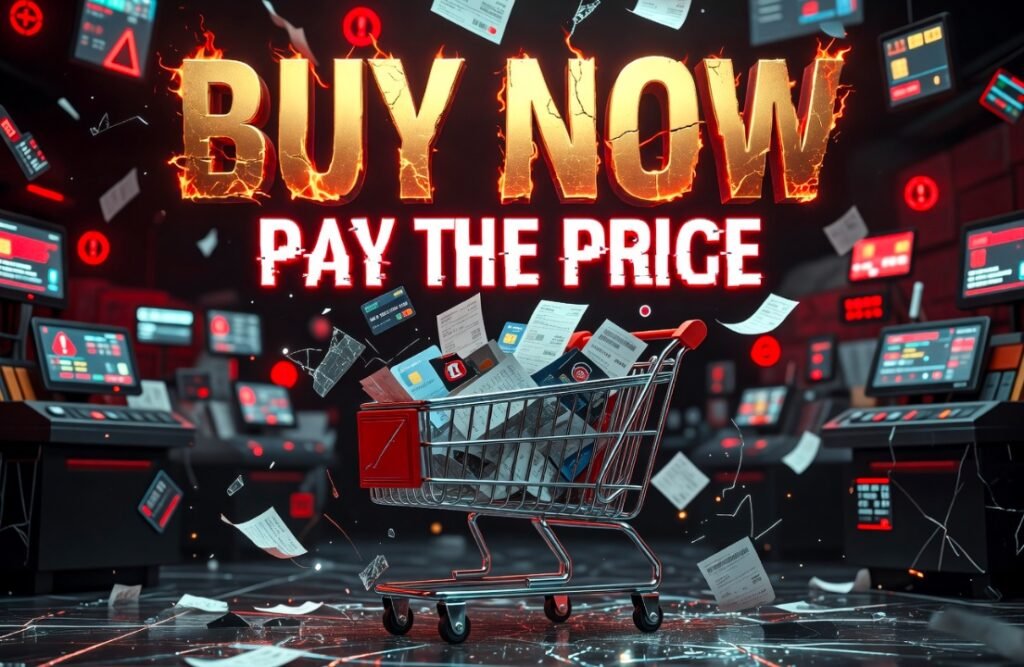
buy now pay later debt risk younger consumers 2026
The Hidden Costs Piling Up for Shoppers
Here is the part the checkout button does not show you.
The CFPB found that 66% of BNPL users take out multiple BNPL loans simultaneously, and 33% borrow from multiple lenders at once. That fragmented debt is nearly impossible for any single lender to see. It is also nearly impossible for many borrowers to track.
A LendingTree survey found that 41% of BNPL users reported making at least one late payment in the previous year. A separate Bankrate survey found the most common problems among BNPL users were overspending, missing a payment, and regretting a purchase. Gen Z users experienced problems at a rate of 66%, making them the most vulnerable group.
A Barclays study uncovered something even more alarming: nearly 23% of 18 to 34-year-old BNPL users had to cut spending on essential purchases like groceries just to keep up with their BNPL repayments. This is not overspending on luxury goods. This is a payment model cannibalizing basic household budgets.
The Kansas City Federal Reserve put it plainly: installment-free pricing makes some purchases seem more affordable than they really are, raising the risk of overspending, debt accumulation, and even default.
- 34% to 41% of U.S. BNPL users report missing at least one payment
- Americans using BNPL carry an average of $871 more in credit card debt than non-users
- Monthly BNPL spending jumped nearly 21%, from $201.60 in June 2024 to $243.90 in June 2025
- About 38% of BNPL users say the loans make shopping feel less financially “real”
Regulators Step In While Washington Steps Back
The regulatory picture right now is deeply divided, and that split is creating real problems for consumers.
On the federal level, the CFPB under the current administration announced in May 2025 that it would not prioritize enforcement of its prior interpretive rule, which had classified BNPL providers as credit card issuers. The bureau later rescinded the rule entirely, leaving BNPL in what regulators describe as a “regulatory limbo” at the national level.
States are now rushing to fill that vacuum. New York enacted the Buy-Now-Pay-Later Act as part of its FY2026 budget, creating the first state-level licensing framework specifically for BNPL lenders in the country. The law requires providers to obtain a license from the New York Department of Financial Services, assess a consumer’s ability to repay before issuing credit, cap fees and interest rates, and meet disclosure standards similar to those for credit cards. In March 2026, New York’s DFS proposed regulations implementing those rules, including a 16% interest rate cap on BNPL loans and a cap of $8 on penalty fees.
The divide between Washington and the states is becoming a patchwork that confuses both consumers and providers. California has classified BNPL products as loans under its financing law since 2020. And globally, the pressure is mounting even faster. The UK’s Financial Conduct Authority will bring BNPL under formal consumer credit regulation starting July 15, 2026. Across Europe, the Second Consumer Credit Directive takes effect in November 2026, closing many of the gaps that previously allowed BNPL to operate outside mainstream regulation.
“These BNPL loans can be an option for something you really need now. But it’s important to know what you’re getting into and many consumers clearly don’t.” – Teresa Murray, Consumer Watchdog Director, U.S. PIRG Education Fund
Your Credit Score Is Now on the Line
For years, BNPL existed in a credit score blind spot. You could take out five loans across three providers in a single month and your credit report would show nothing. That era is ending.
Beginning in fall 2025, FICO introduced two new scoring models, FICO Score 10 BNPL and FICO Score 10 T BNPL, that incorporate BNPL loan data into credit scores for the first time. For the 52% of Americans already using BNPL, this changes what every future mortgage, car loan, or apartment application could look like.
The industry is split on how to handle this shift. Affirm has been working directly with FICO and has begun reporting loan data to Experian, Equifax, and TransUnion. Klarna and Afterpay, however, have declined to participate in the new credit scoring model, citing concerns that credit bureaus are not receiving real-time, accurate BNPL data, which could unfairly damage their customers’ credit profiles.
The inconsistency is now drawing lawmakers into the conversation. Just two days ago, U.S. Senators sent letters to the three major credit bureaus, Equifax, Experian, and TransUnion, pressing them directly on how BNPL payment data is being handled. The timing matters. As FICO simulations show most users will see score changes of roughly plus or minus 10 points, missed BNPL payments now carry real, lasting consequences.
| Provider | Reports to Credit Bureaus? | Approach |
|---|---|---|
| Affirm | Yes (Experian, Equifax, TransUnion) | Partnered with FICO on new scoring models |
| Klarna | No (currently opted out) | Cites data accuracy concerns |
| Afterpay | No (currently opted out) | Waiting for standardized reporting |
| PayPal Pay Later | Partial | Still refining bureau models |
Banks Join the Race and Raise the Stakes
Traditional banks watched BNPL’s rise for years. Now they are competing head-on, and the market dynamics are shifting fast.
American Express Plan It, Chase Pay Over Time, and Citi Flex Pay swept the top spots in JD Power’s 2025 BNPL satisfaction rankings. Chase pulled into the top spot in the 2026 study. Banks bring something fintech providers cannot easily offer: existing customer relationships, stronger regulatory standing, and consistent credit bureau reporting.
U.S. Bank recently launched the Split World Mastercard, a product that functions entirely on a BNPL model. Every purchase under $100 is automatically split into three monthly payments with no fees or interest. It is a direct shot at Klarna and Afterpay.
The fintech side is not standing still either. Affirm applied for a Nevada industrial bank charter and FDIC coverage in late January 2026 to form Affirm Bank, a move that would allow it to raise insured deposits directly. Klarna announced a partnership with JPMorgan Chase to offer BNPL services to the bank’s business clients. These moves are blurring the line between banks and fintechs in ways that would have seemed unlikely just three years ago.
Payment value growth in BNPL is decelerating, dropping from 27.1% in 2024 to 19.2% in 2025, and is forecast to slow further to 14% in 2026. The sector is maturing. The easy growth days driven by pandemic-era online shopping have passed. What remains is a fight for margin, market share, and regulatory survival.
What started as a clever checkout feature has become one of the most contested corners of consumer finance. Millions of people are using BNPL every day without fully understanding what happens when a payment falls through, or what their growing stack of installment loans will mean for the next time they apply for a mortgage or a car loan. Regulators in New York, London, and Brussels are drawing new lines. Banks are muscling in. Credit scores are changing. The question is no longer whether BNPL needs rules. The question is whether those rules will arrive in time to protect the shoppers who need them most. Drop your thoughts in the comments below. Do you think BNPL needs stricter regulation, or is this a case of government overreach.


Capital Clusters and the Dual Tracks of European Tech Finance

Microsoft Shrinks Windows 11 Memory for 8GB PCs

XRP Ledger Brings Back Bugged Features Fixed for Institutions

The Shards Trailer Turns Ellis Nightmare Into Murphy Glamour

WhatsApp Folder Hides Business Messages After Hours

Mova LiDAX Ultra 3000 AWD Cracks the Robot Mower Moat

Urban Arrow FamilyNext Turns Costco Runs Into Bike Trips

Reddit Builds Spoken Video Layer to Reclaim Its Own Viral Stories

Nuggit £5m Fund Treats YouTube Channels as Real Businesses

Galaxy Z Fold 8 Makes Foldables Daily Drivers but Drops Flex Mode

CLARITY Act Final Text Expected This Weekend as 60-Vote Hurdle Looms

Kalshi Loses Major NY Prediction Markets Ruling to Judge Torres

Fed Minutes Cite AI Demand as Inflation Risk, Put a 2026 Hike Back on the Map

Marker AI Writing Startup Lands $13M Seed Led by Index Ventures

Dota 2 Esports World Cup 2026: Spirit Defends $2M Title In Paris

Meta’s Muse Spark 1.1 Beats Rivals on Price, Trails on Coding

CS2 Premier Season 5 Lands With Cache and a C4 Damage Rework

ARC Intelligence Closes €4M Seed Round in Roughly a Week

Finto Picks Munich Over Silicon Valley After YC, Raises $3.4M

Backrooms Returns to Theaters as the Everything Must Go Edition
-
 FINANCE2 months ago
Zcash Patched a Double-Spend Bug as ZEC Climbed 5%
-
 ENTERTAINMENT2 months ago
Steam Summer Sale 2026 Locks In June 25 to July 9 Dates
-
 FINANCE4 weeks ago
CLARITY Act Final Text Expected This Weekend as 60-Vote Hurdle Looms
-
 NEWS3 months ago
Meta Adds AI Replies to Threads, But Users Can’t Block It
-
 ENTERTAINMENT2 months ago
‘Widow’s Bay’ Review: Apple TV’s Sleeper Horror-Comedy Earns Its Fog
-
 NEWS5 months ago
U.S. Navy Deploys Solar-Powered Lightfish Drone to Patrol Oceans
-
 NEWS8 months ago
FolderFresh Review: This Free Tool Automates Windows File Organizing
-
 FINANCE4 weeks ago
Kalshi Loses Major NY Prediction Markets Ruling to Judge Torres