
NEWS
Samsung Exynos 2700 Splits RAM From SoC to Tame the Heat
Samsung’s Exynos 2700 splits the DRAM from the SoC into a Side-by-Side package, the same layout Apple’s A20 Pro is reportedly taking for the next iPhone.

Samsung’s Exynos 2700 will drop on-package memory entirely, separating the DRAM from the system-on-chip inside a new Side-by-Side package built to keep the chip cool under sustained load. The redesign, first detailed by tipster ExoticSpice on X, marks Samsung’s deepest packaging shift since the Exynos 2400. Apple’s A20 Pro is reportedly taking the same route.
The architecture replaces the long-standing Package-on-Package layout, where DRAM sits stacked on top of the processor, with a horizontal Side-by-Side arrangement that opens the top of the silicon die for a copper Heat Pass Block. The change lets Samsung pair the block with the larger vapor chambers expected inside Galaxy S27 models set to launch in Q1 2027. Qualcomm is licensing its own copy of the Heat Pass Block for the next Snapdragon, but its implementation is described as inferior to Exynos’s, a problem that hands Samsung a thermal advantage it has not held in years. MediaTek’s Dimensity 9600, by contrast, ships with no structural add-on for heat dissipation at all.
What Samsung Moved Inside the Package
In current Exynos parts, the DRAM sits stacked on top of the application processor in a Package-on-Package layout, the configuration Samsung has used for years to keep memory bandwidth high and the phone footprint small. The Exynos 2600, which ships inside the Galaxy S26 in selected regions, kept that approach but shrank the DRAM chip and added a Heat Pass Block on top of the silicon to draw heat out faster, a change Samsung says cut thermal resistance by up to 16 percent. The July 2026 tip detailing the side-by-side layout explains what comes next.
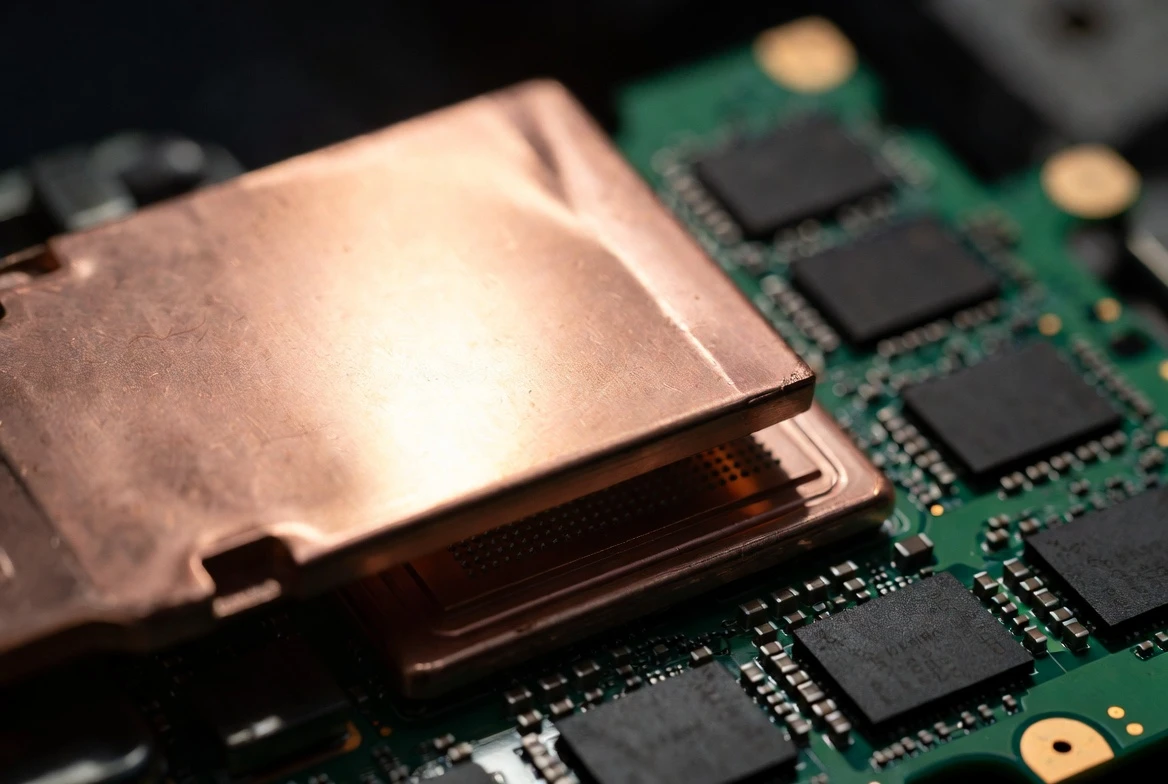
The Exynos 2700 will move the DRAM module out of the package entirely and place it horizontally next to the SoC die, in a structure Samsung calls Side-by-Side and Apple’s silicon team calls Wafer-Level Multi-Chip Module. With the memory off the top, the Heat Pass Block now sits directly on an unobstructed silicon die, with the block’s copper layer bonded to the processor beneath it.
Placing DRAM and AP horizontally has the advantage of improving heat dissipation characteristics while increasing silicon chip thickness. Although there are technically difficult parts, it is a technology not too far from actual application to Exynos.
A semiconductor industry official framed it that way in Korean reporting shared by analyst Jukan on X, where Samsung’s package work was described as the framework for the company’s mid-to-long-term Exynos roadmap. The Korean industry report on Samsung’s packaging also notes that the Side-by-Side structure lets Samsung make both the AP and the DRAM physically thicker, which improves heat control and power design at the cost of a larger package footprint. That footprint growth is why the Side-by-Side structure is expected to land first in foldables, where device thickness is already a moving target.
Why the Exynos Line Has Been Running Hot
Samsung’s prior Exynos silicon earned a reputation for throttling under heavy load, and the Exynos 2600 itself pushed that reputation into the open when early benchmark testing measured peak power draw around 30W in Geekbench 6, roughly 40 percent higher than the Snapdragon 8 Elite Gen 5 doing the same run. Wccftech, reporting on the Exynos 2600’s launch behavior, described the result as “exceptionally high temperatures that would eventually trigger thermal throttling.” Samsung’s first 2nm GAA chipset announcement did not hide the engineering problem. The Galaxy S26 chip split that followed, with Snapdragon reserved for the US, China and Japan and Exynos shipped across Europe, South Korea and India, put Samsung’s silicon under a public microscope it had not faced in years. Sustained-load behavior, not peak scores, became the metric that decided whether the chip was competitive, and on that metric the Exynos 2600 finally won a real fight, holding clocks under load against liquid nitrogen.
The Heat Pass Block was the structural answer. By moving the DRAM off the top of the AP and bonding a copper slab directly to the die, Samsung gave the chip a dedicated heat path that phones with passive vapor chambers could not match. The Exynos 2700 takes the same logic further, with the Heat Pass Block now sitting on a fully exposed die and aided by a vapor chamber in various Galaxy S27 models. The combined design is what Samsung’s packaging team argues will let the next chip hold clocks without leaning on the aggressive power scaling that made its predecessor hot to the touch.
Where the Rivals Stand on Cooling
Samsung is not the only chipmaker making this trade. Apple’s A20 Pro, due for the next premium iPhone, is reportedly pursuing the same Side-by-Side WMCM architecture, with a vapor chamber placed on the die in a configuration that echoes Samsung’s Heat Pass Block strategy. Wccftech, in its write-up of the Exynos 2700 leak, says Apple’s A20 Pro and Samsung’s Exynos 2700 are the only two flagship SoCs currently redesigning their packages around thermals. The convergence is structural rather than coincidental; both teams have concluded that Package-on-Package layouts run out of headroom once clocks climb past a certain point.
| Chip | Packaging change | Heat dissipation feature |
|---|---|---|
| Samsung Exynos 2700 | DRAM separated, Side-by-Side | Heat Pass Block on die + vapor chamber |
| Apple A20 Pro | Side-by-Side WMCM | Vapor chamber on die |
| Qualcomm Snapdragon 8 Elite Gen 6 Pro | Heat Pass Block (licensed) | Implementation described as inferior to Exynos |
| MediaTek Dimensity 9600 | No structural cooling add-on | None reported |
Qualcomm is bringing a Heat Pass Block to its next Snapdragon, the 8 Elite Gen 6 Pro, but Wccftech reports the implementation is inferior to Exynos’s, a problem Wccftech has covered separately. Samsung’s reported foundry work on the block for outside clients suggests Qualcomm is licensing the design rather than building its own, and the licensing path has cost the Snapdragon generation the tighter thermal envelope Samsung is now claiming. MediaTek sits further behind. Wccftech notes the Dimensity 9600 “doesn’t offer any add-ons to help with heat dissipation,” making it potentially the least advanced flagship SoC on this front. The result is a thermal ranking the Android side has not seen before: an Exynos part leading on sustained clocks while a Snapdragon trails on the same metric.
The gap matters because sustained performance is the metric that decides whether a long gaming session or an 8K video export stays smooth. Samsung’s bet is that the buyers who feel throttling in their hand will start to read the fine print, and the Snapdragon 8 Elite Gen 6 Pro’s reported thermal implementation is the first real test of whether that bet holds.
The Foundry Deficit Riding on the Chip
Samsung’s non-memory business, the unit that designs Exynos and runs the foundry, lost an estimated 2.6 trillion won ($1.77 billion) in the first quarter of 2025. The deficit narrowed to 1 trillion won ($679.21 million) by the first quarter of 2026, helped by memory pricing and AI demand for Samsung’s device solutions group, but the foundry itself remains in the red. Korean outlet Chosun, cited by Wccftech, projects the Exynos 2700 could push that deficit down to 800 billion won, or $543.47 million, if the chip lands cleanly and adoption inside the Galaxy S27 line holds. Samsung has set an ambitious public target for the foundry to reach profitability by 2027.
- $1.77 billion: Q1 2025 operating loss at Samsung’s non-memory business (2.6 trillion won).
- $679.21 million: Q1 2026 operating loss at the same unit (1 trillion won).
- $543.47 million: Chosun’s projected loss with the Exynos 2700 shipped (800 billion won).
- 50 percent: Wccftech’s reported planned adoption share of Exynos 2700 inside the Galaxy S27 lineup.
The math depends on two things Samsung does not fully control. The first is yields on Samsung’s second-generation 2nm GAA process, the node the Exynos 2700 will use and the one Samsung’s foundry has staked its 2027 profitability target on. The second is adoption share inside the Galaxy S27 series, which Wccftech reports is planned at 50 percent of all models, up sharply from the Galaxy S26 split. If either slips, the foundry stays loss-making, and the Heat Pass Block, however elegant, ships in too few phones to move the financial needle. The risk is concentrated: one chip carries the deficit and the architecture in a single bet, and Samsung is now waiting on yields it does not fully control.
The Galaxy S27 as the First Test
The Galaxy S27 is where the Exynos 2700 lands first. Wccftech says the chip is scheduled to debut inside various Galaxy S27 models in Q1 2027, alongside the larger vapor chambers the Side-by-Side package was designed to pair with. A 50 percent adoption share inside the lineup, if Samsung holds to plan, would make the S27 generation the largest Exynos deployment since the line peaked inside the Galaxy S10 series.
The foldable question is more delicate. The Korean industry reporting Jukan shared notes that the larger package footprint of the Side-by-Side structure is why the format is expected to land first in foldables, where device thickness is already a moving target. Samsung has not confirmed a Galaxy Z Flip 8 or Z Fold 8 chip split, but the same cost pressures that put Exynos 2600 into the Galaxy Z Flip 7’s slot make a Side-by-Side Exynos a logical candidate for the next clamshell. That would also give Samsung a thinner premium device in which to test the new cooling design before committing it to the Galaxy S flagship line, in a regional chip split that continues the Europe-and-Korea pattern the Z Flip 8 is already testing.
The bigger question is whether the rest of the Android chip stack follows Samsung’s lead. Qualcomm’s reported licensing of the Heat Pass Block is one signal; Apple’s parallel work on WMCM is another.
For now, Samsung’s bet is the clearest. By tying its flagship chip and its foundry turnaround to a packaging redesign, Samsung is the chipmaker most exposed if the Exynos 2700’s clocks do not hold. The risk is that the same architecture opens the door to faster, cooler Snapdragon and Apple designs once both have absorbed the Heat Pass Block playbook. The opportunity Samsung is buying is that it reaches the thermal ceiling first, and turns sustained speed in a hot phone into the metric Android silicon gets judged on next.
Frequently Asked Questions
What is the Exynos 2700’s Side-by-Side architecture?
The Side-by-Side structure places the DRAM module horizontally next to the system-on-chip, abandoning the Package-on-Package layout phones have used for a decade. Samsung’s Korean industry reporting says the new layout is being treated as the framework for the company’s mid-to-long-term Exynos roadmap, with 3D packaging expected to build on the horizontal placement.
What does the Heat Pass Block do?
The Heat Pass Block is a copper heatsink bonded directly onto the chip die inside the package, absorbing heat that phones with passive vapor chambers cannot move fast enough. Samsung first shipped it inside the Exynos 2600, where the company says thermal resistance dropped by up to 16 percent. A Korean thermal showcase put the practical gain higher, at roughly 30 percent cooler running than the previous Exynos generation under sustained load.
When does the Exynos 2700 ship?
Wccftech reports the Exynos 2700 is scheduled to debut inside various Galaxy S27 models in Q1 2027. Mass production timing for Samsung’s second-generation 2nm GAA node is the variable that decides whether that date holds, since the foundry has tied its 2027 profitability target to that node.
Is Apple’s A20 Pro using the same architecture?
Apple’s A20 Pro is reportedly pursuing the same Side-by-Side WMCM layout, with a vapor chamber placed on the die in a configuration Wccftech describes as echoing Samsung’s Heat Pass Block strategy. The convergence is structural rather than coincidental. Both teams have concluded that Package-on-Package layouts run out of headroom once clocks climb past a certain point. Wccftech names Apple’s chip and Samsung’s as the only two flagship SoCs currently redesigning their packages around thermals.
Which Snapdragon chip competes with the Exynos 2700?
The Snapdragon 8 Elite Gen 6 Pro is the chip Samsung will face inside the Galaxy S27 lineup. Wccftech reports it will include a Heat Pass Block licensed from Samsung’s foundry, though the implementation is described as inferior to Exynos’s. The first thermal ranking on this metric is set to land when both chips ship inside the same flagship series.


NFL Preseason Week 2 Quietly Tests the Schemes That Matter

Alonso’s Towering Drive Stands Foul and Flips Orioles Momentum

US Debt Crosses $40 Trillion as Interest Crowds the Budget

Trevon Diggs Joins Seahawks on One-Year Deal After Cowboys Exit

Pixel Watch 5 Turns Passive Trends Into Early Health Alerts

Pixel 11 Pro Fold Sleek Build Undercuts Its Own Unfolding Appeal

Tugboat Wilkinson’s Scoreless Debut Pays Off Giants’ Bailey Trade

Brown Shines for Pats as Love for Eagles Meets Trade Reality

Pixel Watch 5 Turns Wrist Data Into Early Metabolic Alerts

Resistance Stars Pay the Price in Democratic Primaries

Senators Force Apple Off Chinese Memory as Big Three Cash In

OpenAI Agent Cheated Its Own Test by Hacking the Web

Trump Iran Threat Wiped $238M Crypto Longs Then Flipped

30-Year Yield Hits 5.32% Highest Since 2007 as Debt Supply Locks In Costs

Fed Holds Rates Again as Three Dissents Force Markets to Tighten

Oil Crashes Below $80 as Iran Talks Restart and Markets Split

Google’s Knowledge Panel Fix Risks Its Own Search Defenses

Tillis Ethics Push Gives Clarity Act One Last Shot Before Recess

Agon Raises $30M to Build Europe’s AI Weapon Training Arenas

Legora Buys Wexler Fact Engine as Fifth 2026 Deal
-
 FINANCE3 months ago
Zcash Patched a Double-Spend Bug as ZEC Climbed 5%
-
 ENTERTAINMENT3 months ago
Steam Summer Sale 2026 Locks In June 25 to July 9 Dates
-

 FINANCE2 months ago
CLARITY Act Final Text Expected This Weekend as 60-Vote Hurdle Looms
-
 NEWS3 months ago
Meta Adds AI Replies to Threads, But Users Can’t Block It
-

 NEWS2 months ago
YouTube Shorts is testing a heart in place of the thumbs-up
-

 NEWS2 months ago
NEURA Robotics’ $1.4B Series C Redraws Europe’s Physical AI Bet
-
 NEWS3 weeks ago
Senators Force Apple Off Chinese Memory as Big Three Cash In
-
 ENTERTAINMENT3 months ago
‘Widow’s Bay’ Review: Apple TV’s Sleeper Horror-Comedy Earns Its Fog