
NEWS
The SP40 Restomod: A $560K Mustang V8 Wrapped in 1934 Curves
The SP40 Restomod wraps a 480-hp Coyote V8 inside a carbon-fiber homage to Edsel Ford’s 1934 Speedster. A first drive of the $560K build in Malibu.

The SP40 Restomod is a $560,000 tribute to a one-off car almost no one alive has seen, built by an Argentine coachbuilder almost no one has heard of, and powered by a 5.0-liter Coyote V8 any Mustang owner would recognize. A carbon-fiber homage to Edsel Ford’s 1934 Model 40 Special Speedster wraps the modern engine in a body built to look nearly a century old, paired with a five-speed manual gearbox and Brembo brakes pulled straight from modern motorsport.
SlashGear’s Travis Langness drove the prototype through Malibu’s coastal canyons, and his verdict lands somewhere between delight and apology. The SP40 draws stares the way a Lamborghini does in traffic, the steering and brakes feel modern and direct, and the car tracks through sweepers with the poise of something with a 121.2-inch wheelbase. It also refused to rev past 4,000 rpm on two legs of the drive, leaked transmission heat through the center console, and costs as much as a small house. The art-deco costume hides a thoroughly modern set of trade-offs.
An Edsel Ford sketch, scanned and rebuilt in carbon
Edsel Ford, Henry’s son, set up Ford Motor Company’s first formal design department in 1927 and asked the man he hired to run it, Eugene T. “Bob” Gregorie, to sketch something more European than anything Detroit was producing. The result was a low, boat-tailed two-seater built at Ford’s Willow Run aircraft facility, with a tubular frame and hand-formed aluminum bodywork. A 75-horsepower flathead V-8 sat up front. The original was a one-off, the only car of its kind ever built.
A 1948 R&T classified tried to sell it for $2,500, a U.S. Navy sailor later bought it for $603, and Bill Warner of the Amelia Island Concours found it under tin cans in a Florida garage in 1999. After a $1.7 million auction sale in 2008, the Speedster landed in the permanent collection of the Edsel and Eleanor Ford House in Grosse Pointe, Michigan.
From the first time we saw the Model 40 Special Speedster, we were absolutely captivated by the purity of its form. Our goal with the introduction of the SP40 was not to replicate history, but to awaken it. Every line, every curve, every mechanical detail reflects our obsession with making the best car that we could to feel, to see, and to drive.
That is co-founder Arturo Arrebillaga, in Hagerty, describing the philosophy behind the Buenos Aires atelier he runs with childhood friend Francisco Orden. The pair scanned the original Speedster in person and re-created it as an all-carbon-fiber body on a modern tubular space frame. There is no 1930s Ford underneath this time, just modern parts assembled to a vintage shape.
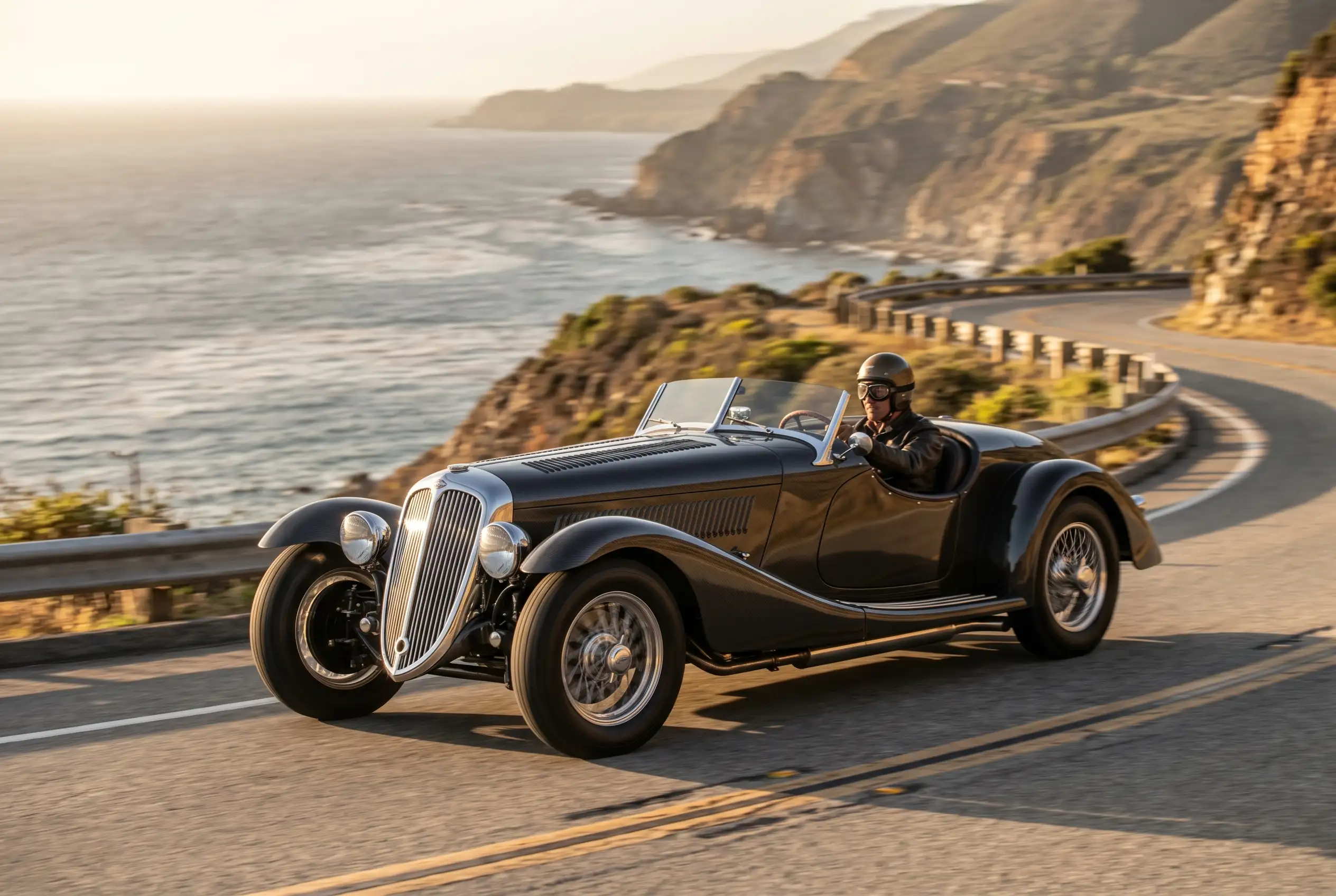
From Buenos Aires with a Coyote V8
Orden and Arrebillaga built Iconic Auto Sports on award-winning replicas of a Mercedes SSK Count Trossi and an Alfa Romeo 1900 C52 Disco Volante before turning to the SP40. The pair attended the same Scottish school in Argentina and remain the company’s public face. The chassis was developed with Argentine race engineer Pedro Campo and tuned at the Autódromo Oscar y Juan Gálvez, a former Formula 1 circuit in Buenos Aires. Two former Pininfarina designers advised on the exterior. The car is sold through Iconic’s Miami office, and the company plans to build 40 examples at roughly five per year.
Under the louvered hood sits a 5.0-liter Coyote V8 dressed up to look like a flathead, paired with a Tremec TKX five-speed manual gearbox and a Torsen limited-slip differential. Output is rated at 480 horsepower, sent to the rear wheels. The partners figure a zero to sixty mph run in about 3.5 seconds, with a 149 mph top speed seen during track development.
The numbers behind the art-deco curves
SlashGear’s spec sheet reads 2,623 pounds for the drive car, a number that is hard to reconcile with the car’s footprint. The carbon-fiber body leaves little metal over the tub. The mass sits low and central, tucked well within the wheelbase the way a vintage roadster would.
The wheelbase stretches 121.2 inches, with a 166.6-inch overall length and tracks of 69.5 inches at the front and 67.7 inches at the rear. A modern Mustang Dark Horse rides on a 107.0-inch wheelbase, measures 189.7 inches nose to tail, and weighs closer to 4,000 pounds. The SP40 ends up roughly a foot shorter, six inches wider in track, and 1,300-ish pounds lighter than the Mustang, with broadly similar horsepower. The dimensions stack into a stance that looks far more aggressive than anything rolling off a Dearborn assembly line.
Weight distribution is 48 percent front and 52 percent rear, a near-perfect grand-touring balance that holds the car flat through high-speed sweepers. The limited-slip differential keeps the rear tires honest when the throttle is punched on corner exit.
The suspension is double wishbones at both ends with adjustable coil-overs, and the brakes are Brembos with 15-inch rotors and six-piston calipers up front, paired with 13-inch rotors and four-piston calipers at the rear. The rolling stock is 20-inch forged aluminum wheels wrapped in Michelin Pilot Sport 4 S tires, 8.5 inches wide at the front and 10 inches wide at the rear. Inside the cabin there is no ABS, no traction control, no airbags, and a four-point harness in place of a three-point belt.
| Specification | SP40 Restomod | Mustang Dark Horse |
|---|---|---|
| Engine | 5.0L Coyote V8 | 5.0L Coyote V8 |
| Transmission | 5-speed manual (Tremec TKX) | 6-speed manual |
| Wheelbase | 121.2 in | 107.0 in |
| Overall length | 166.6 in | 189.7 in |
| Front track | 69.5 in | 62.2 in |
| Rear track | 67.7 in | 63.9 in |
| Curb weight | 2,623 lbs | ~4,000 lbs |
Behind the wheel, between mountains and ocean
Langness met the Iconic Auto Sports founders in Malibu and rolled out of the parking lot into California coastal traffic. The clutch-pedal travel is long, with the gears catching only in the very top of that travel, and the cold rear tires squealed once or twice before warming up. The pedal box is tiny, forcing the driver to be careful where feet land. Every head in the parking lot that wasn’t already turned toward the SP40 swiveled when the engine fired.
Once clear of Pacific Coast Highway and into the Santa Monica Mountains, the nerves settled and the throttle came back. The Coyote V8 rumbled and roared towards redline, with half the soundtrack piped out inches from the driver’s left ear. Langness found the car undeniably fast and approachable, the kind of combination that lets a regular driver push a vintage-shaped machine close to its limits.
Steering is ultra quick in the first 10 degrees of angle, then tracks through flawlessly once the wheel is set for a corner’s radius, per the SlashGear drive. The 121.2-inch wheelbase gives astonishing stability, and the wide track and short overhangs let the car pivot around corners with minimal drama. The Brembos hauled the car down from speed with plenty of margin, though the prototype’s brake pedal could use more initial bite. The car never upset itself on corner exit, even with a hard throttle application into the second half of a sweeper. The full Malibu drive impressions run through every section of the loop in detail.
Where the vintage costume shows its seams
Two short legs of the drive ran into the same problem. The car refused to rev past 4,000 rpm, sputtered at the limit, and refused to go any further. There was plenty of speed below that mark, but the interruption was real and unexpected in a Coyote V8.
The second issue was heat. On a warm day, the transmission tunnel radiated warmth through the center console and the engine’s heat poured out of the hood louvers, leaving the cabin muggy even with the air conditioning running. The drive car is technically a prototype, which Iconic’s team acknowledged, and the team tried the old unplug-it-and-plug-it-back-in trick on the rev-limit issue, which seemed to clear it for the rest of the drive. Side pipes, which sit just below the carbon-fiber doorsill, were warm but not burning after an enthusiastic run, friendlier than a Dodge Viper’s by a wide margin. An independent Miami drive of the same car reported similar low-rev misfires that the team blamed on a hasty engine calibration after a cross-country assembly. The list of small things a production car will need to fix is not long, but it is not nothing either.
The price of being one of forty
A reservation costs $50,000, the build starts with another $100,000, and the completed car lands at the buyer for around $560,000 in its carbon-bodied form. A painted body starts from $500,000, Road & Track reports, and the company’s introductory pricing is already at work, with a warning that the cost is likely to rise over time.
Production is capped at 40 cars total, at roughly five per year, with the first paying customer already an Argentinian collector who previously bought the first Pagani Zonda sold in Latin America. Wealthy California collectors steeped in Ford history are obvious candidates, the co-founders told Road & Track, with no other names disclosed.
Ford has sold more than 10.5 million Mustangs since the 1964½ model year, and a cottage industry of Mustang-based restomods prices into the mid-six figures. The SP40 sits in a different market, with a single one-off original sitting in a museum and a $1.7 million auction record to anchor the design’s pedigree. Buyers stepping up are paying for a hand-laid carbon tribute, developed in Buenos Aires and assembled in the United States, to a car that almost no one alive has seen in person. The plan is to keep the exclusivity high, Iconic’s co-founders told Road & Track, and the math already does that for them. For comparison, this 2026 luxury performance car roundup covers the Corvette ZR1, Lamborghini Temerario, and Aston Martin Vanquish alongside other six-figure machinery.
Key numbers at a glance
- 480 hp from a 5.0-liter Coyote V8
- 2,623 lbs curb weight
- 40 cars total production cap
- $560,000 completed price for the exposed-carbon body
- 149 mph top speed seen in track development
Frequently Asked Questions
What is the SP40 Restomod?
The SP40 Restomod is a hand-built, two-seat tribute to the 1934 Model 40 Special Speedster originally commissioned by Edsel Ford and designed by E.T. Gregorie. Buenos Aires-based Iconic Auto Sports scanned the original car and re-creates its art-deco lines in carbon fiber over a modern tubular space frame.
How much does the SP40 Restomod cost?
Reserving a build slot costs $50,000, kicking off construction requires another $100,000, and the completed car delivers at around $560,000 in the exposed-carbon form. The painted-body version starts at $500,000, and Iconic has warned that introductory pricing is likely to rise over time.
Who builds the SP40?
The SP40 is built by Iconic Auto Sports, an Argentine atelier founded by childhood friends Francisco Orden and Arturo Arrebillaga. The car is sold through the company’s Miami office and assembled in the United States from components developed in Argentina.
What engine is in the SP40 Restomod?
A 5.0-liter Ford Coyote V8, paired with a Tremec TKX five-speed manual gearbox and a Torsen limited-slip differential. Output is rated at 480 horsepower sent to the rear wheels, dressed up under a louvered hood to look like a 1930s flathead.
How many SP40s will be made?
40 examples in total, at a pace of roughly five per year, per Road & Track. The first paying customer is an Argentinian collector who previously bought the first Pagani Zonda sold in Latin America.


Capital Clusters and the Dual Tracks of European Tech Finance

Microsoft Shrinks Windows 11 Memory for 8GB PCs

XRP Ledger Brings Back Bugged Features Fixed for Institutions

The Shards Trailer Turns Ellis Nightmare Into Murphy Glamour

WhatsApp Folder Hides Business Messages After Hours

Mova LiDAX Ultra 3000 AWD Cracks the Robot Mower Moat

Urban Arrow FamilyNext Turns Costco Runs Into Bike Trips

Reddit Builds Spoken Video Layer to Reclaim Its Own Viral Stories

Nuggit £5m Fund Treats YouTube Channels as Real Businesses

Galaxy Z Fold 8 Makes Foldables Daily Drivers but Drops Flex Mode

CLARITY Act Final Text Expected This Weekend as 60-Vote Hurdle Looms

Kalshi Loses Major NY Prediction Markets Ruling to Judge Torres

Fed Minutes Cite AI Demand as Inflation Risk, Put a 2026 Hike Back on the Map

Marker AI Writing Startup Lands $13M Seed Led by Index Ventures

Dota 2 Esports World Cup 2026: Spirit Defends $2M Title In Paris

Meta’s Muse Spark 1.1 Beats Rivals on Price, Trails on Coding

ARC Intelligence Closes €4M Seed Round in Roughly a Week

CS2 Premier Season 5 Lands With Cache and a C4 Damage Rework

Backrooms Returns to Theaters as the Everything Must Go Edition

Finto Picks Munich Over Silicon Valley After YC, Raises $3.4M
-
 FINANCE2 months ago
Zcash Patched a Double-Spend Bug as ZEC Climbed 5%
-
 ENTERTAINMENT2 months ago
Steam Summer Sale 2026 Locks In June 25 to July 9 Dates
-
 FINANCE4 weeks ago
CLARITY Act Final Text Expected This Weekend as 60-Vote Hurdle Looms
-
 NEWS3 months ago
Meta Adds AI Replies to Threads, But Users Can’t Block It
-
 ENTERTAINMENT2 months ago
‘Widow’s Bay’ Review: Apple TV’s Sleeper Horror-Comedy Earns Its Fog
-
 NEWS5 months ago
U.S. Navy Deploys Solar-Powered Lightfish Drone to Patrol Oceans
-
 NEWS8 months ago
FolderFresh Review: This Free Tool Automates Windows File Organizing
-
 FINANCE4 weeks ago
Kalshi Loses Major NY Prediction Markets Ruling to Judge Torres