
GAMING
Valve Raised the Steam Deck $300 With No New Hardware
Valve restocked the unchanged Steam Deck OLED at $789 and $949, and chart estimates show weekly unit sales down as much as 82 percent.

Valve restocked the Steam Deck OLED on May 27, 2026, and raised the 1TB model from $649 to $949. The 512GB unit moved from $549 to $789, a $240 jump on a handheld the company said had not changed.
The second hit showed up later, in Steam’s own sales charts and in the living-room box Valve priced the next month. The Deck that built the handheld PC category on a sub-$650 sticker now asks laptop money for the same silicon.
Valve Restocked the Deck by Raising It $240 to $300
Steam Hardware posted that the OLED models were back, with updated pricing due to rising memory costs. New figures, tax in where Valve applies it, landed across every region it sells.
STEAM DECK OLED STICKERS FROM MAY 27
| Model | US before | US now | UK now | Australia now | Euro now |
|---|---|---|---|---|---|
| 512GB OLED | $549 | $789 | £649 | AUD 1,199 | €779 |
| 1TB OLED | $649 | $949 | £779 | AUD 1,429 | €919 |
That is a 44 percent US rise on the 512GB unit and 46 percent on the 1TB. In Britain the 512GB went from £479 to £649, and the 1TB from £569 to £779. Australia moved the 512GB from AUD 899 to AUD 1,199 and the 1TB from AUD 1,049 to AUD 1,429. Canada’s new tags are CAD 1,129 and CAD 1,349. Poland’s are PLN 3,279 and PLN 3,879.
Valve had already pulled the cheaper LCD Deck in late 2025. After May 27 there is no new unit under $789 in the US.
The Same Chip, the Same Screen, a New Bill
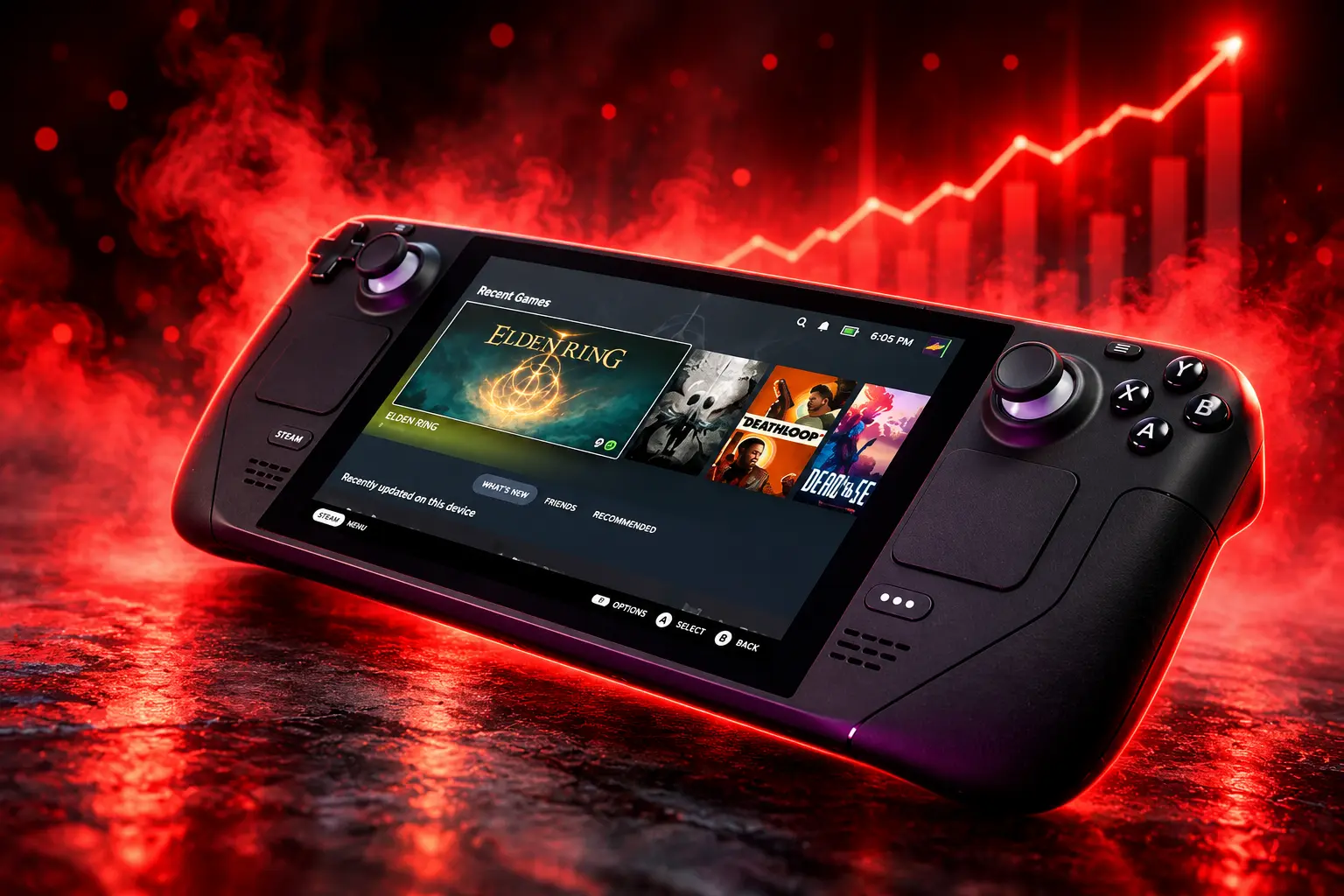
The store page still lists a 6 nm AMD APU with Zen 2 cores and RDNA 2 graphics, 16 GB of LPDDR5, a 7.4 inch HDR OLED panel, a 50 Whr battery, and a 640 gram chassis. Those are the OLED specs Valve shipped in 2023. The May note was explicit that the bill changed because parts did, not because the machine did.
Steam Deck itself hasn’t changed; these new prices reflect the current state of component costs and other global logistical challenges across the industry as a whole. We’ll keep you updated if anything changes.
Valve, Steam Hardware announcement, May 27, 2026
That last sentence is the only relief Valve offered. By September the company had not used it. The product page still carries a warning that OLED units may go out of stock intermittently in some regions because of memory and storage shortages, even while US orders show three to five business days.
Why Memory Costs Hit a Handheld That Does Not Run AI
The Deck does not train models. It still needs LPDDR5 and a NAND SSD, and those wafers now compete with HBM and enterprise flash that data centers will pay almost any price for. AI datacenters now set memory demand, TechInsights wrote in June, and availability matters more than the old boom-bust cycle. New fabs take three to five years to matter, so 2027 looks tighter, not looser.
TrendForce’s contract trackers show how violent the pass-through was. Conventional DRAM rose about 90 to 95 percent quarter on quarter in the first quarter of 2026, then another 58 to 63 percent in the second. The firm’s third-quarter forecast cooled to 13 to 18 percent, which is still an increase, just no longer a doubling. Kioxia president and chief executive Hiroo Ota said on September 9 that NAND prices have risen enough after average selling prices jumped 70 percent in April through June. Micron has told investors it can fill only 50 percent to two-thirds of customer demand in the medium term, and that DRAM and NAND will stay short beyond 2027. SK Hynix chief executive Kwak Noh-jung has talked about tightness running toward 2030.
Valve does not buy HBM. It still stands in the same buying line. When Samsung, SK Hynix, and Micron shift wafer starts toward high-margin AI stacks, consumer LPDDR and client SSD get what is left, at the price of the leftover. A handheld with soldered memory cannot ship a smaller DIMM to dodge the invoice. The 1TB Deck took the larger hit because it carries more of the NAND that enterprise SSD buyers are also chasing.
Chart Math Puts Weekly Deck Sales Down About 82 Percent
Valve does not publish Deck unit sales. Steam’s Global Weekly Top Sellers list ranks by dollar revenue, and through 2025 the handheld sat around fourth or fifth almost every week. After the restock it held for a short stretch, then slid. For two weeks in early July it sat 14th, inside a tenth-to-fifteenth band.
An independent model of those ranks, using SteamDB revenue brackets and a mix-weighted average selling price, translated the slide into a collapse in units. The work is an estimate with wide bands, not a Valve filing, and it is the clearest public read of what the new sticker did to volume.
CHART-BASED WEEKLY DECK ESTIMATES
| Metric | 2025 baseline | Mid-2026 after the hike | Shift |
|---|---|---|---|
| Typical chart rank | No. 4 to No. 5 | No. 10 to No. 15 | Down 8 to 10 places |
| Estimated weekly revenue | $6.0M to $10.0M | $1.2M to $2.5M | About 72 percent down |
| Assumed average price | About $540 | About $835 | About 54 percent up |
| Estimated weekly units | 11,000 to 18,000 | 1,400 to 3,000 | About 82 percent down |
North America sold through the first restock quickly, so some buyers paid the new tag. The durable pattern is the chart fall after that burst. At $399 to $649 the Deck was the cheap way into a full Steam library. At $789 to $949 it is a $240 to $300 bet on software polish against faster Windows handhelds.
Valve’s own Steam Hardware and Software Survey is a rough proxy, because every Deck reports as Linux. Linux share hit 5.33 percent in March 2026, then 3.99 percent in May, down 0.53 points, after weeks of empty shelves and the new price. The survey moves around, and it also counts desktop Linux, so it is not a sales census. It does not look like a restock that won buyers back.
Refurbished Units and the $599 Windows Rival
Valve left a cheaper door open on its own refurbished shelf, and rivals never had to match the $300 leap to look like the value pick. The people who already own a Deck still praise the software. The people shopping in September keep putting the new sticker next to a Switch 2 at $499.99 and a Windows Ally that still lists under $600, and the math is ugly.
WAYS INTO A HANDHELD AFTER THE HIKE
- New OLED: $789 for 512GB and $949 for 1TB, with Valve’s full warranty and current SteamOS builds.
- Certified OLED refurb: Listings at $629 and $759, about 20 percent off the new tags, with a one-year Valve warranty when stock drops.
- LCD refurb, no hike: $279 for 64GB, $319 for 256GB, and $359 for 512GB, the only new-from-Valve path still near the old entry price.
- ROG Xbox Ally: $599.99 list for the base 512GB Windows unit, $190 under the new 512GB Deck.
- ROG Xbox Ally X: $999.99 list, about $50 above the 1TB Deck, with a much newer AMD chip.
Used OLED Decks have been changing hands in a wide $550 to $900 band, which means a clean unit can cost as much as Valve’s new 512GB. The LCD refurb lane is the one that actually preserved the original deal. Stick drift remains the usual used-market complaint, so the certified shelf is the cleaner cut if the goal is SteamOS without paying $789.
Asus and Microsoft did not have to do anything clever. They left the base Ally at $599.99 while Valve added $240 to a slower, older APU. A $949 Deck now sits about $50 under the Ally X, a gap that used to be several hundred dollars and used to be the whole argument for buying Valve’s handheld instead of a Windows one.
How Valve’s Living-Room Box Inherited the Hike
The Deck increase was the preview. On June 22 Valve opened reservations for Steam Machine and said the original price goal was no longer viable. The 512GB box is $1,049, or $1,128 with a Steam Controller. The 2TB is $1,349, or $1,428 with the controller. Shipping began at the end of June.
That is the high Steam Machine price that followed the handheld restock, driven by the same DRAM and NAND invoices. Valve engineers later said there is no point keeping hardware at a high price if parts ease, and that they do not see the shortage resolving soon. One description of the buying process was blunt: memory vendors name a price and a quantity, and a “no” can mean they stop taking the call.
The Machine uses a semi-custom Zen 4 six-core chip, RDNA 3 graphics with 28 compute units, 16 GB of DDR5 plus 8 GB of GDDR6, and a 512GB or 2TB SSD. It is a different product from the Deck. It is not a different market for wafers. If the handheld needed a 44 to 46 percent lift to get back on the shelf, the living-room SKU was never going to land where Valve first modelled it in 2023.
On the current Deck store, the 512GB OLED still listed at $789 and the 1TB at $949, with the same three-to-five-day delivery window. Valve has not rolled the May tags back, even as Kioxia talked about capping further NAND increases.
Switch 2’s $50 Rise Versus the Deck’s $300
The memory squeeze hit every living-room brand. It did not hit them by the same number of dollars. Nintendo of America said it would Switch 2 MSRP from $449.99 to $499.99 beginning September 1, a $50 move it tied to market conditions expected to last. Sony had already lifted PlayStation 5 prices by up to $150 in April. Lenovo added hundreds of dollars to Legion Go 2 tags in the same season. Valve’s $300 step on a three-year-old 1TB handheld is the outlier in that set.
THE 2026 HARDWARE PRICE CALENDAR
- February 2026: Valve warns that Steam Deck OLED stock will be intermittent in some regions because of memory and storage shortages.
- April 2026: Sony raises PlayStation 5 prices by up to $150.
- May 7, 2026: Nintendo of America sets a September 1 Switch 2 rise from $449.99 to $499.99.
- May 27, 2026: Valve restocks Steam Deck OLED at $789 and $949.
- June 22, 2026: Steam Machine reservations open at $1,049 for 512GB.
- September 1, 2026: The Switch 2 US price of $499.99 takes effect.
- September 9, 2026: Kioxia’s chief executive says NAND prices have risen enough.
A $499.99 Switch 2 is still $289 under the new 512GB Deck. Owners who like SteamOS keep saying they would not tell a first-time buyer to pay $789 when Nintendo’s current machine is $500 and a Windows Ally is $599.99. That comparison was not available in 2022, when the LCD Deck opened at $399. It is the comparison the May sticker created.
Valve can cut the Deck the day memory invoices fall. Griffais has already said the company has no interest in defending a high hardware price for its own sake. Until that invoice moves, the store in September still rings up $789 and $949 for the same OLED Deck it sold for $549 and $649 in the spring, and the Top Sellers list has already recorded what that gap did to weekly volume.

UPI MDR Delay Hands Traders the Calendar After Paytm Falls

Google Messages Builds Nine In-Chat Games After Samsung’s Exit

Anthropic’s $100 Million Academy Trains the Firms That Bill Both Sides

Toyota’s Electric C-HR Leaves the Cheap Twin to Subaru

Markets Bet the Fed Skips October After Hawkish Minutes

The Orchard Bug Forced Zcash to Open an Empty Pool

The $5.99 Game That Won Steam’s 2026 Summer Sale

Don Lee Joins Hemsworth as Extraction 3 Starts Shooting

YouTube Shorts Retires Dislikes and Swaps Likes for Hearts

Atlantic City Turned WWE’s Return Into a Civic Night
-
 NEWS5 months ago
The Orchard Bug Forced Zcash to Open an Empty Pool
-
 GAMING5 months ago
The $5.99 Game That Won Steam’s 2026 Summer Sale
-
 ENTERTAINMENT7 months ago
Don Lee Joins Hemsworth as Extraction 3 Starts Shooting
-
 NEWS5 months ago
YouTube Shorts Retires Dislikes and Swaps Likes for Hearts
-
 NEWS5 months ago
Atlantic City Turned WWE’s Return Into a Civic Night
-

 NEWS5 months ago
NEURA Robotics Is Spending Its $1.4B on a Machine Stack
-

 BUSINESS6 months ago
Norway’s Export Bank Backs Nscale’s $790 Million Narvik Loan
-

 GAMING5 months ago
Game of Thrones Dragonfire Follows Boston’s Conquest Playbook