
NEWS
Ukraine Reveals 248 MPH Drone Faster Than Top Hypercars

Ukraine has just unveiled a sky-shredding defense tool that effectively leaves luxury supercars in the dust while hunting enemy targets. Minister Mykhailo Fedorov confirmed a new class of interceptor drone capable of hitting speeds reaching 248 mph. This massive development marks a critical shift in the ongoing aerial war against Russia. It promises to neutralize high-speed threats that have recently overwhelmed traditional air defense systems across the country.
Engineering Speed That Rivals World Class Hypercars
The conflict in Eastern Europe has rapidly evolved into a race for technological dominance. Ukraine is now taking a massive leap forward with its latest interceptor drone iteration.
Mykhailo Fedorov, the First Deputy Prime Minister, announced that this new aerial weapon reaches a top speed of 400 kilometers per hour. This translates to roughly 248.5 mph. This speed allows the drone to chase down fast-moving aerial targets that previous models simply could not catch.
The power behind this machine comes from Motor-G. This company operates under Brave1. Brave1 is the Ukrainian government’s dedicated platform for fostering collaboration within the domestic defense tech industry. While specific engineering schematics remain classified for security reasons, the performance metrics speak volumes about the innovation occurring within Ukrainian borders.
To put this velocity into perspective, this military hardware outpaces some of the most expensive consumer vehicles on the planet.
Speed Comparison: Ukraine Interceptor vs. Iconic Hypercars
| Vehicle | Top Speed (mph) |
|---|---|
| Ukraine Motor-G Drone | 248.5 mph |
| Chevrolet Corvette ZR1 (2026) | 233 mph |
| Pininfarina Battista | 222 mph |
| Pagani Huayra R | 221 mph |
| Ferrari SF90 Stradale | 211 mph |
This achievement is particularly notable for a nation that was not traditionally viewed as a global defense aerospace hub before the war. Ukraine is proving that necessity truly is the mother of invention.
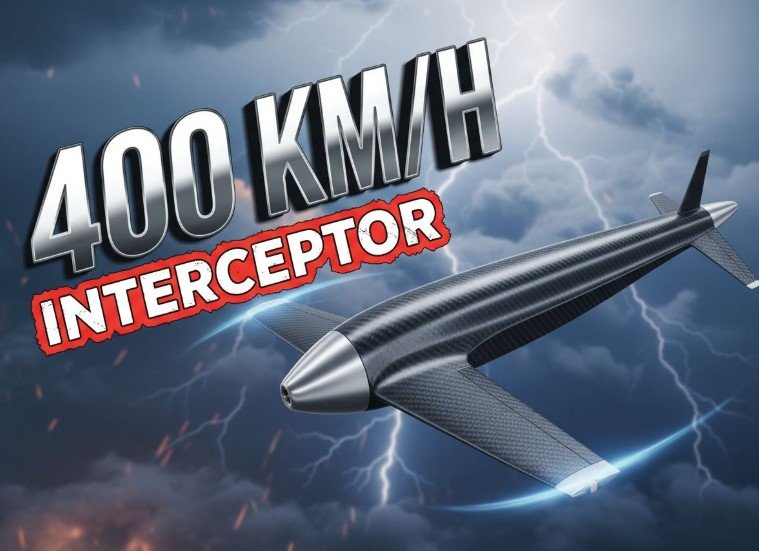
military interceptor drone flying over ukraine skyline at high speed
Why Speed Is The New Armor In Drone Warfare
You might wonder why engineers are obsessed with speed rather than just adding more explosives. The answer lies in the changing tactics of the enemy.
Speed is now the single most critical factor in reducing reaction times and saving lives on the ground.
Slow drones are easy targets. Fast drones are survivors. More importantly, fast drones are hunters. Russia has deployed faster aerial weapons that traditional quadcopters cannot intercept.
Recent data paints a concerning picture of the air defense landscape. A report from ABC News highlighted a drop in interception success rates. The data indicates that in October 2025, Ukrainian forces neutralized only 4,242 out of 5,312 incoming threats. This was recorded as the lowest success figure for that year.
Defense analysts point to a specific cause for this decline. The sheer volume of enemy drones is increasing. Simultaneously, these enemy drones are flying faster and maneuvering more aggressively.
Deploying a million-dollar missile to shoot down a cheap drone is not a sustainable financial strategy for any nation.
Ukraine needs a cost-effective solution. This high-speed interceptor fills that gap. It can engage targets without costing the military millions in advanced rocketry.
Neutralizing The Threat Of Russian Jet Drones
The battlefield has shifted away from slow-moving loitering munitions. The enemy is now prioritizing velocity.
Reports indicate that Russia has integrated jet-powered drones into their arsenal. These include the Shahed-238. This specific variant utilizes a jet engine rather than a propeller. It moves significantly faster than its predecessors.
Standard drones flying at 60 or 70 mph are useless against a target moving at over 200 mph. You cannot catch what you cannot reach.
- The Tactical Advantage: The new Motor-G drone flies at roughly 248 mph.
- The Target: The Shahed-238 and Germany’s Geran-3 cruise around 230 mph.
- The Result: Ukraine now possesses the kinetic capability to intercept and destroy these threats before they strike infrastructure.
Bloomberg reports suggest that these interceptors can immobilize machinery worth millions. The math works in Ukraine’s favor.
This new drone effectively negates the speed advantage that Russian forces recently gained with their jet-powered upgrades.
The Associated Press also notes that Russian tactics now involve flying at higher altitudes. This requires interceptors that can climb fast and strike hard. The Brave1 initiative is directly addressing this evolving threat vector.
Brave1 Platform Drives Local Defense Innovation
This development highlights a crucial strategic pivot for Ukraine. The country is moving away from total reliance on foreign aid for hardware.
Brave1 acts as a catalyst for this change. It connects the military with private sector engineers. Motor-G is a prime example of this synergy. By producing engines locally, Ukraine reduces supply chain vulnerabilities.
We are witnessing a shift where software and engineering speed determine the victor.
“The war has shown that innovation must happen in days, not years. If we do not innovate, we lose the advantage,” a defense insider noted regarding the Brave1 initiative.
The goal is clear. Ukraine aims to create an autonomous shield. This shield must be faster, smarter, and cheaper than the missiles trying to penetrate it. The 400 km/h drone is the first real step toward a hypersonic future for small-scale unmanned systems.
It is no longer just about flying. It is about outrunning the enemy.
The introduction of the Motor-G powered interceptor represents a significant milestone in modern aerial combat. It balances the equation against high-speed Russian threats and offers a financially viable alternative to expensive missile defense systems. As the conflict enters this high-velocity phase, the ability to intercept threats at 248 mph may very well determine the safety of Ukrainian cities in the coming months.


Capital Clusters and the Dual Tracks of European Tech Finance

Microsoft Shrinks Windows 11 Memory for 8GB PCs

XRP Ledger Brings Back Bugged Features Fixed for Institutions

The Shards Trailer Turns Ellis Nightmare Into Murphy Glamour

WhatsApp Folder Hides Business Messages After Hours

Mova LiDAX Ultra 3000 AWD Cracks the Robot Mower Moat

Urban Arrow FamilyNext Turns Costco Runs Into Bike Trips

Reddit Builds Spoken Video Layer to Reclaim Its Own Viral Stories

Nuggit £5m Fund Treats YouTube Channels as Real Businesses

Galaxy Z Fold 8 Makes Foldables Daily Drivers but Drops Flex Mode

CLARITY Act Final Text Expected This Weekend as 60-Vote Hurdle Looms

Kalshi Loses Major NY Prediction Markets Ruling to Judge Torres

Fed Minutes Cite AI Demand as Inflation Risk, Put a 2026 Hike Back on the Map

Marker AI Writing Startup Lands $13M Seed Led by Index Ventures

Dota 2 Esports World Cup 2026: Spirit Defends $2M Title In Paris

Meta’s Muse Spark 1.1 Beats Rivals on Price, Trails on Coding

CS2 Premier Season 5 Lands With Cache and a C4 Damage Rework

ARC Intelligence Closes €4M Seed Round in Roughly a Week

Finto Picks Munich Over Silicon Valley After YC, Raises $3.4M

Backrooms Returns to Theaters as the Everything Must Go Edition
-
 FINANCE2 months ago
Zcash Patched a Double-Spend Bug as ZEC Climbed 5%
-
 ENTERTAINMENT2 months ago
Steam Summer Sale 2026 Locks In June 25 to July 9 Dates
-
 FINANCE4 weeks ago
CLARITY Act Final Text Expected This Weekend as 60-Vote Hurdle Looms
-
 NEWS3 months ago
Meta Adds AI Replies to Threads, But Users Can’t Block It
-
 ENTERTAINMENT2 months ago
‘Widow’s Bay’ Review: Apple TV’s Sleeper Horror-Comedy Earns Its Fog
-
 NEWS5 months ago
U.S. Navy Deploys Solar-Powered Lightfish Drone to Patrol Oceans
-
 NEWS8 months ago
FolderFresh Review: This Free Tool Automates Windows File Organizing
-
 FINANCE4 weeks ago
Kalshi Loses Major NY Prediction Markets Ruling to Judge Torres