
NEWS
London’s First Autonomous Uber Rides Still Carry a Driver
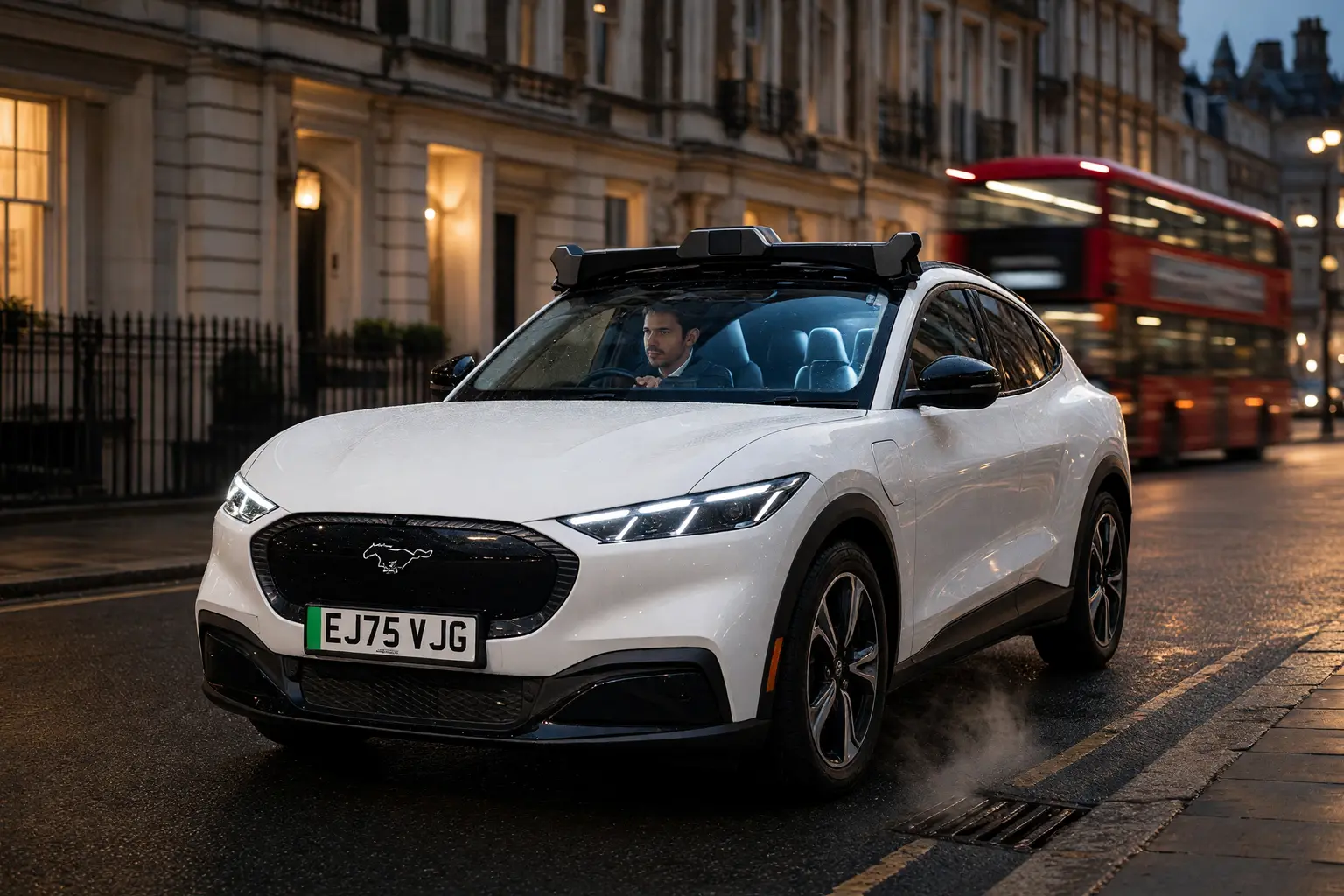
Uber and Wayve opened London autonomous rides on September 3, 2026, in 15 licensed Mach-Es that still carry a TfL private-hire driver.

Uber and Wayve opened supervised autonomous rides in London on September 3, 2026, with a licensed private-hire driver still in every car. Riders who request UberX, Uber Electric or Uber Comfort can be matched with a Wayve-powered Ford Mustang Mach-E at the normal fare, shown before they accept.
The fleet is 15 licensed cars. Airports are excluded. More than 140,000 people have already opted in through Trip Preferences, which is the gap between a historic label and a product you can actually hail.
London’s First Autonomous Uber Still Needs a Licensed Driver
Wayve, founded and based in London, trained this stack on the capital’s roads from 2018. The company calls the system an AI Driver and says it learns from experience rather than HD maps or hand-coded rules, which is why the cars are not limited to a geofenced pocket of the city.
The licence is still a private-hire licence. Transport for London granted those plates on August 5, 2026, 29 days before paying trips began, and the conditions keep a trained, TfL-licensed driver onboard to oversee the trip and take over if needed. Alex Kendall, Wayve’s chief executive and co-founder, called London one of the most complex driving environments in the world and said the public would see the AI Driver there first.
We’re proud to introduce the Wayve AI Driver to the public for the first time right here in London, our home city and one of the most complex driving environments in the world. Autonomous driving technology will complement the city’s rich transport network, and we’re excited for Londoners to experience it first as we begin our global rollout with Uber.
Alex Kendall, CEO and Co-founder, Wayve
Kendall also said the technology is still maturing and declined to date a service with no safety driver, saying he did not want to put a timeline on it. Sarfraz Maredia, Uber’s global head of autonomous mobility, called Wayve a homegrown British success story and said the launch would build credibility with riders and with government.
https://x.com/wayve_ai/status/2095406780364787937
Fifteen Mach-Es, No Airports and No Extra Fare
Each car is an all-electric Mustang Mach-E fitted with surround cameras and radar. Uber designed the cabin screen, which runs in 64 languages and shows the planned path. Riders unlock the doors and start the trip from the Uber app, and they can refuse the match and switch to a normal car before it arrives.
LONDON AT A GLANCE
- Licensed fleet: 15 Ford Mustang Mach-E cars hold TfL private-hire plates for this first phase.
- Waitlist: More than 140,000 Londoners have opted in under Trip Preferences, so a match is a lottery, not a default.
- Fare: There is no surcharge on UberX, Uber Electric or Uber Comfort when a Wayve car is offered.
- Map: Trips can run anywhere in London except airports, with no HD-map geofence.
Wayve will run the driving stack. A UK fleet partner will handle the trained safety drivers at launch, and Uber says it will later share day-to-day fleet work, including a London depot for charging and maintenance. Growth, the companies said, will follow demand, readiness and regulation, which is another way of saying 15 cars is the product until someone licences more.
THE RIDE, STEP BY STEP
- Opt in: Turn on the preference in the Uber app if you want a higher chance of a Wayve match.
- Get offered: A Wayve car can appear on UberX, Uber Electric or Uber Comfort at the same upfront price.
- Accept or switch: You can decline the autonomous car before it arrives and take a normal trip instead.
- Start from the phone: Unlock and begin from the app, then follow the route on the 64-language cabin screen.
- Keep a human: A TfL-licensed private-hire driver stays in the front seat for this phase and can take the wheel.
Heidi Alexander, the transport secretary, called the launch a milestone for British innovation and said people working in the sector now would still have a role as the tech develops. Jonathan Reynolds, the business secretary, said riders would be stepping into homegrown British AI. Both statements treat the cars as the future arriving. The plates treat them as minicabs with extra sensors.
The Empty Seat Needs a Different Permit
The United Kingdom already wrote a path for cars that drive with nobody monitoring from the cabin. Department for Transport guidance published on March 31, 2026, sets out a self-driving pilot for automated vehicle technologies used without a safety driver. That route is distinct from trialling under the code of practice, which still requires a person who is ready, able and willing to resume control.
Wayve and Uber used the trial path. Their August statement said trips would run under the government’s AV trialling code and Uber’s TfL private-hire operator licence, completing the triple-lock requirement for Private Hire trips: operator, driver and vehicle licensed by the same authority. The AI Driver does the driving. The licensed human remains the person the private-hire rules can hold responsible.
A separate automated passenger service permit, issued through the Driver and Vehicle Standards Agency with TfL’s consent in London, is what would let a company carry paying passengers with an empty front seat. Section 83 of the Automated Vehicles Act 2024, in force from May 15, 2026, can disapply private hire vehicle rules for a permitted automated passenger service. TfL has said no operator has completed the first stage of that process for London and that it has received no APS applications. Full driverless approval is widely treated as unlikely in 2026.
That is why the UK’s first autonomous Uber can start collecting fares while the empty-seat law sits unused. A supervised private-hire car and a vehicle listed as driving itself are different legal products. Mixing them in the marketing is easy. Mixing them on the plate is not.
Private Hire Drivers Remain the Legal Drivers
GMB has been arguing this point since before the plates were issued. At the union’s congress in Blackpool on June 8, 2026, it warned that driverless taxis could cost 300,000 drivers their jobs and called for laws to protect taxi and private-hire pay. Ali Haydor, a private-hire driver and GMB congress delegate, put the risk on workers rather than on the stack.
The gig economy firms present driverless taxis as progress – they tell us this technology will increase efficiency, reduce costs and benefit society, but progress for whom? Technology will continue to develop, but workers should not be expected to carry all the risks while companies take all the rewards.
Ali Haydor, private hire driver and GMB Congress delegate, GMB Congress, Blackpool
David McMullen, a GMB senior organiser, said after the launch that with hundreds of thousands of people employed to drive every day, the country needed to be careful with a driverless rollout unless it was prepared for social and economic disruption. He said it was premature to move to driverless services until TfL and government had a plan that protects drivers. The union has asked operators to draw existing drivers into cleaning, charging and remote-ops roles rather than treating them as a cost to remove.
Maredia said Uber had heard drivers argue that London is too complex for this product to compete with them soon, and that the company wants a platform where human drivers and autonomous cars run together. Alexander’s line about people in the sector today is the political version of the same promise. For now the promise is literal: the safety case is a licensed driver, paid to sit in a car that is supposed to drive itself, and to take the blame if the private-hire rules need a name.
Haydor’s own post on the morning of the launch repeated the 15-car tally and the human in the front seat, which is the detail the waitlist of more than 140,000 people will actually meet. A supervised British stack can collect fares on Uber because it stayed inside private-hire law. Consumer driver-assist systems that still need a responsible human are in a different approval box, which is why one product can be sold as a robotaxi and another cannot.
Zagreb Already Sells a Similar Ride
London is the first UK city on Uber’s autonomous list. It is not Uber’s first European autonomous city. Verne, working with Pony.ai, opened a paid robotaxi service in Zagreb on April 8, 2026, and Uber added that service to its app on August 20. Those cars also carry a trained operator in the early phase. The difference is price, airports and honesty about scale.
HOW EUROPE’S FIRST WAVE COMPARES
| City | Stack | Onboard human | Airports | Launch size |
|---|---|---|---|---|
| London | Wayve AI Driver on Uber | TfL-licensed private-hire driver | No | 15 licensed Mach-Es, from September 3, 2026 |
| Zagreb | Pony.ai with Verne, later on Uber | Trained safety operator | Yes | 10 electric cars, from April 8, 2026, at €1.99 a trip in the promo window, 07:00 to 21:00 |
| Tallinn | Bliq, remote supervision | None in the cabin | Not a taxi app | About a dozen cars on public roads from May 2026, first EU empty-seat approval |
Zagreb’s promo fare was €1.99 a ride across a zone of about 90 square kilometres that includes the airport. London charges a normal Uber fare, covers the city, and still will not take you to Heathrow. Bliq, a German firm, took a different product to Estonia: cars with no one in the front seat, watched from a remote centre. Finland cleared Bliq in July 2026 only with a safety driver onboard for the first phase. The empty seat is already legal in one small EU capital. It is not what Uber is selling in London.
Verne also said it wants to drop the onboard operator when regulators allow it. That is the same sentence Wayve and Uber are using. Europe’s “first robotaxi” wave is a wave of supervised cars with a press release about the next permit.
Wayve Trained This Stack on London Streets
The technical claim is the part that is not a licence workaround. Wayve’s AV2.0 pitch is an end-to-end AI Driver that is meant to transfer across vehicles, sensors, weather and cities without rebuilding a map. The company says the stack has been tested in more than 500 cities. The cars use cameras and radar rather than a lidar dome, and the software is meant to be agnostic to the underlying vehicle, which is why a Mustang Mach-E in London can be followed by a Nissan LEAF in Tokyo later in 2026, using NVIDIA DRIVE Hyperion.
That design is also why Uber invested. The 2024 partnership put Wayve-powered vehicles on a plan for 12 markets, beginning with London. Wayve raised $1.2 billion in February 2026, with Microsoft, Nvidia and Uber among the backers, and in June it added a three-way exploration with Stellantis and Uber of Level 4 robotaxis. The London launch is the first time paying strangers sit in that stack. Eight years of test miles on the same streets does not, by itself, retire the person TfL still lists as the driver.
Sarah Gates, Wayve’s vice president of global affairs and assurance, said the August licence was a step toward safer, cleaner, quieter streets and that the company would keep working with regulators and the public. Annie Duvnjak, Uber’s global head of autonomous mobility operations, pointed at the interest list, which had already passed 100,000 in the eight weeks before the plates came through and now stands at more than 140,000. Interest is not the same as capacity. The AI may generalise. The depot does not, until more cars are licensed.
Twelve Markets, 15 Cities and a Human in the Seat
Uber’s wider bet is larger than 15 Mustangs. The company says it is on track to facilitate autonomous trips in as many as 15 cities globally by the end of 2026, and that by 2029 it intends to be the world’s largest facilitator of those trips. It already runs autonomous rides in US cities including Austin and Atlanta, lists more than 30 AV partners, and talks about a hybrid network in which robots and people share the same app. London is the British shop window for that network, and Tokyo is the next named Wayve stop, with Hinomaru Kotsu lined up to run the depot under Japanese taxi rules that still require an authorised operator.
FROM TEST MILES TO A PAYING UBER
- 2018: Wayve puts its first test vehicles on UK streets and begins training the stack in London.
- 2024: Uber invests and agrees to put Wayve-powered vehicles on its network in 12 markets, starting in London.
- February 2026: Wayve raises $1.2 billion as it shifts from proving the stack toward putting it in service.
- March 12, 2026: Wayve, Uber and Nissan sign a Tokyo robotaxi memorandum for a Nissan LEAF pilot later in 2026, still with a safety operator at first.
- March 31, 2026: The Department for Transport publishes the self-driving pilot scheme for vehicles that do not use a safety driver.
- May 15, 2026: Automated Vehicles Act powers that can set aside taxi and private-hire rules for a permitted automated passenger service come into force.
- August 5, 2026: TfL grants private-hire licences to Wayve’s Mustang Mach-Es, with a licensed driver still required.
- September 3, 2026: Paying supervised trips open on Uber in London, except to airports, in a 15-car fleet.
The sequence is a company moving as fast as private-hire law allows, not as fast as its own AV2.0 brochure. Maredia’s credibility point is the honest one. Fifteen cars, a silent licensed driver, a 64-language screen and a waitlist of more than 140,000 people will teach Londoners what this product feels like, and will give ministers something British to point at. The empty front seat remains a different application, to a different agency, that nobody has filed for London.
Until that permit exists, the UK’s first autonomous Uber is a private-hire car that drives itself until it does not, on streets Wayve has been practising since 2018, at the same price as the human-only car you can still choose instead.


Nvidia Buys Hugging Face, the Platform That Turned It Down

OpenAI Names GPT-6 Astra AGI, Then Locks It Down

Relay Q Bets a $150 Puck Can Beat Dictation Apps

Accel Backs Atira to Automate Industrial Sales Engineering

Beyerdynamic Hides a Spare Battery in the Aventho Y

Lummis Pushes the CLARITY Act to Export Wyoming’s Crypto Banks

AI Exposure Turns a Cloud Beat Into a Selloff

Citadel’s XRP ETF Filing Looks Like Dealer Inventory

Revolut’s OCC Nod Starts an 18-Month US Bank Clock

British Business Bank’s Zinc Fund Will Mint 80 Startups

Walter’s TWG Insists No Fraud as Insurer Probes Force Cleanup

30-Year Yield Hits 5.32% Highest Since 2007 as Debt Supply Locks In Costs

PCE Stays at 3.7% as Gas and Tariffs Outrun Coming Revisions

Astute’s $1.2M bet makes B2B creator deals feed AI discovery

Strategy Parks $1.59B Cash While Bitcoin Stack Stays Flat

SpaceX Stock Rebound Tests Real Demand Before Huge Unlock

The 20% Savings Ideal Meets a 2.7% Reality Check

Monzo chair Gary Hoffman exits after board revolt fallout

Amber’s €7M locks Mittelstand knowledge inside Europe

AI data centers win as RAM kits jump nearly 500 percent
-
 FINANCE3 months ago
Zcash Patched a Double-Spend Bug as ZEC Climbed 5%
-
 ENTERTAINMENT3 months ago
Steam Summer Sale 2026 Locks In June 25 to July 9 Dates
-

 FINANCE2 months ago
CLARITY Act Final Text Expected This Weekend as 60-Vote Hurdle Looms
-
 NEWS4 months ago
Meta Adds AI Replies to Threads, But Users Can’t Block It
-

 NEWS3 months ago
YouTube Shorts is testing a heart in place of the thumbs-up
-

 NEWS1 month ago
Senators Force Apple Off Chinese Memory as Big Three Cash In
-

 NEWS3 months ago
NEURA Robotics’ $1.4B Series C Redraws Europe’s Physical AI Bet
-
 ENTERTAINMENT5 months ago
Extraction 3 Is Officially Coming to Netflix in 2027