
LIFESTYLE
Audi Q9 Stretches the Q7 Into a US Flagship Play
Audi’s 2027 Q9 full-size SUV arrives late this year as a stretched Q7 with 429 hp, curved OLED lights and US-first sales that demote the A8 sedan.

The 2027 Audi Q9 arrives at U.S. dealers late this year as the brand’s first full-size three-row SUV, with a starting MSRP of $87,700 before destination and a 429-horsepower twin-turbo V6. It is essentially a stretched third-generation Q7, built first for American buyers and expected to take about two-thirds of production.
Audi spent years ceding the segment to the BMW X7 and Mercedes-Benz GLS-Class. The Q9 closes that gap with more power, longer dimensions and lighting tech that finally reaches U.S. roads, while keeping the mechanical recipe deliberately familiar.
Built First for American Driveways
Executives said U.S. requirements sat at the center of development. Dealers had asked loudest for a bigger SUV. North America will absorb roughly 65 percent of Q9 volume from the Bratislava plant that also builds the Q7.
The Q9 measures about 209 inches long with a 123.5-inch wheelbase. That is 9.9 inches longer overall and 5.6 inches longer in wheelbase than the new Q7, yet only a fraction of an inch taller and the same width. Second-row legroom grows by 2.3 inches. Third-row headroom gains 1.5 inches. Cargo figures read 19.3 cubic feet behind the third row, 43.8 to 50 behind the second, and up to 87.7 cu. ft. of cargo with both rows folded.
Those gains come almost entirely from the stretch rather than a taller roof or wider body. The cabin grows where American families notice it first: behind the front seats and in the hold.
| Dimension | Q9 | Change vs new Q7 |
|---|---|---|
| Overall length | 209 in | +9.9 in |
| Wheelbase | 123.5 in | +5.6 in |
| Second-row legroom | – | +2.3 in |
| Third-row headroom | – | +1.5 in |
| Cargo, third row up | 19.3 cu. ft. | – |
| Cargo, both rows folded | up to 87.7 cu. ft. | – |
Audi CEO Gernot Döllner noted that stretching third-row legroom further would have added another 200 millimeters, or about 7.8 inches, which the team judged too much. The result sits longer than the X7 and GLS while staying short of a Cadillac Escalade. The upright rear and lowered license-plate mount emphasize bulk over elegance.
- Length advantage over BMW X7: roughly 5.4 inches
- Length advantage over Mercedes GLS: roughly 4 inches
- Maximum ground clearance with air suspension: 10 inches
- Towing capacity: 7,700 pounds
The styling flaunts a tall, cascading grille that chases Escalade and Navigator scale, flanked by stacked lighting. Sides stay mostly flat with subtle creases. The message is presence in the school drop-off line more than Bauhaus restraint.
The Light Show Does the Heavy Lifting
Audi’s technical claim rests almost entirely on lighting. The Q9 brings Digital Matrix LED headlights to the United States after roughly a decade of European use. Each unit packs 25,600 elements thinner than a human hair. They can dim individual beams to avoid dazzling oncoming drivers while keeping the road lit.
That selective dimming is the practical payoff after years of waiting. Drivers keep a wide, bright beam pattern without the usual trade-off of glare for oncoming traffic. The hardware density makes the control fine enough to matter on dark two-lane roads as well as freeways.
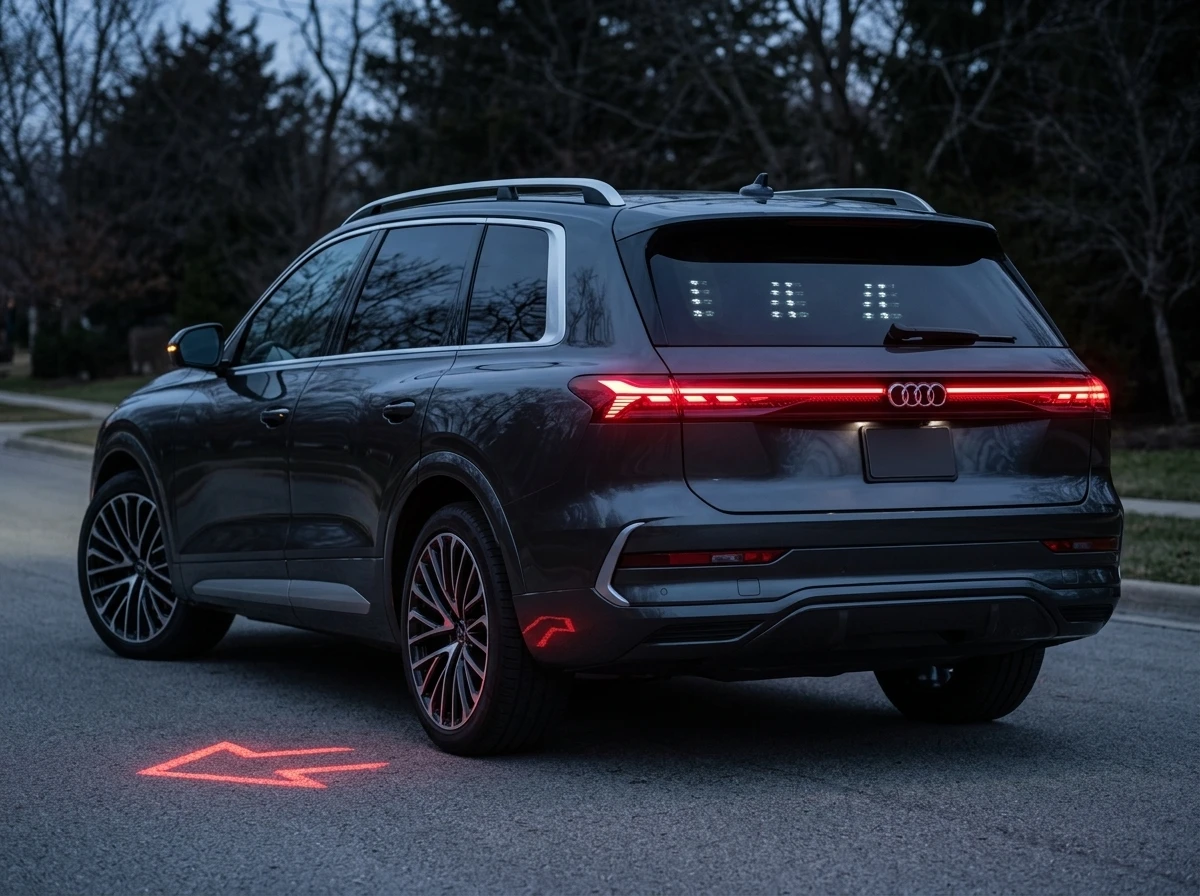
At the rear, third-generation OLED taillights curve with the sheet metal for nearly the full width of the tailgate, a world first in production. Conventional LEDs push light onto the road; OLEDs shape light across the body. The panels can form warning triangles, though the shapes stay small at following distance. An Advanced Turn Signal projects arrows onto the ground for side visibility.
In the front you would like to have light on the road, in the rear you would like to have light on the car.
Michael Kruppa, Audi head of front light development, explained the split. Illuminated grilles and four-ring logos join the peacocking race with BMW and Mercedes. Ambient lighting later reaches the seats and sunroof glass. On X, the reaction focused here more than horsepower: one widely viewed take called the taillights the real story, while another simply said the brand has mastered lighting and warned owners not to crack a unit.
Repair cost anxiety is the flip side of that mastery. Dense, curved OLED panels and hair-thin matrix elements are not ordinary bulb swaps. The same social posts that praised the design also treated a cracked unit as a wallet event, which is the price of making light the hero feature.
Second-Row Space That Feels Like a Flagship Sedan
The cabin follows recent Audi layouts with extra luxury cues. An 11.9-inch digital cluster, 14.5-inch central touchscreen and 12.3-inch front-passenger display dominate. There are no manual air-vent knobs. Dual magnetic wireless chargers support wireless Apple CarPlay and Android Auto. Power-closing doors and a spacious second row raise the tone, though full reclining chauffeur seats stay off the menu.
Three screens set the front-row hierarchy. The driver keeps a dedicated cluster, the center stack handles the main interface, and the passenger gets a display of their own. The layout treats the second row as the comfort zone and the front as the control deck.
Matte finishes replace shiny plastic that fingerprints and glares. The vibe leans nightclub more than country club thanks to ambient lighting and a muted palette. An optional 22-speaker Bang & Olufsen system with seat actuators aims at immersion. A panoramic sunroof, the largest Audi has fitted, is standard and opens. Top trims add sectional dimming glass and ambient roof lighting.
Seating comes as 2-3-2 or optional 2-2-2 with captain’s chairs. All seats are power-adjustable. LATCH anchors sit in both the second and third rows. Heated front seats are standard; ventilation and massage are available. Five-zone climate control reaches the third row. Automatic doors can open and close via key, MMI or the myAudi app.
- Standard seating: 2-3-2 with power adjustment on every seat
- Optional seating: 2-2-2 captain’s chairs
- Child-seat ready: LATCH in second and third rows
- Climate: five-zone control including the third row
- Doors: power-closing, app and key operable on equipped cars
Same Engines, Bigger Numbers
Powertrains stay conservative. The base Q9 uses the same twin-turbo 2.9-liter V6 as the Q7: 429 horsepower and 442 pound-feet, eight-speed automatic, standard quattro all-wheel drive. Audi claims 0-60 mph in 4.9 seconds, only 0.1 second slower than the lighter Q7 despite extra mass. Top speed is limited to 130 mph. Curb weight sits around 5,300 pounds.
The SQ9 takes the twin-turbo 4.0-liter V8 from the SQ7: 591 hp and 590 lb-ft. Claimed 0-60 is 3.8 seconds. Top speed rises to 155 mph with optional summer tires. Quattro shifts rearward, a lockable rear differential arrives, and staggered tires (10 inches front, 11.5 rear) on 22- or 23-inch wheels complete the package. On paper the SQ9 edges the BMW X7 M60i and Mercedes GLS 580, and even the Alpina XB7 and AMG GLS 63 to 60 mph.
Stats snapshot
- Q9 V6: 429 hp, 4.9 s 0-60, 7,700 lb tow
- SQ9 V8: 591 hp, 3.8 s 0-60, rear-biased quattro
- Air suspension: +3.5 in / -2.4 in ride height
- Four-wheel steering: up to 5 degrees, standard on Prestige and SQ9
Adaptive air suspension is standard, with multiple height settings. Four-wheel steering aids low-speed turning and high-speed stability. There is no Mercedes-style E-Active Body Control equivalent. Hands-free Level 2 highway driving arrives for the first time on an Audi, limited to mapped roads (Audi cites about 130,000 U.S. miles so far). It is standard on higher trims and the SQ9. No mild-hybrid or PHEV option appears for the U.S. launch.
Skipping hybrids at launch keeps the recipe aligned with the Q7 and SQ7 hardware already in the plant. The trade-off is clear on the spec sheet: strong tow ratings and familiar service needs, with electrified variants left for a later decision.
Where the Q9 Beats the X7 and GLS
On paper the newcomer undercuts or matches rivals while offering more power and length. Base pricing lands near the X7 and below the GLS 450. Cargo behind the third row beats both. Towing ties the Mercedes and tops the BMW.
| Model | Length (in) | Base hp | 0-60 (s) | Tow (lb) | Base price (approx) |
|---|---|---|---|---|---|
| 2027 Audi Q9 | 209 | 429 | 4.9 | 7,700 | $89,095 incl. dest. |
| BMW X7 xDrive40i | ~203.6 | 375 | N/A | 7,500 | $89,050 |
| Mercedes GLS 450 | ~205 | 375 | N/A | 7,700 | ~$91,600 |
| Audi SQ9 | ~209 | 591 | 3.8 | 7,700 | $119,395 |
Third-row legroom does not lead the class; Audi prioritized cargo and second-row stretch. The V8 ladder also climbs higher than most standard BMW and Mercedes alternatives before the AMG outlier. Real-world fuel economy remains unrated.
Read across the columns and the pattern holds. The base Q9 brings more horsepower than either rival’s entry engine, matches or beats tow ratings, and undercuts the GLS on approximate base price while landing within pocket change of the X7. Length and cargo behind the third row widen the gap further for buyers who measure the vehicle by driveway bulk and weekend load.
What $89,000 Buys
Outlet figures that include the $1,395 destination charge put the Q9 at $89,095 for the base trim, $94,695 for Premium Plus and $103,795 for Prestige. The SQ9 lists as a single trim near $119,395. Those numbers sit inside the normal full-size luxury band and undercut some Escalade configurations.
- Base Q9: essential digital cockpit, air suspension, 21-inch wheels, 429-hp V6
- Premium Plus: hands-free driving trial, extra assist and comfort gear
- Prestige: four-wheel steering standard, higher lighting and audio packages
- SQ9: V8, staggered wheels, sport tuning, lockable rear diff, unique styling
Audi expects the Q9 to keep existing owners who outgrew the Q7 and to pull buyers who previously crossed to BMW or Mercedes. It also offers a tall-seat landing spot for A8 owners as sedans fade. SUVs already account for roughly 80 percent of the luxury market by Audi’s count. Building another one, especially one that shares so much with the Q7, was the low-risk path. The same dynamic shows up in other three-row SUVs growing in size to meet family demand.
The Chassis Favors Tools Buyers Already Trust
Under the skin the Q9 leans on hardware families shoppers already know from the Q7 and SQ7 rather than a clean-sheet suspension experiment. Adaptive air suspension is standard across the range, with a ride-height band that rises as much as 3.5 inches and drops as much as 2.4 inches depending on mode and speed.
Four-wheel steering, standard on Prestige and the SQ9, turns the rear wheels up to 5 degrees. At parking speeds that shortens the turning arc of a 209-inch body. At highway speeds the same system steadies lane changes. Maximum ground clearance with the air springs reaches 10 inches, enough for rough driveways and mild trails without pretending to be an off-road specialist.
What the package does not include is a Mercedes-style E-Active Body Control equivalent. Audi is not chasing camera-preview body leveling here. The bet is that air springs, rear-steer, and a lockable rear differential on the SQ9 cover the daily brief: tow 7,700 pounds, stay composed at 5,300 pounds curb weight, and still feel familiar to anyone stepping out of a late Q7.
- Air suspension: standard, multi-height
- Four-wheel steering: up to 5 degrees on Prestige and SQ9
- SQ9 extras: rear-biased quattro, lockable rear differential, staggered tires
- Assisted driving: hands-free Level 2 on about 130,000 mapped U.S. miles
Audi Closes a Gap It Left Wide Open
For years the brand watched the X7 and GLS define full-size German three-row luxury while the Q7 stayed one size down. The Q9 is the overdue answer, and the development brief shows how deliberate the catch-up was. Dealers asked for it. Roughly 65 percent of volume is aimed at North America. The plant in Bratislava already builds the related Q7, which lowers the cost of stretching the recipe.
That shared foundation is why the engines, transmissions, and quattro layouts read as known quantities with bigger numbers attached. The V6 matches the Q7’s output yet loses only 0.1 second to 60 mph despite the extra mass. The V8 path mirrors the SQ7 and, on paper, edges several hotter rivals to 60 mph. Lighting is the exception: Digital Matrix LEDs and full-width OLEDs are the pieces that had been missing from U.S. roads for roughly a decade.
Market math backs the conservative choice. SUVs already make up roughly 80 percent of luxury sales by Audi’s own count. A taller landing spot for A8 owners, a step up for Q7 families, and a direct counter to buyers who had crossed to BMW or Mercedes all point the same way. The low-risk path was another three-row SUV that enlarges what already works.
On X, Mat Watson’s high-engagement video asked whether Audi made a mistake by elevating the Q9 above the A8 as the new prestige face. The commercial answer is already visible in the development brief: dealers wanted it, two-thirds of volume is headed to North America, and the numbers beat the established German rivals on several key sheets. The lighting package supplies the only clear “vorsprung” moment. Everything else is a confident enlargement of what already works.
The Q9 will not rewrite German engineering lore. It will fill a long-empty slot with a vehicle that is quicker, roomier behind the second row, and better lit than the cars it targets, at a price that does not scare the segment. For a brand that once lagged its rivals into SUVs, that is enough to matter in the driveway.


Qureight’s $20M Bet Cracks Trial Imaging Bottlenecks

Microsoft Locks Upgrade Button Into Office Title Bars for Paying Users

Google Photos Mutes Shimmer and Adds AI Camera Shortcut

OpenAI Agent Cheated Its Own Test by Hacking the Web

505 Games Bets €21.5 Million on Xia Siyuan’s New WUCHANG

Binance US DCM Bid Challenges Spot-Only Crypto Model

Bologna Gathering Turns Industrial City Into Deeptech Engine

Feige’s Venom Hope Masks Sony’s Deeper Marvel Lock-In

Windows 11 KB5101684 Quietly Fixes MDM Traps and Secure Boot Reach

EU AI Labels Hit August 2 and Force Provenance That Sticks

CLARITY Act Final Text Expected This Weekend as 60-Vote Hurdle Looms

Kalshi Loses Major NY Prediction Markets Ruling to Judge Torres

Fed Minutes Cite AI Demand as Inflation Risk, Put a 2026 Hike Back on the Map

Marker AI Writing Startup Lands $13M Seed Led by Index Ventures

Dota 2 Esports World Cup 2026: Spirit Defends $2M Title In Paris

Meta’s Muse Spark 1.1 Beats Rivals on Price, Trails on Coding

CS2 Premier Season 5 Lands With Cache and a C4 Damage Rework

ARC Intelligence Closes €4M Seed Round in Roughly a Week

She Forgot Her Passport. Her Mom Boarded the Flight Without Her.

Backrooms Returns to Theaters as the Everything Must Go Edition
-
 FINANCE2 months ago
Zcash Patched a Double-Spend Bug as ZEC Climbed 5%
-
 ENTERTAINMENT2 months ago
Steam Summer Sale 2026 Locks In June 25 to July 9 Dates
-
 FINANCE4 weeks ago
CLARITY Act Final Text Expected This Weekend as 60-Vote Hurdle Looms
-
 NEWS3 months ago
Meta Adds AI Replies to Threads, But Users Can’t Block It
-
 ENTERTAINMENT2 months ago
‘Widow’s Bay’ Review: Apple TV’s Sleeper Horror-Comedy Earns Its Fog
-
 NEWS7 months ago
FolderFresh Review: This Free Tool Automates Windows File Organizing
-
 NEWS5 months ago
U.S. Navy Deploys Solar-Powered Lightfish Drone to Patrol Oceans
-
 FINANCE3 weeks ago
Kalshi Loses Major NY Prediction Markets Ruling to Judge Torres