
ENTERTAINMENT
Disclosure Day Heads to Peacock After a Split Summer
Steven Spielberg’s Disclosure Day hits Peacock on October 9 after a $241.3 million run that critics liked and opening crowds graded a B.

Universal will stream Steven Spielberg’s Disclosure Day on Peacock on October 9. The film, once sold only as an unnamed Times Square board, has grossed $241.3 million worldwide.
That is the payoff on a $115 million original with no franchise, no title, and a four-word dare. Whether the dare was worth the drop that followed is the rest of the math.
Those Times Square Boards Were the Whole Pitch
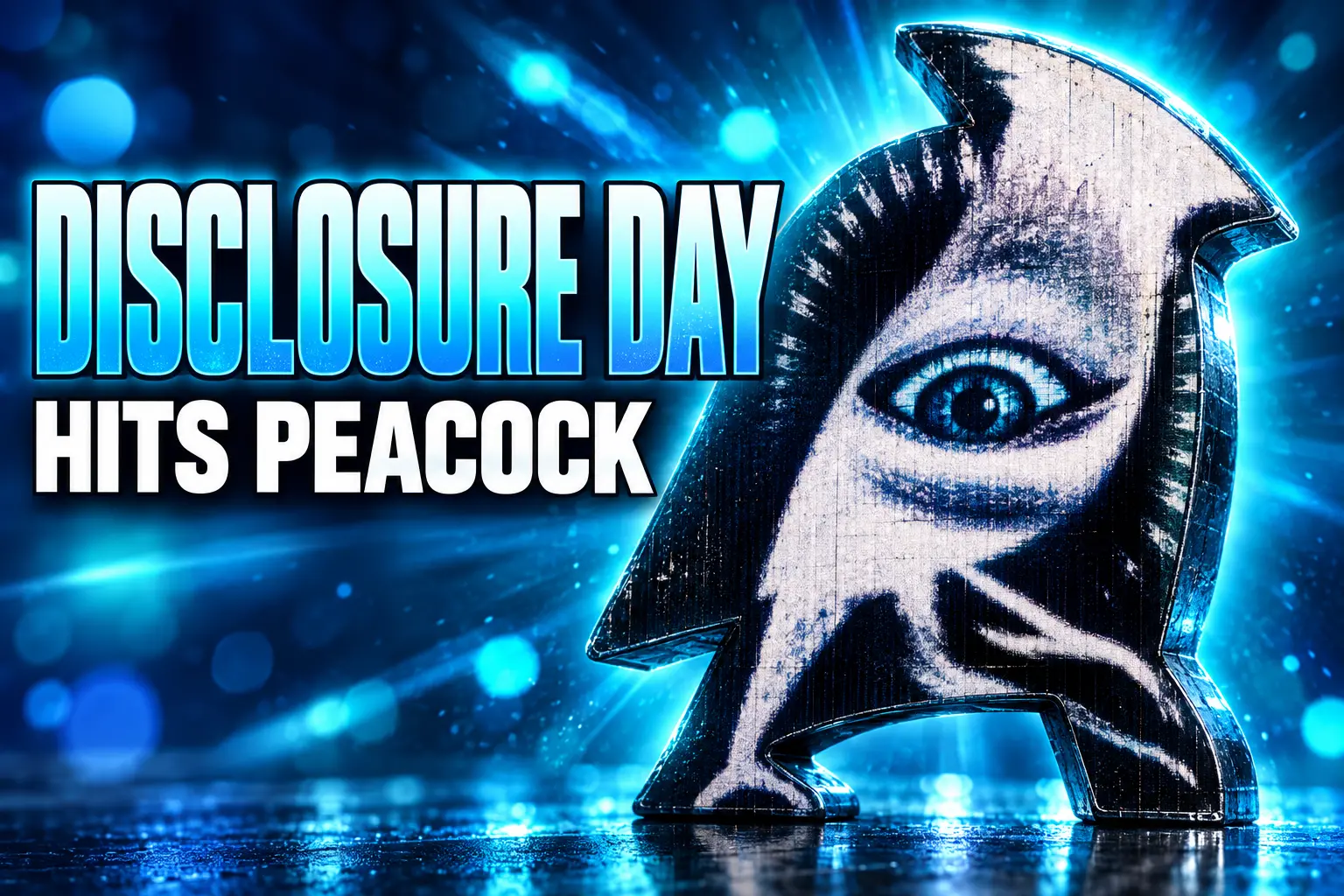
On December 10, 2025, electronic boards went up in New York and Los Angeles with Spielberg’s name, the date 6.12.26, and the line “All will be disclosed.” The image was an upside-down blue eye inside a bird silhouette, which some passersby read as a child’s eye and others as something not human.
Universal had not confirmed a title. The project was still “Untitled Steven Spielberg Project,” a UFO story written by David Koepp from Spielberg’s own outline, with Emily Blunt, Josh O’Connor, Wyatt Russell, Colin Firth, Colman Domingo, and Eve Hewson already attached. Six days later the studio named it.
A film by Steven Spielberg. Disclosure Day is in theaters 06.12.26. pic.twitter.com/ziKewjQLvF
— Universal Pictures (@UniversalPics) December 16, 2025
The same week, the December billboards in New York and Los Angeles did the work a conventional teaser poster usually does. They sold secrecy as the product. The film had already been shot, from February 26, 2025, to late May, under the working title Non-View, in New York and New Jersey.
FROM BOARD TO PEACOCK
- April 2024: Universal is named distributor of Spielberg’s original UFO story, with Koepp writing.
- December 10, 2025: Nameless boards appear with the June 12, 2026 date.
- December 16, 2025: The title Disclosure Day and a teaser land together.
- June 2, 2026: World premiere at Le Grand Rex in Paris.
- June 12, 2026: United States opening on 3,824 screens.
- October 9, 2026: Exclusive Peacock streaming date.
The original theatrical date had been May 15, 2026. Moving it a month put an original adult sci-fi thriller into the heart of summer, which is where the wager got expensive.
The $115 Million Original Nobody Would Title
Disclosure Day cost $115 million to produce and carries a PG-13 rating at 145 minutes. John Williams wrote the score, his 30th with Spielberg. Janusz Kamiński shot most of it on 35 mm Panavision anamorphic. Kristie Macosko Krieger produced with Spielberg for Amblin, and Universal released it.
THE BET ON PAPER
- The budget: $115 million, with no sequel hook and no toy line behind it.
- The opening: $44.5 million in the United States and Canada, plus a worldwide start of $93 million.
- The critics: 80% positive of 433 reviews on Rotten Tomatoes, average 7.2 out of 10.
- The grade: CinemaScore issued a B from opening-night audiences.
It is Spielberg’s highest-grossing film since Ready Player One, which did $607.9 million worldwide in 2018. It is also not that film. A 2.6-times domestic multiple on a $44.5 million open is respectable for an original and modest for a director whose name used to be the franchise.
In press, Spielberg described the leads as ordinary people. Emily, he said, “plays a weather lady in Kansas City” and Josh “plays a kind of whistleblower.” He has been circling the same public itch for decades: if someone already knows we are not alone, why has no one been told?
What Disclosure Day Is About
The official question on the poster is the whole pitch. “If you found out we weren’t alone, if someone showed you, proved it to you, would that frighten you?” Koepp and Spielberg built a 1970s-style chase around that fear rather than a new mothership landing.
Josh O’Connor is Dr. Daniel Kellner, a cybersecurity analyst who steals an extraterrestrial device and a cache of files called the Archive from his employer, the Wardex Corporation. Colin Firth is Noah Scanlon, the contractor’s chief, who wants the leak stopped. Eve Hewson is Jane Blankenship, Daniel’s girlfriend and a former novice. Colman Domingo is Hugo Wakefield, a Wardex defector who wants the files public.
Emily Blunt is Margaret Fairchild, a Kansas City television weather presenter. A cardinal flies into her house. She begins hearing thoughts and speaking languages she has never learned. On a live broadcast she slips into an unknown tongue, the clip spreads, and Wardex treats her as a problem to collect. Daniel hears the clip as if it were English.
That weathercast is the film’s cleanest Spielberg image: a person with a job, a camera, and a message she does not understand yet. Blunt performed the vocalizations in a single four-minute take. Kamiński later said about 90% of the freight-train escape was done live, including a real car hitting a real train on the Cape May Seashore Lines in southern New Jersey.
WHO HOLDS THE SECRET
- Margaret Fairchild: Kansas City weather presenter whose on-air break becomes the leak the plot runs on.
- Daniel Kellner: Wardex analyst who steals the Archive and an extraterrestrial device.
- Noah Scanlon: Wardex chief trying to keep decades of contact off the air.
- Hugo Wakefield: Former director of biological assets, now pushing for a broadcast.
- Jane Blankenship: Daniel’s partner, pulled from a convent hideout into the chase.
Wyatt Russell plays Jackson, Margaret’s boyfriend. Henry Lloyd-Hughes is Casper Boyd, Scanlon’s head of security, and drove the car that hits the train himself. The film is not a sequel to Close Encounters of the Third Kind. Blunt has said there are “definitely questions posed by Close Encounters that are answered in Disclosure Day,” which is a thematic claim, not a shared plot.
He has been in this territory since 1977, and the Close Encounters special edition recut still shapes how that first contact is remembered. Disclosure Day answers with a contractor, a satellite feed, and a newsroom instead of a mountain and a five-note theme.
Koepp Wrote 42 Drafts Because Spielberg Had Been Here Before
Spielberg spent the summer of 2023 on the story after the 2017 Pentagon reporting on a secret U.S. UFO program had pulled the subject back into the papers. He sent Koepp a 38-page attachment. Koepp thought he was being asked for notes. Then Spielberg asked if he wanted to write it.
They had already done Jurassic Park, The Lost World, War of the Worlds, and Indiana Jones and the Kingdom of the Crystal Skull. Koepp still set a personal record: 42 drafts, counting Writers Guild revision sets through goldenrod pages, over about two years. The bones of the outline did not change. The calibration did.
He was more exacting than I’ve ever seen him because he knows he’s worked in this area before. He wants this one to be the best one.
David Koepp, screenwriter
Spielberg, in an email, called Koepp a collaborator who “listens as much to me as I do to him,” and who will rework pages “including and often through principal photography.” Koepp kept the word “alien” out of the script on purpose. He said it carries an immigration meaning he did not want hanging off a movie about non-human biologics, biological life forms, extraterrestrials.
Asked if he believes, Koepp did not sell a saucer. “I think they’re out there. I think maybe we’re looking for the wrong things.” He talked about the narrow band of light human eyes can see, and about beings that might already be here in a form our senses miss. That is the film’s wager inside the studio’s wager: make a chase about proof, and let the audience argue what the proof is.
The Opening Weekend Looked Like a Hit
Thursday previews took $6.5 million. Friday, including those previews, did $19.2 million. The three-day domestic total was $44.5 million from 3,824 theaters, enough for No. 1, ahead of a $35 million tracking line and inside a $40 million to $50 million band some desks had floated.
THE FIRST THREE WEEKENDS, DOMESTIC
| Weekend | Dates | 3-day gross | Change | Running total |
|---|---|---|---|---|
| 1 | June 12-14 | $44.5 million | – | $44.5 million |
| 2 | June 19-21 | $17.7 million | -60% | $79.0 million |
| 3 | June 26-28 | $8.25 million | -53% | $94.5 million |
Overseas added about $49 million in the first frame from 73 markets, for a worldwide start of $93 million. Discussing the film as an original, that opening is the largest of Spielberg’s career in that category, above Ready Player One’s $41.7 million domestic start in 2018.
The first two weeks worldwide reached $161 million, more than West Side Story ($76 million) and The Fabelmans ($45.6 million) took in their entire runs combined. Then the second weekend fell 60%, and the argument shifted from “he’s back” to “how much back.”
Why the Second Weekend Fell 60%
A 60% drop is what a big name buys when the movie itself does not become the conversation. CinemaScore’s B sat next to strong reviews and told exhibitors the same thing the receipts did: plenty of people showed up, fewer insisted their friends go.
Rotten Tomatoes locked at 80% of 433 reviews. The critics’ consensus calls it “a humanistic variation on one of Steven Spielberg’s most revisited themes” whose “breathless pursuit of optimism in an age of conspiracy gets its biggest boost from career-highlight work by Emily Blunt.” Metacritic’s weighted score is 74 out of 100 from 63 critics. One camp treated it as a 1970s paranoia picture that still moves like a director in full command. Another wanted the awe of Close Encounters and got a contractor with a teleporting gadget instead.
WHERE THE VERDICTS SPLIT
- The reviews: 80% on Rotten Tomatoes and a 74 Metacritic, with Blunt’s work as the consistent praise line.
- The audience grade: a B from CinemaScore, which matched the steep second weekend better than the raves did.
- The disclosure crowd: some treated the marketing as a soft launch for real UAP news; others waved it off as entertainment dressed as prophecy.
Universal had walked the film into a culture already fighting about Pentagon hearings, whistleblowers, and “non-human biologics.” The official Disclosure Day trailer leaned on that weather, with Blunt’s broadcast breaking into clicks and crop circles drawing themselves. On the press tour Spielberg asked whether God is God only on this planet, or a God for every system that has civilization. The clip spread faster than the plot. Replies were mostly a shrug: a movie was not going to undo anyone’s faith.
That is the second-order cost of selling disclosure. The people who already believe do not need a PG-13 chase, and the people who do not believe do not change their minds in 145 minutes. Williams, for his part, wrote what Spielberg called the most restrained score of their work together, “at least until it is not,” accompanying the picture from slightly behind it. About 82 minutes of music sit in the cut. The album, on Back Lot Music, is 64 minutes 40 seconds.
Peacock Gets Disclosure Day on October 9
Box Office Mojo’s audited tally is $241.3 million worldwide, with $116.6 million domestic (48.3%) and $124.7 million international (51.7%). The domestic run was essentially done by early August. Digital and VOD arrived July 21. The 4K Ultra HD, Blu-ray, and DVD street date was August 25.
The next window is subscription. Disclosure Day begins streaming on Peacock on October 9, exclusive to the service, four months after the Paris premiere. For a $115 million original that opened like a hit and aged like a well-reviewed adult thriller, that date is where the rest of the bet lands: living rooms, not 3,824 screens.
The boards in December promised that all would be disclosed on June 12. The movie disclosed a title, a contractor, a weathercast, and a $241.3 million gross. The Archive, such as it is, goes to Peacock on October 9.
Frequently Asked Questions
Is Disclosure Day a sequel to Close Encounters of the Third Kind?
No. Universal and Amblin have not tied the plots together, and the new film’s contractor-and-newsroom structure does not continue Roy Neary’s story. Emily Blunt has said Close Encounters posed questions that Disclosure Day answers, which she framed as theme, not continuity.
What was Disclosure Day’s working title during filming?
Production used the title Non-View. Extra casting calls in early 2025 asked for wrestling fans in Huntington, Long Island, diner patrons in the Hudson Valley, and drivers with their own cars in Middlesex County, New Jersey, which is how a UFO thriller filled out its American crowd scenes.
Who composed the music for Disclosure Day?
John Williams, in his 30th score for Spielberg, recorded seven sessions at Sony’s scoring stage in Culver City between September 11, 2025, and February 20, 2026, with the Hollywood Studio Symphony. He held the first date in the newly renamed John Williams Music Building, and no picture was projected for the players so the then-secret footage would not leak.
When and where was Disclosure Day filmed?
Cameras rolled from February 26, 2025, to late May, with studio work at Steiner Studios in the Brooklyn Navy Yard and locations that included Montville and Jersey City in New Jersey, 30 Rockefeller Plaza’s newsroom, a convent exterior in Mendham Township, and Canon’s Melville headquarters standing in for Wardex.
What does Wardex stand for in Disclosure Day?
Wardex is the film’s secretive U.S. government contractor, and the name expands to Waived Reporting, Development, and Extraction. A supporting defector, Nathan Twinning, is named as a nod to the 1947 Twining memo on flying discs.

UPI MDR Delay Hands Traders the Calendar After Paytm Falls

Google Messages Builds Nine In-Chat Games After Samsung’s Exit

Anthropic’s $100 Million Academy Trains the Firms That Bill Both Sides

Toyota’s Electric C-HR Leaves the Cheap Twin to Subaru

Markets Bet the Fed Skips October After Hawkish Minutes

The Orchard Bug Forced Zcash to Open an Empty Pool

The $5.99 Game That Won Steam’s 2026 Summer Sale

Don Lee Joins Hemsworth as Extraction 3 Starts Shooting

YouTube Shorts Retires Dislikes and Swaps Likes for Hearts

NEURA Robotics Is Spending Its $1.4B on a Machine Stack
-
 NEWS4 months ago
The Orchard Bug Forced Zcash to Open an Empty Pool
-
 GAMING4 months ago
The $5.99 Game That Won Steam’s 2026 Summer Sale
-
 ENTERTAINMENT6 months ago
Don Lee Joins Hemsworth as Extraction 3 Starts Shooting
-
 NEWS4 months ago
YouTube Shorts Retires Dislikes and Swaps Likes for Hearts
-
 NEWS4 months ago
NEURA Robotics Is Spending Its $1.4B on a Machine Stack
-

 AUTO6 months ago
Kawasaki Bets the New Z1100 Against Its Own Supercharger
-

 BUSINESS5 months ago
Norway’s Export Bank Backs Nscale’s $790 Million Narvik Loan
-

 GAMING4 months ago
Game of Thrones Dragonfire Follows Boston’s Conquest Playbook