
NEWS
California’s Battery Fee Taxes Coffee Makers, Skips Vapes
Since January 1, 2026, California has charged 1.5% on sealed-battery products, including coffee makers, while disposable vapes remain outside the fee.

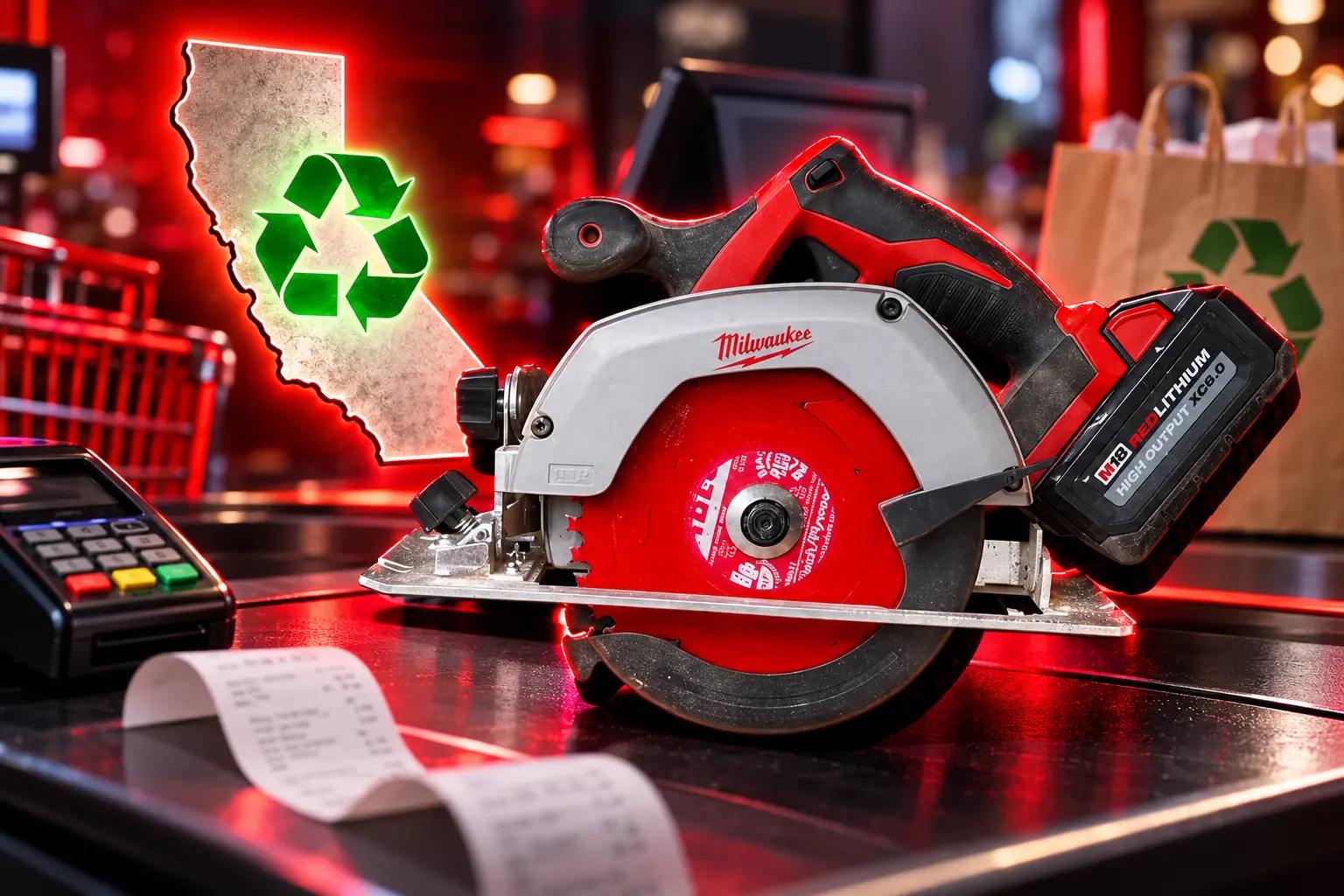
California has charged a 1.5% recycling fee, capped at $15, on products with sealed batteries since January 1, 2026. The surcharge hits power tools, game consoles, and even singing greeting cards at the register. It does not hit disposable nicotine vapes, the lithium devices waste crews say ignite in trucks and sorting plants.
The charge expands a 2003 program built for TVs and computer monitors. Manufacturer notices now fill a list of about 29,000 products, including coffee makers and guitars. CalRecycle says it will not post battery-embedded collection data until 2027.
California Shoppers Already Pay the 1.5% Battery Fee
Senate Bill 1215, written by then-Sen. Josh Newman (D, parts of Los Angeles and San Bernardino) and signed in 2022 as Chapter 370, folded sealed-battery goods into the Covered Electronic Waste Recycling Program. CalRecycle Director Heller approved the rate on September 16, 2025. On January 1, 2026, retailers had to start collecting it.
The Department of Tax and Fee Administration tells retailers to take 1.5 percent of the retail sales price on each new or refurbished covered item, and to stop at $15. A $1,000 product hits that cap on the nose. Marketplace sites that sell into the state have to collect it too. A retailer may keep 3% of what it takes in, as pay for the extra line on the receipt.
THE FEE AT THE REGISTER
- The rate: 1.5% of the retail sales price, with a $15 ceiling on each item.
- The start date: January 1, 2026, for new and refurbished goods sold for use in California.
- The first return: January 1 through March 31, 2026, due April 30, 2026.
- The late hit: 10% of the unpaid fee, plus interest.
Claims for recycling payments on this waste opened April 1, 2026. Makers had to send retailers and CalRecycle an annual notice of covered and exempt goods by July 1, 2025. Products sold in the state must carry the maker’s name or brand, plus the battery chemistry on the label or on the maker’s website. Annual maker reports to CalRecycle are due on or before July 1, 2027. The agency may split the fee into product categories beginning August 1, 2028.
CDTFA spent the spring reminding shops that the first return was not optional, even on a zero quarter.
California introduced a "battery recycling fee" this year that works as a sales tax (~1.5% of net sales value) for any item with batteries.
I am a contractor for one of the 5 largest watchmakers in the world, that was a month long project involving half dozen consultants…
1/2 pic.twitter.com/Z7RjMc47pm
— Nacho Oliveras (@NachoOliveras) April 10, 2026
For companies that never thought of themselves as e-waste brands, the hard part is the catalog, not the math. A contractor for a large watchmaker described a month of work and a half-dozen consultants to decide which sealed-cell SKUs owe the surcharge. Appliance and tool lines have the same mapping problem, because the test is whether a buyer can pop the cell with a Phillips screwdriver, a coin, or a hex key, not whether the box looks like a gadget.
The Spreadsheet Now Has 29,000 Products
CalRecycle will not say whether any given model is in or out. It posts two files built from maker notices, then warns that the files can list the wrong goods and still miss others. A KPMG tax note put those notices at about 29,000 products after the fee went live. The range runs far past phones and earbuds. It includes A/C units, ovens, stoves, microwaves, water heaters, washers, dryers, printers, scanners, guitars, baby monitors, game controllers, GPS units, and coffee makers.
A May 15, 2026 listserv added more names, among them FUJIFILM, Johnson Outdoors, Outward Hound, Piaggio Fast Forward, and Shinola Detroit. Absence from the sheet does not let a retailer skip the fee. Presence does not bind CalRecycle. The agency’s own decision tree is clearer on a few bright lines: a motorized scooter, skateboard, or hoverboard with a sealed pack is in. A TV already covered by the older screen fee is out of this one.
COVERED AND EXEMPT AT CHECKOUT
| Product | Checkout treatment |
|---|---|
| Sealed-battery tools, consoles, scooters, coffee makers, guitars | 1.5% fee, capped at $15 |
| TVs and other video display devices | Older $4, $5, or $6 screen fee, not this surcharge |
| Disposable nicotine vapes | Left out of the fee by statute |
| Certain medical devices | Left out |
| Certain energy storage systems | Left out |
| Loose cells (AA, tool packs you can swap) | Separate producer law, not this fee |
In 2025 CalRecycle left those screen fees at $4, $5, and $6. As of June 2025 the older program had 291 approved collectors and 21 approved recyclers. That network is now the pickup spine for sealed-battery waste, which is how a 2003 TV law became a surcharge on a greeting card that sings.
What the Fee Leaves Out
The statute that defines a covered battery-embedded product also carves it up. CalRecycle’s covered battery-embedded products program lists four exclusions: certain medical devices, video display devices already in the old program, certain energy storage systems, and electronic nicotine delivery systems.
FOUR STATUTORY EXCLUSIONS
- Medical devices: Class II and III devices, plus some Class I gear used or prescribed in care settings.
- Video displays: Screens that already pay the $4 to $6 e-waste fee.
- Energy storage systems: Stationary packs defined in the Public Utilities Code, not a handheld drill.
- Nicotine vapes: E-cigarettes and vape pens, left out after the Department of Toxic Substances Control flagged nicotine as a hazardous substance that collection systems were not built to handle.
Nick Lapis, an advocate at Californians Against Waste, which co-sponsored SB 1215, has said the skip matters because these devices are the fastest-growing lithium-ion trash stream. “If you imagine somebody’s a pack a day smoker, that means every single day they’re throwing out a device with a lithium-ion battery,” Lapis said.
Joe La Mariana, executive director of RethinkWaste, which runs waste service for 12 San Mateo County cities and co-sponsored the 2022 bill, put the same problem in plainer terms when the Legislature later moved a vape ban. Disposable vapes hold lithium-ion cells that cannot be removed, he said, and when they are struck or crushed they start fires in garbage trucks and sorting plants, with the bill passed to ratepayers.
Loose batteries sit on a third track. Assembly Bill 2440, the Responsible Battery Recycling Act of 2022, puts producers on a stewardship plan due April 1, 2027, and repeals the older retailer take-back law on January 1, 2027. Retailers with five or more stores are supposed to serve as drop-off sites. The checkout fee on a sealed coffee maker does not pay for that pile.
After the Shoreway Fire Cost $8.5 Million
The political case for the fee was never a greeting card. It was a plant fire. In 2016 a lithium-ion cell ignited at the Shoreway Environmental Center in San Carlos. The blaze shut the plant for four months and did $8.5 million in damage. RethinkWaste oversees the site. La Mariana said its insurance premium jumped from $180,000 to $3.2 million a year, and the 430,000 ratepayers who own the place paid for that.
“These things are everywhere. They’re ubiquitous,” La Mariana said of sealed lithium products. On the Shoreway books he was blunter about duty. “Being a publicly owned facility, every bit of that property is owned and paid for by our 430,000 ratepayers,” he said. “So we have a fiduciary responsibility to maintain the integrity of these assets. But also, on a human level, we have a very high responsibility for the safety of our colleagues and our co-workers.”
Paying a small check-stand fee to fund proper collection is far cheaper than million-dollar fires, higher insurance premiums, and rate hikes passed back to communities.
Doug Kobold, executive director, California Product Stewardship Council
CalRecycle has estimated about 7,300 tons of batteries still reach landfills illegally or by accident. That figure is a landfill estimate for batteries as a class, not a count of lithium-ion cells pulled from the new fee. The Federal Aviation Administration has said U.S. flights see nearly two battery fires a week. Ryan Fogelman, a fire-prevention consultant at Fire Rover, counted 114 publicly reported incidents at U.S. and Canadian waste and recycling sites through May 2026, under the 430 he logged in 2024 and the 448 in 2025, and called that a new, higher baseline rather than a return to older years.
Large stationary packs are another fire, and another law. A January 2025 blaze at Vistra’s 300-megawatt Moss Landing storage site destroyed roughly 55,000 lithium-ion modules. By June 24, 2026, EPA crews had 33,943 intact batteries ready for recycling, with about 5,000 still in unsafe corners of the burned building. Those systems are excluded from the checkout fee. New CalFire storage rules were set to take effect in 2026.
Recycled Lithium Weight Fell Before Collection Began
The state already tries to count rechargeable cells that come back through handlers. DTSC posts voluntary figures from major recyclers each year. In 2025 those recyclers reported 402,007 pounds of lithium ion batteries, down 31.5% from 586,990 pounds in 2024. DTSC said it checked with the recyclers and that the drop is real. The agency also notes the series is leaky: some handlers do not track the state of origin, cells still inside phones and laptops are often not counted, and California does not require a weight report.
LITHIUM-ION POUNDS RECYCLED IN CALIFORNIA
| Year | Li-ion pounds (DTSC) |
|---|---|
| 2021 | 308,578 |
| 2022 | 348,161 |
| 2023 | 453,357 |
| 2024 | 586,990 |
| 2025 | 402,007 |
Total rechargeable weight collapsed much harder, from 5,870,077 pounds in 2024 to 998,548 pounds in 2025, because small sealed lead-acid returns fell off a cliff. That is a different chemistry and a different story. The lithium-ion line is the one that tracks phones, tools, toys, and vapes, and it was already sliding in the last full year before SB 1215 started paying collectors.
Meg Slattery, a scientist at Earthjustice, has argued that disposal has to be designed in as California leaves fossil fuels. “The next question becomes … where are we sourcing materials, and thinking through what happens to this when we’re not using it anymore, which I think we’re not traditionally great at thinking about as a society,” she said.
Disposable Nicotine Vapes Wait on Newsom’s Desk
Assemblymember Jacqui Irwin (D-Thousand Oaks) spent 2025 and 2026 pushing a different tool than a fee: a ban. Assembly Bill 762 would bar the import or manufacture for sale of new or refurbished disposable, battery-embedded nicotine vapes beginning January 1, 2027, and bar sale, distribution, or offers for sale beginning January 1, 2028. A legal device would have to be rechargeable and either refillable or built for replaceable pods. Cannabis devices are exempt. Local and state officers could seize product, levy civil fines from $500 on a first violation up to $2,000 later, and add an infraction fine of up to $500.
The Senate passed the bill on August 25, 2026, 30-10. The Assembly concurred on August 26, 47-16. The enrolled bill was presented to Gov. Gavin Newsom at 4 p.m. on September 3, 2026. Irwin said she hoped he would “recognize the threat these devices pose to our communities and that the costs of cleaning up the mess these devices leave are borne by ratepayers.” CalPIRG has said 500,000 disposable vapes are thrown away every day in the United States.
FROM TV FEE TO VAPE BAN
- 2003: California starts an e-waste fee on TVs and computer monitors.
- 2016: A lithium-ion fire shuts Shoreway in San Carlos for four months and does $8.5 million in damage.
- 2022: Newsom signs SB 1215, adding sealed-battery products to the TV program, and AB 2440, a producer plan for loose cells.
- July 1, 2025: Makers must notice retailers and CalRecycle of covered and exempt goods.
- September 16, 2025: CalRecycle sets the sealed-battery fee at 1.5%, capped at $15.
- January 1, 2026: Shoppers start paying the fee. Claims open April 1. First retailer returns are due April 30.
- September 3, 2026: AB 762, a disposable nicotine vape ban, is presented to the governor. Cannabis devices stay out.
A sales ban would not pull the pens already in pockets, and it would not put cannabis disposables on a recycling fee either. Those cells would still meet the same compactors that chewed through Shoreway’s equipment. Until CalRecycle posts battery-embedded collection numbers in 2027, the only hard fact at the register is the line item: coffee makers and greeting cards can owe 1.5%, and a disposable nicotine vape still does not.

UPI MDR Delay Hands Traders the Calendar After Paytm Falls

Google Messages Builds Nine In-Chat Games After Samsung’s Exit

Anthropic’s $100 Million Academy Trains the Firms That Bill Both Sides

Toyota’s Electric C-HR Leaves the Cheap Twin to Subaru

Markets Bet the Fed Skips October After Hawkish Minutes

The Orchard Bug Forced Zcash to Open an Empty Pool

The $5.99 Game That Won Steam’s 2026 Summer Sale

Don Lee Joins Hemsworth as Extraction 3 Starts Shooting

YouTube Shorts Retires Dislikes and Swaps Likes for Hearts

NEURA Robotics Is Spending Its $1.4B on a Machine Stack
-
 NEWS5 months ago
The Orchard Bug Forced Zcash to Open an Empty Pool
-
 GAMING5 months ago
The $5.99 Game That Won Steam’s 2026 Summer Sale
-
 ENTERTAINMENT7 months ago
Don Lee Joins Hemsworth as Extraction 3 Starts Shooting
-
 NEWS4 months ago
YouTube Shorts Retires Dislikes and Swaps Likes for Hearts
-
 NEWS4 months ago
NEURA Robotics Is Spending Its $1.4B on a Machine Stack
-

 NEWS5 months ago
Atlantic City Turned WWE’s Return Into a Civic Night
-

 AUTO6 months ago
Kawasaki Bets the New Z1100 Against Its Own Supercharger
-

 BUSINESS5 months ago
Norway’s Export Bank Backs Nscale’s $790 Million Narvik Loan