
NEWS
Trump Sues California to Block 2035 EV Mandate and Gas Car Ban

The Trump administration has fired a major legal shot at California, filing a federal lawsuit to kill the state’s bold plan to end gasoline-powered car sales by 2035. The case pits Washington against Sacramento in a high-stakes battle over clean air, car prices, and who gets to decide what Americans drive. With gas prices soaring past $5 a gallon in the Golden State and tensions in the Middle East shaking global oil markets, the timing could not be more explosive.
What the Federal Lawsuit Actually Says
Attorney General Pamela Bondi and Transportation Secretary Sean P. Duffy announced on March 12, 2026, that the Justice Department, on behalf of the National Highway Traffic Safety Administration (NHTSA), filed suit to stop California from imposing what they call an “illegal electric vehicle mandate.”1
The suit argues that California’s regulations violate the Energy Policy and Conservation Act, a federal law that prohibits state mandates on fuel economy.2
At the heart of the case is a simple question: Can a state tell carmakers how fuel-efficient their vehicles must be, or does that power belong only to the federal government?
The DOJ says California’s scheme would force carmakers to “radically revamp their production lines nationwide” to meet standards more stringent than those set by NHTSA.1 The Trump administration created the “Freedom Means Affordable Cars” initiative, claiming it would save the American people $109 billion over the next five years and save families $1,000 on the average cost of a new vehicle.3
The legal core comes down to two main factors. First, the federal government argues California’s fleetwide CO2 limits are “effectively identical to a rule that limits fuel consumption.” Second, the lawsuit targets the state’s ZEV mandates, which require automakers to sell a certain percentage of zero-emission vehicles. For 2025, roughly 22 percent of cars sold by any automaker in California had to be ZEVs. The DOJ says this interferes with CAFE rules and forces EV sales.4
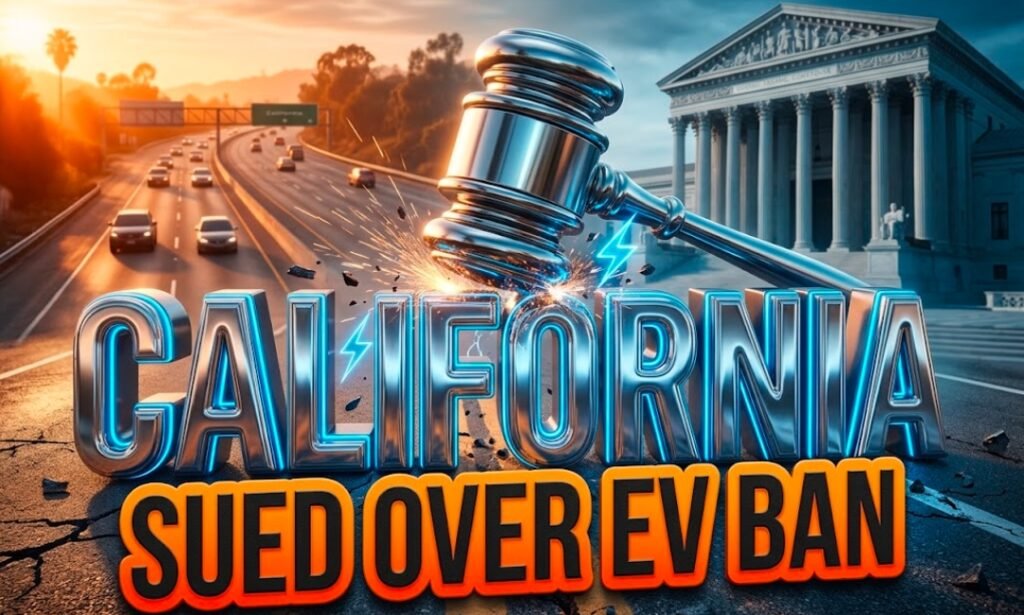
Trump administration federal lawsuit California EV mandate gas prices
What Is California’s EV Mandate?
The regulation, known as Advanced Clean Cars II, was adopted in 2022 by the California Air Resources Board and previously received federal approval during the Biden administration.5
Here is how the mandate phases in:
| Year | Zero-Emission Vehicle Sales Target |
|---|---|
| 2026 | 35% of new cars sold |
| 2030 | 68% of new cars sold |
| 2035 | 100% of new cars sold |
The rule aims to achieve a 25% reduction in smog-causing pollution from light-duty vehicles by 2037 and targets nearly $13 billion in cumulative avoided health impacts from 2026 through 2040.6 Those health benefits include fewer respiratory-related deaths, fewer hospital admissions, and fewer emergency room visits due to asthma.
This is not just a California issue. At least 17 other states, including New York, Colorado, Nevada, and Virginia, have adopted similar rules to the ones the DOJ is now targeting.4 Those states represent nearly 40% of the nation’s vehicle market.7
The outcome of this case could decide the future of EV policy across America.
Governor Newsom Fires Back at Trump
Newsom’s office called the lawsuit “meritless” and said the state would continue defending its climate policies. In a statement, the governor’s office argued the EV transition would reduce reliance on foreign oil and shield consumers from volatile global energy markets.5
Newsom’s spokesperson, Anthony Martinez, did not mince words.
“Gas prices are soaring nationwide because of Trump’s reckless choices, and now he’s attacking the Golden State for trying to give Californians more freedom and cheaper options.”8
California officials argue the state has long held the authority to adopt stricter emissions rules under the Clean Air Act. “We’ve been regulating tailpipe emissions since before the EPA existed,” said Democratic Assemblymember Isaac Bryan, chair of the Assembly Natural Resources Committee.5
The political backdrop here matters. Last May, the U.S. Senate voted 51 to 45 to block California’s initial law. In response, Governor Newsom signed an executive order the following month to continue the state’s EV initiative with various state-mandated fuel regulations.9 That executive order is what triggered this latest lawsuit from the Trump administration.
The California Energy Commission reported in January that more than 2.5 million zero-emission vehicles had been sold in California as of 2025.5 Newsom also outlined a $200 million EV incentive program targeting first-time EV buyers as a point-of-sale rebate.10
Gas Prices Are Crushing California Drivers
While the legal fight plays out in court, families across California are already feeling pain at the pump. The timing of this lawsuit has made gas prices a central talking point for both sides.
It cost Californians $5.37 a gallon on average on Thursday to fill up, according to the American Automobile Association. That compares with a national average of $3.60 per gallon.8
Key gas price facts right now:
- Los Angeles County leads the region with an average of $5.376 per gallon.11
- One LA station posted a staggering $8.21 per gallon for regular gas.12
- Gas prices have risen roughly 20% since the U.S. and Israel attacked Iran.8
- Global crude prices spiked past $110 a barrel, briefly climbing as high as $119.50, their highest levels since the pandemic.12
The surge is not coming from one single cause. The current spike is driven by a “perfect storm” of global and local factors. Internationally, the ongoing war with Iran has destabilized global energy markets, pushing crude oil toward $100 per barrel.11
But there is a local factor making things worse for California specifically. Skyrocketing prices are also due in large part to the closure of several refineries, notably Valero in Benicia and Phillips 66 in Los Angeles.13 Researchers at UC Davis found that by August 2026, when the full effect of those closures hits, California gas prices could rise by an additional $1.21 per gallon.14
Some analysts warn that regular gasoline prices in California could climb past $7 per gallon. Predictions from Polymarket suggest the national average could reach $5 by end of March, with California potentially rising to about $7.48 per gallon.13
What Happens Next and Why It Matters
This lawsuit is headed for what could be a long legal fight. If the challenge succeeds, the decision could reshape the U.S. automotive market.4
The case will likely be decided on a core constitutional question: does the federal government have exclusive power over fuel economy standards, or can states like California set their own path under the Clean Air Act?
If the court sides with the federal government, it could limit how aggressively states push EV adoption beyond federal standards. On the other hand, if California prevails, the divide between state and federal policy could widen even further.4
For everyday Americans, the stakes go beyond politics. Many obstacles still stand in the way of electrifying cars, including the need for more public fast chargers. State officials estimate California needs a million public charging stations in six years and 2.1 million by 2035.15
Meanwhile, observers note that EV technology is rapidly advancing, with China leading the way in fast-charging capabilities, while the U.S. risks falling behind in the electric vehicle market.16
Whether you drive a pickup truck, a sedan, or an electric car, this lawsuit will shape how much you pay for your next vehicle and how clean the air is that your kids breathe. California is not backing down, and the White House is not letting up. Somewhere in the middle, millions of drivers are just trying to afford their next tank of gas. Tell us what you think in the comments: should states be allowed to set their own emission rules, or should Washington call the shots for the entire country?


Blanche Fund Deal Clears Path as DOJ Power Decides CLARITY Fate

S26 FE Cases Repeat the Silver Frame Playbook From Last Year

One UI 9.5 Hits S27 Ultra Servers as Fold 8 Ships Its First Patch

Capital Clusters and the Dual Tracks of European Tech Finance

Microsoft Shrinks Windows 11 Memory for 8GB PCs

XRP Ledger Brings Back Bugged Features Fixed for Institutions

The Shards Trailer Turns Ellis Nightmare Into Murphy Glamour

WhatsApp Folder Hides Business Messages After Hours

Mova LiDAX Ultra 3000 AWD Cracks the Robot Mower Moat

Urban Arrow FamilyNext Turns Costco Runs Into Bike Trips

Kalshi Loses Major NY Prediction Markets Ruling to Judge Torres

Fed Minutes Cite AI Demand as Inflation Risk, Put a 2026 Hike Back on the Map

Marker AI Writing Startup Lands $13M Seed Led by Index Ventures

Dota 2 Esports World Cup 2026: Spirit Defends $2M Title In Paris

Meta’s Muse Spark 1.1 Beats Rivals on Price, Trails on Coding

CS2 Premier Season 5 Lands With Cache and a C4 Damage Rework

Backrooms Returns to Theaters as the Everything Must Go Edition

ARC Intelligence Closes €4M Seed Round in Roughly a Week

Finto Picks Munich Over Silicon Valley After YC, Raises $3.4M

Trump Calls Iran ‘Islamic Republic of Japan’ as Ceasefire Ends
-
 FINANCE2 months ago
Zcash Patched a Double-Spend Bug as ZEC Climbed 5%
-
 ENTERTAINMENT2 months ago
Steam Summer Sale 2026 Locks In June 25 to July 9 Dates
-

 FINANCE1 month ago
CLARITY Act Final Text Expected This Weekend as 60-Vote Hurdle Looms
-
 NEWS3 months ago
Meta Adds AI Replies to Threads, But Users Can’t Block It
-
 ENTERTAINMENT2 months ago
‘Widow’s Bay’ Review: Apple TV’s Sleeper Horror-Comedy Earns Its Fog
-
 NEWS5 months ago
U.S. Navy Deploys Solar-Powered Lightfish Drone to Patrol Oceans
-
 NEWS8 months ago
FolderFresh Review: This Free Tool Automates Windows File Organizing
-
 FINANCE4 weeks ago
Kalshi Loses Major NY Prediction Markets Ruling to Judge Torres