
NEWS
Southaven Residents Fight xAI as Musk’s Noisy Data Center Gets the Green Light

Residents of Southaven, Mississippi, are living in a nightmare they never signed up for. Elon Musk’s xAI data center has turned their formerly quiet town into a noisy, fume-filled ordeal, powered by 27 methane gas turbines that run day and night.1 And despite months of protests, packed hearings, and legal threats, the state permit board just voted unanimously to let xAI expand even further.2
27 Turbines, Zero Warning, and Sleepless Nights
The jet engine roar has been almost nonstop in Southaven since 27 turbines arrived on trailers to power Elon Musk’s AI ambitions.3
Jason Haley, a Southaven resident, first noticed an unrelenting humming noise outside his home on a typical hot August day. He was doing yard work and thought a neighbor left a leaf blower running. A week later, the noise had not stopped.4
No city, county, or company officials provided any notice to residents before workers sliced treelines across from their properties and the noise started.4 For Eddie Gossett, a 76 year old living on the same road as the facility, it felt like a jet engine appeared outside his window overnight. Gossett, who supports Musk’s DOGE initiative, still could not sleep because of the turbines. His suggestion to Musk: “You need to come over and stay at my house for a week.”1
The turbines were never supposed to be permanent. They are labeled “temporary,” which allowed xAI to install them before getting official permits.1 But months later, the noise keeps growing.
Nine more temporary turbines arrived in December, bringing the total to 27.3 Musk’s xAI bought the long dormant power plant in Southaven last year and plans to spend more than $20 billion in the area.3 It was the largest private investment in state history, according to Mississippi’s governor.3
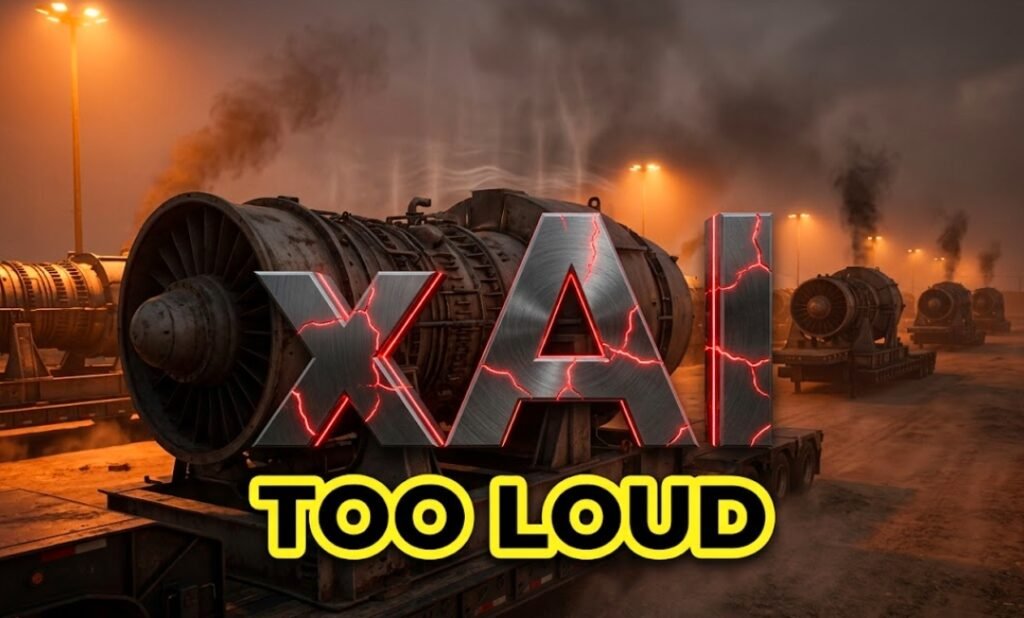
xAI data center gas turbines noise pollution Southaven Mississippi residents
Hundreds Pack a Hearing, Not One Person Supports xAI
The breaking point came on February 17, 2026, at a packed public hearing in Southaven.
In a room of a couple hundred attendees, not one person spoke in favor of the proposed air permit for xAI’s operation.5 About 30 audience members spoke, few stayed under their allotted three minutes, and all either expressed fear of the turbines’ pollution, asked the agency to reject the application, or requested regulators shut down the already operating generators.5
Some wore shirts reading “Not all money is good money.”6
Southaven native Nathan Reed told NBC News: “The scale, the speed, the intensity of this expansion are unlike anything this area has absorbed. This was not a thoughtful, phased development.”1 Mayor Darren Musselwhite, a Republican, acknowledged the noise was a “legitimate concern” but framed the outcry as politically motivated attacks against Musk.1
xAI spent $7 million on a sound wall to reduce the noise. Residents were not impressed. “We make fun of it and say, ‘It’s the Temu sound wall,'” Taylor Logsdon, a nearby resident, told NBC.1
State Board Approves Expansion Despite Public Outcry
Despite all of this, regulators sided with xAI.
On March 10, 2026, the Mississippi Environmental Quality Permit Board granted xAI’s request to add dozens of permanent gas turbines, unanimously approving a construction permit for 41 methane gas fired turbines at its Southaven plant.7 Those permitted machines will replace the 27 unpermitted turbines currently at the facility. The turbines power Grok, xAI’s controversial AI chatbot.7
The final permit was approved at a hearing in Jackson, nearly three hours from Southaven, held on an election day.8 That timing outraged local residents and civil rights groups alike.
“We are outraged that, despite the community’s clear demand to move the Election Day hearing, MDEQ chose to bulldoze through a decision that silenced the very residents most harmed by it,” said Abre’ Conner of the NAACP.9
Here is where things stand for Southaven today:
- 27 unpermitted turbines are already running at the site
- 41 permanent turbines have now been approved to replace them
- Zero residents spoke in favor at the public hearing
- $7 million sound wall has done little to quiet the noise
- A third xAI data center is also planned for Southaven
Jason Haley, who has lived in his home for 20 years, told the permit board: “I’ve lived in my house for 20 years and now I don’t want to be here anymore.”2
The Noise Is Bad, but the Health Risks Are Worse
Sound is just the surface of this crisis.
Gas turbines emit smog forming pollution, fine particulate matter, and hazardous chemicals like formaldehyde. These pollutants are tied to increases in asthma, respiratory diseases, heart problems, and certain cancers. Together, xAI’s 27 unpermitted turbines in Southaven have the potential to make the facility the largest industrial source of nitrogen oxides in the 11 county Memphis metropolitan area.10
A study commissioned by the Southern Environmental Law Center found the proposed permanent turbines could result in an estimated $30 to $44 million in annual health damages.11 Those damages include premature deaths, new asthma cases, heart attacks, hospital visits, and missed school days.
Taylor Logsdon, a mother of three who lives less than half a mile from the plant, said two of her children developed respiratory problems since the turbines started running. Her eczema has spread “dramatically,” which her dermatologist attributed to formaldehyde exposure.5
This is not limited to Southaven. In Boxtown, a predominantly Black neighborhood outside Memphis, residents complain that fumes from xAI’s Colossus data center are making it hard to breathe.1 In Boxtown, the cancer risk is four times the national average.12
The Memphis metropolitan area has struggled with air quality for years. Shelby County and DeSoto County recently received failing grades for ozone pollution from the American Lung Association.13
Legal Battles and a Growing National Movement
The fight is far from over.
On February 13, the Southern Environmental Law Center and Earthjustice, on behalf of the NAACP, sent a notice of intent to sue xAI and subsidiary MZX Tech LLC, saying the company’s turbines require a federal permit, violate the Clean Air Act, and harm nearby communities.14
At the federal level, the EPA recently clarified that these turbines cannot be categorized as temporary non road engines. Nonetheless, xAI has been using them across state lines without obtaining federal permits.14
The SELC and NAACP must wait 60 days after their notice before filing the lawsuit.2 That window is closing fast.
Shannon Samsa, with the Safe and Sound Coalition, confirmed that her group would explore additional legal action to address the constant noise.2
“For us, this is not just one more permit application. It is our homes and our health, our community, and it is our entire lives.” Shannon Samsa, Southaven resident
Southaven is not alone in this fight. At least 16 data center projects worth a combined $64 billion have been blocked or delayed as local opposition mounts across the country.15 Microsoft pulled out of a data center in Wisconsin due to community opposition, and Amazon abandoned plans in Arizona after community protests.14 Virginia is now the focal point for opposition, with 42 activist groups campaigning to slow, stop, or further regulate data center development.15
What is happening in Southaven is not just one town’s problem. It is the story of what happens when the AI industry moves too fast for the communities that bear its costs. Families who simply want clean air and quiet nights are being told their concerns do not matter because the money is too big and the technology is too important. But as this Mississippi town has shown, people are not willing to stay silent while their health and homes are at stake. Drop your thoughts in the comments below, and if this story moved you, share it with someone who needs to hear it.


Blanche Fund Deal Clears Path as DOJ Power Decides CLARITY Fate

S26 FE Cases Repeat the Silver Frame Playbook From Last Year

One UI 9.5 Hits S27 Ultra Servers as Fold 8 Ships Its First Patch

Capital Clusters and the Dual Tracks of European Tech Finance

Microsoft Shrinks Windows 11 Memory for 8GB PCs

XRP Ledger Brings Back Bugged Features Fixed for Institutions

The Shards Trailer Turns Ellis Nightmare Into Murphy Glamour

WhatsApp Folder Hides Business Messages After Hours

Mova LiDAX Ultra 3000 AWD Cracks the Robot Mower Moat

Urban Arrow FamilyNext Turns Costco Runs Into Bike Trips

Kalshi Loses Major NY Prediction Markets Ruling to Judge Torres

Fed Minutes Cite AI Demand as Inflation Risk, Put a 2026 Hike Back on the Map

Marker AI Writing Startup Lands $13M Seed Led by Index Ventures

Dota 2 Esports World Cup 2026: Spirit Defends $2M Title In Paris

Meta’s Muse Spark 1.1 Beats Rivals on Price, Trails on Coding

CS2 Premier Season 5 Lands With Cache and a C4 Damage Rework

Backrooms Returns to Theaters as the Everything Must Go Edition

ARC Intelligence Closes €4M Seed Round in Roughly a Week

Finto Picks Munich Over Silicon Valley After YC, Raises $3.4M

Trump Calls Iran ‘Islamic Republic of Japan’ as Ceasefire Ends
-
 FINANCE2 months ago
Zcash Patched a Double-Spend Bug as ZEC Climbed 5%
-
 ENTERTAINMENT2 months ago
Steam Summer Sale 2026 Locks In June 25 to July 9 Dates
-

 FINANCE1 month ago
CLARITY Act Final Text Expected This Weekend as 60-Vote Hurdle Looms
-
 NEWS3 months ago
Meta Adds AI Replies to Threads, But Users Can’t Block It
-
 ENTERTAINMENT2 months ago
‘Widow’s Bay’ Review: Apple TV’s Sleeper Horror-Comedy Earns Its Fog
-
 NEWS5 months ago
U.S. Navy Deploys Solar-Powered Lightfish Drone to Patrol Oceans
-
 NEWS8 months ago
FolderFresh Review: This Free Tool Automates Windows File Organizing
-
 FINANCE4 weeks ago
Kalshi Loses Major NY Prediction Markets Ruling to Judge Torres