
NEWS
New US Bill Could Make Your Polaris Slingshot Illegal to Drive

A proposed federal law is quietly moving through Congress that could make tens of thousands of legally registered three-wheeled autocycles impossible to sell, register, or even drive on public roads. If you own a Polaris Slingshot, Vanderhall, or Morgan Super 3, this bill could directly affect you.
H.R. 3385, which recently advanced out of a House subcommittee, changes the federal definition of a motorcycle in a way that could make three-wheeled autocycles like the Polaris Slingshot illegal to sell and register in the United States.1 The motorcycle industry is pushing back hard, and the fight is far from over.
What H.R. 3385 Actually Changes
Representative Derrick Van Orden of Wisconsin, co-chair of the Congressional Motorcycle Caucus, introduced H.R. 3385 in the House of Representatives on May 14, 2025.2
The bill defines a motorcycle as a motor vehicle with a seat or saddle you sit astride, designed to travel on no more than three wheels, steered with handlebars, with acceleration and brakes controlled by the handlebars and foot controls, and able to go faster than 30 miles per hour.3 The Department of Transportation must issue the needed regulations within 120 days after the law takes effect.3
That definition is the problem. H.R. 3385 designates a motorcycle as a vehicle with “steering controlled by handlebars” and “having a seat or saddle,” and while that covers two-wheelers and trikes, it excludes autocycles, which come equipped with steering wheels, bucket seats, and foot pedals.1
Here is a quick look at how the bill draws the line:
| Feature | Traditional Motorcycle/Trike | Autocycle (e.g., Slingshot) |
|---|---|---|
| Steering | Handlebars | Steering wheel |
| Seating | Saddle (sit astride) | Bucket seats (sit inside) |
| Controls | Handlebar/foot controls | Pedals like a car |
| Status Under H.R. 3385 | Still a motorcycle | No longer a motorcycle |
The Can-Am Spyder and Ryker use handlebars and are therefore untouched by the fate of H.R. 3385.4 Current trikes from Harley-Davidson would not be affected by the update, but the requirement to sit astride and steer by handlebars would leave current autocycle owners in the lurch.5
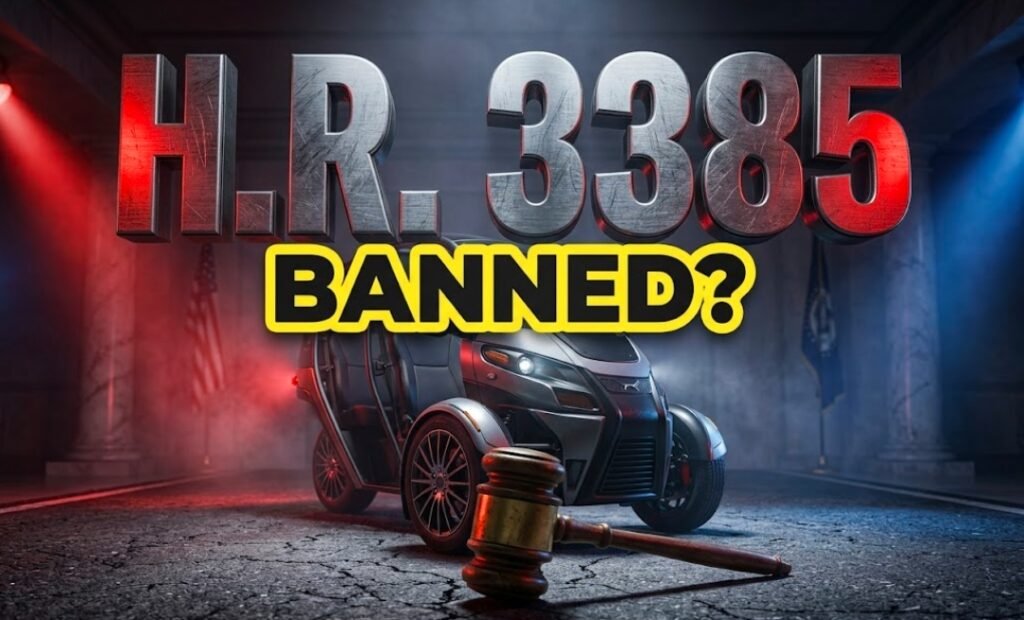
proposed US law banning three wheeled autocycles like Polaris Slingshot
Why Autocycle Owners Face “Classification Limbo”
This is where things get serious. Federal law currently lacks a separate “autocycle” safety category.6
Three-wheeler autocycles like the Slingshot, which use a steering wheel, would not count as motorcycles, and because they have three wheels, they would not be cars either. Effectively pulling a whole category of vehicles out of the code that defines them has the potential to create havoc for owners who wish to register them.4
That is the “classification limbo” the industry keeps warning about. These vehicles cannot meet car safety standards because they were never designed to. Manufacturers develop autocycle models to meet motorcycle safety standards, not automobile safety standards, which require airbags, side impact protection, and crash-rated bumpers.1
According to the Motorcycle Industry Council, 15 states, including Alabama, Idaho, and Florida, tie state law to the federal definition of a motorcycle.1 In that way, H.R. 3385 could invalidate “tens of thousands of current state autocycle registrations,” rendering the operation of such vehicles illegal.1
If you already own one of these vehicles in those states, your registration could suddenly be worthless.
Motorcycle Industry Council Sounds the Alarm
The Motorcycle Industry Council, on behalf of hundreds of companies in the powersports industry, “strongly opposes” this work and called the bill “not a mere administrative adjustment” but a “de facto ban on an established and successful motorcycle market segment.”5
In a formal letter to the House Energy and Commerce Subcommittee, the MIC laid out several key concerns:
- Total market elimination for autocycles with no alternative legal path
- Conflict with 15 state laws that tie directly to the federal motorcycle definition
- Plant closures and job losses across manufacturing and dealership networks
- A blow to free-market principles that punishes companies for innovating within existing rules
Industry leaders say the autocycle segment represents hundreds of millions of dollars in domestic investment and is part of a powersports retail market valued at $51 billion in 2025.7
“We respectfully urge you to protect American innovation and jobs that support the manufacturing sector and oppose H.R. 3385. We believe that regulatory clarity should support market growth, not act as a ‘death knell’ to a thriving sector of the powersports industry.” Motorcycle Industry Council, January 2026 letter to Congress
American Jobs and Businesses at Stake
The financial fallout could be real and painful.
The Polaris Slingshot, one of the more popular autocycle models, is made in Huntsville, Alabama, in a facility that also builds the off-road utility vehicle, Ranger.4 As of 2022, that Polaris plant employed 1,350 people.4
A Polaris spokesperson told Hagerty that “our team is actively engaging legislators and collaborating with the Motorcycle Industry Council on H.R. 3385 to clearly communicate industry concerns and our opposition to the proposal.”4
Utah’s Vanderhall Motor Works, meanwhile, employs around 200 people, and would see its entire business case evaporate overnight.5 Vanderhall vehicles are hand-built in Provo, Utah, by 30 people, and the Morgan Super 3 is also hand-built but imported to the U.S. from England, meaning it too would be affected.4
Four Republican lawmakers have co-sponsored the bill, which would see popular vehicles like the Morgan Super 3, Polaris Slingshot, Campagna T-Rex, and Vanderhall not only illegal to manufacture and distribute, but potentially illegal to register for the road altogether.5
For smaller companies like Vanderhall, this is not just a policy debate. It is an existential threat.
Where the Bill Stands Now and What Comes Next
H.R. 3385 was forwarded to the Full Committee by a voice vote.8 That subcommittee vote happened on February 10, 2026.9
The bill has been forwarded to the full Energy and Commerce committee for the next vote. It still has many hoops to jump through before hitting the President’s desk for signature into law.5
That does not mean owners should relax. The MIC contends that H.R. 3385 could spell the end of entire product lines, signal the closure of manufacturers and production plants, and lead to the loss of skilled manufacturing and engineering jobs. The organization’s opposition has not swayed legislators so far, as subcommittee members advanced the bill.1
On the other side of the debate, proponents argue that autocycles are included in the current statistics on injuries and deaths among motorcyclists, and since autocycles and classic motorcycles are recorded in the same category, it is not possible to reliably determine how many accidents are actually attributable to each type.2
If you own an autocycle or support the segment, now is the time to contact your representatives. The bill is moving, and silence from the public could allow it to pass without enough pushback.
What started as a two-page bill about updating a 60-year-old definition now threatens to wipe out an entire category of American-made vehicles, put hundreds of people out of work, and strand tens of thousands of owners with machines they can no longer legally ride. Whether you believe autocycles belong in the motorcycle category or not, one thing is clear: removing them from the books without offering a real alternative is not a solution. It is a dead end. Share your thoughts in the comments below and let us know where you stand on this bill.


Bitget BGBTC Upgrade Turns Idle Bitcoin Into Daily Yield

FFXIV Switch 2 Port Brings Portability With a Second Bill

MacBook Air Delays Reveal AI Memory Crunch Repricing Laptops

Bitcoin BIP-110 Soft Fork Dies on Tiny Miner Support

CXMT LPDDR6 Push Locks In Mobile DRAM Split

Snapchat Hands Spotlight Priority to Human Creators Over AI Farms

Sheriffs Hold Out as Trump Weighs Ethics Deal on CLARITY Act

Apple Upgrade Turns Flagship Buys Into Monthly Leases With Klarna

Trump Iran Threat Wiped $238M Crypto Longs Then Flipped

Blanche Fund Deal Clears Path as DOJ Power Decides CLARITY Fate

Kalshi Loses Major NY Prediction Markets Ruling to Judge Torres

Fed Minutes Cite AI Demand as Inflation Risk, Put a 2026 Hike Back on the Map

Marker AI Writing Startup Lands $13M Seed Led by Index Ventures

Dota 2 Esports World Cup 2026: Spirit Defends $2M Title In Paris

Meta’s Muse Spark 1.1 Beats Rivals on Price, Trails on Coding

CS2 Premier Season 5 Lands With Cache and a C4 Damage Rework

Backrooms Returns to Theaters as the Everything Must Go Edition

ARC Intelligence Closes €4M Seed Round in Roughly a Week

Finto Picks Munich Over Silicon Valley After YC, Raises $3.4M

Trump Calls Iran ‘Islamic Republic of Japan’ as Ceasefire Ends
-
 FINANCE2 months ago
Zcash Patched a Double-Spend Bug as ZEC Climbed 5%
-
 ENTERTAINMENT2 months ago
Steam Summer Sale 2026 Locks In June 25 to July 9 Dates
-

 FINANCE1 month ago
CLARITY Act Final Text Expected This Weekend as 60-Vote Hurdle Looms
-
 NEWS3 months ago
Meta Adds AI Replies to Threads, But Users Can’t Block It
-
 ENTERTAINMENT3 months ago
‘Widow’s Bay’ Review: Apple TV’s Sleeper Horror-Comedy Earns Its Fog
-
 NEWS5 months ago
U.S. Navy Deploys Solar-Powered Lightfish Drone to Patrol Oceans
-
 NEWS8 months ago
FolderFresh Review: This Free Tool Automates Windows File Organizing
-
 FINANCE4 weeks ago
Kalshi Loses Major NY Prediction Markets Ruling to Judge Torres