
NEWS
Alcolase Lands €1.5M to Crack Alcohol Intolerance Code

A Danish biotech born inside a student dorm during the pandemic just pulled off a major leap. Alcolase has closed a €1.5 million round to scale an enzyme that breaks down alcohol inside the stomach itself. The startup is chasing a fix for the 540 million people whose genes turn a single drink into a flushed, racing-heart ordeal. What happens next could reshape social drinking across Asia.
Inside the €1.5M Round and the Investors Backing It
Alcolase confirmed the raise this week, with capital flowing in from a mix of European and life-science focused funds. The Danish biotech startup raised 1.5 million euros, around $1.7 million, in its latest funding round, backed by Ada Ventures, Delphinus Venture Capital, Antler, Manigoff Invest, and a group of business angels.
The cheque is small by global biotech standards, but the plan attached to it is not. The fresh capital will fund in vivo studies, further technology development, intellectual property work, and early commercial partnerships in target markets.
Ada Ventures is also pulling Alcolase deeper into Britain’s research scene. Alcolase has also established a UK therapeutic subsidiary, with Ada Ventures supporting its expansion into the UK life sciences ecosystem. Venture Partner Alasdair Thong will take a seat on the board to guide the next phase.
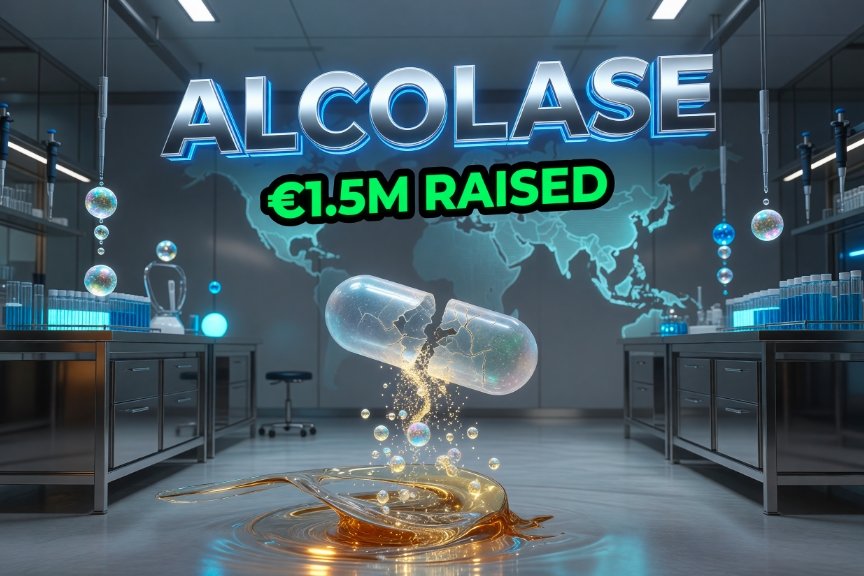
alcolase enzyme capsule for asian flush alcohol intolerance
How the Stomach-Based Enzyme Actually Works
Most hangover pills aim at the liver. Alcolase is doing something different and, frankly, bolder.
The company uses liposomal encapsulation to protect enzymes from stomach acid and keep them active in the stomach, allowing them to act before alcohol enters the bloodstream. The science borrows a trick from a familiar problem. The supplement is based on a novel enzyme system and an enzyme-stabilizing technology that delivers enzymes to the stomach in order to break down toxic aldehyde, with a mechanism inspired by enzymes used for lactose intolerance.
Here is the simple three-step idea behind the product:
- The problem: ALDH2-deficient individuals cannot effectively break down acetaldehyde.
- The fix: A specialized enzyme helps degrade this toxin directly in the stomach.
- The payoff: Improved social and physical well-being for the consumer.
That stomach-first approach is the part that has investors leaning in. Unlike many existing supplements that aim to support liver metabolism, Alcolase’s patented enzyme system takes a novel approach: it acts directly in the stomach, before alcohol and its toxic byproducts fully enter the bloodstream.
Why 540 Million People Need This Fix
The science of ALDH2 deficiency is brutal, and the numbers explain why investors are paying attention.
One prominent East Asian-specific missense variant, the ALDH2*2 allele, affects an estimated 540 million East Asians, or 8% of the world population. The reaction is informally termed Asian flush due to its frequent occurrence in East Asians, with approximately 30 to 50% of Chinese, Japanese, and Koreans showing characteristic physiological responses to drinking alcohol that includes facial flushing, nausea, headaches and a fast heart rate.
And it is not just embarrassment at dinner. An ALDH2-deficient drinker has four to eight times the risk of developing esophageal cancer as a drinker not deficient in the enzyme. The condition is also linked to cardiovascular disease and other long-term illness.
| Region | ALDH2 Deficiency Prevalence |
|---|---|
| East Asia (China, Japan, Korea, Taiwan) | 35 to 40% |
| Europe | 5 to 10% |
| Africa | 1 to 5% |
| Global total affected | Around 560 million people |
ALDH2*2 variants affect approximately 560 million people worldwide, making it one of the most common genetic risk factors globally, with 35-40% of people from China, Japan, Korea, Taiwan, and Southeast Asia carrying at least one ALDH2*2 allele, and 8-10% of the adult population in these regions having severe ALDH2 deficiency.
Why the Story Started in a Student Dorm
Alcolase did not begin in a corporate lab. It began with three young scientists stuck indoors during lockdown.
Chief Executive and co-founder Mikkel Precht said the startup began during the coronavirus pandemic as a student dorm discussion among founders looking to apply biotechnology to everyday health problems. The team kept circling back to one issue that hit close to home for millions: being excluded from social and professional rooms because of a single gene.
For Precht, the mission is less about parties and more about belonging.
“When you speak to people with alcohol intolerance, you realise this is not about wanting to drink more. It is about not being shut out of dinners, work events and family gatherings because of a genetic difference. We want to give people a real choice they are currently denied.” — Mikkel Precht, CEO and Co-founder of Alcolase
He made the broader stakes plain in earlier interviews. Precht has said alcohol intolerance is not just a sensitivity but a genetic inability to detoxify a harmful substance, and in societies where alcohol consumption is embedded in culture, total abstinence is often not a realistic option.
Singapore First, South Korea Next: The Asia Roadmap
The commercial play is sharp and regional. Alcolase plans to launch first in Singapore before expanding to South Korea, where alcohol intolerance is also common.
South Korea is a huge prize. According to the company’s own market data shared earlier this year, roughly 30% of the South Korean population is affected by alcohol intolerance, and the country’s deeply rooted business drinking culture makes a science-backed supplement particularly attractive.
The pitch to Asian partners is already landing. Alcolase is actively exploring entry into the Korean market, with Precht stating that Korea is a vital part of the expansion roadmap and that there is strong demand for a solution grounded in science, not just convenience.
Antler, an early backer, sees the global angle too. As Michael Wiatr Aagaard, Partner at Antler, put it: “Mikkel and his co-founders have the ambition, scientific expertise and determination required to find a solution to a major health and social issue. We’ve backed Alcolase from an early stage and are proud to continue supporting them as they turn their vision into global impact.”
Check Warner, Co-founding Partner at Ada Ventures, framed why she signed the cheque even more directly: “Alcolase is exactly the kind of company we look for: a science-led team tackling a problem that affects hundreds of millions of people.”
For now, Alcolase remains a tiny team with a big idea, working at the awkward border between a consumer supplement and a real therapeutic. The next 12 months will decide which of those lanes wins. If the in vivo data holds up, a quiet Copenhagen lab could end up changing how half a billion people experience a single sip of soju, sake or champagne. For the millions who have spent a lifetime saying no, that small enzyme could be the first honest yes. What do you think, would you try a stomach enzyme to enjoy social drinking safely? Drop your thoughts in the comments and share this story with someone who has ever turned bright red after one beer.


Howard the Duck at 40 Still Owns Marvel’s First Flop

Valve Skin Ban Hits BLAST and Forces CS2 Teams Toward Betting Cash

Oil Crashes Below $80 as Iran Talks Restart and Markets Split

Netflix Screening Erases Fortitude Exclusivity in $105M Cage Suit

Bitget BGBTC Upgrade Turns Idle Bitcoin Into Daily Yield

FFXIV Switch 2 Port Brings Portability With a Second Bill

MacBook Air Delays Reveal AI Memory Crunch Repricing Laptops

Bitcoin BIP-110 Soft Fork Dies on Tiny Miner Support

CXMT LPDDR6 Push Locks In Mobile DRAM Split

Snapchat Hands Spotlight Priority to Human Creators Over AI Farms

Kalshi Loses Major NY Prediction Markets Ruling to Judge Torres

Fed Minutes Cite AI Demand as Inflation Risk, Put a 2026 Hike Back on the Map

Marker AI Writing Startup Lands $13M Seed Led by Index Ventures

Dota 2 Esports World Cup 2026: Spirit Defends $2M Title In Paris

Meta’s Muse Spark 1.1 Beats Rivals on Price, Trails on Coding

CS2 Premier Season 5 Lands With Cache and a C4 Damage Rework

Finto Picks Munich Over Silicon Valley After YC, Raises $3.4M

ARC Intelligence Closes €4M Seed Round in Roughly a Week

Backrooms Returns to Theaters as the Everything Must Go Edition

Trump Calls Iran ‘Islamic Republic of Japan’ as Ceasefire Ends
-
 FINANCE2 months ago
Zcash Patched a Double-Spend Bug as ZEC Climbed 5%
-
 ENTERTAINMENT2 months ago
Steam Summer Sale 2026 Locks In June 25 to July 9 Dates
-

 FINANCE1 month ago
CLARITY Act Final Text Expected This Weekend as 60-Vote Hurdle Looms
-
 NEWS3 months ago
Meta Adds AI Replies to Threads, But Users Can’t Block It
-
 ENTERTAINMENT3 months ago
‘Widow’s Bay’ Review: Apple TV’s Sleeper Horror-Comedy Earns Its Fog
-
 NEWS5 months ago
U.S. Navy Deploys Solar-Powered Lightfish Drone to Patrol Oceans
-
 NEWS8 months ago
FolderFresh Review: This Free Tool Automates Windows File Organizing
-
 FINANCE4 weeks ago
Kalshi Loses Major NY Prediction Markets Ruling to Judge Torres