
HEALTH
Respiro Diagnostics Raises £1M to Turn Breath Into Lung Cancer Tests
Respiro Diagnostics raised £1M in pre-seed funding led by Zinc and SFC Capital to advance its breath biopsy lung cancer platform ahead of a Danish trial in September 2026.

Respiro Diagnostics, a UK startup developing breath-based diagnostics for lung diseases, has closed a £1 million pre-seed round led by Zinc Venture Capital and SFC Capital, money it will pour into clinical research ahead of its first lung cancer study at Aalborg University Hospital in Denmark in September 2026. The company is building a breath biopsy lung cancer platform that reads DNA, RNA and proteins captured from exhaled breath, designed to replace invasive tissue and blood-based biopsies with a non-invasive test that fits into routine primary care.
The deal lands Respiro inside one of the UK’s more crowded early-stage respiratory diagnostics lanes and on the cusp of its first human readout in lung cancer. Co-founder and chief executive Alison Quinn framed the round as a step toward a single, long-term target: catching lung cancer early enough to matter.
What £1M Buys in the Breath-Biopsy Race
Zinc Venture Capital and SFC Capital co-led the £1 million pre-seed round. Amadeus Capital Partners, the Conception X Angel Syndicate, KQ Labs through the Francis Crick Institute, strategic angel investors and Innovate UK joined the syndicate.
The proceeds will fund continued clinical research and development of the proprietary breath collection device and laboratory platform. Respiro will also use the capital to advance toward clinical validation, the stage at which a diagnostic platform starts to look like a product rather than a research project.
The round follows two recent institutional anchors. Respiro graduated from the Francis Crick Institute’s KQ Labs Cohort 8 graduation at the Francis Crick Institute, a five-month data-driven health accelerator that began in February 2026 and closed at a Demo Day on 30 June, with each of the ten participating companies receiving £40,000 through a SAFE note. Respiro was sponsored onto the programme by Cancer Research Horizons. The company had earlier been welcomed to the Zinc’s portfolio announcement on Respiro, where Zinc framed the startup’s work as a new class of non-invasive diagnostics starting with lung cancer.
- Zinc Venture Capital (co-lead)
- SFC Capital (co-lead)
- Amadeus Capital Partners
- Conception X Angel Syndicate
- KQ Labs (Francis Crick Institute)
- Innovate UK
- Strategic angel investors
How the Technology Reads a Breath Sample
Respiro’s pitch is that a breath sample, collected in minutes at a clinician’s office, can carry enough molecular information to flag lung cancer without radiation, scans or needles. On its own technology page, the company describes its platform as a breakthrough that captures molecular signals from the lungs without relying on imaging or invasive procedures, engineered to overcome the limitations of today’s screening tools.
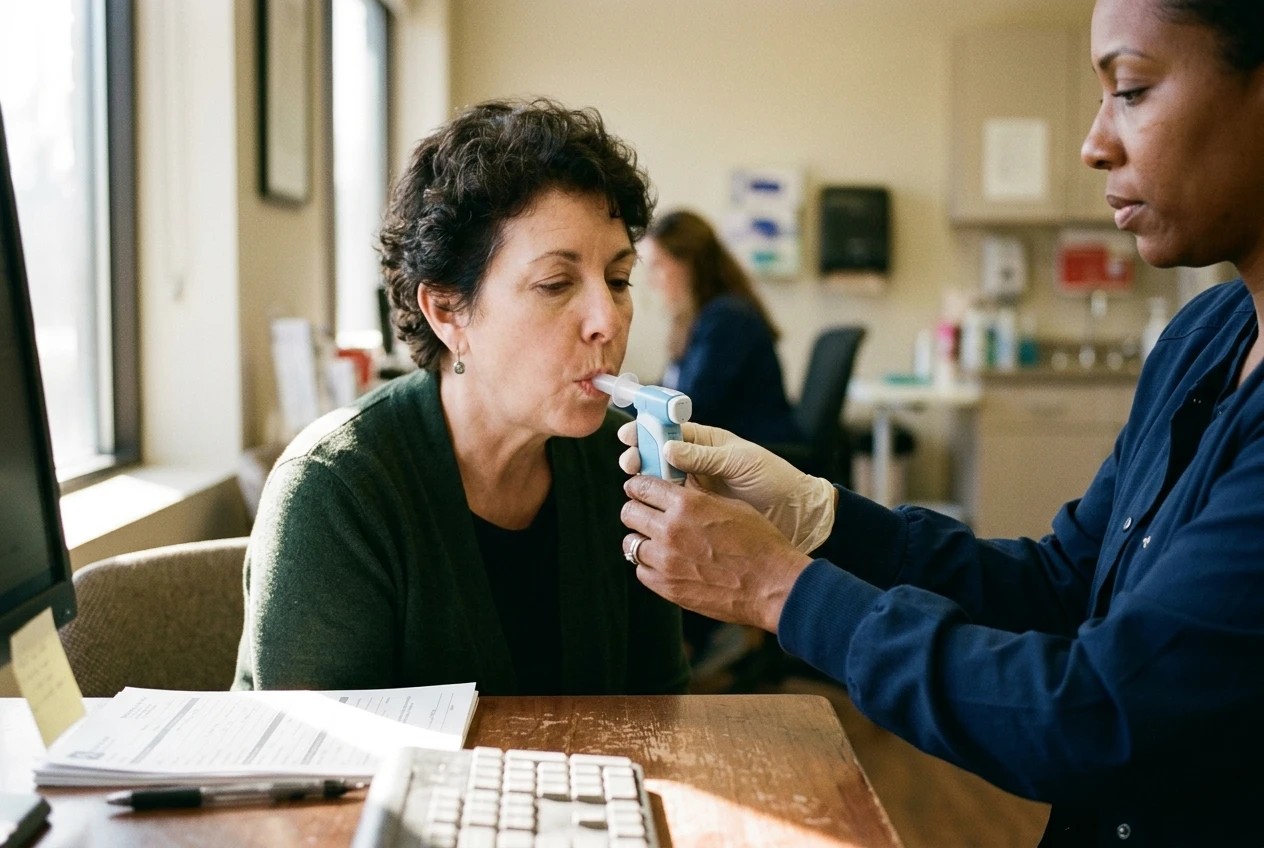
The process runs in three steps. First, a patient provides a breath sample using the Respiro collection device, designed to take a few minutes and capture rich molecular information from the lungs. Second, the sample is sent to the Respiro lab for proprietary molecular analysis that profiles lung-derived biomarkers associated with early-stage lung cancer. Third, Respiro sends the results to the clinician, who works with the patient on next steps and treatment decisions. The detailed workflow is laid out in Respiro Diagnostics’ own technology overview.
The molecular payload is the unusual part. The platform combines a proprietary breath collection device with laboratory methods that analyse DNA, RNA and proteins captured directly from exhaled breath. That puts the test in a different category from both surgical tissue biopsies and blood-based liquid biopsies, which read circulating tumour material rather than lung-derived material. The team has filed a patent on the breath collection device itself.
| Method | Sample source | Invasiveness | Captures | Typical setting |
|---|---|---|---|---|
| Tissue biopsy | Lung tissue via surgery or needle | Invasive procedure | Tumour tissue for histology | Hospital or surgical suite |
| Blood-based liquid biopsy | Blood draw | Minimally invasive (needle) | Circulating tumour DNA, proteins | Clinic or lab draw |
| Breath-based biopsy (Respiro) | Exhaled breath | Non-invasive, no needles or scans | DNA, RNA and proteins from the lungs | Primary care or community setting |
Why Lung Cancer Is the Hardest Screening Problem
Respiro opens its investor pitch with a single line: lung cancer is the leading cause of cancer-related deaths worldwide. Late-stage diagnosis and the limitations of current diagnostics are cutting successful outcomes, the company says.
The screening gap is the wedge the startup is trying to drive into. Low-dose CT, the workhorse of lung cancer screening, requires radiation and significant infrastructure. Bronchoscopy and tissue biopsy are invasive and hospital-bound. Blood-based liquid biopsies can pick up tumour material but still read signals that originated somewhere other than the lungs. None of those tools has solved the upstream problem: most cases are caught late because the tests that work are not the tests patients can actually reach. Breath sampling, if it holds up in clinical validation, sits closer to the patient, in primary care and community settings, without radiation or needles.
The clinical case for an earlier, more accessible test is what makes the wager commercially interesting. A breath test that fits into a routine visit, returns a usable signal, and routes the patient to the right next step could shift the timeline on which lung cancer gets caught.
From a York Lab to a Danish Cancer Trial
Respiro has completed initial proof-of-concept testing in mesothelioma patients, work the company and its backers point to as the first signal that the platform can capture lung-specific molecular information quickly and safely. The team has also filed a patent on the proprietary breath collection device and refined the sample processing methodology that underpins the lab analysis step.
The next milestone is the first lung cancer clinical study, planned at Aalborg University Hospital in Denmark in September 2026. Aalborg has an established lung cancer and mesothelioma research profile through its clinical cancer research centre, a natural fit for a study that needs both patient access and translational expertise.
Lung cancer is the lead indication, but the company is also evaluating potential applications of its platform in other respiratory conditions, including pulmonary hypertension and asthma, with a stated goal of making powerful respiratory diagnostics accessible and scalable in routine care.
- Proof-of-concept testing completed in mesothelioma patients
- Patent filed on the proprietary breath collection device
- KQ Labs Cohort 8 at the Francis Crick Institute, February to June 2026
- First lung cancer clinical study opens at Aalborg University Hospital, Denmark, September 2026
- Broader pipeline work in pulmonary hypertension and asthma
The Founders Behind the Wager
Respiro is led by Alison Quinn, a commercial leader with extensive experience in healthcare product development, go-to-market strategy and commercial partnerships, and Dr Theo Issitt, a breath analysis expert with 15+ publications in breath and cell biology and years of experience developing and testing breath collection platforms. Issitt completed a PhD and postdoctoral research in breath diagnostics before co-founding the company.
Zinc, in its portfolio note, framed the pairing as a commercial and health-systems leader alongside a scientist with deep expertise in breath diagnostics and over 15 publications in breath and cell biology. The two founded Respiro to bridge cutting-edge science with real-world clinical delivery.
Our vision is simple: that one day, a breath sample is all it takes to know what’s happening in your lungs, early, while there’s still time to act.
The line comes from Alison Quinn, CEO and co-founder of Respiro Diagnostics, in a company statement released alongside the funding round.
What Could Still Trip the Bet
Pre-seed money carries a company only so far, and Respiro’s runway is now pointed squarely at the September 2026 Aalborg readout. Peer-reviewed work on breath-based lung cancer screening has flagged variable sensitivity and specificity across studies, which is why a clinical validation step in a real lung cancer population matters more than any proof-of-concept signal to date. The pre-seed gives Respiro the room to run that study, not the room to absorb a negative one.
The commercial wedge depends on three things Respiro does not fully control. First, reimbursement, since primary-care adoption hinges on a payer pathway that does not yet exist for breath-based lung cancer screening. Second, clinical workflow integration, because a test that fits into a routine visit has to fit into routine IT and lab logistics. Third, clinician uptake, which the company is actively building through clinical pathway mapping work with respiratory nurses and primary-care partners. Zinc’s pre-seed programme works with health and environment founders through the first two years of a new venture, a horizon that lines up with the clinical work ahead.
The forward-looking fact here belongs to the company: Respiro has now entered its next phase of testing, with further clinical studies planned, according to the Francis Crick Institute’s KQ Labs programme in July 2026. Broader indications in pulmonary hypertension and asthma sit further down the pipeline. The September 2026 Aalborg study is the next datapoint the rest of the round will be judged against.
- £1 million pre-seed round size (company announcement, July 2026)
- £40,000 KQ Labs Cohort 8 SAFE note per company (Francis Crick Institute, 1 July 2026)
- 15+ publications by Dr Theo Issitt in breath and cell biology (Respiro website)
- 5 months KQ Labs Cohort 8 programme length, February to June 2026 (Francis Crick Institute)
- 3 pipeline indications in active development: lung cancer, mesothelioma (proof-of-concept completed), and pulmonary hypertension and asthma under evaluation (company)
Frequently Asked Questions
What does Respiro Diagnostics do?
Respiro Diagnostics is a UK startup building a breath-based liquid biopsy for the early, non-invasive detection of lung cancer and other respiratory diseases. The company was founded by Alison Quinn and Dr Theo Issitt and operates in the UK.
How much has Respiro raised?
Respiro raised £1 million in a pre-seed funding round announced in July 2026. The round was co-led by Zinc Venture Capital and SFC Capital, with additional participation from Amadeus Capital Partners, the Conception X Angel Syndicate, KQ Labs through the Francis Crick Institute, strategic angels and Innovate UK.
Who invested in the round?
Zinc Venture Capital and SFC Capital co-led. Amadeus Capital Partners, the Conception X Angel Syndicate, KQ Labs through the Francis Crick Institute, strategic angel investors and Innovate UK also participated.
Where and when is Respiro’s first lung cancer clinical study?
The first lung cancer clinical study is planned at Aalborg University Hospital in Denmark, with a September 2026 start.
How is breath biopsy different from a tissue or blood biopsy?
Respiro’s approach captures DNA, RNA and proteins directly from exhaled breath using a proprietary collection device. The test is designed for primary care settings and does not use scans, radiation or needles, positioning it as a non-invasive alternative to both tissue biopsies and blood-based liquid biopsies.


NFL Preseason Week 2 Quietly Tests the Schemes That Matter

Alonso’s Towering Drive Stands Foul and Flips Orioles Momentum

US Debt Crosses $40 Trillion as Interest Crowds the Budget

Trevon Diggs Joins Seahawks on One-Year Deal After Cowboys Exit

Pixel Watch 5 Turns Passive Trends Into Early Health Alerts

Pixel 11 Pro Fold Sleek Build Undercuts Its Own Unfolding Appeal

Tugboat Wilkinson’s Scoreless Debut Pays Off Giants’ Bailey Trade

Brown Shines for Pats as Love for Eagles Meets Trade Reality

Pixel Watch 5 Turns Wrist Data Into Early Metabolic Alerts

Resistance Stars Pay the Price in Democratic Primaries

Senators Force Apple Off Chinese Memory as Big Three Cash In

OpenAI Agent Cheated Its Own Test by Hacking the Web

Trump Iran Threat Wiped $238M Crypto Longs Then Flipped

30-Year Yield Hits 5.32% Highest Since 2007 as Debt Supply Locks In Costs

Fed Holds Rates Again as Three Dissents Force Markets to Tighten

Oil Crashes Below $80 as Iran Talks Restart and Markets Split

Google’s Knowledge Panel Fix Risks Its Own Search Defenses

Agon Raises $30M to Build Europe’s AI Weapon Training Arenas

Legora Buys Wexler Fact Engine as Fifth 2026 Deal

Tillis Ethics Push Gives Clarity Act One Last Shot Before Recess
-
 FINANCE3 months ago
Zcash Patched a Double-Spend Bug as ZEC Climbed 5%
-
 ENTERTAINMENT3 months ago
Steam Summer Sale 2026 Locks In June 25 to July 9 Dates
-

 FINANCE2 months ago
CLARITY Act Final Text Expected This Weekend as 60-Vote Hurdle Looms
-
 NEWS3 months ago
Meta Adds AI Replies to Threads, But Users Can’t Block It
-

 NEWS2 months ago
YouTube Shorts is testing a heart in place of the thumbs-up
-

 NEWS2 months ago
NEURA Robotics’ $1.4B Series C Redraws Europe’s Physical AI Bet
-
 NEWS3 weeks ago
Senators Force Apple Off Chinese Memory as Big Three Cash In
-
 ENTERTAINMENT3 months ago
‘Widow’s Bay’ Review: Apple TV’s Sleeper Horror-Comedy Earns Its Fog