
NEWS
reverse.fashion Bags Seven-Figure HTGF Extension for AI Sorting
Berlin AI startup reverse.fashion closed a seven-figure HTGF extension to scale its AI textile sorting platform as EU mandates reshape fashion.

Berlin-based AI startup reverse.fashion has closed a seven-figure extension to its pre-seed round, with High-Tech Gründerfonds leading the investment. Co-sort, reverse.fashion’s AI textile sorting software, will move from pilot projects to commercial rollout alongside line.sort, the company’s automated industrial sorting system. Spun out of the Technical University of Berlin in 2024, the 12-person team is now preparing to ship line.sort to its first customers. The founders frame the round as a response to EU textile mandates they say are outpacing manual facilities.
The HTGF extension is the second stage of a pre-seed that already included H&M Group and KISORA as backers. The combined cap table pairs a fashion corporate, an early-stage venture investor, and Germany’s most active seed fund. Co-founder Mario Osterwalder called the partnership the start of a new chapter as reverse.fashion enters its commercial phase. Co-founder and CTO Dr. Karsten Pufahl said customers on the platform are seeing a 40% productivity lift and an around 20% revenue increase.
HTGF Backs a Sorting Platform Built for EU Mandates
High-Tech Gründerfonds led the extension, with Senior Investment Manager Dr. Anne Umbach driving the deal on the HTGF side. The capital is sized to push reverse.fashion from pilot deployments into commercial sales across Europe’s textile recycling and sorting sector. The fresh capital will scale existing pilot projects and drive forward the ongoing market launch of line.sort, per the announcement of the seven-figure pre-seed extension. The two product lines target different points in the same bottleneck, the labour-intensive sorting step that sits between textile collection and any reuse or recycling pathway. The startup will continue running pilot projects with sorters and recyclers while pushing line.sort into the market.
Rising regulatory requirements such as EPR and EU mandates are driving the transformation of the textile industry. reverse.fashion addresses a central bottleneck with its AI technology and creates the foundation for greater efficiency and profitability.
Dr. Anne Umbach, HTGF’s Senior Investment Manager, made the case in the firm’s release announcing the round that EU rules are forcing textile players to industrialise. She added that HTGF is very much looking forward to accompanying this visionary team on its journey. Co-founder Mario Osterwalder framed the round as a strategic milestone, with the successful pilot phase and the current market entry putting reverse.fashion into a new chapter. The same release flagged 12 employees, a TU Berlin research base, and IP developed jointly with Freie Universität Berlin and circular.fashion GmbH.
reverse.fashion is selling into a regulated industry whose compliance deadlines are already on the books. The startup currently employs 12 people and says the extension is sized for commercial expansion rather than further research. Two product lines, co.sort and line.sort, target two different buyer profiles inside the same sorting bottleneck. The cap table pairs an industry strategic, an early-stage venture lead, and a public-backed seed fund.
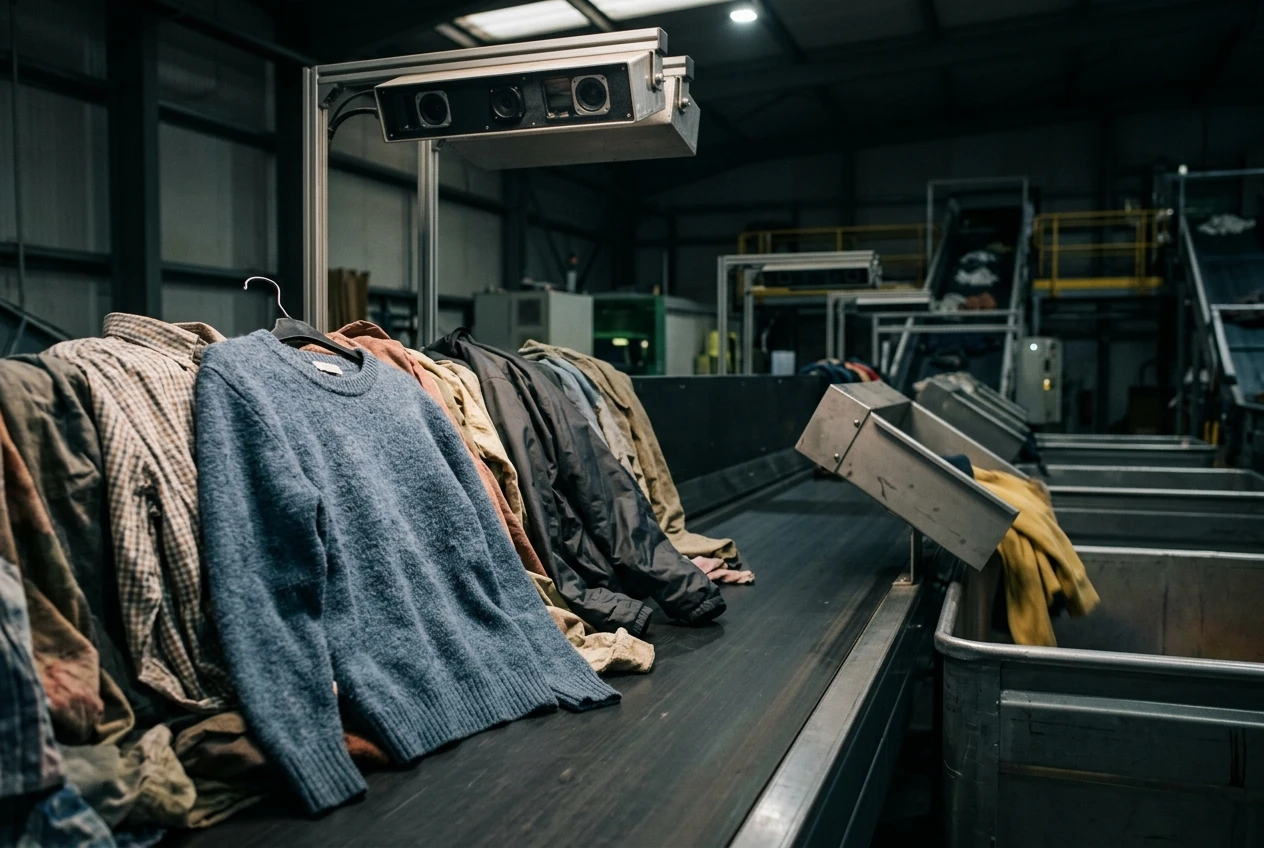
The Bottleneck Manual Sorting Cannot Clear
The fashion industry’s circularity problem starts at the sorting bin. Used garments arrive at facilities in mixed loads, and the labour-intensive process of hand sorting each item by fibre, condition, and brand caps both throughput and resale value. Without precise classification, recyclable fibres get downcycled into insulation or shredded for waste, while rewearable pieces miss the resale channel. Volume is rising, and EU rules are pushing the industry toward higher recovery rates.
The bottleneck is operational as much as technical. A worker identifying each garment by eye can sort only so many items an hour, and the data captured is mostly lost. That gap makes downstream claims about recycled content hard to verify, which is the kind of paper trail regulators now want. The result is a circular economy that runs on manual sorting at exactly the moment it needs industrial-scale precision.
Extended Producer Responsibility regimes for textiles are live or coming in EU member states, and they shift the cost of collection and recycling onto producers. A Digital Product Passport for textiles is on the EU’s regulatory runway as part of the Ecodesign for Sustainable Products Regulation, and it will require brands to record and share data on every garment. Brands cannot meet those data demands if their sorting supply chain is invisible. AI sorting infrastructure feeds EPR and DPP reporting with the material composition and condition data they require at industrial scale.
reverse.fashion’s co.sort software already captures the structured data each garment needs. line.sort extends that into a physical system that scans, classifies, and physically routes garments without a worker handling each piece. The full stack feeds downstream systems with material composition and condition data that DPP and EPR reporting require. Customers gain the audit trail regulators want and the throughput scale circular fashion needs to clear EU targets.
How co.sort and line.sort Score a Garment
reverse.fashion’s product line is built on two layers that operate independently and together. The co.sort software layer is the one currently running in pilot projects at customer facilities. The line.sort system layers hardware on top, automating the physical sorting itself, and its market rollout has just kicked off.
By significantly increasing sorting quality and throughput, our customers boost their productivity by 40% while simultaneously achieving a revenue increase of around 20%.
Dr. Karsten Pufahl, reverse.fashion’s CTO and co-founder, gave the concrete numbers behind the company’s commercial pitch in the firm’s release. Both layers use the same underlying AI: computer vision, machine learning, and sensing technologies, with Digital Product Passport integration built in. The systems identify garments by material composition, brand, condition, style, and size, and they classify each piece for its best recovery pathway. Customers using the platform lift productivity by 40% and revenue by around 20%.
| Aspect | co.sort | line.sort |
|---|---|---|
| Product type | Software product | Industrial sorting system |
| Current status | Pilot projects with sorters and recyclers | Market rollout has just kicked off |
| Primary function | Digitises and classifies used textiles | Automates physical sorting and routing |
Three Founders Pair AI Research with Sorting Operations
reverse.fashion’s team pairs academic AI research with on-the-floor sorting expertise. The three founders are Managing Director Mario Osterwalder, CTO Dr. Karsten Pufahl, and Head of Strategy Paul Doertenbach. Osterwalder co-founded one of Europe’s most successful circular agencies and has worked across a breadth of EU and German sustainability projects. Pufahl’s research has been driving innovation in textile sorting for the last decade. Doertenbach ran Europe’s most modern garment sorting facility for over 12 years and has spent recent years helping businesses prepare for Europe’s upcoming EPR regulations.
The IP behind the platform was developed at the Chair of Micro and Precision Devices at TU Berlin, led by Prof. Dr. Dirk Oberschmidt. Joint research projects with Freie Universität Berlin and circular.fashion GmbH provided the test beds for the technology, per the reverse.fashion founding team and platform overview. Spinning out of TU Berlin in 2024 gave the founders both the technology and the academic network to take the platform into industry. The founding team combines more than 125 years of experience in machine learning, software, design, and textiles, the company says, and the team has grown to 12 people since the spin-off.
A Two-Stage Pre-Seed Built Around H&M
reverse.fashion’s pre-seed was structured in two stages. The first stage, earlier in the round, was a six-figure investment led by KISORA with H&M Group also participating. Legal advice on that stage came from HEUKING, with the firm’s VC and IP teams led by Dr. Patrick Müller and Dr. Ruben Hofmann. The HTGF extension is the second, larger stage of the same pre-seed round.
H&M Group’s participation signals where circularity is heading inside fashion’s largest players. The Swedish retailer has been investing in recycling and resale infrastructure for years as secondhand and textile-to-textile recycling move from CSR sidelines into core operations. KISORA’s lead role reflects a bet that AI-led sorting will become standard kit inside European textile facilities.
The combined cap table now pairs an early-stage venture investor, a strategic corporate from the fashion industry, and High-Tech Gründerfonds as the lead of the extension. HTGF’s typical cheque size and stage focus make it a natural anchor for a startup preparing its first commercial sales motion. The strategic blend at the cap table is unusual at pre-seed, with an industry buyer, a venture lead, and a public-backed seed fund all present before Series A.
The legal advice note on the pre-seed financing from HEUKING confirmed the earlier six-figure structure, with KISORA as lead and H&M among the other investors. That earlier stage closed before HTGF joined, and reverse.fashion now carries three investor profiles into the line.sort market rollout. Each brings a different lever: H&M for off-take and pilot facilities, KISORA for early-stage venture discipline, and HTGF for German deep-tech networks.
Where the Money Goes Next
The HTGF capital is earmarked for commercial expansion, not further R&D. reverse.fashion plans to scale existing pilot projects for co.sort with current sorters and recyclers. At the same time, the company is moving into the market rollout phase for line.sort. The deployment target is automated sorting processes across the industry at scale, the company says.
The two product tracks share customers but serve different facility types. co.sort slots into existing manual sorting lines as an AI upgrade. line.sort targets greenfield facilities and high-volume sorters that need full automation to meet EU circularity targets. The combination means reverse.fashion can sell into incumbent operators today and into the next generation of automated sorting plants as they come online.
Pilot learnings will feed into the line.sort installations as the hardware unit ships to its first customers. As Umbach put it in HTGF’s release, rising EPR and EU mandates are driving the transformation of the textile industry, and reverse.fashion’s AI is the technology HTGF said addresses the central bottleneck. Manual sorting cannot clear the bottleneck reverse.fashion is selling AI infrastructure into.


NFL Preseason Week 2 Quietly Tests the Schemes That Matter

Alonso’s Towering Drive Stands Foul and Flips Orioles Momentum

US Debt Crosses $40 Trillion as Interest Crowds the Budget

Trevon Diggs Joins Seahawks on One-Year Deal After Cowboys Exit

Pixel Watch 5 Turns Passive Trends Into Early Health Alerts

Pixel 11 Pro Fold Sleek Build Undercuts Its Own Unfolding Appeal

Tugboat Wilkinson’s Scoreless Debut Pays Off Giants’ Bailey Trade

Brown Shines for Pats as Love for Eagles Meets Trade Reality

Pixel Watch 5 Turns Wrist Data Into Early Metabolic Alerts

Resistance Stars Pay the Price in Democratic Primaries

Senators Force Apple Off Chinese Memory as Big Three Cash In

OpenAI Agent Cheated Its Own Test by Hacking the Web

Trump Iran Threat Wiped $238M Crypto Longs Then Flipped

30-Year Yield Hits 5.32% Highest Since 2007 as Debt Supply Locks In Costs

Fed Holds Rates Again as Three Dissents Force Markets to Tighten

Oil Crashes Below $80 as Iran Talks Restart and Markets Split

Google’s Knowledge Panel Fix Risks Its Own Search Defenses

Tillis Ethics Push Gives Clarity Act One Last Shot Before Recess

Agon Raises $30M to Build Europe’s AI Weapon Training Arenas

Legora Buys Wexler Fact Engine as Fifth 2026 Deal
-
 FINANCE3 months ago
Zcash Patched a Double-Spend Bug as ZEC Climbed 5%
-
 ENTERTAINMENT3 months ago
Steam Summer Sale 2026 Locks In June 25 to July 9 Dates
-

 FINANCE2 months ago
CLARITY Act Final Text Expected This Weekend as 60-Vote Hurdle Looms
-
 NEWS3 months ago
Meta Adds AI Replies to Threads, But Users Can’t Block It
-

 NEWS2 months ago
YouTube Shorts is testing a heart in place of the thumbs-up
-

 NEWS2 months ago
NEURA Robotics’ $1.4B Series C Redraws Europe’s Physical AI Bet
-
 NEWS3 weeks ago
Senators Force Apple Off Chinese Memory as Big Three Cash In
-

 FINANCE2 months ago
Kalshi Loses Major NY Prediction Markets Ruling to Judge Torres