
NEWS
Porelio Closes €2.4M Pre-Seed to Scale PFAS Water Materials
Porelio raised €2.4M in an oversubscribed pre-seed round to scale its FOMS materials, which capture palladium faster and remove more TFA than activated carbon.

Porelio, a Potsdam-based deeptech startup, has closed an oversubscribed €2.4 million pre-seed round led by Lisbon’s Faber to scale its Functionalized Ordered Mesoporous Silicas (FOMS) for PFAS removal and precious-metal recovery. The fresh capital arrives as EU drinking-water rules put real compliance pressure on industrial water streams across Europe.
Founded in 2025, Porelio is one of a small group of European chemistry startups chasing a materials platform researchers have understood for decades but never produced at industrial scale. The startup’s pitch is that it can finally make FOMS cheaply enough, and in large enough volumes, to matter to chemical, semiconductor, and water-utility buyers at the same time. That timing, more than the round size, is what drew the investors.
What Porelio Will Build With the €2.4M
The investment was led by Faber, with participation from Polytechnique Ventures, Grupo Tecnológica, and better ventures. The round was oversubscribed, a description pre-seed rounds rarely earn in a European deeptech market still working through a quieter 2025. Porelio said the €2.4 million pre-seed will accelerate technology development and push production from pilot quantities to industrial scale.
The current pilot line produces Porelio’s FOMS at kilograms per day. The goal is industrial output measured in tonnes per year, a jump that requires the startup’s patented continuous-flow process to hold its economics at much larger volumes. Porelio also plans to convert its existing industrial collaborations into commercial partnerships following several successful proof-of-concept projects across Europe. That second piece matters as much as the first: pilots prove chemistry, but recurring contracts prove a business.
Porelio’s materials target two industrial problems with one platform: recovering precious metals such as gold, platinum, palladium, and rhodium from industrial effluents, and removing persistent PFAS chemicals from water. The two markets sit in different regulatory regimes and on different buyer desks, but they share the same material. That shared foundation is what lets one startup aim at both at once. For the round details, Porelio’s €2.4M pre-seed announcement is on tech.eu.
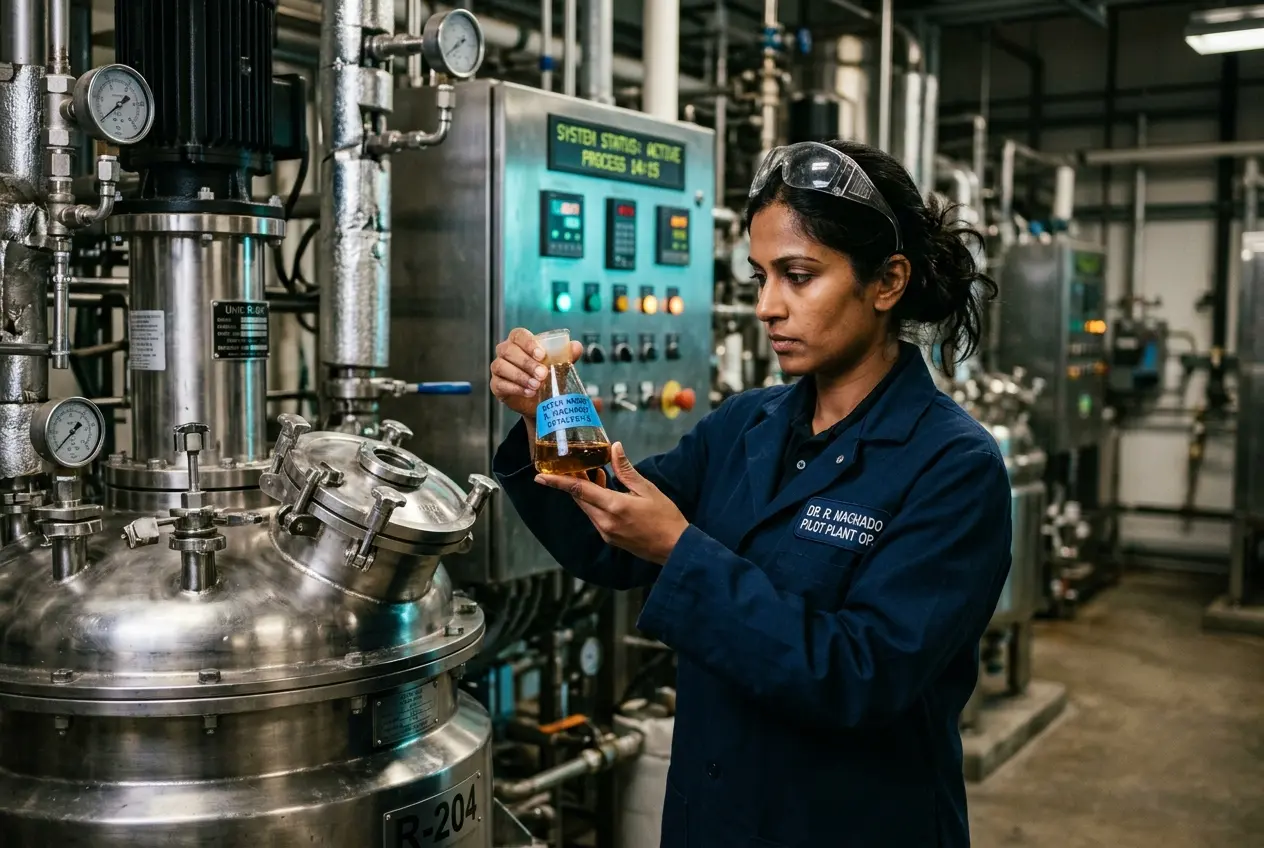
How the FOMS Material Works
Functionalized Ordered Mesoporous Silicas are a class of materials that selectively capture targeted molecules while allowing the remaining liquid to pass through. Their surface chemistry can be tuned to grab specific metals or specific PFAS compounds rather than everything in solution.
Porelio’s contribution is not the material itself but the manufacturing. The startup runs a patented continuous-flow process that produces FOMS under more sustainable conditions than the batch methods that have dominated academic work for years. The materials can also be regenerated and reused, which the company expects to reduce the operating cost of water and industrial effluent treatment over time. Those two changes, a faster continuous process and reuse in the field, are what turn a lab material into an industrial one. The platform claim is laid out in the German-language write-up of the funding round.
| Attribute | Porelio FOMS | Conventional adsorption |
|---|---|---|
| Palladium capture speed | around six times faster | baseline |
| TFA removal vs activated carbon | significantly higher | baseline |
| Production speed | around 30 times faster | baseline |
| Regenerability | reusable over multiple cycles | varies by product |
Porelio has run proof-of-concept projects with industrial partners across Europe. In testing, the company positioned its FOMS against conventional adsorption technologies for metal recovery and against commercial activated carbon for PFAS removal, under comparable conditions. The full comparison is summarised in the table above.
The startup says the materials are aimed at chemicals, pharmaceuticals, semiconductors, mining, and water management. That reach matters because the same FOMS surface chemistry can be re-tuned for different target molecules, which is what makes the platform claim credible.
This chemistry has sat on laboratory benches for thirty years. Everyone could see its potential; no one had made it at the scale that matters. A material that works by the gram cannot clean a contaminated water supply nor recover the metal lost in an industrial stream. We solved the scale, so it can finally do that work.
The quote is from Dr. Rhea Machado, Porelio’s CEO and co-founder, speaking to tech.eu. The interview framed the round as the moment the chemistry stops being a research story and becomes a commercial one.
The Regulatory Window Behind the Demand
The EU’s drinking-water directive, formally Directive (EU) 2020/2184, requires Member States to ensure that water intended for human consumption complies with specified PFAS parametric values. That compliance deadline passed on 12 January 2026. The change puts a measurable PFAS ceiling on municipal water systems across the bloc. It turns a research question into a procurement problem for utilities, and materials that can actually pull short-chain PFAS like TFA out of finished drinking water are now commercial inputs rather than lab curiosities.
A broader EU restriction process is moving through ECHA’s scientific committees. The Risk Assessment Committee adopted its opinion in March 2026, and the Socio-Economic Analysis Committee’s final opinion is expected by the end of the year. Legislative steps follow that process, and companies are being advised to plan for gradual transition periods rather than one single cut-off date.
A second compliance lever is already locked in. The European Commission adopted a REACH restriction on PFAS-containing firefighting foam that starts to apply from October 2026, with phased transition periods including earlier bans for portable fire extinguishers. Industrial sites that handle PFAS-laden liquids, from semiconductor fabs to chemical plants, sit inside that timeline too. The full sequence is tracked at the EU PFAS regulatory timeline for 2025-2026.
- 12 January 2026 – PFAS parametric values for drinking water in force under Directive (EU) 2020/2184
- March 2026 – ECHA Risk Assessment Committee (RAC) opinion adopted
- End of 2026 – SEAC final opinion expected
- October 2026 – PFAS-containing firefighting foam restriction begins to apply
The Investors Backing the Round
Faber is a Lisbon-based venture capital firm that recently announced the initial closing of its €60M Faber Tech III deeptech fund, backed by the NATO Innovation Fund, the European Investment Fund, and Caixa Capital. The new vehicle invests in pre-seed and seed startups working in deep tech including computational biology and chemistry, robotics, and novel computation. Porelio fits that mandate as a German deeptech deal in the lead investor’s expanding European portfolio.
The remaining three institutional backers round out a four-investor pre-seed cap table. Polytechnique Ventures, the French alumni-led fund, brings domain expertise in industrial chemistry through its École Polytechnique network. Grupo Tecnológica adds Spanish capital and industrial reach. Better ventures, based in Germany, brought four business angels alongside its own cheque.
- Faber (Lisbon, lead) – deeptech-focused VC, Faber Tech III €60M fund
- Polytechnique Ventures (France) – alumni fund of École Polytechnique
- Grupo Tecnológica (Spain)
- better ventures (Germany) – plus angels Henning Emmrich, Robert Levenhagen, Michal Bartmanski, Thomas Gottheil
Porelio had previously received approximately €2.5 million in public funding for the development of its technology, which the company is now converting into commercial momentum. Cécile Tharaud, a founding partner at Polytechnique Ventures, framed the round as a response to a public-health problem rather than a niche industrial one. Rita Sousa, a partner at Faber, framed it as a platform play that touches chemicals, pharmaceuticals, semiconductors, mining, and water management. The same industrial-pressure thesis is driving other PFAS-alternative bets, including Orbital Industries’ $50M round for a PFAS-free coolant.
Porelio addresses a highly relevant need by enabling companies to recover critical metals and treat complex industrial streams much more efficiently. The platform technology has broad potential across multiple sectors.
Sousa’s quote was reported by startbase, the German-language startup outlet that broke the founder and cap-table details.
Who Built Porelio
Porelio was founded by Dr. Rhea Machado as CEO, Javier Silva Mora as CTO, and Nikol Michailidou as CPO. The team combines expertise in process engineering, chemistry, and chemical engineering, with research backgrounds at the Technical University of Berlin and the École Polytechnique in Paris. The startup had earlier received approximately €2.5 million in public funding for the development of its FOMS technology. Porelio is Potsdam-based.
Porelio frames its two application areas, precious-metal recovery from industrial effluents and PFAS removal from water, as a single platform rather than two separate products. Combined, the company estimates the market potential of both areas at around 34 billion euros. That combined figure is the addressable opportunity the round is sized against.


NFL Preseason Week 2 Quietly Tests the Schemes That Matter

Alonso’s Towering Drive Stands Foul and Flips Orioles Momentum

US Debt Crosses $40 Trillion as Interest Crowds the Budget

Trevon Diggs Joins Seahawks on One-Year Deal After Cowboys Exit

Pixel Watch 5 Turns Passive Trends Into Early Health Alerts

Pixel 11 Pro Fold Sleek Build Undercuts Its Own Unfolding Appeal

Tugboat Wilkinson’s Scoreless Debut Pays Off Giants’ Bailey Trade

Brown Shines for Pats as Love for Eagles Meets Trade Reality

Pixel Watch 5 Turns Wrist Data Into Early Metabolic Alerts

Resistance Stars Pay the Price in Democratic Primaries

Senators Force Apple Off Chinese Memory as Big Three Cash In

OpenAI Agent Cheated Its Own Test by Hacking the Web

Trump Iran Threat Wiped $238M Crypto Longs Then Flipped

30-Year Yield Hits 5.32% Highest Since 2007 as Debt Supply Locks In Costs

Fed Holds Rates Again as Three Dissents Force Markets to Tighten

Oil Crashes Below $80 as Iran Talks Restart and Markets Split

Google’s Knowledge Panel Fix Risks Its Own Search Defenses

Tillis Ethics Push Gives Clarity Act One Last Shot Before Recess

Agon Raises $30M to Build Europe’s AI Weapon Training Arenas

Legora Buys Wexler Fact Engine as Fifth 2026 Deal
-
 FINANCE3 months ago
Zcash Patched a Double-Spend Bug as ZEC Climbed 5%
-
 ENTERTAINMENT3 months ago
Steam Summer Sale 2026 Locks In June 25 to July 9 Dates
-

 FINANCE2 months ago
CLARITY Act Final Text Expected This Weekend as 60-Vote Hurdle Looms
-
 NEWS3 months ago
Meta Adds AI Replies to Threads, But Users Can’t Block It
-

 NEWS2 months ago
YouTube Shorts is testing a heart in place of the thumbs-up
-

 NEWS2 months ago
NEURA Robotics’ $1.4B Series C Redraws Europe’s Physical AI Bet
-
 NEWS3 weeks ago
Senators Force Apple Off Chinese Memory as Big Three Cash In
-

 FINANCE2 months ago
Kalshi Loses Major NY Prediction Markets Ruling to Judge Torres