
FINANCE
Blockchain Association’s Crime-Fighting Pitch Runs Into a Police Divide
The Blockchain Association calls the CLARITY Act a crime-fighting bill, but police groups representing over 70,000 officers warn it creates gaps.

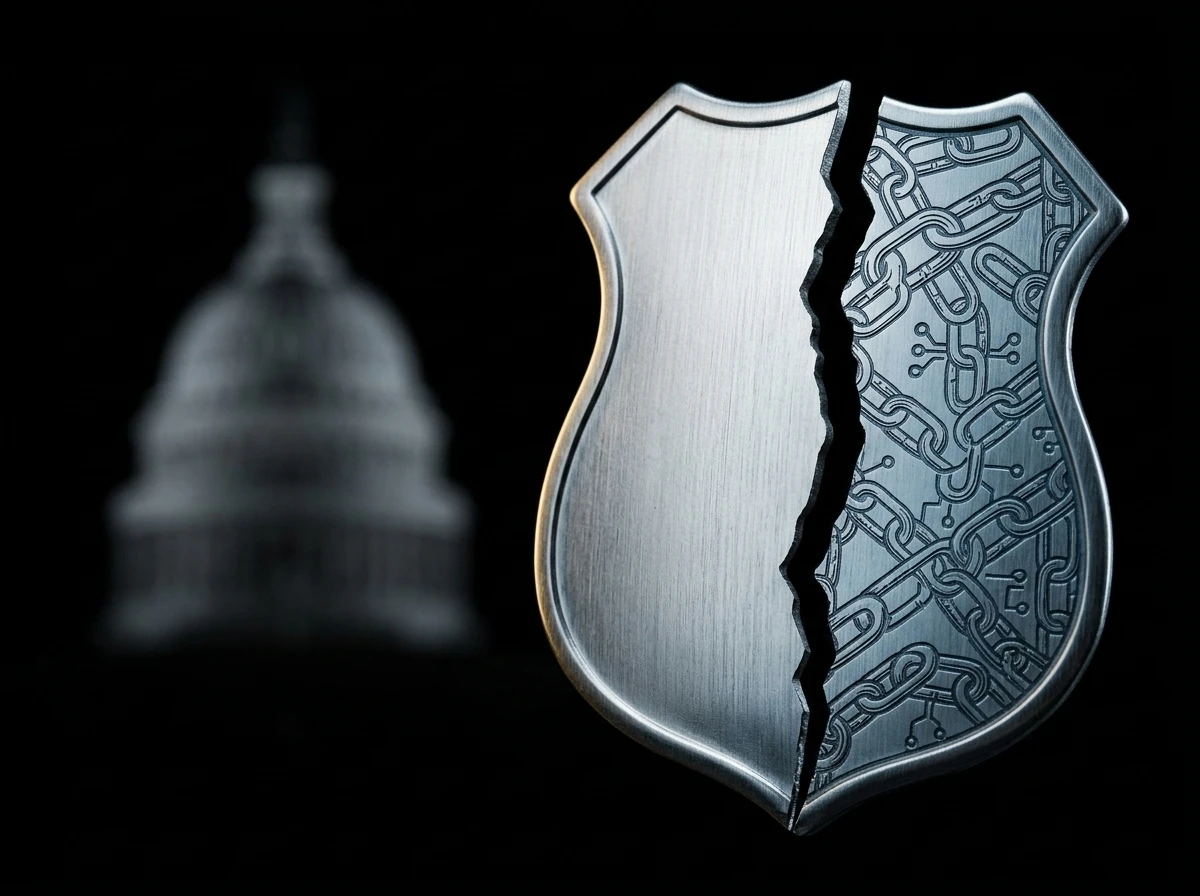
The Blockchain Association wants Washington to see the CLARITY Act as a crime-fighting law, not a crypto industry wish list. Formally called the Digital Asset Market Clarity Act, the bill would place crypto exchanges, brokers and custodians under direct federal oversight for the first time. Four national law enforcement groups representing more than 70,000 officers and prosecutors say its central developer exemption would do the opposite.
The dispute lands the same week House lawmakers gather at Federal Hall in New York to sell the bill’s benefits, with Polymarket’s odds of enactment this year down to about 43% from the mid-70s in May, and the Senate’s August recess closing in fast.
Blockchain Association Sells CLARITY Act as a Crime-Fighting Tool
The industry’s argument centers on one idea: firms operating legally inside the United States answer to regulators, while activity routed offshore or through unclear rules does not. Bringing more of the market under federal registration, the group says, gives investigators better visibility into where money actually moves.
The Blockchain Association wrote that clear rules empower law enforcement, adding that companies operating inside a defined federal framework can become stronger compliance partners for investigators. Ripple’s chief legal officer, Stuart Alderoty, made a similar case, arguing that voting the bill down would leave bad actors free to keep exploiting a market with no federal rulebook at all.
The legislation itself, filed in Congress as a system of regulation for digital commodity markets, would newly require:
- Registration, examinations and recordkeeping duties for exchanges, brokers, dealers and custodians
- Expanded anti-money-laundering, sanctions and reporting obligations for regulated intermediaries
- Federal oversight of digital asset kiosks, the machines widely known as Bitcoin ATMs
- Registration, transaction disclosures and anti-fraud rules for kiosk operators
That framework is real. It is also the exact bill that four of the country’s biggest police, sheriff and prosecutor associations spent June warning could backfire.
Odds Sink to 43% as the Senate Clock Runs Out
The bill has moved further than any earlier crypto proposal, then stalled at the moment its backers wanted it finished. It passed the House 294 to 134 in July 2025. The Senate Agriculture Committee advanced its own version 12-11 along party lines this January. The Senate Banking Committee took the biggest step on May 14, voting 15-9, with all 13 Republicans joined by Democratic Senators Ruben Gallego of Arizona and Angela Alsobrooks of Maryland, who advanced the bill in a historic bipartisan vote.
Neither Democrat promised the committee vote would carry to the floor. The bill was placed on the Senate’s legislative calendar June 1, formally eligible for floor time, then missed the White House’s own July 4 signing target. The Senate returned from recess July 13, already inside a two-week window before the August break, and it still needs 60 votes to survive a filibuster.
- 294-134: the House vote that passed the bill in July 2025
- 15-9: the Senate Banking Committee vote advancing it in May 2026
- 43%: Polymarket’s odds of enactment this year, down from the mid-70s in May
- 60 votes: the Senate floor threshold still standing between the bill and the President’s desk
Europe is not waiting on Washington. The European Union’s Markets in Crypto-Assets regulation, known as MiCA, is already operational, and Ripple secured full authorization in Luxembourg this month, a move that shows how quickly firms redirect compliance operations toward whichever jurisdiction offers settled rules.
Senate Majority Leader John Thune has pledged floor time before the recess, with the week of July 20 under active discussion.
Sheriffs and Prosecutors Say the Bill Leaves Gaps
The fight over crime-fighting claims is not abstract. Blockchain analytics firm TRM Labs estimated illicit crypto volume reached $158 billion in 2025, up nearly 145% from 2024. The Federal Bureau of Investigation’s (FBI) 2025 Internet Crime Report put cryptocurrency investment fraud losses alone at $7.2 billion.
Four of the country’s largest law enforcement associations, including the National Sheriffs’ Association and the International Association of Chiefs of Police, sent a joint letter on June 23 to Acting Attorney General Todd Blanche and White House crypto adviser Patrick Witt. Together the signatories represent more than 70,000 prosecutors, chiefs and sheriffs.
Their target is Section 604, built from the earlier Blockchain Regulatory Certainty Act (BRCA), which shields software developers who never control customer funds from being classified as money transmitters. The groups said the safe harbor sweeps in more than code writers, and warned other provisions would reduce transparency and limit accountability in the anti-money-laundering system.
The National Sheriffs’ Association had already put its objection in writing two months earlier, telling Senate Banking Committee leaders that “No good reason supports giving mixers, tumblers, and DeFi a blanket exemption.”
A Department of Justice spokesperson pushed back the next day, saying the letter contained factual inaccuracies and mischaracterized administration policy, and that investigators’ access to information would not change under the bill. The Blockchain Association’s chief policy officer, Lindsay Fraser, made a related point, saying Section 604 exempts only developers who cannot move, freeze or control user funds, not intermediaries who do. Nearly 100 Catholic leaders raised a parallel concern the same month, warning the bill could weaken safeguards against human trafficking.
The split among law enforcement groups now looks like this:
| Group | Position on the Bill | Stated Reason |
|---|---|---|
| National Sheriffs’ Association, International Association of Chiefs of Police, National District Attorneys Association, National Association of Assistant United States Attorneys | Oppose Section 604 | Joint June 23 letter warns the developer safe harbor could shield mixers and DeFi platforms from anti-money-laundering rules |
| National Organization of Black Law Enforcement Executives (NOBLE) | Endorses the bill | Says it adds new capabilities while preserving existing criminal enforcement authorities |
| Fraternal Order of Police | Opposes Section 604 | April 21 letter warned the exemption would limit prosecutors’ financial crime cases |
| Department of Justice | Defends the bill | Called the June 23 letter factually inaccurate about investigators’ access to data |
The Senate Banking Committee’s own minority staff went further, warning in a formal advisory that the draft fails to close the Tornado Cash sanctions loophole.
A Letter With 160 Names Draws Its Own Backlash
The Blockchain Association answered with its own letter, signed by 160 former law enforcement, intelligence and national security officials and sent to Senate leaders in early June. The group then arranged meetings between some of those signatories and senators.
The Revolving Door Project, a watchdog group that tracks ties between government officials and corporate interests, said the letter obscures how many signatories now work for crypto companies. Its executive director, Jeff Hauser, said the industry is “so assured of its complete control over the U.S. Senate that it believes this farce is sufficient.”
TRM Labs published its own section-by-section review arguing that criminal liability for knowingly facilitating crime survives Section 604 under existing federal law, regardless of the safe harbor. White House crypto adviser Patrick Witt has described the bill as “pro-regulatory, pro-enforcement,” arguing the deeper problem is the current absence of any federal standard at all.
Not every Democrat on the Banking Committee is convinced. Senator Catherine Cortez Masto said after May’s vote that the bill “undermines law enforcement’s ability to trace illicit finance and recover victims’ money.”
Consumer advocates raised a separate alarm. The National Consumers League urged Senate leaders to oppose the bill, arguing it leaves gaps in fraud protection, ethics rules and financial stability alike.
Banks object for different reasons entirely. JPMorgan Chase chief executive Jamie Dimon said in May that banks would fight the bill because it lets digital asset firms pay deposit-like rewards without the safeguards banks must follow, a skepticism that lines up with JPMorgan’s own warnings about blockchain’s risk to Bitcoin.
The Long Road to a Senate Floor Vote
Getting here took fourteen months.
- May 29, 2025: Rep. French Hill introduces the Digital Asset Market Clarity Act in the House.
- July 17, 2025: The House passes the bill 294-134 and sends it to the Senate.
- January 29, 2026: The Senate Agriculture Committee advances its version 12-11 along party lines.
- May 14, 2026: The Senate Banking Committee advances the bill 15-9.
- June 1, 2026: The bill is placed on the Senate Legislative Calendar as Calendar No. 423.
- July 13, 2026: The Senate returns from recess with weeks left before August.
- July 14, 2026: A merged Senate draft drops the ethics language Democrats demanded, and three senators announce their opposition.
Even a Senate win this month would not flip a switch overnight. The framework still needs reconciliation with the House’s 2025 text, and analysts tracking the bill’s rulemaking timeline expect the Securities and Exchange Commission (SEC) and the Commodity Futures Trading Commission (CFTC) to spend into 2027 and 2028 writing the actual rules, meaning enforceable compliance duties would arrive in phases, not immediately.
Grayscale’s own research note describes the bill’s core function as splitting oversight between the SEC and the CFTC, replacing a decade of enforcement-driven regulation with a statute that would be harder for a future administration to unwind.
Trump’s Own Crypto Fortune Complicates the Endgame
The dispute now holding up the bill has nothing to do with police or prosecutors. It is whether the law restricts a sitting president’s own crypto business.
Financial disclosures released this month showed Trump earned about $1.2 billion in crypto-related income last year, including roughly $594 million from World Liberty Financial and $635 million tied to his meme coins. Democratic Senators Ruben Gallego and Angela Alsobrooks have said their committee votes do not guarantee floor support without a fix limiting officials’ personal crypto ties.
A merged Senate draft released Tuesday combined the Banking and Agriculture committees’ texts but left that provision out. Senators Chris Murphy, Chris Van Hollen and Jeff Merkley responded with a press conference formally opposing the bill.
President Trump is expected to meet with senators this week to try closing the gap himself, according to people familiar with the plans. He has pushed lawmakers toward passage without ever saying publicly what restrictions on his own businesses he would actually sign.
The fight gained a personal edge after Senator Lindsey Graham, a longtime Trump ally, died over the weekend at 71. Trump wrote on Truth Social that “the U.S. Senate should pass the Clarity Act” in Graham’s honor, casting the vote as part of a broader competition with China over financial technology.
Missing the August recess, one of the bill’s lead Senate authors has warned, would not simply delay the legislation. It would hand the rulebook to someone else first.
We spend the next decade catching up.
Senator Cynthia Lummis of Wyoming made that warning to colleagues, arguing no other country should get to set digital asset rules before the United States does.
Friday’s field hearing at Federal Hall cannot pass anything by itself. It puts industry lobbyists, police associations and undecided senators in the same room two blocks from Wall Street, one week before Thune’s promised floor vote and roughly three weeks before the Senate leaves town for August.
Frequently Asked Questions
What Is Section 604 of the CLARITY Act?
Section 604, built from the earlier Blockchain Regulatory Certainty Act, exempts software developers who never control customer funds from being classified as money transmitters under the Bank Secrecy Act. TRM Labs argues that criminal liability for knowingly facilitating crime survives under existing federal money-laundering law regardless of the exemption, a distinction both critics and supporters cite in the same argument.
How Many Senate Votes Does the CLARITY Act Still Need?
The bill needs 60 votes to clear a Senate filibuster. Reporting on the negotiations has put the number of additional Democratic votes required at roughly seven, since the Republican majority alone falls short of that threshold.
Will the CLARITY Act Become Law in 2026?
It is not guaranteed. Polymarket priced the odds at around 43% in mid-July, down from the mid-70s in May, though Senate Majority Leader John Thune has pledged floor time before the August recess. Galaxy Research had earlier estimated that, at the pace Congress was keeping, a signed bill could arrive during the week of August 3, an estimate made before July’s ethics standoff hardened.
Why Do Some Police Groups Support the Bill While Others Oppose It?
The split centers on Section 604. The National Sheriffs’ Association, the International Association of Chiefs of Police and two prosecutor associations say the developer exemption is written too broadly. The National Organization of Black Law Enforcement Executives endorsed the bill instead, calling it legislation that provides “meaningful new capabilities while preserving longstanding criminal enforcement authorities.”
What Would the CLARITY Act Do to Bitcoin ATMs?
Kiosk operators, the machines commonly called Bitcoin ATMs, would face new federal registration, transaction disclosure and anti-fraud requirements under the bill. Supporters say the rules target scammers who use unmonitored kiosks to move stolen funds quickly, the same abuse pattern regulators have flagged in fraud cases nationwide.
Disclaimer: This article is for informational purposes only and does not constitute investment, legal or financial advice. Cryptocurrency markets and pending legislation carry significant uncertainty and risk. Consult a qualified professional before making financial decisions. Figures are accurate as of publication on July 17, 2026.


Nvidia Buys Hugging Face, the Platform That Turned It Down

OpenAI Names GPT-6 Astra AGI, Then Locks It Down

Relay Q Bets a $150 Puck Can Beat Dictation Apps

Accel Backs Atira to Automate Industrial Sales Engineering

Beyerdynamic Hides a Spare Battery in the Aventho Y

Lummis Pushes the CLARITY Act to Export Wyoming’s Crypto Banks

AI Exposure Turns a Cloud Beat Into a Selloff

Citadel’s XRP ETF Filing Looks Like Dealer Inventory

Revolut’s OCC Nod Starts an 18-Month US Bank Clock

British Business Bank’s Zinc Fund Will Mint 80 Startups

Walter’s TWG Insists No Fraud as Insurer Probes Force Cleanup

30-Year Yield Hits 5.32% Highest Since 2007 as Debt Supply Locks In Costs

PCE Stays at 3.7% as Gas and Tariffs Outrun Coming Revisions

Astute’s $1.2M bet makes B2B creator deals feed AI discovery

Strategy Parks $1.59B Cash While Bitcoin Stack Stays Flat

SpaceX Stock Rebound Tests Real Demand Before Huge Unlock

The 20% Savings Ideal Meets a 2.7% Reality Check

Monzo chair Gary Hoffman exits after board revolt fallout

Amber’s €7M locks Mittelstand knowledge inside Europe

AI data centers win as RAM kits jump nearly 500 percent
-
 FINANCE3 months ago
Zcash Patched a Double-Spend Bug as ZEC Climbed 5%
-
 ENTERTAINMENT3 months ago
Steam Summer Sale 2026 Locks In June 25 to July 9 Dates
-

 FINANCE2 months ago
CLARITY Act Final Text Expected This Weekend as 60-Vote Hurdle Looms
-
 NEWS4 months ago
Meta Adds AI Replies to Threads, But Users Can’t Block It
-

 NEWS3 months ago
YouTube Shorts is testing a heart in place of the thumbs-up
-

 NEWS1 month ago
Senators Force Apple Off Chinese Memory as Big Three Cash In
-

 NEWS3 months ago
NEURA Robotics’ $1.4B Series C Redraws Europe’s Physical AI Bet
-
 ENTERTAINMENT5 months ago
Extraction 3 Is Officially Coming to Netflix in 2027