
NEWS
Work Louder Built OpenAI’s First Hardware, a $230 Codex Keypad
OpenAI’s $230 Codex Micro keypad launched this week, though the hardware itself is a Montreal studio’s design already worn by Figma and Framer.

OpenAI began selling its first piece of hardware this week, a $230 mechanical keypad built for its Codex coding agent. Pre-orders opened July 15, with the first units due to ship before the end of the month.
The device is called Codex Micro, and Work Louder designed it, a small Montreal keyboard studio now on its third major tech partnership using nearly the same hardware each time. OpenAI added the software and lighting. Work Louder built almost everything else.
A Dial That Adjusts How Hard the AI Thinks
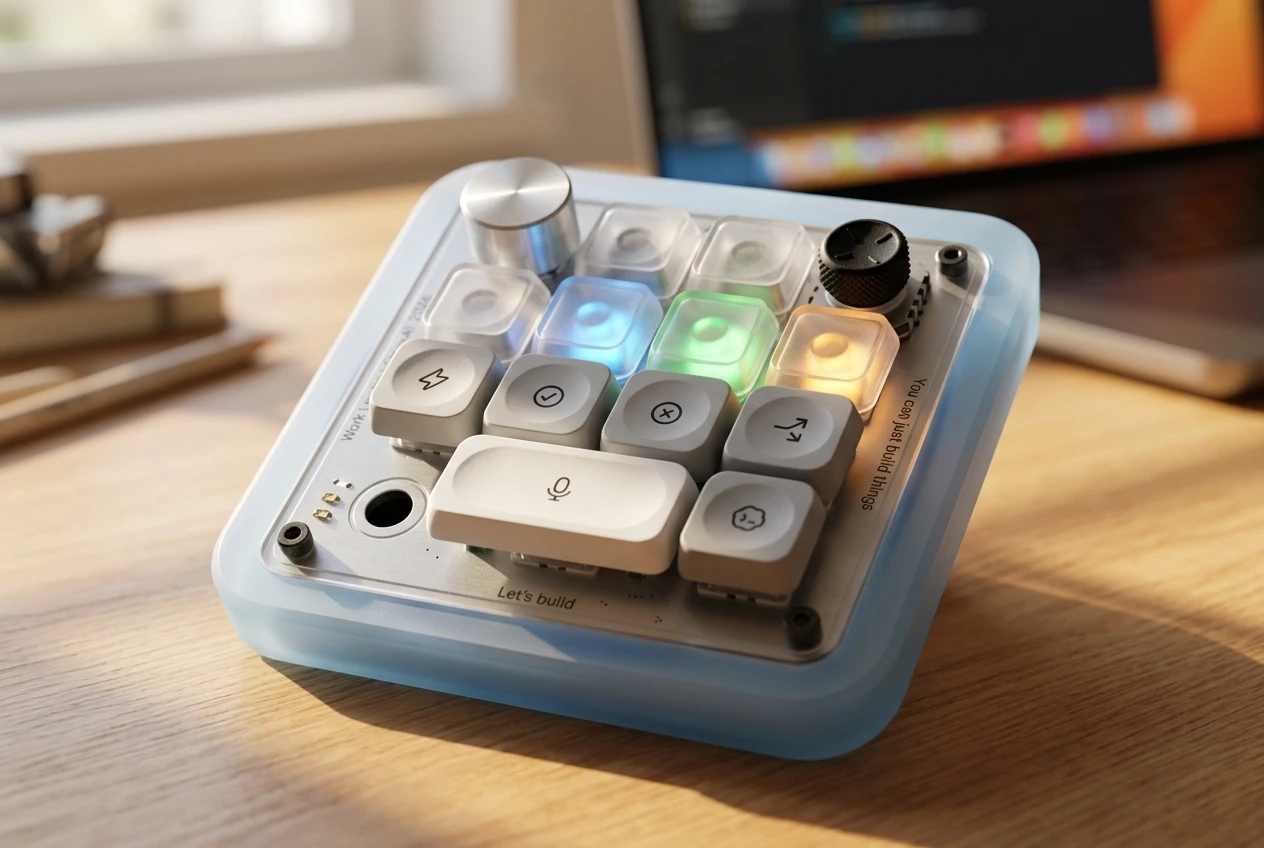
OpenAI first teased the keypad’s silhouette on June 29 at the AI Engineer World’s Fair, then followed with full specs and pricing on July 15. What shipped is a compact macro pad carrying 13 mechanical switches, a touch sensor, a rotary dial and a small analog joystick.
Six of those switches are what OpenAI’s own product page calls Agent Keys, each lit from within to show the live status of a running Codex task before a user even switches tabs. The color code is specific:
- White – the agent is idle and waiting for a new task
- Blue – the agent is actively thinking through a problem
- Green – the job is finished and ready for review
- Amber – the agent needs input before it can continue
- Red – something has gone wrong and thrown an error
A single tap on a key selects the agent tied to it. A double tap brings that thread to the front of the screen. The rotary dial raises or lowers Codex’s reasoning level in real time, so a developer can keep things fast for routine edits and turn the depth up for a harder problem without opening a settings menu. The joystick fires off multi-step workflows such as reviewing a pull request, debugging an error or refactoring a block of code. The keypad ships with 32 extra keycaps, including a Codex-specific icon set, and connects over Bluetooth or USB-C to both Windows and Mac machines.
The Keyboard Studio Behind Figma, Framer and OpenAI
Work Louder is not a name most developers know. It designs and builds modular mechanical keyboards out of Montreal, and its signature product is a small macro pad called the Creator Micro, which packs the same switch, dial and joystick combination now sitting inside Codex Micro.
The pattern started in December 2023, when Figma paired with Work Louder to build a version of that keypad for its own design software. Work Louder co-founder Michael di Genova said the grid layout made it “super easy to mentally map your custom shortcut placement.” Website builder Framer later commissioned its own co-branded version, using the identical chassis with a different icon set and colorway.
Codex Micro is the third company to put its name on that hardware. OpenAI supplied the software, the RGB agent telemetry and the reasoning dial. The switches, the touch sensor, the joystick and the rotary encoder are the same parts Work Louder already sells under its own brand, and already sold to two other companies before OpenAI showed up.
Same Chassis, Bigger Price Tag
| Keypad | Partner Brand | Launched | Price | Standout Feature |
|---|---|---|---|---|
| Creator Micro 2 (base) | Work Louder only | Ongoing | $144 to $199 | Standard 13-switch, joystick and dial layout |
| Figma Creator Micro | Figma | December 2023 | $139 | 48 mappable shortcuts across two rotary encoders |
| Codex Micro | OpenAI | July 2026 | $230 | RGB Agent Keys mirror live Codex task status |
The base Creator Micro 2 hardware that underpins all three runs from about $144 for a wired version to roughly $199 for the wireless Pro model. Codex Micro costs $230, a premium of $30 to $85 over Work Louder’s own product for what is mostly a software layer, new keycaps and colored lighting bolted onto a keypad that already existed.
That gap has drawn criticism online, with buyers asking whether a rotary dial and a joystick justify a price close to a mid-range monitor arm. The honest answer depends on how often someone runs Codex. A developer juggling several coding agents saves real time by glancing at a lit key instead of alt-tabbing between browser tabs. Someone who opens Codex twice a week is paying $230 for a fancier version of a shortcut they already know. General-purpose macro pads, including Elgato’s Stream Deck line, offer similar tactile programmability at a range of price points, minus the Codex-specific dial and agent telemetry, and they work with any application rather than one company’s coding tool.
The Hardware Everyone Wanted Waits Until 2027
Most people picture something else entirely when they hear the phrase OpenAI hardware: a screen-free companion gadget the company has been building with Jony Ive, the designer behind the iPhone and iMac, since it bought his startup io Products for $6.5 billion in 2025.
That device is not coming soon. Court filings made public in February showed OpenAI pushing its ship date from the end of 2026 to no earlier than February 2027, with no packaging or marketing materials built yet. The same filings confirmed OpenAI dropped the io name after a trademark dispute brought by an unrelated audio startup called iyO.
Sam Altman, OpenAI’s chief executive, has tried to lower expectations himself. “Do not expect anything very soon,” Altman said, citing unresolved compute, privacy and personality questions. Financial Times reporting has described OpenAI engineers still wrestling with how to run large models on a small, battery-powered gadget, while Amazon and Google already have years of cloud infrastructure behind their own smart speakers.
A Lawsuit Calls the Hardware Business Rotten to Its Core
The Ive device is also why OpenAI’s hardware plans are tangled up in court. Apple filed a trade secrets lawsuit against OpenAI on July 10 in the U.S. District Court for the Northern District of California, naming io Products alongside two individuals: Tang Yew Tan, a 24-year Apple veteran who left the company in early 2024 to help found io before becoming OpenAI’s chief hardware officer, and Chang Liu, a former Apple systems engineer who joined OpenAI in January 2026.
Apple’s complaint accuses Liu of downloading confidential hardware files after failing to return a company laptop, and accuses Tan of directing OpenAI job candidates still employed at Apple to bring hardware components to interviews for what the filing calls “show and tell” sessions. Apple says more than 400 of its former employees now work at OpenAI.
Rotten to its core by its illegal reliance on misappropriated trade secrets.
Apple wrote in its July 10 trade secret complaint, describing OpenAI’s entire hardware operation as built on stolen material. Drew Pusateri, OpenAI’s director of strategic communications, said the company has “no interest in other companies’ trade secrets,” Fortune reported. Apple is separately seeking an injunction forcing OpenAI to return any disputed material, a request that could complicate its hardware timeline even further.
Codex Micro is not part of that fight. Apple’s complaint targets io Products and the Ive-designed device specifically. Work Louder built Codex Micro on hardware it already owned before OpenAI became a customer, which keeps the keypad clear of the dispute. Apple’s complaint also states that its separate deal putting ChatGPT inside Apple Intelligence is not part of the claims.
Is the Codex Micro Worth $230?
For most people, no. The keypad only pays for itself if someone already runs Codex constantly, since its reasoning dial, agent status lights and workflow joystick have no function outside OpenAI’s coding tool. OpenAI has said Codex now draws more than five million weekly users, which is the audience this accessory is actually built for.
Codex itself has grown past a simple coding sidebar. OpenAI recently folded it into a broader app alongside standard ChatGPT and a general productivity tool called ChatGPT Work, which is part of why a dedicated control surface might matter more now than it would have a year ago. Codex also competes for developer attention against Anthropic’s Claude Code and rivals from Google and Meta. OpenAI’s own Operator coding agent already fights that battle on the software side, while Meta’s Muse Spark 1.1 model has undercut rivals on price while lagging on raw coding ability. A $230 keypad tied exclusively to Codex only pays off if OpenAI keeps winning that daily-usage fight.
Buyers should weigh the limited-run status too. OpenAI’s own launch post on X leaned into the scarcity, telling buyers to “get yours before stock returns 410,” a nod to the HTTP error code for a page that is gone for good. Work Louder and OpenAI have both described supply as constrained, with no promise of restocks, confirmed international shipping or long-term software support once the first batch sells out.
Pre-orders remain open on OpenAI’s site and on Work Louder’s own store, with shipping due before August. Three different tech brands have now paid a small Montreal keyboard studio to put their name on the same design, and OpenAI is only the latest.


The House Cancels September Votes and Strands the CLARITY Act

Ascentiz Recruits Developers Around Its Modular Exoskeleton at IFA

Saylor’s Bitcoin Speech Claim Needs a Statute

Zeit AI Raises €5 Million for the Mid-Market Data Layer

Onwards and Sideways Turns Five Good Years Into a Joke

The Galaxy Watch 9 Splits Samsung’s Watch Update Path

Rightcharge Raises £500,000 as Fleets Drift Onto Public Chargers

Early Payment Discounts Hand Buyers a 37 Percent Return

AI Score Raises $5.4 Million as Security Alumni Watch Agents

Sony’s PlayStation Settlement Pays Users in Store Credit

Walter’s TWG Insists No Fraud as Insurer Probes Force Cleanup

30-Year Yield Hits 5.32% Highest Since 2007 as Debt Supply Locks In Costs

PCE Stays at 3.7% as Gas and Tariffs Outrun Coming Revisions

Evernorth S-4 Clears Path for Active XRP Treasury on Nasdaq

Astute’s $1.2M bet makes B2B creator deals feed AI discovery

Strategy Parks $1.59B Cash While Bitcoin Stack Stays Flat

Instinct Hits $2.5 Billion as AI Agent Access Sparks Trust Fights

Amber’s €7M locks Mittelstand knowledge inside Europe

CLARITY Act Cloture Opens a Door Ethics Still Blocks

SpaceX Stock Rebound Tests Real Demand Before Huge Unlock
-
 FINANCE3 months ago
Zcash Patched a Double-Spend Bug as ZEC Climbed 5%
-
 ENTERTAINMENT3 months ago
Steam Summer Sale 2026 Locks In June 25 to July 9 Dates
-

 FINANCE2 months ago
CLARITY Act Final Text Expected This Weekend as 60-Vote Hurdle Looms
-
 NEWS4 months ago
Meta Adds AI Replies to Threads, But Users Can’t Block It
-
 ENTERTAINMENT5 months ago
Extraction 3 Is Officially Coming to Netflix in 2027
-

 NEWS3 months ago
YouTube Shorts is testing a heart in place of the thumbs-up
-

 NEWS1 month ago
Senators Force Apple Off Chinese Memory as Big Three Cash In
-

 NEWS3 months ago
NEURA Robotics’ $1.4B Series C Redraws Europe’s Physical AI Bet