
BUSINESS
Five Startups Wager Brussels Will Write Sensors Into Clean Air Law
Five sensor makers launched CT4CA in Brussels to push EU states to recognize low-cost air sensors before national clean air laws lock in this December.

Five companies that build low-cost air pollution sensors launched a coalition in Brussels today, and they are chasing a deadline the announcement itself barely mentioned. European Union member states have until December 2026, about five months from now, to write the bloc’s revised Ambient Air Quality Directive into national law.
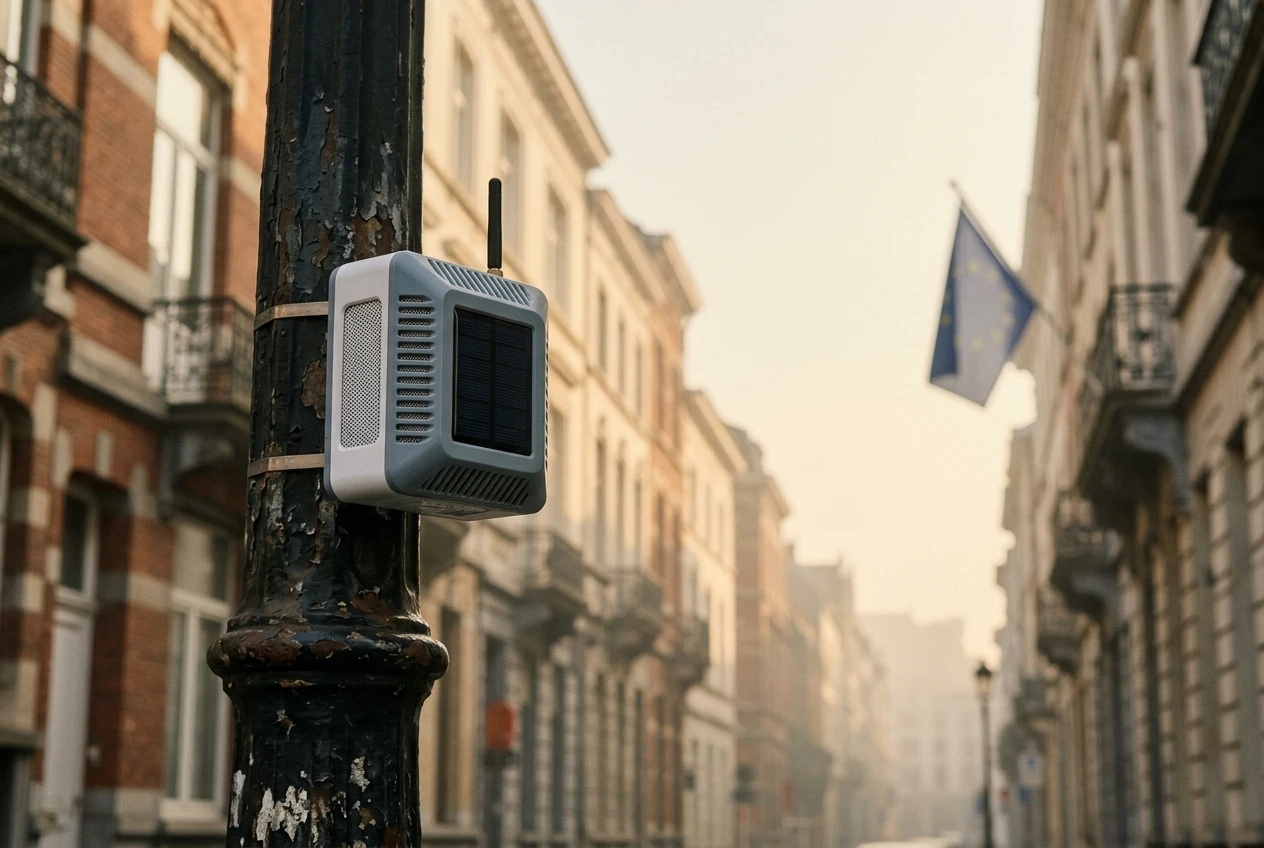
The coalition, called Clean Tech for Clean Air (CT4CA), groups Poland’s Airly, France’s Ecomesure and Ellona, Spain’s Kunak Technologies and the US-based Clarity Movement Co. Together they want national governments to formally recognize small, low-cost sensors as legitimate tools for tracking pollution, not just the sparse network of expensive reference stations that currently define legal compliance.
A Coalition Lands With a Deadline Already Ticking
Wiktor Warchałowski, chief executive and co-founder of Airly, is spearheading the effort. The Kraków based company he helped start in 2016 has grown into one of Europe’s more established air quality sensor networks, and its lead role gives CT4CA a base in a fight that will ultimately be settled in 27 separate capitals rather than in Brussels alone.
The revised Ambient Air Quality Directive entered into force in December 2024, after roughly two years of negotiation between the European Parliament and the Council. Member states then got two years to transpose the directive into law, a clock that runs out this December. Whatever each government decides to say about sensor data in that national text will be very hard to unwind afterward.
- October 26, 2022: The European Commission proposes merging two older air quality directives into one, with a 2050 zero-pollution goal attached.
- February 20, 2024: Parliament and Council negotiators strike a provisional deal on stricter 2030 limits for fine particulates and nitrogen dioxide.
- April 24, 2024: Parliament formally adopts the text by 381 votes to 225.
- October 14, 2024: The Council gives its final green light.
- December 10, 2024: The revised directive enters into force across the bloc.
- December 2026: Deadline for every member state to transpose the rules into national law.
- January 1, 2030: Stricter pollutant limit values become legally binding.
That sequence took over two years just to clear the EU level. CT4CA is now asking two dozen national bureaucracies to settle a much narrower technical question, whether small sensors count, in a fraction of that time.
Most Europeans Still Breathe Air the WHO Would Fail
Nobody in this fight disputes the underlying health numbers. European Environment Agency data cited by the coalition show that 95 percent of city dwellers in the EU are still exposed to pollutant concentrations above World Health Organization guideline levels, despite years of measurable air quality improvement across the bloc.
Air pollution worsens asthma and other chronic conditions. It also contributes to ischaemic heart disease and lung cancer, adding up to roughly 300,000 premature deaths across Europe every year, according to the Council of the EU. Emerging research now links long-term exposure to dementia too, with some studies suggesting that disease burden could eventually outweigh several of the other conditions already blamed on dirty air.
The directive’s own numbers explain the urgency. The annual limit for PM2.5, the fine particulate matter tied to most pollution deaths, drops from 25 micrograms per cubic meter to an interim limit of 10 micrograms by 2030. The WHO’s own guideline sits at 5 micrograms, so even the tightened EU standard is still double what health researchers consider safe.
The European Commission’s impact assessment put a price on waiting. It estimated gross annual benefits of up to €121 billion (roughly $130 billion) against projected costs of less than €6 billion a year, with premature deaths from air pollution potentially falling by more than 55 percent once the rules take full effect.
Three Asks, Built on Rules That Already Exist
CT4CA’s policy request breaks into three parts: formal recognition of high-quality small sensors as a tool for closing monitoring gaps, use of technical specifications that already exist to enable deployment now, and greater acceptance of sensor data by the public authorities that write local air-quality plans.
Fixed reference stations still handle the legal measurements that determine compliance. CT4CA wants sensors layered alongside them, filling the gaps between stations that can sit kilometers apart in the same city.
| What CT4CA Is Asking For | What Already Exists to Support It |
|---|---|
| Formal recognition of small sensors in national transposition law | The directive’s own stronger monitoring and modelling requirements, due to apply from December 2026 |
| Use of existing European technical specifications | CEN’s 2024 particle sensor performance standard and its 2021 companion standard covering gas sensors |
| Wider authority acceptance of sensor readings | the JRC’s open source AirSensEUR sensor system, built and field tested by the EU’s own science service |
Those standards did not appear overnight. CEN, the European Committee for Standardization, published its first sensor-system performance benchmark back in 2017 and has kept refining it since. The European Commission’s Joint Research Centre has run its own multi-city trials too, deploying dozens of low-cost units alongside official stations in Antwerp, Oslo and Zagreb to see how the cheaper technology holds up against reference-grade equipment.
The Five Companies Behind the Coalition
The founding members are not equally sized, and they arrive with very different track records.
- Airly (Poland) – founded in Kraków in 2016 by Warchałowski and two co-founders; the company has since raised a $5.5 million Series A round backed by investors including Richard Branson.
- Kunak Technologies (Spain) – builds sensor packages for carbon monoxide, ozone, nitrogen oxides, sulfur dioxide and particulate matter, with campaign deployments from Belgium to Ethiopia; it also belongs to a separate transport focused clean air alliance coordinated by the campaign group Transport and Environment.
- Clarity Movement Co (United States) – based in Berkeley, California, and has installed monitors in hundreds of cities worldwide, including London, Los Angeles, Singapore and Manila.
- Ecomesure (France) – one of two French members, supplying sensor systems and environmental data services to public authorities.
- Ellona (France) – the coalition’s other French member, also working in environmental data and air quality monitoring.
Warchałowski has made his pitch bluntly before. Government-run stations are typically too expensive to build more than a handful per city, he told TechCrunch in 2022, and the ones that exist can take hours to report what they measure.
A Niche Market Compounding at 26 Percent a Year
There is money behind the health argument. The global installed base of small, non-regulatory air quality sensors reached 154,000 units in 2023 and is projected to grow at a compound annual rate of 26.4 percent over five years, according to one global smart cities market study. Europe, alongside North America and China, leads adoption.
All five CT4CA members show up on lists of the sector’s leading vendors. So do at least nine rivals that did not join the coalition, including Aclima, Vaisala, PurpleAir and Germany’s Breeze Technologies. Big tech has already noticed the space: Google absorbed Airly rival Breezometer in a September 2022 acquisition, folding its pollution forecasting into its own mapping products.
Can Member States Just Buy More Time?
Yes, within limits. The revised directive lets a member state postpone its 2030 attainment deadline by up to ten years, until January 1, 2040, but only if it can show either a high share of low-income households paired with below-average national income, or modelling proving the tighter pollutant limits are technically unreachable on time.
Extensions are not automatic. Brussels requires a bespoke roadmap showing how compliance will still be reached as soon as possible, and regulators can reject a weak one. That postponement clause applies to the 2030 pollution limits, not to the transposition deadline itself.
Every government still has to put something on the books by December 2026, sensors included or not.
Frequently Asked Questions
What counts as a small air quality sensor under EU rules?
European standards treat a low-cost sensor as part of a broader Sensor System that bundles the sensing element with power supply, sampling hardware and data handling. CEN’s technical specifications, first published for gas sensors in 2021 and extended to particle sensors in 2024, define how these bundled systems get evaluated for accuracy before authorities can trust their readings.
Which pollutants does the revised Ambient Air Quality Directive cover?
The directive lowers allowable levels for twelve pollutants: fine and coarse particulate matter, nitrogen dioxide and nitrogen oxides, sulphur dioxide, ozone, carbon monoxide, benzene, benzo(a)pyrene, arsenic, cadmium, nickel and lead. Most of CT4CA’s sensor hardware focuses on the particulate matter and nitrogen dioxide readings that drive the bulk of Europe’s health impact.
Do low-cost sensors replace official monitoring stations?
No. Legal compliance with binding EU limit values is still measured through reference-grade fixed stations that meet strict data-quality rules. Low-cost sensors fill in the spatial gaps between those stations, which is why CT4CA frames its request as a complement rather than a substitute.
What happens if an EU country misses the transposition deadline?
Member states that fail to transpose or enforce an EU directive on time can face infringement proceedings, and the European Court of Justice has the power to impose financial penalties in cases that reach it. Earlier infringement actions have already been pursued under the previous, less strict version of the air quality rules.
Has any EU country agreed to formally recognize sensor data yet?
Not on the public record. CT4CA only launched its campaign today, and its three core requests, formal recognition, use of existing technical specifications and wider authority acceptance of sensor readings, remain asks directed at the national governments now drafting their transposition laws ahead of the December 2026 deadline.


British Business Bank’s Zinc Fund Will Mint 80 Startups

Philips Hue IFA Gear Opens TVs and Gates the Hub

Souk Raises $1.6 Million for Its AI Partner Manager

Anthropic Bets on Cheaper Cache for Claude Fable 5.1

Food Processors Back Backbone’s €4 Million Quality Round

Scosche Bets IFA Shoppers Will Buy Fewer Charging Bricks

ELO Bets Sentinel XR Gaming Glasses at IFA Berlin

ShiftCam SuperZoom Lenses Bet on a 350mm Phone Gap

Clooney Defends Ruffalo’s Speech While Collecting Venice’s Lion

Jungheinrich Is the Sole Backer of Uplift’s €100M Fund

30-Year Yield Hits 5.32% Highest Since 2007 as Debt Supply Locks In Costs

Walter’s TWG Insists No Fraud as Insurer Probes Force Cleanup

Astute’s $1.2M bet makes B2B creator deals feed AI discovery

Strategy Parks $1.59B Cash While Bitcoin Stack Stays Flat

PCE Stays at 3.7% as Gas and Tariffs Outrun Coming Revisions

SpaceX Stock Rebound Tests Real Demand Before Huge Unlock

The 20% Savings Ideal Meets a 2.7% Reality Check

Amber’s €7M locks Mittelstand knowledge inside Europe

Monzo chair Gary Hoffman exits after board revolt fallout

Nvidia’s $16,000 RTX Pro 6000 Turns Local AI Into a Luxury
-
 FINANCE3 months ago
Zcash Patched a Double-Spend Bug as ZEC Climbed 5%
-
 ENTERTAINMENT3 months ago
Steam Summer Sale 2026 Locks In June 25 to July 9 Dates
-

 FINANCE2 months ago
CLARITY Act Final Text Expected This Weekend as 60-Vote Hurdle Looms
-
 NEWS4 months ago
Meta Adds AI Replies to Threads, But Users Can’t Block It
-

 NEWS3 months ago
YouTube Shorts is testing a heart in place of the thumbs-up
-

 NEWS1 month ago
Senators Force Apple Off Chinese Memory as Big Three Cash In
-

 NEWS3 months ago
NEURA Robotics’ $1.4B Series C Redraws Europe’s Physical AI Bet
-
 ENTERTAINMENT5 months ago
Extraction 3 Is Officially Coming to Netflix in 2027