
FINANCE
Iran’s Tanker Claims Push Oil Past $91 While Insurers Set the Price
Iran’s tanker attack claims sent Brent crude past $91 and Bitcoin lower, but war-risk insurers, not missiles, are what’s actually pricing the Hormuz standoff.

Brent crude jumped to $91.40 a barrel on July 20, its highest level since June 11, after Iran’s Islamic Revolutionary Guard Corps (IRGC) claimed it had exploded and disabled two oil tankers in the Strait of Hormuz. Bitcoin slipped to $64,051.61, down 0.87% on the day. Gold, the asset that is supposed to climb when wars break out, fell too.
A London underwriting room, not a missile, set the price that actually moved. War-risk insurers reprice the Strait within hours of any claim, verified or not, and that repricing is what is now bleeding into oil, gold and Bitcoin alike.
Iran’s Tanker Claim Meets CENTCOM’s Ninth Night of Strikes
The IRGC said the two tankers were hit in the southern Strait of Hormuz and warned the waterway “will not be safe” for oil and petrochemical transit as long as U.S. military activity in the region continues. It told American forces to prepare for a “punitive operation.”
U.S. Central Command (CENTCOM) confirmed on X that it opened a new wave of strikes for the ninth consecutive night at 7 p.m. ET on July 19, aimed at degrading Iran’s ability to hit commercial vessels and civilian mariners transiting the Strait.
The blockade runs both ways. CENTCOM said Navy sailors aboard the guided-missile destroyer USS John Finn had redirected six vessels and disabled one by July 19 to enforce compliance with the naval blockade against Iran.
The Strait normally carries roughly a fifth of the world’s oil supply each day, a corridor this year’s fighting has already pushed toward a 9 million barrel daily cut in flow. Neither Monday’s tanker claim nor the exact strike count has been independently verified.
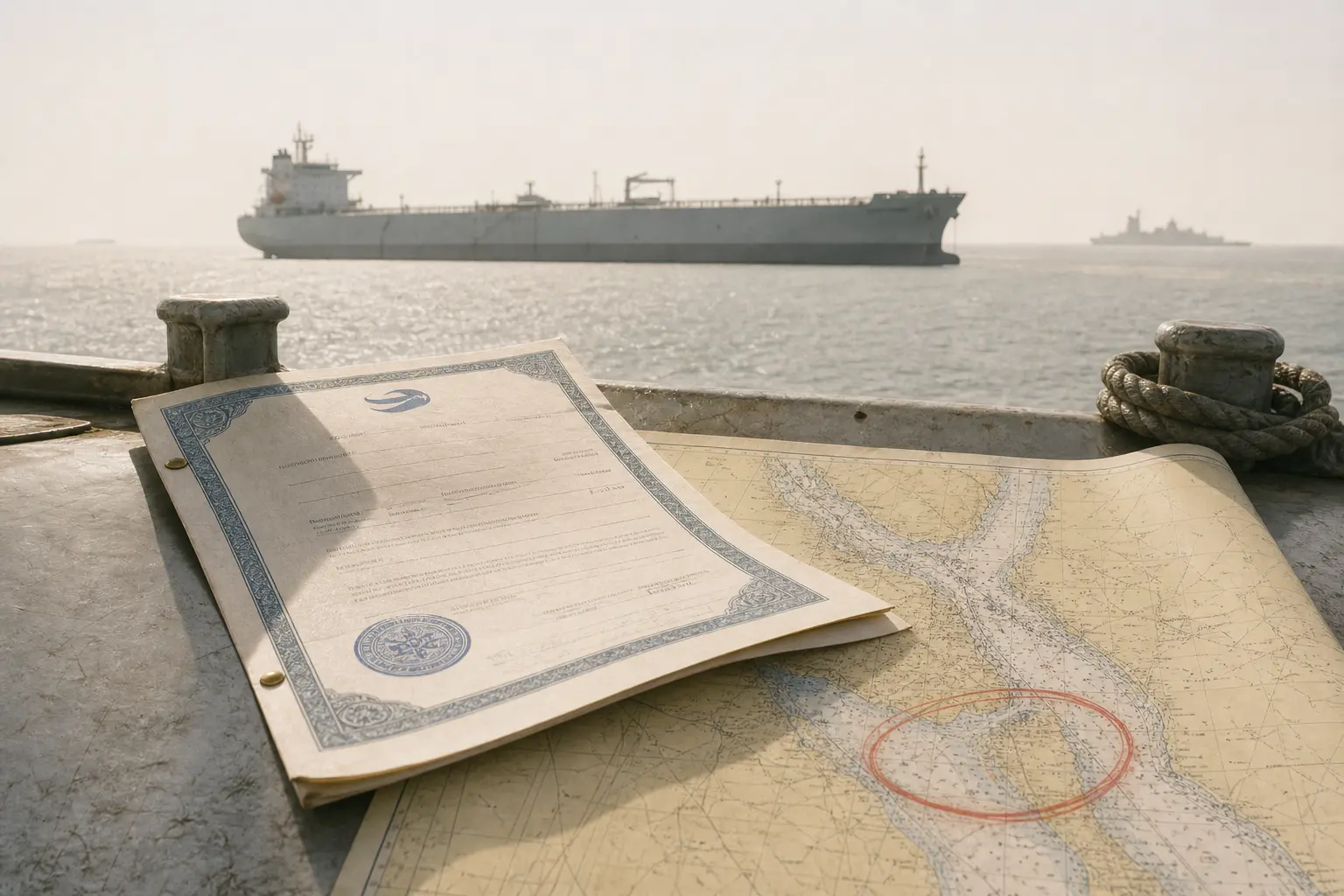
The Insurance Desk Setting Oil’s Real Price
Before February 28, insuring a supertanker for one Hormuz transit cost about 0.25% of hull value, roughly $250,000 on a $100 million ship. By last week that same transit cost between 3% and 10% of hull value, or $3 million to $10 million, according to the Abu Dhabi based paper The National.
“War rates have been on a roller coaster mirroring the development of the price of oil,” said Marcus Baker, global head of marine, cargo and logistics at the insurance brokerage Marsh.
The mechanism is procedural, not military. The Lloyd’s Joint War Committee (JWC), which designates high-risk maritime zones for the Lloyd’s of London market, has listed the Gulf as an area of enhanced risk, meaning every vessel entering it needs additional war-risk cover at whatever rate underwriters quote that week. The Lloyd’s Market Association (LMA) has said 88% of underwriters still willing to write Hormuz cover, just at far higher prices.
“War-risk rates have moved as risk has moved,” said Neil Roberts, head of marine and aviation at the LMA, earlier this month, describing a softening after the U.S. and Iran signed a memorandum of understanding in June, then an uptick after three vessels were attacked.
Two officials looking at the same numbers reach different conclusions about whether the price is fair.
Where the experts disagree:
- Marcus Baker, Marsh: premiums are simply tracking oil’s own swings in a live, responsive market.
- Arsenio Dominguez, IMO secretary general: market pricing is not adjusting as conditions improve, which he calls a matter of “great concern.”
- Iran’s Revolutionary Guard navy: transit under Iranian oversight has recovered to roughly half of pre-war levels, a claim this month’s shipping-tracking data does not support.
The International Maritime Organization (IMO) has pressed insurers to reflect current conditions rather than the peak of the crisis. So far, the market has not listened.
Gold and Bitcoin Are Both Failing the Safe-Haven Test
Gold surged within hours when this war first broke out in February, part of a run that carried it to an all-time high above $5,600 an ounce by January. It has not worked that way this month.
Gold traded near $4,017 an ounce on July 14, down 2.6% in a single session, after Iran announced a fresh closure of the Strait, according to gold slid to $4,017 an ounce on July 14 as war-risk headlines hit.
Arslan Butt, an analyst at FX Leaders, wrote that “this geopolitical escalation is driving the price of oil higher, instead of gold as it should,” tying the move to rising bets on a Federal Reserve rate increase.
The same logic now works against Bitcoin. Higher oil raises inflation expectations. Inflation expectations raise the odds of tighter Fed policy. Tighter policy pulls money out of assets that pay no interest. Gold pays no interest. Neither does Bitcoin, which is still up 2.16% on the week despite Monday’s dip, supported by a market capitalization of about $1.28 trillion and roughly 20 million coins in circulation, according to CoinGecko data.
Iran’s Bitcoin Toll Keeps Collecting Anyway
While Bitcoin’s price answers to Fed expectations, Iran spent the year building a separate use for it: a way around the sanctions this same war is meant to enforce.
Since April, Iran has charged tankers roughly $1 a barrel in bitcoin, stablecoins or yuan for safe passage through the Strait. Hamid Hosseini, a spokesperson for Iran’s Oil, Gas and Petrochemical Products Exporters’ Union, told the Financial Times how the toll would work in practice, in comments later cited by the blockchain analytics firm Chainalysis.
Vessels would be given a few seconds to pay in bitcoin, ensuring they can’t be traced or confiscated due to sanctions.
The toll is one piece of a wider system that detailed Iran’s Bitcoin toll plan for Hormuz months before this week’s tanker claim:
- Bitcoin mining – Iran hosts roughly 4.5% of global Bitcoin mining, according to the blockchain analytics firm Elliptic, turning subsidized electricity into cryptocurrency that sanctions cannot easily reach.
- Per-barrel crypto tolls – tankers have been asked to pay about $1 a barrel in digital currency for Hormuz passage since April 2026.
- Sanctioned exchanges – Nobitex, which once handled more than half of Iran’s digital-asset inflows, was sanctioned by the Treasury’s Office of Foreign Assets Control (OFAC) on June 2, 2026.
- Stablecoin settlement – dollar-pegged tokens such as USDT give oil traders price stability without touching the U.S. banking system.
Iran’s crypto ecosystem generated an estimated $7.8 billion in trading activity in 2025. That figure is large enough that U.S. enforcement now treats it as a national security question rather than a financial-crime footnote.
Five Months of Escalation, Five Market Whiplashes
This week’s tanker claim is not an isolated shock. It is the fifth clear turn in a cycle that has run since late February.
| Date | Development | Market Reaction |
|---|---|---|
| Feb 28, 2026 | U.S. and Israel launch coordinated strikes on Iran; war begins | Hormuz war-risk premiums surge fivefold within 48 hours; gold jumps from about $5,100 to over $5,300 an ounce |
| June 17, 2026 | U.S. and Iran sign a 60-day negotiating memorandum | War-risk premiums soften; Bitcoin rallied past $71,000 on peace-talk optimism |
| July 10, 2026 | Iran resumes tanker attacks after the truce; renewed U.S. strikes follow | Premiums climb back toward 5% of hull value, the new market norm at the time |
| July 17, 2026 | Iran hits UAE supertankers Mombasa and Al Bahyah with cruise missiles, killing one sailor | War-risk premiums reach their highest level of the war so far |
| July 20, 2026 | IRGC claims two more tankers exploded and were disabled in the southern Strait | Brent hits $91.40, highest since June 11; Bitcoin dips to $64,051.61 |
Each turn followed the same script. A claim or an attack lands, underwriters reprice within a day or two, and Brent moves before anyone outside the shipping industry has confirmed what actually happened on the water.
What Would Actually Move These Prices This Week?
A verified attack, a confirmed ceasefire, or a shift in Federal Reserve language would move markets fastest. Brent above $92 to $95 a barrel would deepen inflation fears and add pressure to Bitcoin. A denial from CENTCOM or Tehran, or fresh imagery confirming or disproving the tanker claim, could reverse the move within hours.
Brent at $91.40 is the level to watch first. A sustained push past $92 to $95 would intensify inflation concerns and spread pressure across risk assets, the same mechanism already dragging gold lower this month. An official denial of the tanker claim, or a de-escalation statement from either side, could unwind the premium just as fast.
Verifying any of it independently just got harder. Planet Labs, the satellite imagery company that had been tracking damage across the region, halted its coverage of the war zone indefinitely this month, leaving traders to price a claim they cannot see confirmed from orbit.
The crypto research outlet Coin Bureau called Monday’s jump in oil unusually fast, even by this war’s standards.
Brent was still trading above $91 a barrel late Monday. The ninth night of strikes CENTCOM announced a day earlier was not the last one planned.
Frequently Asked Questions
How often do war-risk insurance premiums change during the Hormuz crisis?
Marine war-risk cover is typically sold in seven-day blocks and can be repriced every 24 to 48 hours as underwriters reassess the threat level. Even a small percentage shift adds hundreds of thousands of dollars a day in extra cost for a large tanker.
How many tankers have been damaged since the war began in February?
Industry estimates from the reinsurance broker Howden Re put the number at nine to fifteen tankers damaged since February 28, implying up to $1.75 billion in industry losses before cargo is even counted. Named casualties include the Nova, the Stena Imperative and the MKD Vyom.
How many mariners are stranded by the standoff?
Roughly 6,000 seafarers were trapped in the region as of mid-July, according to reporting cited by The National, with the International Maritime Organization working to evacuate stranded crews through safe corridors.
Does paying Iran’s crypto toll violate U.S. sanctions?
Yes. U.S. guidance states that payments to the Government of Iran or the IRGC for safe passage through the Strait, in any form including digital currency, are not authorized for U.S. persons or U.S.-linked entities, regardless of whether a payment is actually made.
Disclaimer: This article is for informational purposes only and is not investment advice. Oil, gold and cryptocurrency prices are highly volatile and can move sharply on unverified reports; consult a licensed financial adviser before trading, and note that figures here are accurate as of publication on July 20, 2026.


Replit Opens Its London Office Inside an AI Crowd

Straight Circle Trailer Lands Without a U.S. Date

Anemo Labs Bets £700,000 on an AI Sense of Smell

Nintendo Prices the Zelda 40th Switch 2 at $519

Copilot Capital Buys the Autopilot Already Running 90 GW

Ground A Raises €9.1 Million for a Pallet Laser

Gibney’s Musk Film Opens in Venice Without Its Subject

Torvalds Blames AI for a Full-Fat Linux 7.3-rc2

Dexter Returns Sharper, Older, and Stuck Between Killers

Meta’s Muse Agent Can Spend Before the Privacy Lock

Walter’s TWG Insists No Fraud as Insurer Probes Force Cleanup

30-Year Yield Hits 5.32% Highest Since 2007 as Debt Supply Locks In Costs

PCE Stays at 3.7% as Gas and Tariffs Outrun Coming Revisions

Evernorth S-4 Clears Path for Active XRP Treasury on Nasdaq

Astute’s $1.2M bet makes B2B creator deals feed AI discovery

Strategy Parks $1.59B Cash While Bitcoin Stack Stays Flat

CLARITY Act Cloture Opens a Door Ethics Still Blocks

Instinct Hits $2.5 Billion as AI Agent Access Sparks Trust Fights

Oracle’s 2.8 GW Bloom Deal Exposes the AI Power Bypass

AI data centers win as RAM kits jump nearly 500 percent
-
 FINANCE3 months ago
Zcash Patched a Double-Spend Bug as ZEC Climbed 5%
-
 ENTERTAINMENT3 months ago
Steam Summer Sale 2026 Locks In June 25 to July 9 Dates
-

 FINANCE2 months ago
CLARITY Act Final Text Expected This Weekend as 60-Vote Hurdle Looms
-
 NEWS4 months ago
Meta Adds AI Replies to Threads, But Users Can’t Block It
-
 ENTERTAINMENT5 months ago
Extraction 3 Is Officially Coming to Netflix in 2027
-

 NEWS3 months ago
YouTube Shorts is testing a heart in place of the thumbs-up
-

 NEWS1 month ago
Senators Force Apple Off Chinese Memory as Big Three Cash In
-

 NEWS3 months ago
NEURA Robotics’ $1.4B Series C Redraws Europe’s Physical AI Bet