
NEWS
Google’s Frozen v2 Chip Bets on an Architecture It Just Delayed
Google’s Frozen v2 chip could cut Gemini’s power use tenfold by 2028, but the bet assumes an architecture its own delayed flagship model still can’t fix.

Alphabet is designing a server chip that hardwires pieces of Gemini’s neural architecture directly into silicon, a project engineers project could cut AI energy costs six to ten times by 2028. The Information, a subscription tech and business news outlet, first reported the chip, code-named Frozen v2. Alphabet’s stock rose roughly 3% on the news, easing investor nerves over a capital budget now topping $190 billion a year.
The wager rests on one assumption: that Gemini’s architecture holds still long enough to freeze into hardware. Four days earlier, Bloomberg reported that Google had delayed its next flagship Gemini model because that same architecture was falling short on coding tasks.
Baking Gemini’s Blueprint Into Silicon
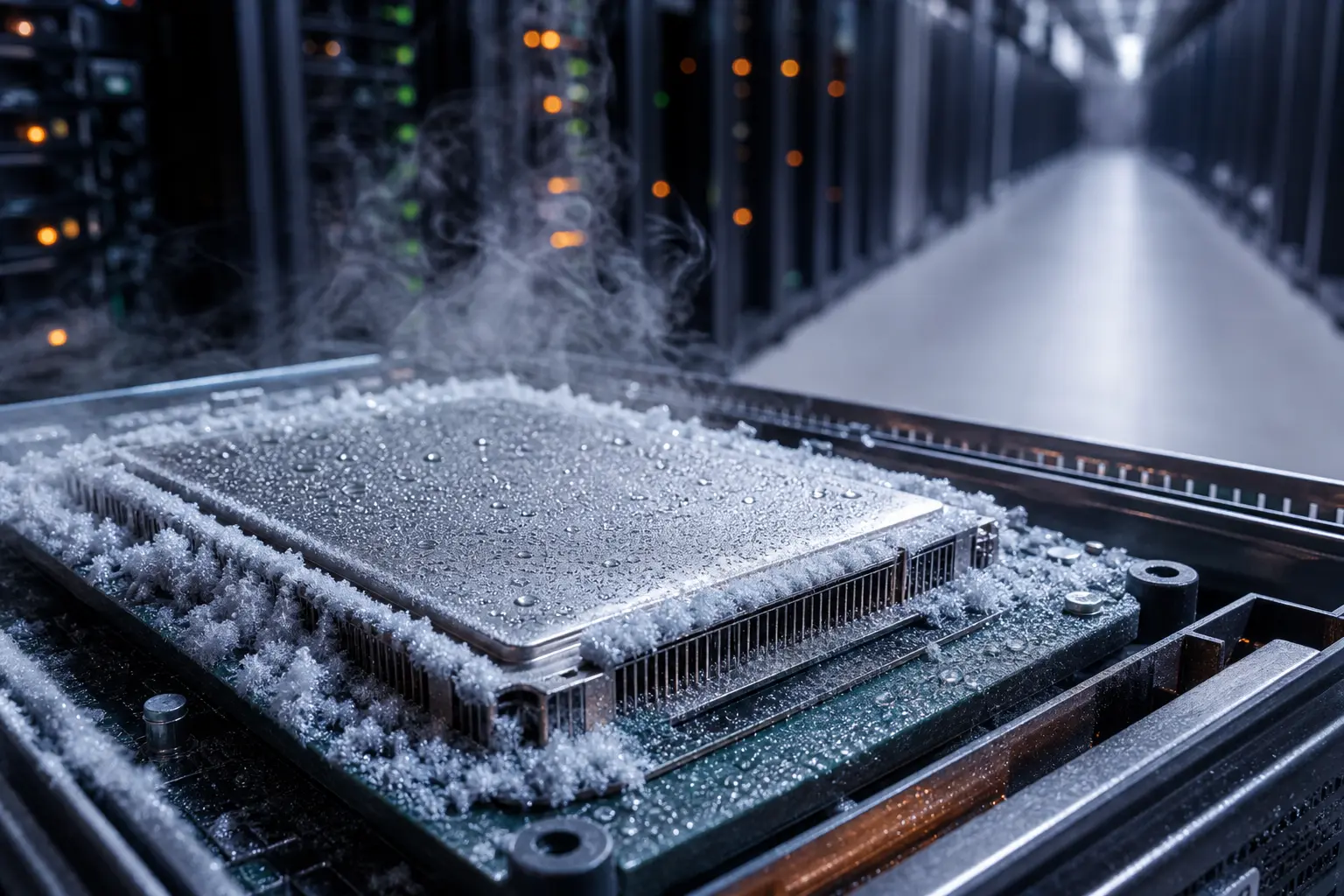
Running Gemini today means computing a model’s structural requirements from scratch on every single query. Google’s current Tensor Processing Units, its proprietary AI accelerator line known as TPUs, handle that work with general-purpose circuitry built to run almost any model.
Frozen v2 skips that step. It hardwires Gemini’s own routines directly into the chip, cutting the calculations and the data traffic between chips that drain power during heavy workloads. Google engineers estimate the result at six to ten times more tokens generated per unit of power than the latest TPU generation, though that figure reflects internal projections rather than a benchmarked result.
A Google spokesperson gave TechCrunch a careful non-answer. “Our teams are constantly researching and experimenting with new innovations to deliver maximum performance and efficiency for our users and customers,” the company said, declining to confirm or deny the chip’s existence.
The bottleneck Google is chasing, shuttling data between chips and memory during inference, is also drawing early-stage money in Europe. The photonics startup closed a €4.5 million pre-seed round for AI optical interconnects chasing the same traffic jam from a different angle.
Will Frozen v2 Replace Google’s TPUs?
No. Frozen v2 is shaping up as a separate, specialized line sitting alongside Google’s TPUs rather than a replacement for them. Because its circuitry is wired specifically to Gemini’s architecture, the chip almost certainly will not become a shared cloud product available to outside customers the way TPUs are.
Google currently leases TPUs to external customers, including Anthropic and Meta. A chip built to run only Gemini cannot serve someone else’s model on shared infrastructure, so Frozen v2 is expected to stay in-house.
- Confirmed: Alphabet is building a new server chip beyond its TPU lineup, and Google has acknowledged researching hardware-software co-design without confirming a code name or specs.
- Confirmed: Alphabet’s 2026 capital spending guidance sits at $180 billion to $190 billion, and Google Cloud has turned away enterprise demand it could not supply.
- Unconfirmed: The Frozen v2 name, its exact specifications and the 2028 date all trace back to anonymous sources cited by The Information, and Google has not verified any of it publicly.
- Unconfirmed: How much of Gemini’s architecture will actually be hardcoded, since Google’s own engineers reportedly have not finalized that design choice.
Google reportedly views the project as exploratory rather than a planned mass rollout, and production volumes are expected to fall well short of TPU levels.
The Bet on a Frozen Architecture
Hardwiring a model’s structure into silicon only pays off if that structure stops changing. Frozen v2’s entire case rests on Google’s belief that the transformer design underneath Gemini has stabilized enough to lock into permanent circuitry.
That belief carries a real cost if it turns out wrong. Should Google move Gemini toward a different architecture, a state-space design like Mamba, a hybrid system, or something not yet invented, the hardwired elements would stop matching the model they were built for. The chip could become partially or entirely obsolete before it ever reaches full production.
A Coding Delay Complicates the Wager
Google CEO Sundar Pichai told developers at the company’s I/O conference in May that Gemini 3.5 Pro, the next flagship model, would ship in June. June came and went with no release.
Bloomberg reported on July 16 that the model is months behind schedule because its coding performance fell short of internal targets. Google reset the data used to train Gemini in late June to try to fix the problem; the results disappointed, according to ten current and former employees cited in the report. Alphabet shares fell about 4.5% that day, closing at $354.17.
Some of those employees told Bloomberg they worry Google is losing ground to Anthropic and OpenAI, whose models have pulled ahead in code generation. Frozen v2 would hardwire the very architecture behind a model Google was still reworking four days before the chip story broke.
Compute Rationed Even Inside Google’s Own Walls
Frozen v2 is not only about Gemini’s electricity bill. It targets a shortage that is already costing Google business.
A Backlog That Nearly Doubled in a Quarter
Google Cloud’s revenue hit $20 billion in the first quarter of 2026, up 63% year over year, and its backlog of signed but undelivered contracts nearly doubled to $462 billion.
We are compute constrained in the near term. Our cloud revenue would have been higher if we were able to meet the demand.
Pichai told analysts on Alphabet’s first-quarter 2026 earnings call, months before Frozen v2 became public.
Meta Gets Rationed, Google Rents From SpaceX
The shortage runs deeper than one earnings call. The Financial Times reported that Google told Meta as early as March 2026 that it could not supply the full Gemini computing capacity Meta wanted, forcing Meta to ration its own internal use of AI tokens.
Google itself has had to rent capacity it doesn’t own. In June, it agreed to pay SpaceX $920 million a month, roughly $30 billion over the life of the contract, for access to about 110,000 borrowed Nvidia GPUs as bridge capacity. Anthropic separately pays SpaceX $1.25 billion a month for a different facility’s full output, a deal it signed in May.
- $462 billion: Google Cloud’s backlog of signed but undelivered contracts, nearly double the prior quarter’s total.
- $920 million a month: what Google pays SpaceX for roughly 110,000 borrowed Nvidia GPUs.
- $180 billion to $190 billion: Alphabet’s raised 2026 capital spending guidance, up from $175 billion to $185 billion.
- 63%: Google Cloud’s year-over-year revenue growth in the first quarter of 2026.
Alphabet raised that guidance at its April earnings call and disclosed a $30 billion equity offering to help fund it, warning investors that 2027 capital spending will “significantly increase” again. First-quarter capital spending alone came to $35.7 billion, more than double what Alphabet spent in the same period a year earlier. The sums dwarf Europe’s own semiconductor funding scene; Europe’s ten biggest chip funding rounds of 2025, combined, would not cover a single quarter of Alphabet’s infrastructure spending.
Nvidia’s Rivals Multiply Across the Industry
Google is not alone in trying to design its way around Nvidia. Custom chips built for one narrow job, instead of general-purpose GPUs, are now moving toward production across nearly every major AI lab and cloud provider.
OpenAI and Broadcom unveiled their own chip, an application-specific integrated circuit, or ASIC, called Jalapeño, this past June. Broadcom says the project reached a nine-month design-to-tape-out cycle, among the fastest ever for advanced chips, with initial deployment planned by the end of 2026, two years ahead of Frozen v2’s target.
| Company | Chip or Partner | Purpose | Target Timeline |
|---|---|---|---|
| Frozen v2 | Hardwired Gemini inference chip, in-house only | 2028 | |
| TPU | General-purpose AI accelerator, leased to cloud customers | Ongoing generations | |
| OpenAI | Jalapeño, with Broadcom | LLM inference chip | End of 2026 |
| Meta | Custom silicon, with Broadcom | Internal AI workloads | Through 2029 |
| Amazon | Trainium and Inferentia | Training and inference accelerators | Ongoing generations |
| Anthropic | Talks with Samsung | Custom AI hardware, exploratory | Unconfirmed |
Broadcom now designs custom silicon for Google, Meta and OpenAI alike, a role chief executive Hock Tan calls a multi-generation roadmap. Nvidia remains the dominant supplier of AI computing hardware, with a market value near $4.8 trillion, but each new custom chip chips away at a business that once faced almost no competition in AI inference.
Alphabet’s next earnings report will show whether Wall Street’s three-percent vote of confidence holds up. Frozen v2 itself will not reach production for at least two years, and only if Gemini’s architecture still looks the way it does today.


Replit Opens Its London Office Inside an AI Crowd

Straight Circle Trailer Lands Without a U.S. Date

Anemo Labs Bets £700,000 on an AI Sense of Smell

Nintendo Prices the Zelda 40th Switch 2 at $519

Copilot Capital Buys the Autopilot Already Running 90 GW

Ground A Raises €9.1 Million for a Pallet Laser

Gibney’s Musk Film Opens in Venice Without Its Subject

Torvalds Blames AI for a Full-Fat Linux 7.3-rc2

Dexter Returns Sharper, Older, and Stuck Between Killers

Meta’s Muse Agent Can Spend Before the Privacy Lock

Walter’s TWG Insists No Fraud as Insurer Probes Force Cleanup

30-Year Yield Hits 5.32% Highest Since 2007 as Debt Supply Locks In Costs

PCE Stays at 3.7% as Gas and Tariffs Outrun Coming Revisions

Evernorth S-4 Clears Path for Active XRP Treasury on Nasdaq

Astute’s $1.2M bet makes B2B creator deals feed AI discovery

Strategy Parks $1.59B Cash While Bitcoin Stack Stays Flat

Instinct Hits $2.5 Billion as AI Agent Access Sparks Trust Fights

CLARITY Act Cloture Opens a Door Ethics Still Blocks

Oracle’s 2.8 GW Bloom Deal Exposes the AI Power Bypass

Space Mirror Demo Revives 1993 Russian Night-Light Test
-
 FINANCE3 months ago
Zcash Patched a Double-Spend Bug as ZEC Climbed 5%
-
 ENTERTAINMENT3 months ago
Steam Summer Sale 2026 Locks In June 25 to July 9 Dates
-

 FINANCE2 months ago
CLARITY Act Final Text Expected This Weekend as 60-Vote Hurdle Looms
-
 NEWS4 months ago
Meta Adds AI Replies to Threads, But Users Can’t Block It
-
 ENTERTAINMENT5 months ago
Extraction 3 Is Officially Coming to Netflix in 2027
-

 NEWS3 months ago
YouTube Shorts is testing a heart in place of the thumbs-up
-

 NEWS1 month ago
Senators Force Apple Off Chinese Memory as Big Three Cash In
-

 NEWS3 months ago
NEURA Robotics’ $1.4B Series C Redraws Europe’s Physical AI Bet