
BUSINESS
Sila’s $300 Million Battery Raise Is a National Security Bet
Sila’s $300 million raise lists In-Q-Tel, the intelligence community’s venture arm, as a backer, timed to a graphite export truce expiring in November 2026.

Sila closed a $300 million round this week to expand its silicon anode battery factory in Moses Lake, Washington. Atreides Management and Sutter Hill Ventures led the raise. The California company makes a graphite substitute called Titan Silicon, and investors are backing it even as US electric vehicle (EV) demand cools.
Most coverage of the deal stopped at that contrast. Sila’s own list of backers holds a name that recasts the whole bet: In-Q-Tel, the venture arm of the US intelligence community.
What Titan Silicon Actually Replaces
Titan Silicon swaps out graphite, the material used in most lithium-ion battery anodes today. Sila says the switch lifts energy density by 20 to 40 percent over a conventional cell of the same size. That means more range for an EV, or a longer-lasting charge for a smaller gadget, without adding bulk.
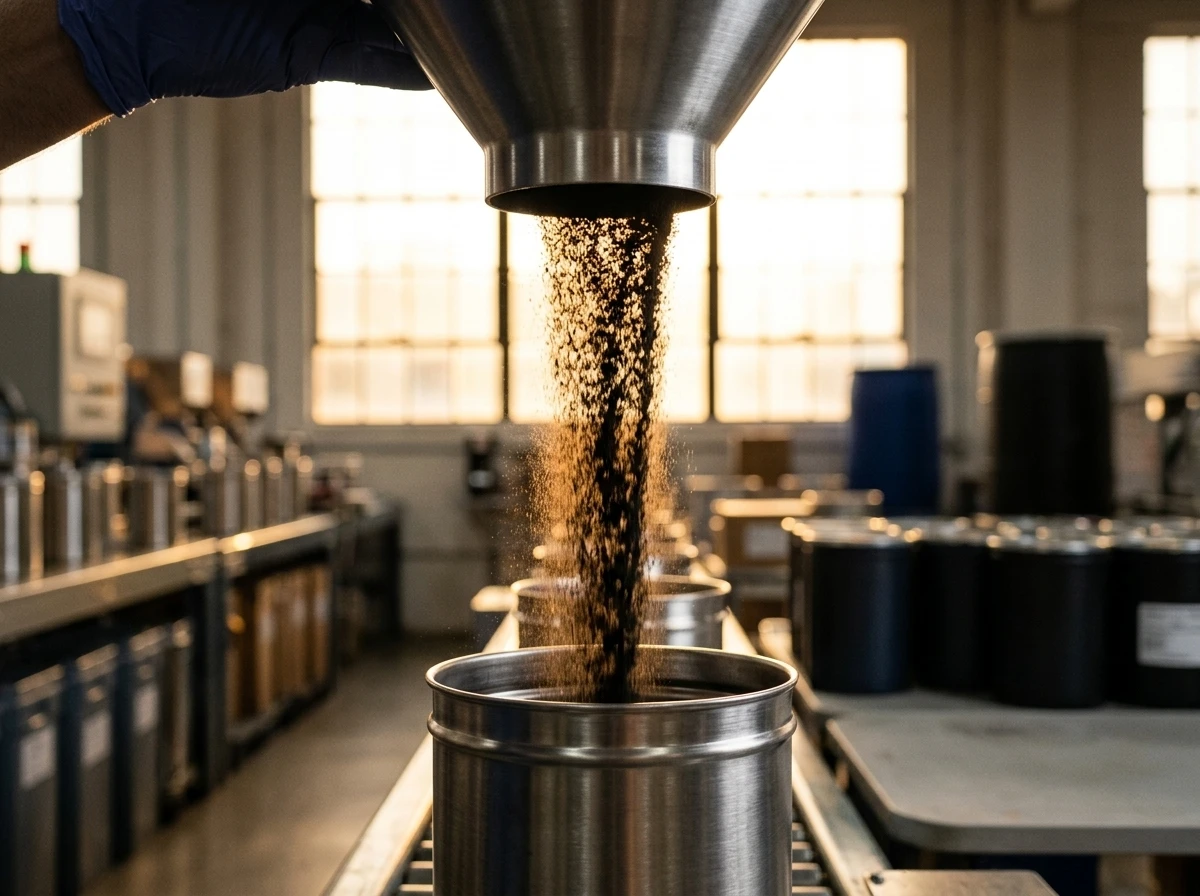
The material comes out of a renovated 600,000 square foot building on a 160 acre campus in Moses Lake, in central Washington. The plant began operating in the fall of 2025 and currently runs at a Phase 1 capacity of 2 gigawatt-hours a year. The new money funds a second phase meant to push that toward 250 gigawatt-hours within five years, a scale Sila says would make Moses Lake the largest anode production site anywhere.
Fifteen Years, One Shipped Product
Gene Berdichevsky, Sila’s co-founder and chief executive, was Tesla’s seventh employee before he started Sila in 2011 with Alex Jacobs and Gleb Yushin. Their goal was to get silicon out of the lab and into a working anode. It took a long time.
Mercedes-Benz invested in 2019 and later picked Sila’s material for its electric G-Class, with production once penciled in for the middle of this decade. Panasonic said in December 2023 it would use Titan Silicon in its own cells. Neither has shipped yet. The only product on the market today built with Sila’s anode is the WHOOP 4.0 fitness tracker, a device that needs a battery the size of a coin.
| Year | Round | Amount | What It Funded |
|---|---|---|---|
| 2019 | Series E | $219 million | Mercedes-Benz invests; G-Class collaboration begins |
| 2021 | Series F | $590 million | Scale-up toward a US factory site |
| 2022 | DOE grant | $100 million | Moses Lake building renovation begins |
| 2024 | Series G | $375 million | Finish Moses Lake construction; Coatue, CPPIB join |
| 2026 | Private equity round | $300 million | Phase 2 expansion toward 250 GWh |
Add the equity rounds and Sila has raised upward of $1.6 billion since 2011, separate from the federal grant. The $100 million Moses Lake buildout award came from the US Department of Energy (DOE) in October 2022, funded through the Bipartisan Infrastructure Law. That same award backed a plan its boosters said would build the largest silicon anode plant in the world, a claim Sila is only now spending real money to test.
Sutter Hill Ventures has backed Sila since its early days. Vic Miller, an investor there, called the shift from lab chemistry to factory output “a masterclass in American operational discipline.”
The Investor Nobody Mentioned
Sila’s own announcement of the raise lists its full roster of backers: 8VC, Atreides Management, Bessemer Venture Partners, Coatue, In-Q-Tel, Matrix Partners, Sutter Hill Ventures, and funds advised by T. Rowe Price Associates. Coatue and In-Q-Tel are not named as leads of the new round, but both sit on the company’s cap table today, according to Sila’s own release.
- Atreides Management and Sutter Hill Ventures – co-led the new $300 million round announced July 21
- 8VC, Bessemer Venture Partners, Matrix Partners – joined this week’s round alongside funds advised by T. Rowe Price Associates
- In-Q-Tel – the venture arm of the US intelligence community, listed among Sila’s existing backers
- Coatue and Canada Pension Plan Investment Board – joined through Sila’s $375 million round in June 2024
In-Q-Tel’s presence alongside a battery materials maker is not an accident. Sila has spent the past year widening its pitch beyond automakers, toward aerospace, robotics, AI infrastructure and defense customers.
You really don’t have an AI industry.
Berdichevsky told GeekWire that line, arguing the US cannot expand its AI sector while importing all the equipment and hardware that industry depends on. Battery materials, in his framing, sit next to chips as infrastructure the country cannot outsource.
The Graphite Clock Sila Is Racing
Graphite makes up about 95 percent of the anode material in today’s lithium-ion batteries. China controls roughly 75 percent of global natural graphite production and most of the downstream processing that turns raw ore into battery-grade powder, according to mining-investment research firm Crux Investor.
China’s Ministry of Commerce added lithium-ion batteries, cathode materials, and artificial graphite anode materials to its export control list in October 2025, effective November 8. One day before that rule took hold, Beijing suspended it as part of a broader trade truce with Washington that also touched rare earths and port fees. That suspension runs until November 10, 2026, according to law firm Herbert Smith Freehills Kramer. A separate measure covering graphite exports to the US specifically expires November 27, 2026.
Sila’s Phase 2 buildout is meant to ramp through that exact window. If China lets the suspension lapse, US automakers and battery makers without a domestic graphite alternative would feel it first.
What We Know
- November 10, 2026 is when China’s general suspension on battery and graphite anode export controls expires.
- November 27, 2026 is the separate deadline for the graphite measure aimed at the US.
What’s Unconfirmed
- Whether Beijing renews the suspension, which depends on trade relations between the two governments at the time, per Herbert Smith Freehills Kramer’s analysis.
- Whether Sila’s Phase 2 expansion reaches meaningful output before either deadline arrives.
Group14 and the Rivals Running Out of Runway
Sila is not alone in central Washington. Group14 Technologies, based nearby in Woodinville, received its own $100 million DOE grant on the same day in October 2022 and is investing $223 million of its own money into a competing silicon-carbon anode plant a short drive from Sila’s site.
Some of Sila’s peers from that era have not survived the slowdown intact. SES AI ended its EV battery development work this year, pivoting toward drones and energy storage, the Boston Globe reported in March. 24M Technologies went through extensive layoffs and is weighing its future, per the same report.
Sila’s own history includes a stretch when a slower rollout could have looked similar. Commercial production, once penciled in for mid-2025, began that September instead, a gap of months rather than years. The plant is running today, while peers elsewhere are shutting programs down.
Frequently Asked Questions
What is In-Q-Tel, and how is it connected to Sila’s new raise?
In-Q-Tel is the venture arm of the US intelligence community, and Sila’s own announcement lists it among the company’s backers. It is not named as a lead of the July round specifically, but its place on the cap table shows defense and intelligence agencies already treat domestic battery material production as a security concern.
How many jobs will Sila’s Moses Lake expansion create?
Sila started production with roughly 100 workers and has said it expects to scale toward 500 at full build-out. The Phase 2 expansion funded by this round is expected to add several hundred more manufacturing jobs in Washington State as production increases.
What industries besides EVs does Sila’s battery material target?
Sila’s pitch now spans electric vehicles, aerospace, robotics, artificial intelligence infrastructure, and defense applications. That is a wider customer base than the one the company described when it broke ground on Moses Lake in 2023, when Mercedes-Benz was the headline customer.
Did Sila hit its original production timeline?
Not quite. Sila’s own 2024 materials targeted mid-2025 for the start of commercial production at Moses Lake. The plant instead began operating that September, a few months later than planned but still within the same general window investors had been told to expect.


Veridue Raises $4 Million to Speed Energy Deal Diligence

Healey Adds a £150m Rung for Northern Scale-Ups

Ten Deals Took Most of Europe’s August Tech Money

Holmes Hired Fielder to Film Her Last Days

Molten Bets £100m of Plc Cash on Late-Stage Tech

Garlinghouse Cited Dutch Gold, and London Got the Bars

byFounders Bets $4.3 Million on Fluencify After $2M ARR

Alpha Gang Puts A-List Stars on a Zellner Wager

Angel Bets a Recut PG-13 Chase on Ritchson and Wilson

Flex IT and T1A Combine to Own Corporate Device Supply

Walter’s TWG Insists No Fraud as Insurer Probes Force Cleanup

30-Year Yield Hits 5.32% Highest Since 2007 as Debt Supply Locks In Costs

PCE Stays at 3.7% as Gas and Tariffs Outrun Coming Revisions

Evernorth S-4 Clears Path for Active XRP Treasury on Nasdaq

Astute’s $1.2M bet makes B2B creator deals feed AI discovery

Strategy Parks $1.59B Cash While Bitcoin Stack Stays Flat

Instinct Hits $2.5 Billion as AI Agent Access Sparks Trust Fights

Oracle’s 2.8 GW Bloom Deal Exposes the AI Power Bypass

Amber’s €7M locks Mittelstand knowledge inside Europe

CLARITY Act Cloture Opens a Door Ethics Still Blocks
-
 FINANCE3 months ago
Zcash Patched a Double-Spend Bug as ZEC Climbed 5%
-
 ENTERTAINMENT3 months ago
Steam Summer Sale 2026 Locks In June 25 to July 9 Dates
-

 FINANCE2 months ago
CLARITY Act Final Text Expected This Weekend as 60-Vote Hurdle Looms
-
 NEWS4 months ago
Meta Adds AI Replies to Threads, But Users Can’t Block It
-
 ENTERTAINMENT5 months ago
Extraction 3 Is Officially Coming to Netflix in 2027
-

 NEWS3 months ago
YouTube Shorts is testing a heart in place of the thumbs-up
-

 NEWS1 month ago
Senators Force Apple Off Chinese Memory as Big Three Cash In
-

 NEWS3 months ago
NEURA Robotics’ $1.4B Series C Redraws Europe’s Physical AI Bet