
NEWS
Gritt’s $32.4M Physical AI Launch Exposes Europe’s Robot Gap
Gritt’s $32.4 million construction robotics launch contrasts with NEURA Robotics’ $1.4 billion humanoid bet, exposing what Europe isn’t funding yet.

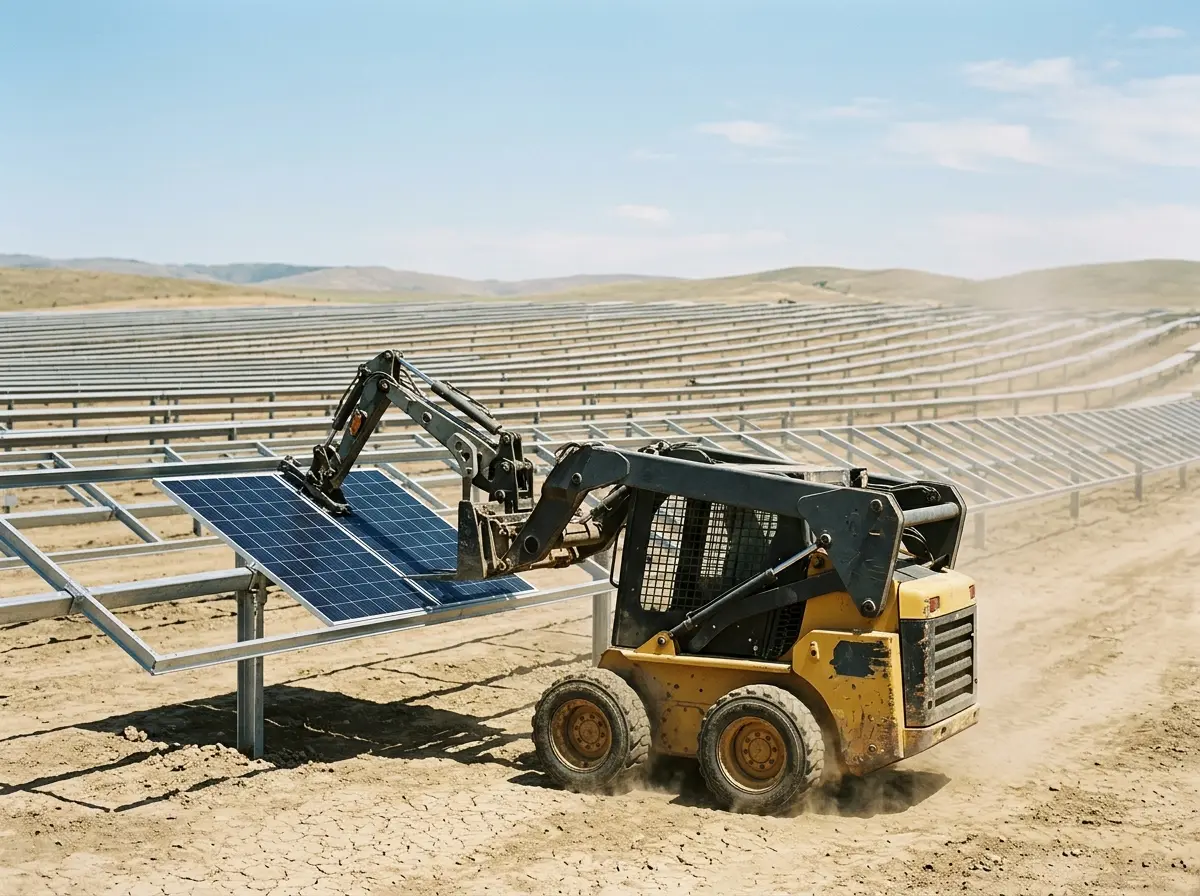
Gritt, a San Francisco robotics startup, came out of stealth this week with $32.4 million to put physical AI to work on the ugliest jobs on a construction site. The system bolts onto skid steers and forklifts crews already own, rather than replacing them.
A month earlier, a German company chasing a much bigger version of the same idea closed a round more than 40 times the size. That gap says more about where physical AI money is actually going than either deal does alone.
A Retrofit Kit, Not a Humanoid
Gritt’s pitch is mechanical, not futuristic. Robotic arms and AI plug into equipment a construction crew already owns, then pick, place, assemble, and move material with millimeter precision on sites that change by the hour. The company says the same task that once took months to train now takes days, since the system gets better with every deployment.
The launch round combined pre-seed and a $26 million Series A led by Obvious Ventures, with Union Square Ventures and Active Impact Investments joining, alongside earlier backers First Round Capital, Climactic, Congruent Ventures, and VSC Ventures. The founding team draws from Carnegie Mellon, Stanford, and MIT. First commercial deployments are running on large-scale solar farms, the kind of harsh, outdoor, constantly shifting site that has resisted automation for decades.
- Physical AI – artificial intelligence built to sense, decide, and act inside changing real-world environments, rather than software running in a browser or a data center
Andrew Beebe, managing director at Obvious Ventures, framed the bet in the funding announcement.
Gritt is bringing physical AI to the toughest construction sites in the world.
Each new jobsite deployment feeds data back into the system, the kind of flywheel investors in hardware rarely get to underwrite this early.
Germany’s Physical AI Bet Dwarfs the American One
Six weeks before Gritt’s launch, a Series C sized at up to $1.4 billion landed at NEURA Robotics, a cognitive and humanoid robotics maker based in Metzingen, Germany. NEURA calls its platform the Neuraverse, an open ecosystem where humanoid and cognitive robots are meant to share intelligence at scale. Backers included Tether, Qualcomm Technologies, Amazon, NVIDIA, imec.xpand, Bosch, Schaeffler, the European Investment Bank, Lingotto Horizon, and InterAlpen Partners.
Europe’s marquee physical AI bet, in other words, is aimed at general-purpose humanoid robots that can eventually do many things reasonably well. Gritt’s much smaller bet is aimed at one narrow, ugly job: outdoor construction. Both count as physical AI. They are not the same wager, and NEURA’s Series C redrew what Europe is willing to fund in this category months before Gritt existed publicly.
| Detail | Gritt | NEURA Robotics |
|---|---|---|
| Headquarters | San Francisco, U.S. | Metzingen, Germany |
| Round at launch | $32.4 million (pre-seed plus Series A) | Up to $1.4 billion (Series C) |
| Core product | Retrofit robotic arms for existing equipment | General-purpose humanoid and cognitive robots |
| First commercial focus | Large-scale solar construction | Industrial and eventual household deployment |
The dollar gap is not really about who has the better technology. It is about what each side is choosing to fund first.
Why the Big Checks Still Chase Humanoids
The money behind both deals is part of the same surge. Robotics and physical AI startups raised $16.3 billion across 492 deals in the first quarter of 2026 alone, according to a report showing robotics funding hit $16.3 billion in Q1 from private markets data provider PitchBook, its strongest quarter on record, lifted by megadeals for Shield AI, Saronic, and NEURA itself. Startup data tracker Crunchbase separately counted robotics fundraising at $18.8 billion for 2026 so far, already ahead of the $15 billion raised in all of 2025 and past the prior peak of $14.1 billion set in 2021.
Most of that capital is landing on platforms designed to do many jobs at once, not on tools built for one dirty task. General-purpose robots make for a cleaner story to investors chasing a category-defining winner. Retrofit players like Gritt are betting the opposite: that a narrow, well-understood job pays back faster than a robot that can theoretically do everything.
Europe Is Short 2.1 Million Construction Workers
That narrower bet lines up with a labor gap Europe has been unable to close for years. The EU construction sector faces a workforce shortfall of roughly 2.1 million personnel in 2026, according to an analysis published by workforce provider Dynamic Staffing Services, driven both by rising project volume and workers migrating to other trades.
The EU’s own employment network flags how deep that gap runs.
- Heavy truck drivers
- Nursing professionals and specialist doctors
- Electricians
- Roofers
- Construction labourers
Those occupations sit among the construction labourers among the most severe shortages tracked by EURES, the European Employment Services network. Eurostat’s job vacancy data for the third quarter of 2025 showed the strain running highest in the Netherlands at 4.1%, Belgium at 3.8%, and Malta at 3.8%, against an EU average of 2.0%.
This is not a new warning. Tom Deleu, general secretary of the European Federation of Building and Woodworkers (EFBWW), said in a 2023 assessment tied to a commissioned industry report that construction already faced serious gaps.
“There are already labour shortages; around 2m workers will be needed as a conservative estimate,” Deleu said, according to a report projecting more than 2 million workers by 2030 from the International Trade Union Confederation (ITUC). Three years later, the 2026 numbers suggest that warning was conservative, not overstated.
Is Europe Building Its Own Version of Gritt?
Not exactly, and that is the gap worth watching. NEURA is building the humanoid platform. Qualcomm Technologies, which backed NEURA’s round, has separately made its own case for where this category goes next, a vision Qualcomm’s chief executive has staked out publicly. Neither company is building a retrofit kit for a skid steer on a solar site.
The closer European analogue sits one layer down. Apoha, which raised $36 million to build a data layer for physical AI, is chasing the infrastructure other robots will plug into rather than the robots themselves. That is a real and useful bet. It is not the same as a company building arms for a European solar or road crew today.
Nobody has yet announced a European Gritt: a company retrofitting excavators and loaders on EU jobsites at commercial scale. Given the shortage numbers above, that looks less like a gap in ambition and more like an opening still sitting unclaimed.
Hardware’s Slower, Costlier Road
None of this makes physical AI a shortcut to easy returns. Hardware moves slower than software, consumes more capital per milestone, and runs straight into real safety and liability questions the moment a robotic arm works near people on an active jobsite.
Founders sitting on the software, service, or data side, the Apoha model, can ride the wave with far less capital and a shorter path to revenue. Founders building the machines themselves need patient investors and a longer runway, because the frictions that kept this category small for years have not disappeared. They have just gotten better funded.
Frequently Asked Questions
What Makes Physical AI Different From a Traditional Industrial Robot?
Traditional industrial robots run fixed, pre-programmed motions inside controlled settings like an assembly line. Physical AI systems, including Gritt’s, are built to adapt in real time to unstructured environments, such as a construction site that changes layout by the hour, and to improve their own performance across deployments without being reprogrammed from scratch each time.
Does Europe Have a Company Like Gritt?
Not directly. Europe’s largest physical AI bet, NEURA Robotics’ Series C of up to $1.4 billion, targets general-purpose humanoid and cognitive robots rather than retrofit kits for existing construction equipment. Apoha is building a data layer for physical AI systems generally. No European company has yet announced a commercial retrofit robotics product aimed specifically at outdoor construction and infrastructure work the way Gritt has.
How Much Did Gritt Raise Before Its Series A?
Public figures show the $26 million Series A sat inside a total raise of $32.4 million, which implies a pre-seed round of roughly $6.4 million ahead of the Series A, though Gritt has not broken out that earlier figure separately in its launch announcement.
What Comes After Solar for Gritt’s Robots?
Gritt’s own materials describe large-scale solar construction as the starting point, with the company’s stated mission framed around infrastructure buildout more broadly. It has not named a second vertical publicly, though the underlying retrofit approach, built around skid steers and forklifts common across construction and logistics, was designed to extend beyond a single site type.


Kevin Warsh’s Fed Turns Hawkish on the Rate Cuts Trump Wanted

Gritt’s $32.4M Physical AI Launch Exposes Europe’s Robot Gap

StrongestLayer Raises $4.1 Million in a Crowded AI Security Race

Conor Oberst’s Trump Writer’s Block Exposes a Bigger Crisis

Siemens Wires Its Chip Software Into NVIDIA’s Quantum Agents

Pixel 11 Price Hikes Reveal Memory Chipmakers’ Record Profits

Charles Schwab Backs the CLARITY Act as Odds Collapse

Nodes Upgrading to XRP Ledger’s xrpld 3.2.0 Fall Out of Sync

Trump Halts Iran Strikes as Bitcoin Stays Stuck Near $64K

ChatGPT’s Health Push Repeats a Bet That Killed Two Rivals

CLARITY Act Final Text Expected This Weekend as 60-Vote Hurdle Looms

Kalshi Loses Major NY Prediction Markets Ruling to Judge Torres

Fed Minutes Cite AI Demand as Inflation Risk, Put a 2026 Hike Back on the Map

Marker AI Writing Startup Lands $13M Seed Led by Index Ventures

Dota 2 Esports World Cup 2026: Spirit Defends $2M Title In Paris

Meta’s Muse Spark 1.1 Beats Rivals on Price, Trails on Coding

CS2 Premier Season 5 Lands With Cache and a C4 Damage Rework

Trump Calls Iran ‘Islamic Republic of Japan’ as Ceasefire Ends

ARC Intelligence Closes €4M Seed Round in Roughly a Week

Finto Picks Munich Over Silicon Valley After YC, Raises $3.4M
-
 FINANCE2 months ago
Zcash Patched a Double-Spend Bug as ZEC Climbed 5%
-
 ENTERTAINMENT2 months ago
Steam Summer Sale 2026 Locks In June 25 to July 9 Dates
-
 NEWS3 months ago
Meta Adds AI Replies to Threads, But Users Can’t Block It
-
 FINANCE3 weeks ago
CLARITY Act Final Text Expected This Weekend as 60-Vote Hurdle Looms
-
 ENTERTAINMENT2 months ago
‘Widow’s Bay’ Review: Apple TV’s Sleeper Horror-Comedy Earns Its Fog
-
 NEWS7 months ago
FolderFresh Review: This Free Tool Automates Windows File Organizing
-
 NEWS4 months ago
U.S. Navy Deploys Solar-Powered Lightfish Drone to Patrol Oceans
-
 FINANCE3 weeks ago
Kalshi Loses Major NY Prediction Markets Ruling to Judge Torres