
FINANCE
Elon Musk Says Money Won’t Matter After $700 Billion Wipeout
Elon Musk’s Tesla and SpaceX stock crash is quietly reshaping his own trillion dollar pay package, even as short sellers and Cathie Wood cash in.

Elon Musk told The Economist that money will not matter by 2036. He said it days after Bloomberg’s Billionaires Index showed his own fortune had shrunk by nearly $700 billion in five weeks. Tesla and SpaceX, the two companies that built that fortune, spent the same stretch crashing.
That crash is doing something more concrete than testing Musk’s abundance theory. It is pushing his own trillion dollar Tesla pay package further from reach, while short sellers and one prominent dip buyer already have real money to show for the slide.
Musk Tells The Economist Money Will Not Matter by 2036
The prediction came during a nearly 90 minute interview with Economist editor in chief Zanny Minton Beddoes, recorded at Tesla’s Texas Gigafactory and published in late July. Musk forecast AI surpassing human intelligence within five years and said work would become optional, like a hobby, inside a coming decade of abundance.
Pressed on how people holding Musk related stocks should feel about a world where money stops mattering, he said people only need money to buy goods and services. If robots and AI end up producing more than humans can consume, he asked, what would anyone need money for.
He tied the idea to a specific economic call. “Deflation will be the issue, not inflation,” he said, arguing that the money supply is growing fast but the supply of goods and services, turbocharged by AI and robotics, could grow even faster and make money itself less scarce.
He did not pretend the path there was settled.
I’ve gone from exhilaration to terror regarding AI.
Musk offered that line later in the same conversation, a hedge that sat oddly next to his own certainty about 2036.
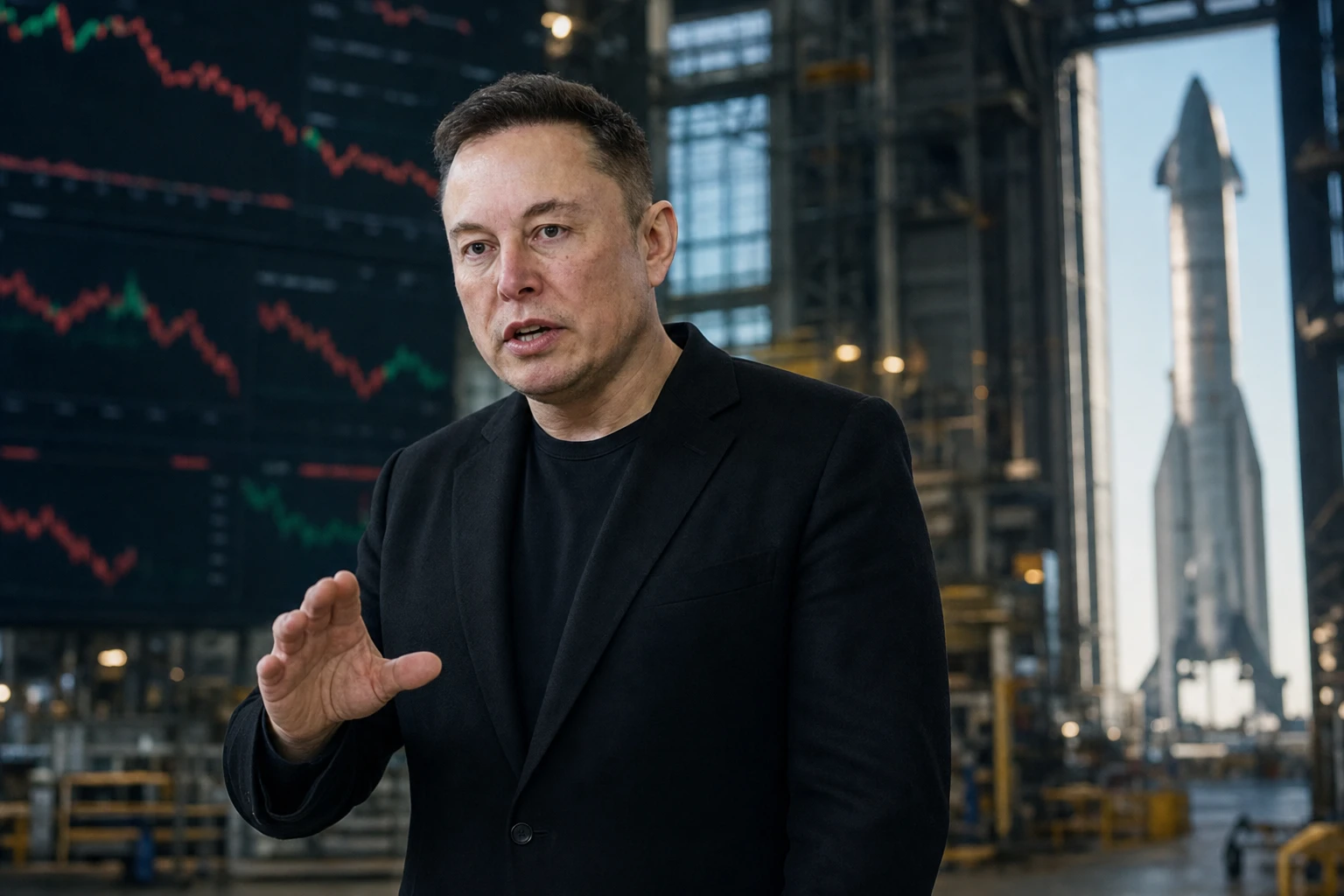
A Trillion Dollars Vanishes from SpaceX’s Post-IPO Highs
SpaceX listed at $135 a share and rocketed to $225.64 by June 16, the day its market value hit $2.64 trillion and Musk’s own paper fortune peaked near $1.45 trillion, according to Bloomberg’s Billionaires Index, which tracks his fortune daily against Tesla and SpaceX.
The slide that followed accelerated after a delayed Starship launch on July 16 and a broader selloff across AI-linked stocks. By July 24, SpaceX shares closed at $115.07, down almost 50% from the peak and below the IPO price for a seventh straight session. The company’s total value fell to $1.51 trillion, a drop of around a trillion dollars in barely five weeks.
- June 16: SpaceX’s market value reaches $2.64 trillion, and Musk’s paper fortune peaks near $1.45 trillion.
- July 2: Tesla reports record deliveries of 480,126 vehicles; the stock falls anyway.
- July 16: A Starship launch is delayed, and SpaceX shares extend their post-IPO slide.
- July 23: Bloomberg’s index puts Musk’s net worth at $738 billion, down nearly $700 billion from the June peak.
- July 24: SpaceX closes at $115.07 and Tesla at $313.03, closing out a brutal week for both stocks.
Other trackers tell a slightly different story on the exact number. Forbes put Musk’s fortune at $722.4 billion on the same July 23 date, and a more recent Bloomberg read had drifted down near $719 billion by the following week, the gap coming from how each service prices his SpaceX and xAI stakes.
Tesla Beats on Revenue, Craters on Profit
Tesla’s own quarter added to the pressure. The company delivered results that looked strong on the surface and weak underneath.
- Revenue: $28.24 billion, about 7.1% above analyst estimates.
- Deliveries: a record 480,126 vehicles for the quarter.
- Adjusted earnings per share: $0.33, roughly 38.5% below the $0.5367 consensus estimate.
The earnings miss dragged Tesla’s stock down about 19% for the week, closing at $313.03 on Friday. A record delivery number and a beaten revenue line were not enough to offset a profit line that fell well short of what Wall Street had priced in.
Who Is Profiting from This Crash?
Two very different players are already sitting on real gains from a slide that has cost Musk roughly $700 billion on paper: short sellers betting against SpaceX, and an asset manager buying Tesla on the way down.
| Point in Time | Shares Sold Short | Share of Float | Paper Profit |
|---|---|---|---|
| Around SpaceX’s June IPO | About 40 million | 5% to 7% | Minimal |
| July 16 close | About 185 million | About 29% | $8.7 billion |
| Week of July 23 | About 206 million | About 32% | $15.5 billion |
That progression, tracked by data providers S3 Partners and Ortex and first reported by Reuters, shows bears roughly doubling their unrealized winnings in about a week as the stock kept falling. It is a sharp escalation from the modest bets placed around the IPO, and it lines up with the pattern short sellers reliving Musk’s costliest trade already described once this slide began.
On the other side of the trade, Cathie Wood’s ARK Invest bought 160,151 Tesla shares for about $51.2 million on July 23, spreading the purchase across multiple ARK funds. It fits ARK’s parallel buying of Tesla and Circle stock through this same downturn, a bet that the slide is temporary rather than structural.
The $2 Trillion Hurdle Behind Musk’s Pay Package
Here is where the crash stops being philosophical for Musk personally. Tesla shareholders approved a new pay package for him built around 12 tranches of stock, each one unlocked only if Tesla hits a rising series of market capitalization targets, a securities filing outlining the pay plan’s tranche structure shows.
The first tranche pays out at a $2 trillion market cap. The next nine arrive in $500 billion steps up to $6.5 trillion, and the final two require $1 trillion jumps, topping out at $8.5 trillion for the full award. Musk’s Tesla stake would grow from roughly 13% to 25% if every tranche vests, adding more than 423 million shares over a decade.
Tesla’s stock would need to climb dramatically from Friday’s close just to reach that first milestone, let alone the $8.5 trillion finish line. A week that erased 19% of the share price does not narrow that gap, it widens it. This is not Musk’s first fight over Tesla pay, either; shareholders separately restored a $56 billion pay package tied up in court before this newer, larger plan was even put to a vote.
Where Economists Say Musk’s Abundance Math Breaks Down
Musk’s argument rests on a simple mechanism: if AI and robots can produce more goods and services than people can consume, prices fall, and money loses its grip on daily life. He has floated government issued checks as the backstop once that abundance arrives.
Economists who have pushed back on the idea do not dispute that robots can make manufactured goods cheaper. Their objection is narrower and harder to wave away. A house with a specific view, a seat at a top school, or the attention of an in demand surgeon or teacher cannot be mass produced no matter how good the robots get.
Scarcity, in other words, does not vanish. It just moves to whatever cannot be copied.
Frequently Asked Questions
What Did Elon Musk Propose as a Replacement for Money?
Musk suggested that once goods and services become abundant enough, governments could simply issue direct payments or checks to citizens rather than relying on wages tied to traditional work, a system he framed as a natural response to AI driven deflation rather than a formal policy plan.
How Much of Elon Musk’s Fortune Has He Lost in 2026?
Based on Bloomberg’s $1.45 trillion peak on June 16 and its $738 billion reading on July 23, Musk’s tracked fortune fell by roughly 49%, or just under half, in five weeks, even though the remaining sum still ranks among the largest personal fortunes ever recorded.
What Are the Operational Targets in Musk’s Tesla Pay Package?
Beyond the market cap tranches, the plan requires Tesla to reach 20 million cumulative vehicle deliveries, put 1 million Optimus robots and 1 million robotaxis into use, grow Full Self-Driving subscribers by 10 million, and lift annual EBITDA to $400 billion over the ten year term.
Has Cathie Wood Bought Tesla Stock Before This Latest Dip?
Yes. On July 2, ARK funds bought 96,935 Tesla shares worth about $38.1 million, with roughly $27.44 million routed into the ARKK fund, on a day the stock fell 7.49% despite Tesla reporting record quarterly deliveries.
How Much of Tesla Does Elon Musk Currently Own?
Musk currently holds an estimated 13% stake in Tesla. Under the new pay package, that stake could rise to about 25% if all twelve tranches vest over the next decade, though nothing vests unless Tesla hits the required market cap and operational targets first.
Disclaimer: This article covers public stock prices, net worth trackers and executive pay disclosures for informational purposes only; markets move quickly, figures are accurate as of publication on July 27, 2026, and nothing here is financial advice.


Conor Oberst’s Trump Writer’s Block Exposes a Bigger Crisis

Siemens Wires Its Chip Software Into NVIDIA’s Quantum Agents

Pixel 11 Price Hikes Reveal Memory Chipmakers’ Record Profits

Charles Schwab Backs the CLARITY Act as Odds Collapse

Nodes Upgrading to XRP Ledger’s xrpld 3.2.0 Fall Out of Sync

Trump Halts Iran Strikes as Bitcoin Stays Stuck Near $64K

ChatGPT’s Health Push Repeats a Bet That Killed Two Rivals

Crypto Rallies on Iran Truce While Fed Hike Odds Triple

Samsung’s New Lockout Rule Targets Thieves and Police Forensic Tools

Gemini Daily Brief Tests Custom Prompts, a Year Behind Samsung

CLARITY Act Final Text Expected This Weekend as 60-Vote Hurdle Looms

Fed Minutes Cite AI Demand as Inflation Risk, Put a 2026 Hike Back on the Map

Kalshi Loses Major NY Prediction Markets Ruling to Judge Torres

Marker AI Writing Startup Lands $13M Seed Led by Index Ventures

Dota 2 Esports World Cup 2026: Spirit Defends $2M Title In Paris

Meta’s Muse Spark 1.1 Beats Rivals on Price, Trails on Coding

CS2 Premier Season 5 Lands With Cache and a C4 Damage Rework

Trump Calls Iran ‘Islamic Republic of Japan’ as Ceasefire Ends

ARC Intelligence Closes €4M Seed Round in Roughly a Week

Finto Picks Munich Over Silicon Valley After YC, Raises $3.4M
-
 FINANCE2 months ago
Zcash Patched a Double-Spend Bug as ZEC Climbed 5%
-
 ENTERTAINMENT2 months ago
Steam Summer Sale 2026 Locks In June 25 to July 9 Dates
-
 NEWS2 months ago
Meta Adds AI Replies to Threads, But Users Can’t Block It
-
 FINANCE3 weeks ago
CLARITY Act Final Text Expected This Weekend as 60-Vote Hurdle Looms
-
 ENTERTAINMENT2 months ago
‘Widow’s Bay’ Review: Apple TV’s Sleeper Horror-Comedy Earns Its Fog
-
 NEWS7 months ago
FolderFresh Review: This Free Tool Automates Windows File Organizing
-
 NEWS4 months ago
U.S. Navy Deploys Solar-Powered Lightfish Drone to Patrol Oceans
-
 FINANCE3 weeks ago
Fed Minutes Cite AI Demand as Inflation Risk, Put a 2026 Hike Back on the Map