
FINANCE
Tight Jobless Claims Cap Bitcoin Under $65,000 on Hike Odds
US initial claims at 199,000 beat forecasts and lifted September rate-hike odds near 55 percent, pinning Bitcoin below resistance after a brief rally off $62,400.

Bitcoin slipped to roughly $64,300-$64,500 on Thursday after U.S. initial jobless claims came in at 199,000, under the 202,000-204,000 range economists expected. The print reinforced a tight labor market and pushed traders to price a higher chance of a Federal Reserve rate increase in September, rejecting a brief recovery attempt at the $65,000 area.
The move fits a familiar pattern: strong employment data that looks healthy for the broader economy raises the opportunity cost of holding non-yielding assets and keeps policy restrictive longer than crypto bulls prefer.
That tension is mechanical rather than emotional. When claims stay low, markets read fewer layoffs and firmer wage pressure. Policy stays tight, real yields hold up, and an asset that pays no coupon has to clear a higher bar just to keep pace with cash.
The Claims Number That Reset Odds
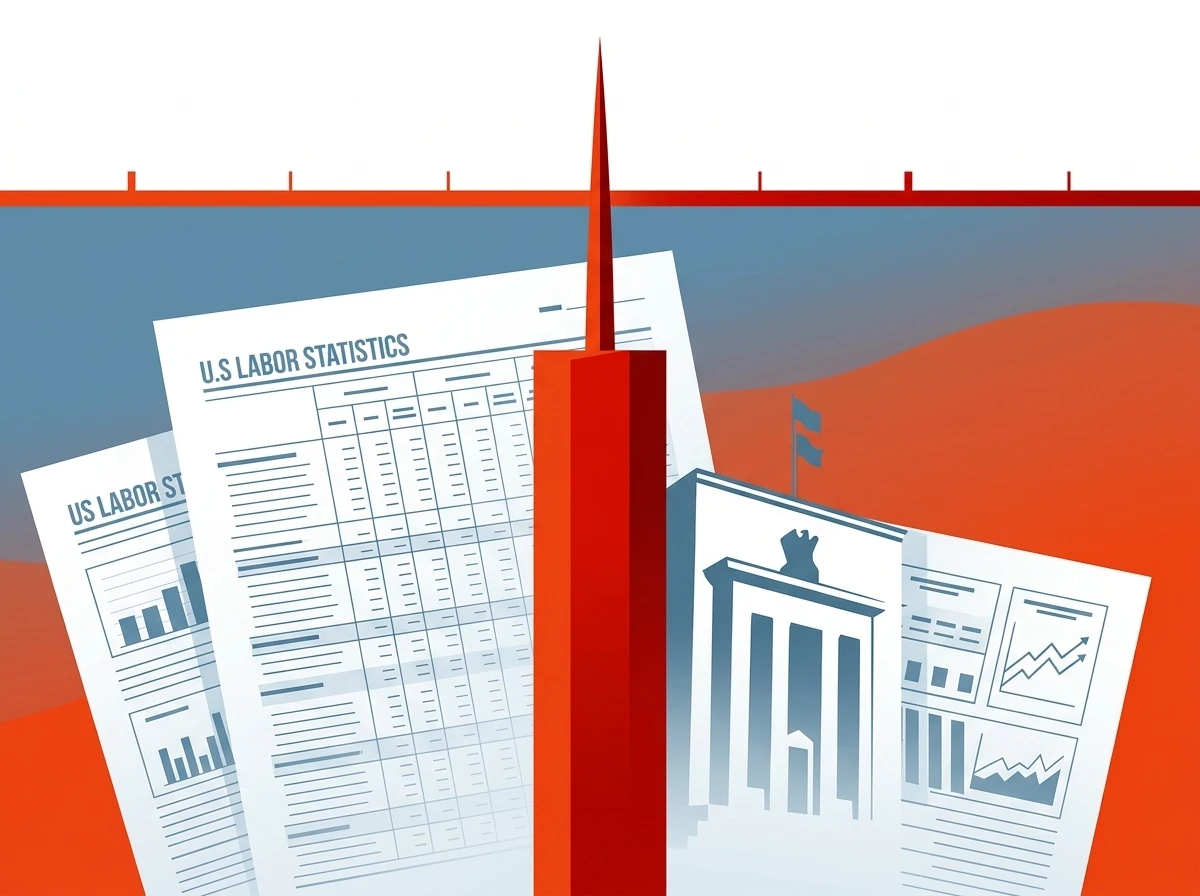
The U.S. Department of Labor reported seasonally adjusted initial claims of 199,000 for the week ending August 1. That was an increase of 1,000 from the prior week’s revised 198,000 level. The four-week moving average fell to 198,750, down 4,500 from the previous revised average of 203,250.
Unadjusted claims totaled 171,246. The insured unemployment rate held at 1.2 percent. Continued claims rose modestly in the latest available week, yet the overall picture still pointed to limited layoffs and ongoing labor tightness.
- 199,000 advance seasonally adjusted initial claims
- 198,000 prior week revised
- 198,750 four-week moving average
- 1.2% insured unemployment rate
The FRED series tracking weekly initial claims shows the print sits near multi-year lows in absolute terms, consistent with a market that has rarely needed large-scale hiring freezes this cycle.
The gap between the print and the forecast mattered as much as the level. Economists looked for 202,000 to 204,000. A 199,000 outcome undershot that band and left little room to argue the labor market was cooling on schedule. The four-week average sliding to 198,750 reinforced the same message over a longer window.
Unadjusted claims at 171,246 and an insured unemployment rate stuck at 1.2 percent filled in the detail. Layoffs remain limited. Firms are not shedding workers at a pace that would force the Fed to ease purely on employment grounds.
Why the $65,000 Ceiling Held
Bitcoin had climbed off recent lows near $62,400 and tested the $64,800-$65,000 zone. It never closed above that band. Sellers appeared at resistance and pushed the price back toward the $64,000 support pocket. At press time around the claims release window the spot price sat near $64,384, down about 0.7 percent on the day in the source report; later prints hovered in the mid-$64,000s.
Higher real yields and a firmer dollar typically accompany hotter labor data. Both raise the relative appeal of cash and short-term Treasuries against an asset that pays no coupon. Leveraged long positions built on easier-money assumptions become more expensive to carry, which can force quick exits when the macro tape turns.
Crowd chatter on X after the print focused on the same pressure point: hot jobs data keeps the Fed hawkish, and that remains a classic headwind few want to dismiss even when the broader economy looks solid.
The failed test of $64,800 to $65,000 left a clean technical marker. Buyers had momentum off the $62,400 area, yet they could not convert the bounce into a close through resistance. That sequence turned a recovery attempt into a rejection, and the claims release supplied the macro reason sellers needed to lean on the tape.
Carry costs amplify the effect. When hike odds rise, funding for leveraged longs tightens. Positions sized for a gentler policy path face higher daily costs and thinner patience. A modest spot decline can then cascade into faster exits if stops cluster just under the rejected zone.
September Pricing Now Favors a Hike
Markets currently price the federal funds target in a 3.50-3.75 percent range. For the September 16 FOMC meeting, the CME FedWatch tool probabilities and related monitors show roughly a 55.1 percent chance of a move to 3.75-4.00, with the hold probability near 45 percent. Earlier in the week the hike odds sat a few points lower; the claims data nudged them higher.
| Meeting | Hold (3.50-3.75) | Hike to 3.75-4.00 |
|---|---|---|
| September 16, 2026 | 44.9% | 55.1% |
| October 28, 2026 | 31.5% | 52.1% (plus higher bands) |
Later meetings still carry cumulative hike risk into year-end. That path keeps liquidity tighter and makes it harder for speculative flows to chase Bitcoin higher without a clear inflation or growth surprise in the other direction.
The shift from earlier in the week was incremental, not a full repricing. A few points on the hike probability still flipped the September balance from roughly even to a modest lean toward a move. Crypto markets often react to the direction of that lean as much as the absolute level, because funding and options skew adjust quickly once the modal outcome changes.
October pricing already shows a thinner hold probability at 31.5 percent and a 52.1 percent weight on a hike into the 3.75-4.00 band plus higher outcomes. Cumulative risk into year-end therefore stays alive even if September only holds. That stretch of restrictive settings is what keeps opportunity cost elevated for non-yielding holdings.
Warsh’s Communication Reset Adds Uncertainty
Fed Chair Kevin Warsh has been in the role since spring 2026. After the July meeting that held rates steady, he described his upcoming Jackson Hole speech as still a blank page while task forces work on policy frameworks. Markets watch for any shift in how the Committee signals its reaction function.
Warsh has stressed no soft inflation target and a willingness to act when needed. At the same time he has left room for strategy discussions after the next turn of the calendar. That mix leaves traders parsing every data print more carefully because the reaction function is still being clarified in public.
A blank-page framing for Jackson Hole keeps optionality high and guidance light. Without a pre-committed script, each labor and inflation release carries extra weight as markets try to infer how the new chair will map data into policy. The July hold already showed patience; the open question is how far that patience extends if claims remain near current levels.
No soft inflation target narrows the path for premature easing talk. Willingness to act when needed keeps a hike live. Strategy talks deferred past the next calendar turn mean the near-term reaction function will be read from speeches and dots more than from a finished framework document.
Who Carries the Immediate Cost
Risk-asset holders feel the first impact. Bitcoin’s correlation with equities and rate-sensitive names has tightened with institutional participation, so a higher terminal rate path hits both. Short-term yield products and money-market funds gain relative appeal.
- Long-leveraged crypto traders face higher funding costs and forced deleveraging risk if price fails to reclaim $65,000 quickly.
- Spot ETF flow momentum can slow when macro headlines dominate and opportunity cost rises.
- Miners and treasury holders with balance-sheet Bitcoin still mark-to-market lower on days like this, even if longer horizons remain intact.
- Cash and T-bill vehicles capture the yield that non-yielding digital assets forgo while rates stay elevated.
Some longer-term allocators treat dips as inventory opportunities, consistent with long-term Bitcoin holding strategies that ignore weekly macro noise. Others look to products that turn idle Bitcoin into yield while the rate backdrop stays restrictive.
The split in behavior is durable. Tactical accounts tied to funding rates and daily marks absorb the first hit. Strategic holders with multi-year mandates can treat the same print as noise, provided liquidity on their venues stays deep enough to add without moving the market against them.
Support Levels That Matter Next
Immediate support clusters near $64,000. A clean break lower opens the path toward the recent $62,400 low. On the upside, a decisive close back above $65,000 would ease the rejection narrative and let bulls retest higher ranges. Volume and ETF flow data on the next sessions will show whether the claims reaction was a one-day fade or the start of a deeper reset.
Upcoming releases, including the next weekly claims print and the mid-month inflation suite, will either confirm the tight-labor story or open a door for easier pricing. Until then the market remains data-dependent and September-focused.
The distance between the current mid-$64,000s pocket and the $62,400 reference low is the near-term risk window. A hold above $64,000 keeps the rejection contained. A break that travels to the prior low would rewrite the short-term structure and likely pull more leveraged supply into the market.
- Next weekly claims print – confirms or softens the tight-labor read
- Mid-month inflation suite – tests whether price pressure still justifies a restrictive stance
- September 16 FOMC meeting – converts the 55.1 percent hike probability into a decision
Jobs Prints Have Stung Crypto Before
Earlier in the summer a plunge in claims toward multi-decade lows also lifted hike odds and pressured Bitcoin. Weak payrolls at other points revived cut hopes and supported rebounds. The pattern is consistent: labor strength that reduces the odds of easier policy tends to cap risk assets until the next soft print arrives.
Bitcoin’s sensitivity has grown as more traditional capital entered via ETFs and corporate treasuries. That integration makes weekly claims and payrolls higher-stakes events than they were in prior cycles dominated by crypto-native flows.
The channel is straightforward. Stronger labor data lifts the expected path of the policy rate. Higher expected rates support the dollar and real yields. Those moves raise the hurdle rate for holding Bitcoin and compress the room for speculative leverage. Soft labor data runs the same chain in reverse and has, at other points this cycle, reopened cut hopes and supported price rebounds.
Tight Labor Keeps Holding Costs Elevated
Opportunity cost is the bridge between a 199,000 claims print and a rejected $65,000 test. Cash and short-term Treasuries pay a coupon tied to the policy rate. Bitcoin does not. When the funds target sits in a 3.50-3.75 percent range and markets lean toward 3.75-4.00, that gap widens in favor of yielding alternatives.
Institutional channels transmit the pressure faster than in earlier cycles. Spot ETF flows respond to macro headlines. Corporate treasury marks move with the screen price. Correlation with equities and rate-sensitive names means the same higher-terminal-rate impulse hits several risk books at once.
| Factor | Effect while claims stay low |
|---|---|
| Real yields and the dollar | Tend to firm, lifting the bar for non-yielding assets |
| Leveraged long carry | Becomes more expensive as hike odds rise |
| Spot ETF momentum | Can slow when macro headlines dominate flows |
| Cash and T-bill appeal | Rises relative to assets that pay no coupon |
None of that requires a collapse in the labor market to reverse. It requires enough cooling for markets to cut the September hike probability and reopen an easier path. Until a soft print arrives, the default setting remains restrictive.
September Still Anchors The Near Path
The September 16 meeting is the next hard checkpoint. A 55.1 percent chance of a move to 3.75-4.00 and a 44.9 percent hold probability leave the outcome open, yet the lean is clear enough to shape positioning. Traders who faded the $65,000 area after the claims release were trading that lean as much as the level itself.
Warsh’s still-unwritten Jackson Hole remarks sit on the same calendar path. A blank page leaves room for either a firmer or a more patient tone. Markets will parse the speech against the claims trend and the mid-month inflation suite before the Committee votes.
- Hold at 3.50-3.75 percent would ease some carry pressure but leave cumulative hike risk into October alive.
- Hike to 3.75-4.00 percent would confirm the post-claims repricing and keep liquidity tight.
- Guidance around the reaction function will matter as much as the decision if the framework review is still incomplete.
Volume, ETF flows, and the next claims print will show whether Thursday’s rejection was a one-session fade or the start of a deeper reset. The structure above $64,000 and below $65,000 remains the near-term map until those inputs arrive.
For now the irony holds. A labor market firm enough to keep unemployment claims near 199,000 is the same force keeping Bitcoin capped under $65,000 and September hike odds above 50 percent. Traders will watch the next data points and Warsh’s Jackson Hole remarks for any sign that the policy path can ease.


OpenAI Bets $300 Donut Speaker Can Seed Its Device Future

OpenAI Bets $300 Donut Speaker Can Seed Its Device Future

Dell Parks Flagship XPS 13 Chassis on Googlebook Platform

OpenAI Bets $300 Donut Speaker Can Seed Its Device Future

CLARITY Act Delay Leaves Crypto Bill Racing a Midterm Clock

Ethics Deal on CLARITY Act Could Force Trump Crypto Sale With Tax Deferral

Chrome Wins Netflix 4K on Windows 11 but Edge Keeps More

Tight Jobless Claims Cap Bitcoin Under $65,000 on Hike Odds

Maher Gasps at DSA Communists While Hollywood Stays Silent

Netflix Gets GTA 6 Extended Look Six Hours Before YouTube

Fed Minutes Cite AI Demand as Inflation Risk, Put a 2026 Hike Back on the Map

Marker AI Writing Startup Lands $13M Seed Led by Index Ventures

Meta’s Muse Spark 1.1 Beats Rivals on Price, Trails on Coding

Finto Picks Munich Over Silicon Valley After YC, Raises $3.4M

CS2 Premier Season 5 Lands With Cache and a C4 Damage Rework

Backrooms Returns to Theaters as the Everything Must Go Edition

Trump Calls Iran ‘Islamic Republic of Japan’ as Ceasefire Ends

IO Interactive Regains Project Fantasy, Closes Istanbul Studio

Kord’s £6.4M Series A Bets Identity and Payments Run on One Stack

Taiwan Margin Debt Climbs 160% as Locals Borrow Into the TSMC Rally
-
 FINANCE2 months ago
Zcash Patched a Double-Spend Bug as ZEC Climbed 5%
-
 ENTERTAINMENT2 months ago
Steam Summer Sale 2026 Locks In June 25 to July 9 Dates
-

 FINANCE1 month ago
CLARITY Act Final Text Expected This Weekend as 60-Vote Hurdle Looms
-
 NEWS3 months ago
Meta Adds AI Replies to Threads, But Users Can’t Block It
-
 ENTERTAINMENT3 months ago
‘Widow’s Bay’ Review: Apple TV’s Sleeper Horror-Comedy Earns Its Fog
-
 NEWS5 months ago
U.S. Navy Deploys Solar-Powered Lightfish Drone to Patrol Oceans
-
 FINANCE2 months ago
CLARITY Act Floor Vote Likely Shifts to August, Lummis Says
-

 FINANCE1 month ago
Kalshi Loses Major NY Prediction Markets Ruling to Judge Torres