
FINANCE
Ethics Deal on CLARITY Act Could Force Trump Crypto Sale With Tax Deferral
Bipartisan ethics language may require President Trump to sell crypto businesses and defer capital gains as the CLARITY Act races the August recess.

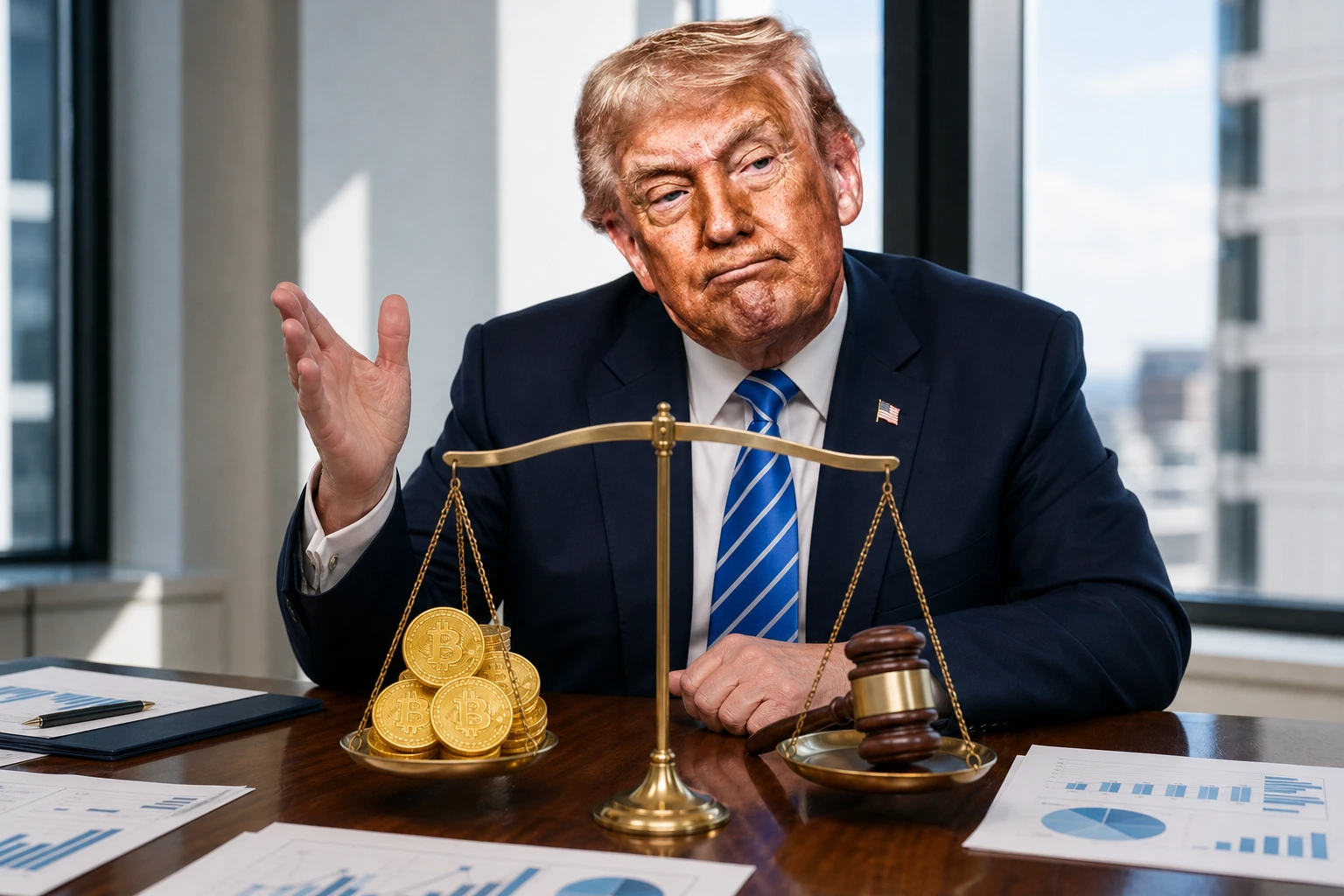
A bipartisan ethics counteroffer circulating this week would require President Donald Trump to divest crypto-related businesses as the price of moving the CLARITY Act, according to Bloomberg News reporting carried by Reuters. The same language could let him defer capital gains taxes on the sale.
Negotiators led by Sens. Thom Tillis (R-N.C.) and Ruben Gallego (D-Ariz.) sent the proposal to the White House last week. The market-structure bill still needs Democratic votes and faces an immediate recess deadline.
The package ties two fights that had run on separate tracks: statutory rules for digital-asset markets, and the ethics terms Democrats now treat as the price of those rules. Without both pieces locked in, the bill lacks a clear path to 60 votes before members leave town.
The Counteroffer Now on the Table
Politico reporter Jasper Goodman confirmed the counteroffer includes an explicit divestment requirement that would apply to the president and other federal officials. It also would let state attorneys general sue the Justice Department for failing to enforce the rules.
Earlier Republican drafts barred officials and spouses from issuing or sponsoring digital assets for compensation, but only prospectively. Those versions left preexisting ventures largely untouched, relied solely on the attorney general for enforcement, and sunset on January 20, 2029.
Democrats had conditioned support on stronger language after Trump’s 2025 financial disclosure showed more than $1.4 billion in crypto-related income. The White House has not publicly responded to the latest counteroffer.
The shift from prospective limits to an explicit divestment demand is the core change. It converts a forward-looking conduct rule into a requirement that existing holdings be unwound if the bill is to advance.
| Element | Earlier Republican Drafts | Tillis-Gallego Counteroffer |
|---|---|---|
| Scope of restriction | Prospective bar on issuing or sponsoring for compensation | Explicit divestment for the president and other federal officials |
| Preexisting ventures | Largely untouched | Brought under the divestment demand |
| Enforcement path | Attorney general only | State attorneys general may sue the Justice Department for non-enforcement |
| Tax treatment on sale | Not addressed | Path to defer capital gains levies |
| Sunset | January 20, 2029 | Full public text not yet released |
What Trump’s Crypto Income Looks Like
The June 2026 Office of Government Ethics filing for calendar 2025 made crypto the largest single source of Trump’s reported income. Multiple outlets reviewing the 927-page disclosure put the family haul above $1.4 billion.
| Source | Reported 2025 Figure | Notes |
|---|---|---|
| World Liberty Financial tokens and interests | $500M-$799M range | Token sales plus sale of business interests; split with family |
| $TRUMP memecoin licensing/royalties | Approx. $636M | Name, image and likeness arrangements |
| Personal Bitcoin and Ethereum holdings | At least $100M | Held as investments |
| Total crypto-linked income | More than $1.4B | Largest category in disclosure |
World Liberty Financial launched in 2024 with Trump listed as co-founder emeritus and his sons among the principals. An Abu Dhabi-linked firm later took a large stake. The $TRUMP memecoin launched days before inauguration. Nansen data cited in coverage showed most retail wallets that bought the token were underwater by mid-2026.
The disclosure spread the haul across token sales, business-interest sales, licensing and royalties, and personal holdings. That mix is why Democrats focused on revenue-sharing, name-and-likeness streams, and family entities rather than on a single asset class alone.
Because the largest lines sit in operating ventures and licensing arrangements, a narrow bar on new issuance would have left the main 2025 channels intact. The counteroffer’s divestment frame is aimed at those channels directly.
Why Democrats Drew a Hard Line
Senate Democrats made ethics the non-negotiable after the disclosure landed. Ranking Member Elizabeth Warren released a detailed staff analysis arguing the July Republican draft left the main money channels open.
Donald Trump raked in more than $1.4 billion from cryptocurrency ventures, and this bill does nothing to prevent him from vacuuming up his next $1.4 billion in crypto profits.
Warren said the text still allowed unlimited personal crypto investing while the president sets policy, preserved name-and-likeness deals, and put enforcement solely in the hands of an attorney general Trump appointed. She also flagged that the next Justice Department would be barred from pursuing violations after January 2029.
Gallego and others had earlier labeled weaker versions inadequate. The fight produced the Tillis-Gallego counteroffer now under White House review. Coverage of Gillibrand calling the ethics clause a dealbreaker tracked the same pressure point weeks earlier.
The hard line turned on three points that kept recurring in Democratic and watchdog critiques: open personal investing during policy-setting, continued name-and-likeness monetization, and an enforcement design that ended with the current term. Closing only one of those gaps was never going to unlock the votes.
Loopholes Watchdogs Still Flag
Even with a divestment mandate on the table, outside groups say core conflict channels remain at risk. Transparency International U.S. reviewed the July text and found it failed to force divestiture of revenue-sharing, licensing rights or family entities that generated the $1.4 billion.
- Safe harbor for certain preexisting ventures after blind trust or limited divestment
- Explicit permission for preexisting name, image and likeness use to continue minting and selling additional assets
- No clear bar on family members or intermediaries launching new ventures
- Sunset of ethics rules on the day Trump leaves office plus erasure of liability for prior violations
- Holding any digital asset as a personal investment remains expressly allowed
The Transparency International critique of the ethics text called the result “not clarity-it’s a conflict.” The Senate Banking minority analysis of ethics loopholes reached parallel conclusions on enforcement and family carve-outs. Later counteroffer language on state AG standing aims to address the enforcement gap; full public text has not been released.
Until that text is public, the open question is whether the divestment mandate reaches revenue-sharing and family entities or stops at direct personal ownership. Watchdogs have treated that distinction as the difference between a real unwind and a paper one.
The Tax Math of a Forced Sale
Forcing a sale of appreciated crypto businesses or tokens would normally trigger capital gains tax. Bloomberg reporting, carried by Reuters on August 6, said the ethics addendum under discussion includes a path to defer those levies.
Details remain private. Market observers immediately noted the irony: an ethics clean-up that both removes the conflict and potentially softens the tax bill for the very officeholder whose holdings created the controversy. VanEck digital assets head Matthew Sigel summarized the dual headlines on X: bipartisan plan to require Trump to sell, and Trump could net a tax windfall.
Some posts framed it as a catch-22-sale creates a large taxable event, yet the deal structure may let the gain roll. No official White House or IRS confirmation has appeared. The deferral concept sits alongside ordinary like-kind or reinvestment mechanics that already exist for certain asset classes; whether crypto qualifies under the specific draft is unconfirmed.
The political effect is immediate either way. Democrats get a divestment commitment they can show voters. The sale mechanics, if they include deferral, reduce the personal cost of agreeing to that commitment. That pairing is what turned a pure ethics demand into a negotiable package.
Recess Clock Meets the 60-Vote Reality
The House passed its version of the Digital Asset Market Clarity Act in July 2025 by 294-134. The Senate Banking Committee advanced a version 15-9 in May 2026. The combined text still needs 60 votes. Republicans hold 53 seats.
| Checkpoint | Figure |
|---|---|
| House floor (July 2025) | 294-134 |
| Senate Banking Committee (May 2026) | 15-9 |
| Votes needed on Senate floor | 60 |
| Republican seats | 53 |
| Prediction-market full-year odds | Near 30 percent |
Majority Leader John Thune has publicly doubted finishing before the August recess. Prediction markets put full-year enactment odds near 30 percent. After recess the chamber returns mid-September, then faces midterms and a compressed lame-duck window. Thune flagging the recess clock on a procedural vote captured the squeeze weeks ago.
- July 22, 2026, Republicans release revised CLARITY text with White House-backed ethics language; Democrats and watchdogs immediately criticize loopholes.
- Late July, Tillis and Gallego begin circulating a bipartisan counteroffer.
- August 3-4, Forbes and others report the bill seven votes short and running out of session days.
- August 6, Bloomberg details the divestment-plus-tax-deferral elements of the counteroffer still under negotiation.
If the ethics piece lands, sponsors still must resolve stablecoin rewards fights with banks and other consumer-protection demands. Failure this year would leave the industry under agency guidance that a future administration could reverse. The full text of the Digital Asset Market Clarity Act remains the base vehicle.
State-level pressure has also surfaced. Coverage of state attorneys general as the quiet enforcement lever noted how AG standing could matter if federal enforcement stays narrow.
State Attorneys General Gain a Direct Lever
The counteroffer’s grant of standing to state attorneys general changes the enforcement map that earlier drafts drew. Those drafts left every decision inside the Justice Department. The new language lets states challenge non-enforcement in court.
That matters because the sunset and liability-erasure concerns raised by Democrats and watchdogs both turn on who can act, and for how long. A state AG suit does not depend on the priorities of a single federal appointee.
It also creates a second audience for the final text. Even if federal enforcement stays narrow, state officers would have a statutory hook. Coverage of that lever already framed AG standing as the quiet backstop if Washington declines to move.
The design still leaves gaps. Standing to sue over non-enforcement is not the same as a mandate to investigate. Family carve-outs and name-and-likeness safe harbors, if they survive, would limit what any enforcer can reach. The lever is real; its range still depends on the closed text.
Industry Rules Depend on Clearing the Ethics Gate
For exchanges, custodians and token issuers, the ethics fight is the gate in front of the market-structure prize. The bill’s core bargain is statutory clarity on which tokens fall under the SEC versus the CFTC, plus registration paths that replace pure agency guidance.
That framework would outlast any single administration. Agency guidance does not. Sponsors have warned that failure this year leaves the industry exposed to a future reversal, which is why the recess clock and the midterms now hang over every draft.
Stablecoin rewards fights with banks and remaining consumer-protection demands still sit behind the ethics package. Even a signed divestment deal would not finish the bill. It would only reopen the lane for those other fights to be closed in time.
- SEC-versus-CFTC token classification written into statute
- Registration paths for exchanges and custodians
- Resolution of stablecoin rewards disputes with banks
- Consumer-protection terms still under negotiation
Prediction markets near 30 percent full-year odds already price the chance that none of those pieces land before the calendar turns. The ethics counteroffer is the first domino; it is not the last.
What the Forced Sale Would Change
A completed divestiture would remove direct ownership of the businesses and tokens covered by the final language. It would not erase the policy influence of a president who already shaped the regulatory environment that lifted those assets. Family members outside the covered definitions could retain roles. Preexisting licensing streams might continue under the name-and-likeness safe harbor unless the counteroffer closes it.
For the industry the larger prize is statutory clarity on which tokens fall under the SEC versus the CFTC, plus registration paths for exchanges and custodians. That framework would outlast any single administration. The ethics fight has become the gate that either unlocks those rules or strands them past the midterms.
As of August 7 the counteroffer remains private and the White House response unannounced. The Senate calendar is nearly empty of session days before members leave town. Whether the ironic tax-and-divest package is enough to assemble 60 votes will decide if CLARITY becomes law this year or joins the long list of crypto bills that never quite crossed the finish line.
The next signal is simple: a public White House reply, or a release of the Tillis-Gallego text. Until one of those arrives, the bill stays short of the votes and short of the calendar.
Disclaimer: This article is for informational purposes only and does not constitute investment, tax or legal advice. Cryptocurrency and political developments involve substantial risk; readers should conduct their own research and consult qualified professionals.


OpenAI Bets $300 Donut Speaker Can Seed Its Device Future

OpenAI Bets $300 Donut Speaker Can Seed Its Device Future

Dell Parks Flagship XPS 13 Chassis on Googlebook Platform

OpenAI Bets $300 Donut Speaker Can Seed Its Device Future

CLARITY Act Delay Leaves Crypto Bill Racing a Midterm Clock

Ethics Deal on CLARITY Act Could Force Trump Crypto Sale With Tax Deferral

Chrome Wins Netflix 4K on Windows 11 but Edge Keeps More

Tight Jobless Claims Cap Bitcoin Under $65,000 on Hike Odds

Maher Gasps at DSA Communists While Hollywood Stays Silent

Netflix Gets GTA 6 Extended Look Six Hours Before YouTube

Fed Minutes Cite AI Demand as Inflation Risk, Put a 2026 Hike Back on the Map

Marker AI Writing Startup Lands $13M Seed Led by Index Ventures

Meta’s Muse Spark 1.1 Beats Rivals on Price, Trails on Coding

Finto Picks Munich Over Silicon Valley After YC, Raises $3.4M

CS2 Premier Season 5 Lands With Cache and a C4 Damage Rework

Backrooms Returns to Theaters as the Everything Must Go Edition

Trump Calls Iran ‘Islamic Republic of Japan’ as Ceasefire Ends

IO Interactive Regains Project Fantasy, Closes Istanbul Studio

Kord’s £6.4M Series A Bets Identity and Payments Run on One Stack

Taiwan Margin Debt Climbs 160% as Locals Borrow Into the TSMC Rally
-
 FINANCE2 months ago
Zcash Patched a Double-Spend Bug as ZEC Climbed 5%
-
 ENTERTAINMENT2 months ago
Steam Summer Sale 2026 Locks In June 25 to July 9 Dates
-

 FINANCE1 month ago
CLARITY Act Final Text Expected This Weekend as 60-Vote Hurdle Looms
-
 NEWS3 months ago
Meta Adds AI Replies to Threads, But Users Can’t Block It
-
 ENTERTAINMENT3 months ago
‘Widow’s Bay’ Review: Apple TV’s Sleeper Horror-Comedy Earns Its Fog
-
 NEWS5 months ago
U.S. Navy Deploys Solar-Powered Lightfish Drone to Patrol Oceans
-
 FINANCE2 months ago
CLARITY Act Floor Vote Likely Shifts to August, Lummis Says
-

 FINANCE1 month ago
Kalshi Loses Major NY Prediction Markets Ruling to Judge Torres