
BUSINESS
Ford Fathom Hits $28,350 and Rewrites EV Truck Rules
Ford names its midsize EV truck Fathom at $28,350 MSRP, first on the Universal EV platform with assembly-tree production and LFP batteries aimed at volume.

Ford named its first Universal EV platform pickup the Fathom and set the standard-range model at a starting MSRP of $28,350 with standard-range battery. Add the $1,595 destination charge and the drive-away figure lands at $29,945, squarely under the $30,000 target the company floated earlier. Preorders open early 2027; deliveries follow later that year from Louisville Assembly.
The price alone puts a Ford badge on a midsize electric truck that undercuts most EV pickups and sits next to the brand’s own gas-hybrid Maverick. The deeper play is the new manufacturing system and domestic LFP pack meant to make that number stick at volume.
A Sticker That Under $30,000 Changes the Conversation
Ford Model e general manager Kay Hart framed the buyer as someone whose wallet and daily needs look different from the traditional truck owner. The Fathom seats five, claims more passenger volume than a Toyota RAV4, and adds a frunk plus a bed. Every truck ships BlueCruise-capable hardware, a large high-resolution screen, digital key, bidirectional power, Apple CarPlay and Android Auto.
- $28,350 base MSRP for the standard-range battery version
- $29,945 with destination
- Early 2027 preorder window, full reveal expected alongside
- Later 2027 first customer deliveries
That pricing undercuts the discontinued F-150 Lightning Pro standard-range by more than $20,000 and lands in the same neighborhood as the current Maverick hybrid. The company kept CarPlay and Android Auto after some rivals moved away from them, a detail that drew quick notice from owners tracking the launch.
Crossing under the $30,000 line matters because it moves the truck out of the specialty EV aisle and into the same consideration set as compact gas and hybrid pickups. Buyers who never shopped an electric truck now see a Ford badge at a familiar monthly payment. The standard kit list reinforces that shift. BlueCruise hardware, bidirectional power, and phone-as-key features arrive without a premium trim tax, so the base truck already feels complete rather than stripped.
The conversation then turns from whether an EV truck can exist at this price to whether Ford can deliver it at volume without quietly raising the real cost of ownership through options or delayed content.
The Assembly Tree Is the Real Cost Weapon
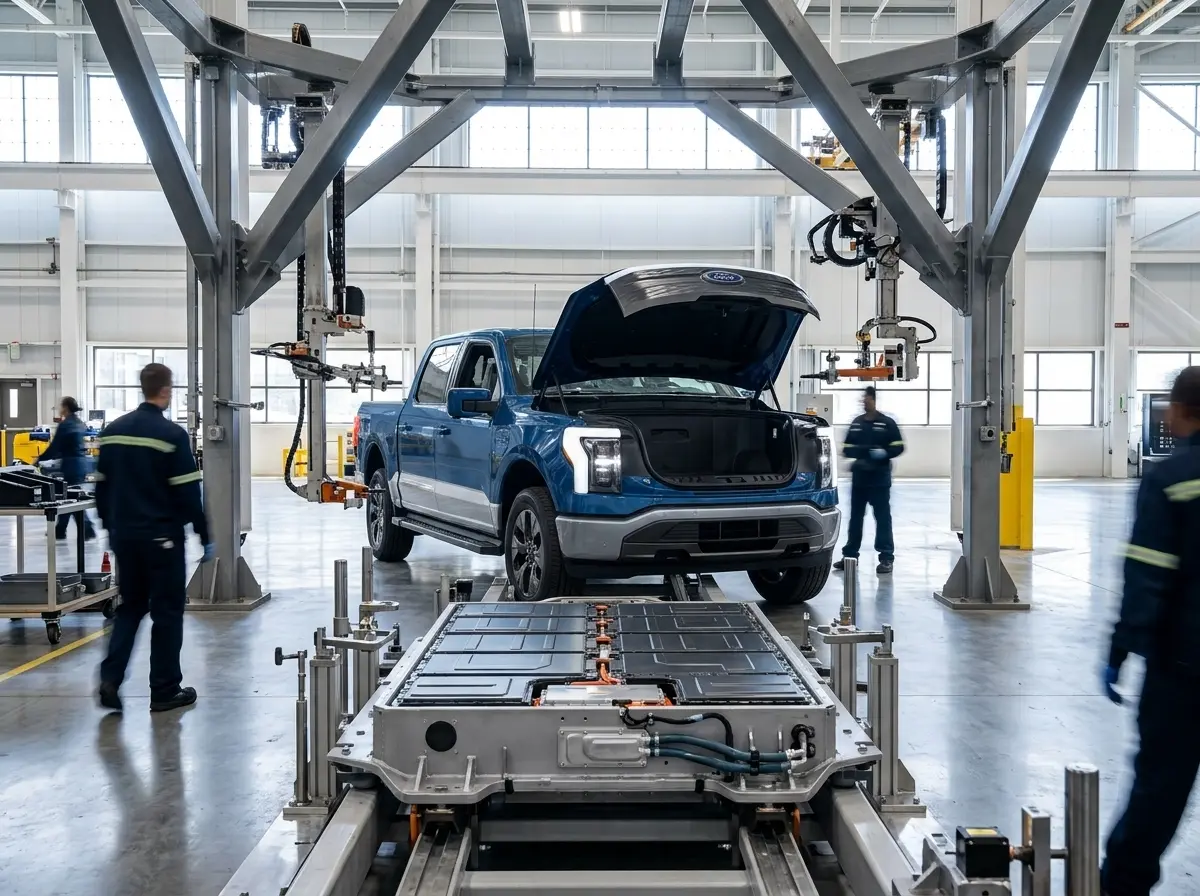
Ford is spending roughly $2 billion to retool Louisville Assembly for the Universal EV platform. The plant drops the classic moving line Henry Ford popularized. In its place sits a tree-shaped process that joins three major sub-assemblies, cuts parts count by about 20 percent, and relies on large aluminum unicasts for the front and rear structures. The structural LFP battery pack, seats and carpet come together separately before the final join.
The company calls it its most automated assembly operation. The investment is also meant to lock in 2,200 hourly jobs at the Kentucky plant. Batteries will come from BlueOval Battery Park Michigan in Marshall, which is producing LFP cells under technology licensed from CATL. Ford positions itself as the first U.S. maker of automotive LFP packs. The chemistry skips cobalt and nickel, trades some energy density for lower cost and thermal stability, and uses a 400-volt cell-to-pack layout with a 48-volt low-voltage system that replaces the usual 12-volt battery.
These choices are how Ford believes it can hit the sub-$30,000 mark while still offering five seats, a frunk and bidirectional power. The same platform is expected to underpin more small EVs later.
The tree layout works by letting major modules mature on parallel branches instead of waiting their turn on a single conveyor. Front structure, rear structure, and the cabin-and-pack module each reach a finished state before the final join. Fewer parts and large unicasts reduce fixtures, fasteners, and rework loops. Automation then holds the takt time steady once the process is dialed in. That is the mechanical path from a $2 billion retool to a sticker that does not rely on temporary incentives.
- Parallel build: three major sub-assemblies advance on separate branches
- Module prep: structural LFP pack, seats, and carpet finish offline
- Final join: completed modules meet in a single mating step
- Parts reduction: roughly 20 percent fewer pieces versus classic line builds
What Ford Has Already Locked In
Hardware commitments are clearer than performance numbers. Every Fathom will support BlueCruise hands-free highway driving and will integrate Apple Maps for a smoother on-ramp to off-ramp handoff once the system is activated. Bidirectional power is standard, so the truck can feed a home or tools. A digital car key and Phone as a Key are part of the package. The charge port uses NACS and sits on the rear driver side, a placement owners immediately praised as practical.
Cabin space is pitched against the RAV4, one of the highest-volume vehicles in the United States. The five-seat layout plus frunk and open bed is meant to cover both family and light work duty. Ford has also said the platform can support Level 3 eyes-off driving later, with a 2028 target mentioned in reporting around the launch.
Locking the feature set early serves two purposes. It gives dealers a concrete story before range and towing cards arrive, and it signals that software-dependent items such as BlueCruise and bidirectional power are not optional upcharges on the volume model. The rear-left NACS port and retained phone projection further reduce the list of daily irritations that often turn EV curiosity into a hard pass.
How the Fathom Stacks Against the Closest Rivals
Direct competition is thin. The gas-hybrid 2026 Maverick hybrid starting near the same sticker remains the in-house foil. Startup Slate has talked about a bare-bones EV truck closer to $25,000 before fees, with smaller projected ranges on its base pack. Full-size EV trucks still sit tens of thousands higher.
| Model | Base price (approx.) | Powertrain | Known notes |
|---|---|---|---|
| Ford Fathom std-range | $28,350 MSRP ($29,945 w/ dest) | LFP EV, 400 V | 5 seats, frunk, bi-dir, BlueCruise hardware; range TBA |
| Ford Maverick hybrid | ~$27,145-$28,145 MSRP | 2.5 L hybrid | Established compact truck, gas infrastructure |
| Slate Truck (est.) | ~$25,000 range | EV | Smaller, modular claims; base range historically cited lower |
The Fathom’s advantage is a full Ford dealer network and brand familiarity. Its risk is that buyers still default to a proven hybrid Maverick or wait for clearer range and towing figures.
Against the Maverick the Fathom must justify the shift to plugging in rather than filling up. Against Slate it must justify a higher starting point with five seats, a frunk, bidirectional power, and a national service footprint. Full-size electric trucks remain a different shopping trip entirely, priced and sized for buyers who already accepted a much larger outlay. The open question is which comparison shoppers will actually make once the truck is on lots.
Lightning Lessons Still Shadow the Launch
Ford’s first-generation F-150 Lightning proved the company could build a capable electric truck. It also showed how quickly production ambitions can outrun demand and how costly idle capacity becomes. In late 2023 and early 2024 the company cut Lightning output plans sharply after earlier expansions, shifting workers and tempering the 150,000-unit annual run-rate goal. Sales rose year-over-year at points but never reached the scale that justified the plant investments.
Mach-E volume has also cooled in recent periods. Those experiences sit behind the UEV skunkworks approach and the simplified assembly tree. Ford is trying to avoid another round of “good truck, hard to get, then hard to sell at volume.” The Louisville process and LFP cost structure are the mechanical answer. Whether they hold under real demand remains the open variable.
- Late 2023 to early 2024: Lightning output plans cut after earlier expansions
- Worker shifts: staff moved as the 150,000-unit annual goal was tempered
- Sales pattern: year-over-year gains at points, never the scale that matched plant spend
- UEV response: skunkworks program, tree assembly, and LFP cost structure designed to avoid a repeat
The lesson is not that electric trucks lack demand. It is that cost structure and assembly flexibility have to match the demand that actually appears, not the demand that was forecast when the plant was sized. The Fathom program is built around that correction.
What Still Sits in the Shadows
What We Know
- Name, $28,350 standard-range MSRP, $1,595 destination
- UEV platform first vehicle, Louisville assembly tree, LFP from Michigan
- BlueCruise hardware, bi-directional power, CarPlay/Android Auto, digital key, frunk, 5 seats, more passenger room than RAV4
- Preorders early 2027, deliveries later 2027, NACS charge port rear-left
What’s Unconfirmed
- Exact EPA range for standard and any long-range packs (base is not expected to hit 300 miles)
- Battery kWh, charge times, peak power, 0-60 figure on production trucks
- Payload and towing ratings
- Bed dimensions, final exterior/interior design, trim ladder and option pricing
- Dealer allocation strategy and any direct-order or markup controls
SlashGear and other coverage have floated competitive targets around 250-300 miles of range, 1,500-plus pounds of payload and roughly 2,000 pounds of towing for the truck to feel like a real alternative rather than a novelty. Ford has not published those numbers yet. Until it does, the sticker is the main selling point and the main source of buyer caution.
The gap between known hardware and unknown ratings leaves a long window for speculation. Buyers who need towing certainty will wait. Buyers who mainly want five seats, a bed, and a low payment may preorder on the sticker alone. Ford’s own messaging so far leans into the second group, the one Kay Hart described as driven by wallet and daily needs rather than traditional truck metrics.
Selling It Without the Usual Markup Trap
Price discipline only works if the truck reaches customers at something close to MSRP. Dealer markups on high-demand EVs have repeatedly turned attractive window stickers into $10,000-plus surprises. Some dealers may also prefer to push higher-margin F-150s and Expeditions over a thin-margin volume EV. Ford has time before early-2027 preorders to set allocation rules, consider direct elements, or police advertised pricing.
Marketing will need to do more than announce existence. The truck has to feel like the smarter daily choice against a hybrid Maverick and against simply waiting. Ford’s recent employee-pricing push after a sales drop shows the company is already willing to pull demand levers when volumes soften. The Fathom will test whether those levers still work on a new platform in a segment that has never had a true volume EV player.
Crowd reaction on X landed exactly where the product sits: genuine surprise at the $28k-class number, applause for keeping CarPlay and placing the NACS port in a usable spot, and immediate skepticism that range and real-world capability will match the hype once numbers appear. Gas-truck inertia remains the quiet competitor no press release can erase.
Allocation rules and advertised-price policing will decide whether the $29,945 drive-away figure survives first contact with a dealer lot. If the truck becomes a loss-leader showroom piece that steers buyers toward higher-margin metal, the volume thesis collapses. If Ford holds the line, the Fathom can reset expectations for what a midsize electric truck should cost.
The LFP Pack Trades Density for Cost
The battery choice is central to the sticker. Ford’s LFP cells from BlueOval Battery Park Michigan skip cobalt and nickel, the two metals that have driven cost and supply risk in many nickel-rich packs. The trade is lower energy density. The gain is lower material cost and stronger thermal stability, which simplifies pack design and cooling demands.
A 400-volt cell-to-pack layout further trims intermediate modules and housings. The 48-volt low-voltage system replaces the usual 12-volt battery, cutting another conventional part from the bill of materials. Together these decisions support the claim that Ford can be the first U.S. maker of automotive LFP packs while still fitting five seats, a frunk, and bidirectional hardware into a sub-$30,000 truck.
- Chemistry: LFP without cobalt or nickel
- Architecture: 400-volt cell-to-pack
- Low-voltage: 48-volt system in place of a 12-volt battery
- Supply: cells from Marshall, Michigan, under CATL-licensed technology
Range will reflect the density trade. Ford has already signaled the base pack is not expected to hit 300 miles. That is the open variable buyers will weigh against the price and the feature list once EPA figures appear.
More Small EVs Will Share This Platform
The Fathom is the first vehicle on the Universal EV platform, not the only one. Ford has said the same architecture is expected to underpin more small EVs later. That matters for the $2 billion Louisville retool and the Michigan LFP investment. Spreading fixed cost across a family of vehicles is how a thin-margin truck becomes a durable business rather than a one-off experiment.
Shared unicasts, a common pack approach, and the tree assembly method all scale more cleanly when a second and third model reuse the same branches. Job commitments at the Kentucky plant also look sturdier if volume does not depend on a single nameplate. The 2028 Level 3 target mentioned around the launch likewise assumes a platform life long enough to absorb later software and sensor upgrades.
For shoppers the implication is simpler. Buying the first truck on a new platform always carries timing risk. Knowing Ford intends a broader small-EV family at least signals that parts, service knowledge, and software support are meant to outlast the launch window.
Ford has put a credible price and a new industrial process on the table. The Fathom will succeed or stall on whether the assembly tree actually runs, the LFP packs deliver usable miles, and the trucks leave lots at the advertised number. The next 18 months of reveals and preorder traffic will show if the disruption is real or just another well-priced teaser.


OpenAI Bets $300 Donut Speaker Can Seed Its Device Future

OpenAI Bets $300 Donut Speaker Can Seed Its Device Future

Dell Parks Flagship XPS 13 Chassis on Googlebook Platform

OpenAI Bets $300 Donut Speaker Can Seed Its Device Future

CLARITY Act Delay Leaves Crypto Bill Racing a Midterm Clock

Ethics Deal on CLARITY Act Could Force Trump Crypto Sale With Tax Deferral

Chrome Wins Netflix 4K on Windows 11 but Edge Keeps More

Tight Jobless Claims Cap Bitcoin Under $65,000 on Hike Odds

Maher Gasps at DSA Communists While Hollywood Stays Silent

Netflix Gets GTA 6 Extended Look Six Hours Before YouTube

Fed Minutes Cite AI Demand as Inflation Risk, Put a 2026 Hike Back on the Map

Marker AI Writing Startup Lands $13M Seed Led by Index Ventures

Meta’s Muse Spark 1.1 Beats Rivals on Price, Trails on Coding

Finto Picks Munich Over Silicon Valley After YC, Raises $3.4M

CS2 Premier Season 5 Lands With Cache and a C4 Damage Rework

Backrooms Returns to Theaters as the Everything Must Go Edition

Trump Calls Iran ‘Islamic Republic of Japan’ as Ceasefire Ends

IO Interactive Regains Project Fantasy, Closes Istanbul Studio

Kord’s £6.4M Series A Bets Identity and Payments Run on One Stack

Taiwan Margin Debt Climbs 160% as Locals Borrow Into the TSMC Rally
-
 FINANCE2 months ago
Zcash Patched a Double-Spend Bug as ZEC Climbed 5%
-
 ENTERTAINMENT2 months ago
Steam Summer Sale 2026 Locks In June 25 to July 9 Dates
-

 FINANCE1 month ago
CLARITY Act Final Text Expected This Weekend as 60-Vote Hurdle Looms
-
 NEWS3 months ago
Meta Adds AI Replies to Threads, But Users Can’t Block It
-
 ENTERTAINMENT3 months ago
‘Widow’s Bay’ Review: Apple TV’s Sleeper Horror-Comedy Earns Its Fog
-
 NEWS5 months ago
U.S. Navy Deploys Solar-Powered Lightfish Drone to Patrol Oceans
-
 FINANCE2 months ago
CLARITY Act Floor Vote Likely Shifts to August, Lummis Says
-

 FINANCE1 month ago
Kalshi Loses Major NY Prediction Markets Ruling to Judge Torres