
FINANCE
CLARITY Act Delay Leaves Crypto Bill Racing a Midterm Clock
Senate Majority Leader Thune confirms the crypto market structure bill waits until September, compressing odds and ethics talks before midterms.

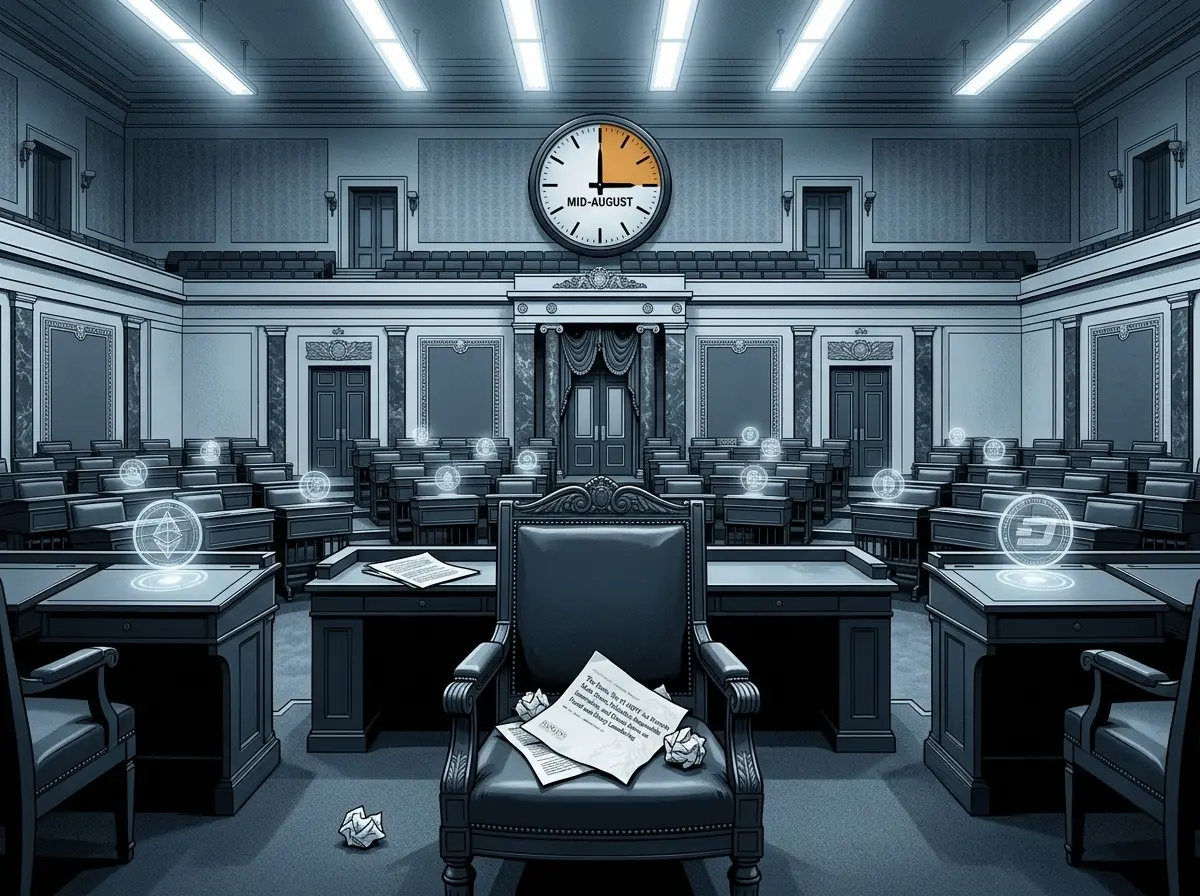
Senate Majority Leader John Thune confirmed late Thursday that the CLARITY Act will not receive a floor vote before the August recess. The crypto market structure bill now waits until mid-September, when senators return for a short session already crowded by other priorities.
Thune told reporters the Democrats insisted on no Clarity vote now. He added the measure would be queued up first thing when the chamber reconvenes.
Thune Confirms the Recess Punt
POLITICO reporter Jordain Carney broke the confirmation with a post that drew more than 267,000 views. “NEWS: Thune just confirmed our scoop that Senate is punting clarity vote until September,” she wrote. “Said they would get it teed up for when they return.”
The Block independently confirmed the same language from Thune: “Well, the Dems are insistent on no Clarity vote. Anyway, I worked with sponsors of the bill. Senator [Cynthia Lummis] was great, and we’re getting that queued up first thing when we come back.”
The Senate is set to leave Friday for a month-long break and return in mid-September for only a few weeks of work before attention fully shifts to the November midterms. That leaves a narrow runway.
Republican leaders had hoped to advance the bill during the final pre-recess days alongside Russia sanctions, nominations and a continuing resolution. Procedural rules limit the chamber to one contested measure at a time. The other items won the queue.
The sequence left sponsors with a public pledge but no locked calendar slot. Thune’s commitment to tee the bill first on return is the clearest procedural win available under the circumstances. It still leaves the measure exposed to every competing must-pass item that reappears in September.
What the CLARITY Act Does
H.R. 3633, the Digital Asset Market Clarity Act of 2025, passed the House 294-134 in July 2025 with 78 Democrats joining every Republican who voted. It reached the Senate Banking Committee calendar earlier this year.
The bill draws a bright line between the Commodity Futures Trading Commission and the Securities and Exchange Commission. Digital commodities that rely on mature, decentralized blockchains fall under CFTC spot-market oversight. Investment-contract assets stay with the SEC.
- Exchanges, brokers and dealers in digital commodities must register and meet trade-monitoring, recordkeeping and customer-asset segregation rules.
- Bank Secrecy Act anti-money-laundering and sanctions obligations apply to those intermediaries.
- Issuers of certain ancillary assets face disclosure and resale restrictions while the network decentralizes.
- Software developers who publish code without controlling customer funds receive explicit protections; self-custody remains legal.
- Digital-asset kiosks face registration, warnings, holding periods and fraud-detection requirements.
A Senate Banking fact sheet on protections frames the measure as closing gaps that allowed FTX-style collapses while preserving lawful innovation. The official summary of H.R. 3633 on Congress.gov confirms the CFTC-centric digital-commodity regime and provisional registration path.
That dual-track design is the core trade the bill offers: clearer CFTC authority over spot digital commodities in exchange for registration, surveillance and segregation duties on the intermediaries that touch customer assets. Developer protections and self-custody language sit alongside the kiosk rules, giving both industry and consumer advocates pieces they can defend.
Why Democrats Held the Line
Democrats refused a time agreement that would have cleared multiple pending bills, including CLARITY, before the break. They want continued talks on outstanding issues rather than a fast-track compromise.
WHAT WE KNOW
- Thune needs roughly seven Democratic votes to clear the 60-vote filibuster threshold.
- Ethics language remains the sharpest sticking point, including provisions that could force public officials and spouses to divest digital-asset holdings.
- A bipartisan Tillis-Gallego ethics package is under White House review; one version could create large tax deferrals for forced divestitures.
- Stablecoin rewards and bank-industry opposition earlier delayed markup progress.
WHAT’S UNCONFIRMED
- Whether Thune files cloture before leaving town to position the bill for an immediate September start.
- Exact Democratic vote commitments once ethics text hardens.
One source familiar with talks told The Block that Democrats also weighed the political optics of crypto industry influence ahead of the midterms. The same calendar that once favored a summer finish now works against it.
Earlier pressure included an earlier Grayscale push before recess that failed to lock in the vote. The Senate vote math that got tougher has only tightened further.
The ethics package is the hinge. Until the White House finishes its review of the Tillis-Gallego text, Democratic vote counters have cover to withhold the roughly seven votes Thune still needs. That review, not floor scheduling alone, now sets the pace.
Industry Reaction and Falling Odds
Digital Chamber CEO Cody Carbone called the outcome “not the result any of us hoped for” but said the fight continues. Crypto Council for Innovation CEO Ji Hun Kim labeled the delay “disappointing” yet insisted the direction has not changed and efforts will not stop.
Prediction markets moved faster. Polymarket now prices a 14 percent chance of 2026 enactment, down from peaks above 80 percent earlier in the year and from the mid-30s just weeks ago. Volume on the market exceeds $5 million.
| Milestone | Status / Figure |
|---|---|
| House passage | 294-134 (July 2025) |
| Senate cloture threshold | 60 votes |
| Polymarket 2026 law odds | 14% |
| Senate return window | mid-September, few weeks |
| Midterm election day | November 2026 |
On X, high-engagement posts mixed frustration with resignation. Ash Crypto’s “CLARITY IS DELAYED” note drew hundreds of likes within hours. Crowd chatter framed the recess as a gift to opponents who want the bill to die quietly under election-year pressure.
Well, the Dems are insistent on no Clarity vote. Anyway, I worked with sponsors of the bill. Senator [Cynthia Lummis] was great, and we’re getting that queued up first thing when we come back.
Thune’s own words, reported by The Block, leave little ambiguity about who forced the timing.
The drop from peaks above 80 percent to 14 percent compresses months of eroded confidence into a single number. Traders who once treated 2026 enactment as the base case now price the opposite outcome. The $5 million in volume shows the market is liquid enough for that repricing to matter.
September’s Compressed Reality
When senators return, CLARITY will compete with unfinished appropriations, nominations and whatever election-year messaging both parties prioritize. The chamber has only a short stretch of legislative days before the midterm campaign fully absorbs oxygen.
Stats snapshot
- 14% Polymarket probability the bill becomes law in 2026
- mid-September earliest realistic floor action
- few weeks of effective session before midterms dominate
- 60 votes still required; Republican support has also wavered at times
If the bill clears the Senate it must return to the House for any amendments before reaching President Trump’s desk. That extra step consumes more calendar that no longer exists in abundance.
- August 7-8, 2026, Senate departs for recess without CLARITY cloture.
- mid-September 2026, Chamber reconvenes; Thune has pledged to tee the bill first.
- late September-October, Possible debate and vote window if ethics text closes and Democratic votes materialize.
- November 2026, Midterms; lame-duck possibilities shrink if control shifts or priorities reset.
The ethics fight itself carries an internal timer. One version of the provision is an ethics provision built to expire, adding another layer of negotiation complexity.
Every day spent reopening ethics text is a day lost from the already short September-October window. Sponsors must close that text fast enough for cloture math to form before campaign travel empties the floor.
How the Calendar Became the Enemy
The bill spent more than ten months in bipartisan talks before the Senate Banking markup cycle. Stablecoin rewards sparked open conflict between crypto firms and banks. Jamie Dimon’s public blast at Coinbase’s Brian Armstrong captured the temperature. Illicit-finance tools and DeFi treatment produced further amendments.
By late July the procedural path still looked open. Thune kept the bill on the agenda and Lummis publicly insisted it would move. Then Russia sanctions, nominations packages and the continuing resolution consumed the remaining days. Once Democrats withheld consent for a multi-bill time agreement, the math collapsed.
Prediction markets tracked the erosion in real time. Odds that once priced near-certainty of 2026 passage now sit at levels that imply most traders expect either failure or a multi-year delay.
The same ten-month investment that built bipartisan architecture also consumed the calendar buffer. When the final pre-recess days filled with other priorities, no spare legislative weeks remained to absorb a Democratic hold. The recess did not create the problem; it merely made the lost buffer visible.
What the Next Ninety Days Decide
Industry groups will spend August lobbying both sides on the final ethics package and any remaining AML or consumer-protection language. The White House review of the Tillis-Gallego text could unlock or freeze Democratic support.
Thune’s public commitment to queue the bill immediately on return gives sponsors a clean starting line. It does not guarantee debate time once other must-pass items reappear. A failed cloture vote in September would effectively end realistic 2026 hopes.
Markets already price that risk. The same traders who once saw CLARITY as inevitable now treat the September session as a low-probability last stand. For exchanges, custodians and token issuers still operating under dual SEC-CFTC ambiguity, the delay extends the status quo another quarter at minimum.
The House Path Still Requires Another Round
Even a clean Senate passage does not finish the job. Any amendments adopted in the Senate send H.R. 3633 back to the House for concurrence before the measure can reach President Trump’s desk.
That second House step is mechanical when the chambers agree and time-consuming when they do not. The original House vote of 294-134, including 78 Democrats, showed broad support for the core text. It does not automatically extend to every ethics or AML change the Senate may still insert.
- Senate passage with no amendments: House concurrence can move quickly.
- Senate passage with ethics or AML changes: House must review and vote again.
- Disagreement between chambers: conference or informal negotiation consumes further days.
The narrow September-to-October window must absorb both the Senate fight and any return trip to the House. Calendar scarcity turns a routine bicameral step into a material risk.
Dual Oversight Keeps Firms Waiting
Until CLARITY becomes law, exchanges, brokers, custodians and token issuers remain under the existing split between SEC and CFTC authority. The bill’s central promise is a bright line: digital commodities on mature decentralized networks to the CFTC, investment-contract assets to the SEC.
That line is still only a House-passed framework. Registration duties, customer-asset segregation rules, Bank Secrecy Act obligations and developer protections all stay prospective. Self-custody remains legal under current practice, yet the statutory shield the bill would add is not yet in force.
| Participant | What stays unresolved |
|---|---|
| Exchanges and brokers | Which agency runs spot oversight and registration |
| Custodians | Final segregation and recordkeeping standard |
| Token issuers | Ancillary-asset disclosure and resale limits |
| Software developers | Explicit code-publication protections |
Each quarter of delay leaves those questions open. Market participants continue to operate inside the ambiguity the House bill was written to close.
The recess is over. The clock is not.


OpenAI Bets $300 Donut Speaker Can Seed Its Device Future

OpenAI Bets $300 Donut Speaker Can Seed Its Device Future

Dell Parks Flagship XPS 13 Chassis on Googlebook Platform

OpenAI Bets $300 Donut Speaker Can Seed Its Device Future

CLARITY Act Delay Leaves Crypto Bill Racing a Midterm Clock

Ethics Deal on CLARITY Act Could Force Trump Crypto Sale With Tax Deferral

Chrome Wins Netflix 4K on Windows 11 but Edge Keeps More

Tight Jobless Claims Cap Bitcoin Under $65,000 on Hike Odds

Maher Gasps at DSA Communists While Hollywood Stays Silent

Netflix Gets GTA 6 Extended Look Six Hours Before YouTube

Fed Minutes Cite AI Demand as Inflation Risk, Put a 2026 Hike Back on the Map

Marker AI Writing Startup Lands $13M Seed Led by Index Ventures

Meta’s Muse Spark 1.1 Beats Rivals on Price, Trails on Coding

Finto Picks Munich Over Silicon Valley After YC, Raises $3.4M

CS2 Premier Season 5 Lands With Cache and a C4 Damage Rework

Backrooms Returns to Theaters as the Everything Must Go Edition

Trump Calls Iran ‘Islamic Republic of Japan’ as Ceasefire Ends

IO Interactive Regains Project Fantasy, Closes Istanbul Studio

Kord’s £6.4M Series A Bets Identity and Payments Run on One Stack

Taiwan Margin Debt Climbs 160% as Locals Borrow Into the TSMC Rally
-
 FINANCE2 months ago
Zcash Patched a Double-Spend Bug as ZEC Climbed 5%
-
 ENTERTAINMENT2 months ago
Steam Summer Sale 2026 Locks In June 25 to July 9 Dates
-

 FINANCE1 month ago
CLARITY Act Final Text Expected This Weekend as 60-Vote Hurdle Looms
-
 NEWS3 months ago
Meta Adds AI Replies to Threads, But Users Can’t Block It
-
 NEWS5 months ago
U.S. Navy Deploys Solar-Powered Lightfish Drone to Patrol Oceans
-
 ENTERTAINMENT3 months ago
‘Widow’s Bay’ Review: Apple TV’s Sleeper Horror-Comedy Earns Its Fog
-
 FINANCE2 months ago
CLARITY Act Floor Vote Likely Shifts to August, Lummis Says
-

 FINANCE1 month ago
Kalshi Loses Major NY Prediction Markets Ruling to Judge Torres