
NEWS
OpenAI Bets $300 Donut Speaker Can Seed Its Device Future
OpenAI’s first hardware is a portable doughnut-shaped AI speaker priced $300-400, built with Jony Ive, aiming to feel alive amid Apple’s lawsuit.

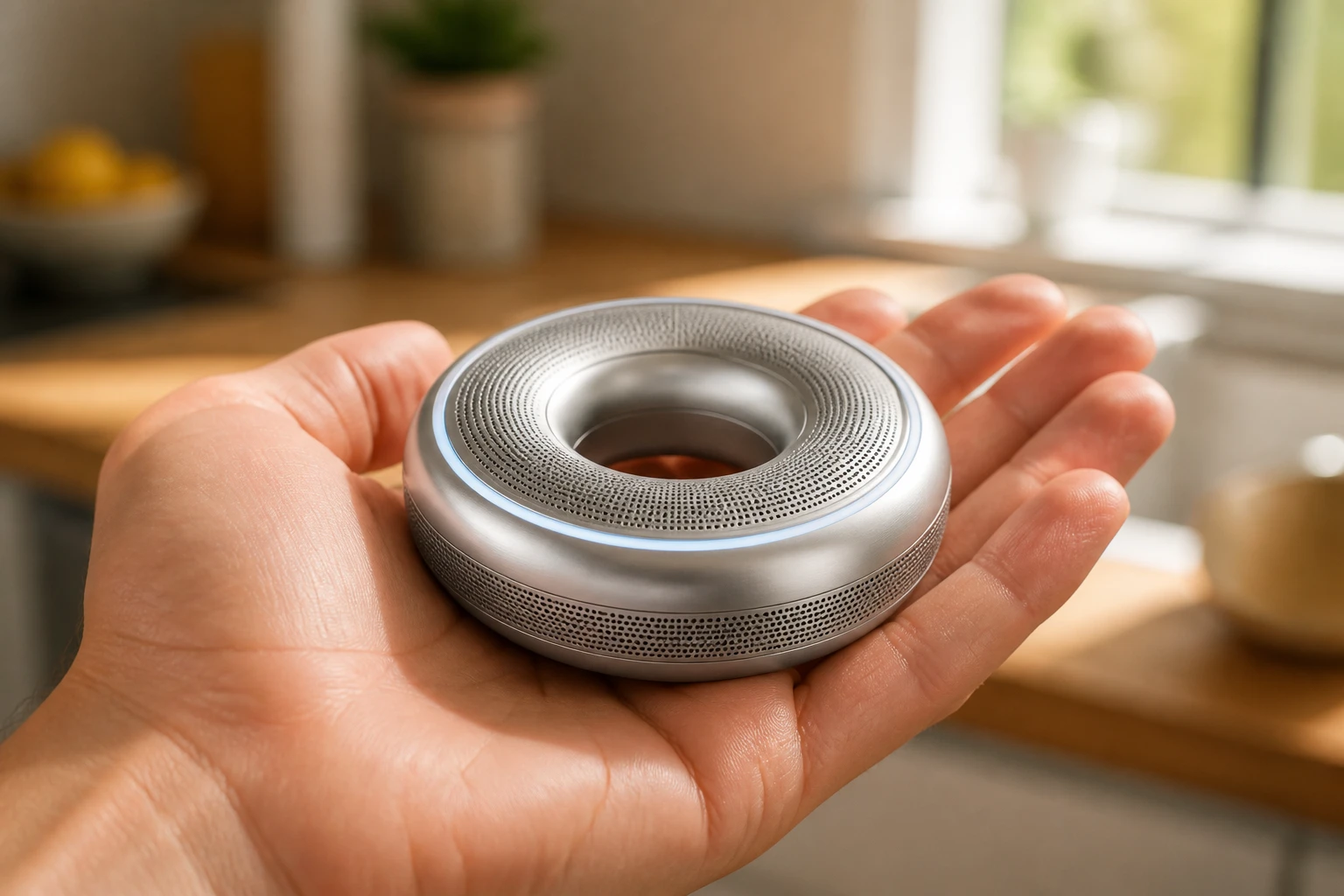
OpenAI’s first consumer hardware is a battery-powered, doughnut-shaped smart speaker the size of a hockey puck that targets a $300 to $400 price and a 2027 launch, according to people familiar with the project briefed to Bloomberg’s Mark Gurman. The screenless device, designed with Jony Ive’s LoveFrom studio, packs moving mechanical parts, lights, a camera and sensors so it can feel alive while running advanced ChatGPT voice models.
The bet is clear: turn ambient voice AI into a portable companion people carry room to room, then expand into a full device family that one day challenges the smartphone.
The Puck That Moves on Its Own
The product is essentially a smart speaker without a display. It is shaped like a doughnut roughly the size of a hockey puck so a user can hold it in one hand and set it on a nightstand, kitchen counter or table. Battery power frees it from the wall outlet that anchors most Echo and HomePod units.
Physical parts shift by themselves during conversations. Combined with LED lights they signal listening or responding and give the object a sense of aliveness traditional stationary speakers lack. Microphones handle voice; speaker grills deliver audio; an onboard camera system plus environmental sensors feed real-time visual context into OpenAI’s multimodal models.
- Battery-powered for room-to-room carry
- Self-moving mechanical elements for visual feedback
- Camera and sensors for environmental awareness
- Advanced voice models tuned beyond phone ChatGPT Voice Mode
- Learns routines for personalized planning and research
It controls smart-home gear, plays media, answers questions, handles messages and stays in conversation the way a human-like companion would. OpenAI wants the hardware to become a physical manifestation of ChatGPT that lives in the home.
Premium Materials Meet a Steep Price
Upscale metal finishing, dynamic lighting and integrated grills aim for a premium look. Internal pricing talks put the unit between $300 and $400. That sits well above a basic Echo Dot that often sells for under $50 and even above many higher-end Amazon and Google models that top out near $240.
| Device | Approx. Price | Power | Display | Key Differentiator |
|---|---|---|---|---|
| OpenAI speaker (reported) | $300-$400 | Battery | None | Moving parts, camera, advanced ChatGPT |
| Amazon Echo Dot | $30-$50 | Plug-in | None | Alexa ecosystem, low cost |
| Apple HomePod mini | ~$99 | Plug-in | None | Siri + Apple services |
| Higher-end Echo / Nest | up to ~$240 | Mostly plug-in | Some models | Better audio or screens |
The premium tag positions the device as a gateway rather than a volume play. OpenAI sees it seeding a broader ecosystem. Whether buyers will pay four to ten times the price of an Echo for personality and portability remains the open question the market will answer in 2027.
Jony Ive’s Bridge From io to OpenAI
The hardware effort grew directly from io Products, the startup Ive co-founded with former Apple colleagues. OpenAI acquired io in a deal valued at $6.5 billion in May 2025. The all-stock transaction folded the roughly 55-person team into OpenAI while LoveFrom stayed independent and took deep design responsibility across the company.
In their public letter, Sam and Jony described the merger as the moment computers that see, think and understand finally escape traditional interfaces. Ive wrote that everything he had learned over 30 years led to this collaboration. Altman called the care Ive’s team puts into every process extraordinary.
- May 2025, OpenAI announces $6.5 billion acquisition of io Products; Ive and LoveFrom take design lead.
- July 2025, io team officially merges into OpenAI.
- July 2026, Early reports surface of a movable screenless AI companion speaker.
- August 2026, Detailed doughnut form, $300-$400 pricing and moving parts confirmed.
- Target 2027, Planned market release after possible 2026 unveiling.
The same talent pipeline that once defined the iPhone, iPad and Apple Watch is now pointed at ambient AI. That pedigree is the core of the wager.
Apple’s Metal Claim Lands on the Same Table
The project collides with Apple’s July 2026 federal lawsuit accusing OpenAI and two former Apple employees of trade-secret theft. The complaint alleges OpenAI misled a longtime shared manufacturing partner into performing a confidential metal-finishing technique while claiming Apple’s permission. A metal design appears in the speaker’s reported construction, though OpenAI says it is unclear whether the suit targets this exact product, another concept or a scrapped idea.
What we know
- Apple filed suit July 10, 2026 in Northern California naming OpenAI, io and two ex-employees.
- Central allegation: unauthorized use of a proprietary metal-finishing process via a supplier.
- OpenAI filed a motion to dismiss calling the claims speculative and stating an internal probe cleared the stack.
- OpenAI’s filing: “OpenAI is building something entirely new and different from anything at Apple.”
What’s unconfirmed
- Whether a preliminary injunction will delay the 2027 schedule.
- Exact manufacturing partner or technique details beyond the complaint language.
- Whether Ive himself faces any named liability (he does not appear as a defendant).
People familiar with the device say OpenAI believes the ring-shaped, motion-enabled assistant uses none of Apple’s secrets. The company continues full-speed development. Still, an injunction request sits in the background of every launch timeline.
Ambient Companion Versus the Crowded Echo Shelf
Smart speakers already fill millions of homes. The global smart speakers market valued near $16 billion in the mid-2020s remains dominated by Amazon, with Google a clear second and Apple a smaller premium player. Many of those devices lose money or serve mainly as ecosystem hooks.
OpenAI’s entry ignores the low-price volume game. It leans on personality, portability and continuous learning. The software is meant to grow more humanlike over time, offering daily planning, research help and conversational continuity that basic command-response speakers rarely deliver.
Crowd reaction on X mixed excitement with sharp skepticism. One widely read take noted that every major AI hardware launch of the prior two years-Humane’s AI Pin, the Rabbit R1-had flopped or been written down, and that a $300 moving doughnut would have to clear that bar while OpenAI itself continues heavy losses. Optimists, including longtime tech observers, said they would buy simply for the chance of an always-available cooking helper or research partner that feels present.
Gurman’s breakdown of the doughnut form itself drew hundreds of thousands of views within hours, underscoring how closely the industry is watching the first tangible output of the Ive partnership.
The Family of Devices That Comes After
The speaker is framed internally as the first product in a planned family. Longer-term ambitions include hardware that could eventually replace smartphones. A portable, camera-equipped, always-listening companion that already understands context is an obvious on-ramp to glasses, wearables or other form factors once the software and trust models mature.
That path also explains the premium materials and price. OpenAI is not trying to win the living-room speaker race on volume. It is trying to establish a new interaction surface that people invite deeper into their routines. Success would validate the $6.5 billion io bet and give the company a hardware margin story ahead of any IPO path. Failure would join a lengthening list of AI gadgets that looked clever in demos and vanished from shelves.
An earlier OpenAI hardware keypad project showed the company is willing to experiment with physical interfaces. The doughnut speaker is the first mass-market attempt. Parallel work on safety frameworks, including joint frontier safety framework work with Anthropic, sits in the background of any always-on home device that carries a camera and continuous audio.
OpenAI still targets an official unveiling later in 2026. Legal friction could slip that calendar. The metal, the motors, the models and the $300-plus tag are already set. Whether enough people decide the companion is worth the premium will decide if the bet pays.


OpenAI Bets $300 Donut Speaker Can Seed Its Device Future

OpenAI Bets $300 Donut Speaker Can Seed Its Device Future

Dell Parks Flagship XPS 13 Chassis on Googlebook Platform

OpenAI Bets $300 Donut Speaker Can Seed Its Device Future

CLARITY Act Delay Leaves Crypto Bill Racing a Midterm Clock

Ethics Deal on CLARITY Act Could Force Trump Crypto Sale With Tax Deferral

Chrome Wins Netflix 4K on Windows 11 but Edge Keeps More

Tight Jobless Claims Cap Bitcoin Under $65,000 on Hike Odds

Maher Gasps at DSA Communists While Hollywood Stays Silent

Netflix Gets GTA 6 Extended Look Six Hours Before YouTube

Fed Minutes Cite AI Demand as Inflation Risk, Put a 2026 Hike Back on the Map

Marker AI Writing Startup Lands $13M Seed Led by Index Ventures

Meta’s Muse Spark 1.1 Beats Rivals on Price, Trails on Coding

Finto Picks Munich Over Silicon Valley After YC, Raises $3.4M

CS2 Premier Season 5 Lands With Cache and a C4 Damage Rework

Backrooms Returns to Theaters as the Everything Must Go Edition

Trump Calls Iran ‘Islamic Republic of Japan’ as Ceasefire Ends

IO Interactive Regains Project Fantasy, Closes Istanbul Studio

Kord’s £6.4M Series A Bets Identity and Payments Run on One Stack

Taiwan Margin Debt Climbs 160% as Locals Borrow Into the TSMC Rally
-
 FINANCE2 months ago
Zcash Patched a Double-Spend Bug as ZEC Climbed 5%
-
 ENTERTAINMENT2 months ago
Steam Summer Sale 2026 Locks In June 25 to July 9 Dates
-

 FINANCE1 month ago
CLARITY Act Final Text Expected This Weekend as 60-Vote Hurdle Looms
-
 NEWS3 months ago
Meta Adds AI Replies to Threads, But Users Can’t Block It
-
 NEWS5 months ago
U.S. Navy Deploys Solar-Powered Lightfish Drone to Patrol Oceans
-
 ENTERTAINMENT3 months ago
‘Widow’s Bay’ Review: Apple TV’s Sleeper Horror-Comedy Earns Its Fog
-
 FINANCE2 months ago
CLARITY Act Floor Vote Likely Shifts to August, Lummis Says
-

 FINANCE1 month ago
Kalshi Loses Major NY Prediction Markets Ruling to Judge Torres