
BUSINESS
Cursor’s $2.3 Billion Round Built a Model Lab SpaceX Bought
Cursor’s $2.3 billion Series D paid for in-house coding models, with NVIDIA and Google joining; SpaceX later bought the company for $60 billion.

Cursor closed a $2.3 billion Series D on November 13, 2025, at a $29.3 billion post-money valuation. Accel and Coatue co-led the round, and Coatue, NVIDIA, and Google joined as new partners beside Thrive Capital and Andreessen Horowitz.
The company said the cash would fund research. Composer, its own agent model, had shipped two weeks earlier, on October 29, 2025, and the raise was meant to train what came next.
The $2.3 Billion Went to Research First
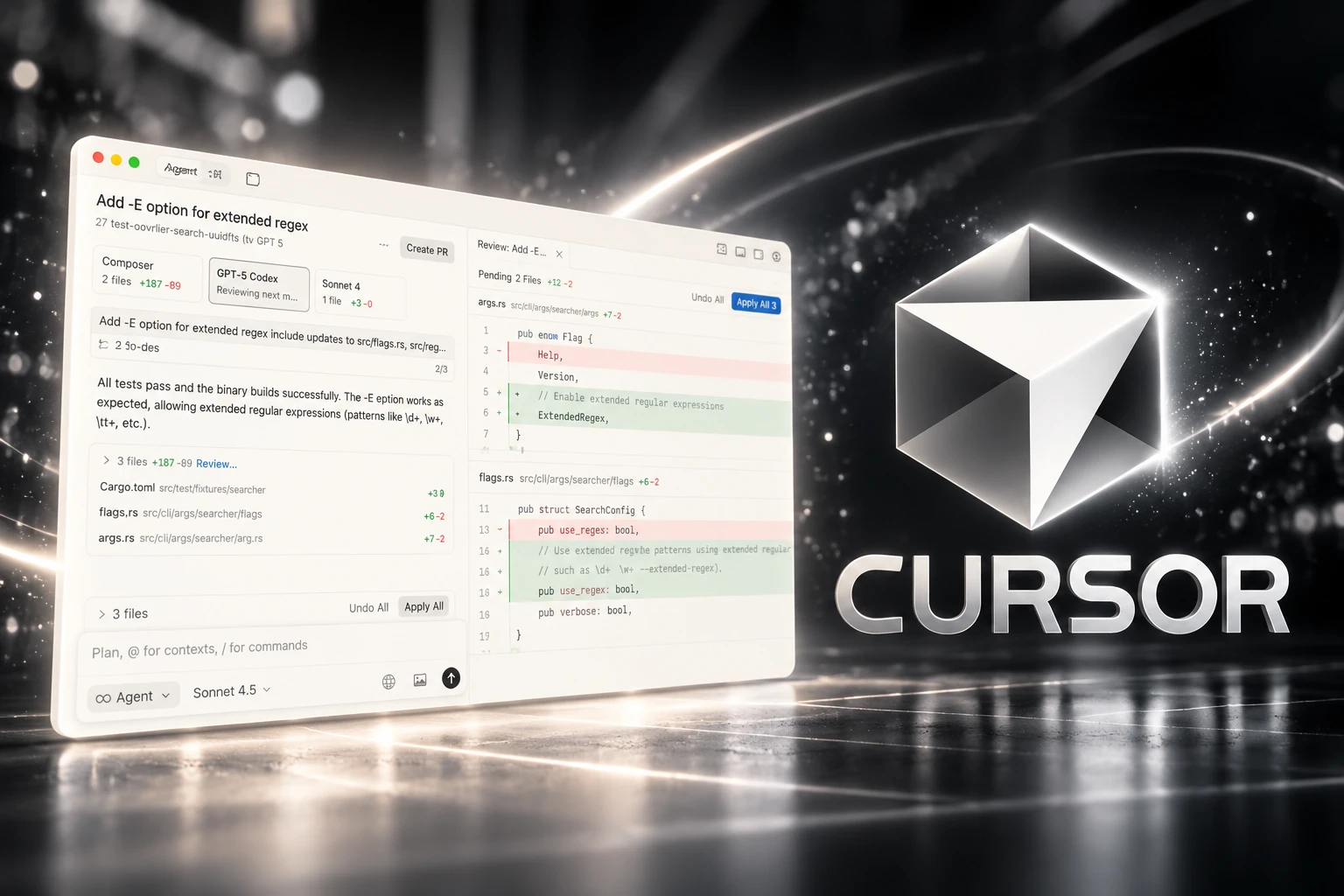
In a Series D of $2.3 billion, Cursor told customers it had crossed $1 billion in annualized revenue and grown past 300 engineers, researchers, designers, and operators. Millions of developers were already on the product, including over half of the Fortune 500. The editor, built on Microsoft’s open-source VS Code, had become a place to run agents over a whole codebase, not only a window for typing.
Anysphere, Inc., the Delaware company behind the product, is based in San Francisco and had opened a New York office by the time of the close. Michael Truell, co-founder and CEO, put the new money on research and on a larger footprint, not on a marketing splash.
WHERE THE NEW CAPITAL WAS AIMED
- Model work: Cursor said the round would fund technical research and frontier model training, including Composer.
- The product: The same release pointed to more work on tools that write, read, and review code.
- The offices: Headcount was set to grow in San Francisco and New York.
- The accounts: Cursor said enterprise revenue had grown 100x in 2025 through the November announcement, a separate claim from the $1 billion annualized line.
The company’s own post on X restated the raise, the revenue mark, and the plan to put the money into research.
We've raised $2.3B in Series D funding from Accel, Andreessen Horowitz, Coatue, Thrive, Nvidia, and Google.
We're also happy to share that Cursor has grown to over $1B in annualized revenue and now produces more code than any other agent in the world.
This funding will allow…
— Cursor (@cursor_ai) November 13, 2025
NVIDIA Was a Customer Before It Was an Investor
NVIDIA and Google were odd names on a software cap table only if you treated Cursor as a thin wrapper on other people’s models. By Series D, NVIDIA was already a named customer, listed beside Uber and Adobe when Cursor announced its Series C, and Accel later added OpenAI and Stripe to that customer list. Google was already a model supplier inside the editor.
The second-order move was vertical. Cursor still let teams pick models from Google, OpenAI, and Anthropic, and it wanted Composer to take more of that load. Google wrote a check anyway. NVIDIA wrote a check too, after years of selling the GPUs that training runs consume. Accel, which co-led, described Cursor as a research lab and a software company in the same breath, and said the IDE win was only the start.
We believe that coding will be the single biggest driver of global productivity over the next decade, and our mission is to accelerate that progress. This funding allows us to dramatically increase our investment in research and product efforts and expand our footprint, ensuring we can continue to equip the world’s engineering teams with the best tool for crafting software.
Michael Truell, co-founder and CEO, Cursor Series D release
That stack of roles did not unwind. In a February 2026 customer note, Cursor said more than 30,000 NVIDIA developers used the editor daily and were committing three times more code than before. On September 20, 2026, NVIDIA chief Jensen Huang said, “We use Cursor, SpaceXAI’s product.” The chipmaker had been a user, then a Series D investor, then a user of a SpaceX unit, without ever leaving the building.
The Team Hit $1 Billion With 300 People
THE SERIES D SNAPSHOT
- New capital: $2.3 billion, co-led by Accel and Coatue.
- Post-money mark: $29.3 billion.
- Annualized revenue: $1 billion.
- Headcount: more than 300 people.
Accel’s Josh Fang, Rohan Kamat, and Andrew Braccia wrote that Cursor eclipsed $1 billion within three quarters. Five months earlier, on June 6, 2025, Cursor had put annualized revenue above $500 million in its Series C post. The company also said it served over 50,000 teams worldwide by the Series D close.
The extra surface area around the editor showed where the money was supposed to work. Bugbot, an add-on for AI code review, was adopted by over 3,000 customers within weeks of launch, Accel said. Within a week of a Linear integration, over 45% of enterprise customers were assigning tasks to Cursor agents inside Linear. Slack could kick off coding agents without a trip back to the desktop, and Figma was being wired from design into those same agents.
GitHub Copilot still won on price and on the number of editors it could sit inside. Cursor’s bet was the opposite: one AI-native editor, its own models, and a toolchain that pulled review, tickets, and design toward that window. The $2.3 billion did not have to buy distribution. It had to buy compute, researchers, and time.
The Price Rose From $9.9 Billion in Five Months
The Series D landed five months after Cursor raised $900 million at a $9.9 billion valuation on June 6, 2025, from Thrive, Accel, Andreessen Horowitz, and DST. That Series C post already named NVIDIA, Uber, and Adobe and said over half of the Fortune 500 were on the product. The new round moved the mark from $9.9 billion to $29.3 billion without a long quiet period in between.
Earlier checks were smaller and closer together. Cursor raised $60 million in a Series A dated August 22, 2024, then $105 million in a Series B dated January 16, 2025. Thrive had led the middle rounds. Accel, already on the Series C, stepped up to co-lead the Series D with Coatue, a first-time name on the list. NVIDIA and Google came in on that same close.
CURSOR’S PRICED MARKS
| Round | Date | Raised | Stated value |
|---|---|---|---|
| Series C | June 6, 2025 | $900 million | $9.9 billion |
| Series D | November 13, 2025 | $2.3 billion | $29.3 billion |
| SpaceX close | August 14, 2026 | All-stock | $60 billion |
The jump from Series C to Series D is the part that still looks like a software story. The next line on the same table is the part that is not. Nine months after the $29.3 billion close, SpaceX took the company in for $60 billion in stock.
How Composer Uses NVIDIA’s Chips
Composer shipped on October 29, 2025, as Cursor 2.0 landed, with a new layout built around many agents in parallel. Cursor called it an agent model for software work and said it hit frontier coding results on the company’s own tests with generation speed four times faster than similar models. Most turns, the company said, finished in under 30 seconds, which was the point: keep a person in the loop instead of sending them out for coffee.
The model is a mixture-of-experts system trained with reinforcement learning on real engineering tasks in large codebases. During training it could read and edit files, run terminal commands, and search a repo. Cursor built an internal test, Cursor Bench, from real agent requests by its own engineers, scored not only on correctness but on whether the model respected a codebase’s existing habits. The company also said the work scaled training to thousands of NVIDIA GPUs, using custom low-precision kernels so the same runs could serve faster inference later.
Tab, Cursor’s custom completion model, was the earlier in-house piece. Composer was the attempt to take that idea into multi-step agent work, after an internal prototype the company referred to as Cheetah. In-house models, Cursor said at Series D, already generated more code than almost any other LLMs in the world. That line is a usage claim, not a public benchmark win, and Cursor itself noted that GPT-5 and Sonnet 4.5 still outperformed Composer on the “best frontier” slice of its own chart.
The research plan did not stop at one release. Composer 1.5, Composer 2, and Composer 2.5 followed in 2026, still priced for heavy agent use, while the editor kept a second lane for Claude, GPT, Gemini, and, after the SpaceX close, Grok. The Series D was the bill for that split: a cheap specialist for daily agent work, rented frontier models for the hard turns, and a lab that wanted to own more of the specialist side.
SpaceX Closed a $60 Billion All-Stock Deal
On April 21, 2026, Cursor said it was partnering with SpaceX to speed up model training, after calling compute the bottleneck. On June 16, 2026, Space Exploration Technologies Corp. filed that it had signed a merger agreement with Anysphere, Inc. The filing set an implied equity value of $60 billion and said Cursor would survive as a wholly owned subsidiary. The deal closed on August 14, 2026.
FROM COMPOSER TO THE SPACEX CLOSE
- October 29, 2025: Cursor ships Composer and Cursor 2.0, with a multi-agent interface.
- November 13, 2025: Series D closes at $2.3 billion and a $29.3 billion post-money valuation.
- April 21, 2026: Cursor announces a SpaceX partnership to accelerate model training.
- June 16, 2026: SpaceX and Anysphere sign a merger agreement at $60 billion.
- August 14, 2026: Cursor says the acquisition is complete and that it will have access to SpaceX’s GPU fleet.
In the close post, Cursor wrote that it would have access to the largest fleet of GPUs in the world, and that the aim was stronger models that cost less to run. Grok 4.6 was already in the editor that week as an early sample of the joint work. On September 21, 2026, Cursor put Grok 4.7 in the same picker and said Composer remained the fast, cheaper model for everyday coding. The lab did not collapse onto a single nameplate after the sale.
Google’s and NVIDIA’s Series D checks look different in that light. They were not only financial. They were positions in a company that was already training on NVIDIA silicon, routing some traffic through Google models, and collecting the session data that a larger lab would want. SpaceX paid $60 billion, nine months after the $29.3 billion round, for that combination of distribution and training loop.
Frequently Asked Questions
Who Led Cursor’s Series D Funding Round?
Accel co-led the $2.3 billion Series D with Coatue on November 13, 2025. Thrive Capital and Andreessen Horowitz stayed in from earlier rounds, and NVIDIA and Google joined as new partners. DST Global, which had backed the $900 million Series C, remained as an existing investor in the press release even though Cursor’s blog post did not list it among the new names.
What Is Anysphere in the Cursor Deal?
Anysphere, Inc. is the Delaware corporation that sells Cursor. SpaceX’s June 16, 2026 merger agreement names Anysphere as the company being acquired and X67 Inc., a SpaceX subsidiary, as the merger vehicle, with Cursor surviving as a wholly owned subsidiary when the deal closed on August 14, 2026.
When Did Cursor First Ship Its Composer Model?
Composer shipped on October 29, 2025, two weeks before the Series D, as part of Cursor 2.0. It grew out of Cursor Tab, the company’s custom completion model, and out of an internal prototype Cursor referred to as Cheetah, which the team used to test whether a faster agent model would keep developers in the flow of an interactive session.
How Was the SpaceX Purchase of Cursor Paid?
The purchase was all stock. Each outstanding Anysphere common and preferred share converted into SpaceX Class A shares, with the share count set by a $60 billion implied equity value and by the volume-weighted average closing price of SpaceX Class A stock over the seven trading days immediately before close. The June 16, 2026 filing said SpaceX expected the merger to close in the third quarter of 2026, and Cursor said the deal completed on August 14, 2026.
Disclaimer: This article is news reporting and analysis of Cursor’s Series D and the later SpaceX purchase, and it is for information only. It is not investment advice, a solicitation to buy or sell any security, or a recommendation on SpaceX Class A shares, private-company marks, or any other financial instrument. Readers who may act on valuation or deal terms should consult a qualified financial adviser or securities lawyer who can review the underlying filings. Figures and ownership details reflect the company posts, investor notes, and the June 16, 2026 merger filing as cited, and they can change with later disclosures.

UPI MDR Delay Hands Traders the Calendar After Paytm Falls

Google Messages Builds Nine In-Chat Games After Samsung’s Exit

Anthropic’s $100 Million Academy Trains the Firms That Bill Both Sides

Toyota’s Electric C-HR Leaves the Cheap Twin to Subaru

Markets Bet the Fed Skips October After Hawkish Minutes

The Orchard Bug Forced Zcash to Open an Empty Pool

The $5.99 Game That Won Steam’s 2026 Summer Sale

Don Lee Joins Hemsworth as Extraction 3 Starts Shooting

YouTube Shorts Retires Dislikes and Swaps Likes for Hearts

NEURA Robotics Is Spending Its $1.4B on a Machine Stack
-
 NEWS5 months ago
The Orchard Bug Forced Zcash to Open an Empty Pool
-
 GAMING5 months ago
The $5.99 Game That Won Steam’s 2026 Summer Sale
-
 ENTERTAINMENT7 months ago
Don Lee Joins Hemsworth as Extraction 3 Starts Shooting
-
 NEWS4 months ago
YouTube Shorts Retires Dislikes and Swaps Likes for Hearts
-
 NEWS4 months ago
NEURA Robotics Is Spending Its $1.4B on a Machine Stack
-
 NEWS5 months ago
Atlantic City Turned WWE’s Return Into a Civic Night
-
 AUTO6 months ago
Kawasaki Bets the New Z1100 Against Its Own Supercharger
-

 BUSINESS5 months ago
Norway’s Export Bank Backs Nscale’s $790 Million Narvik Loan