
NEWS
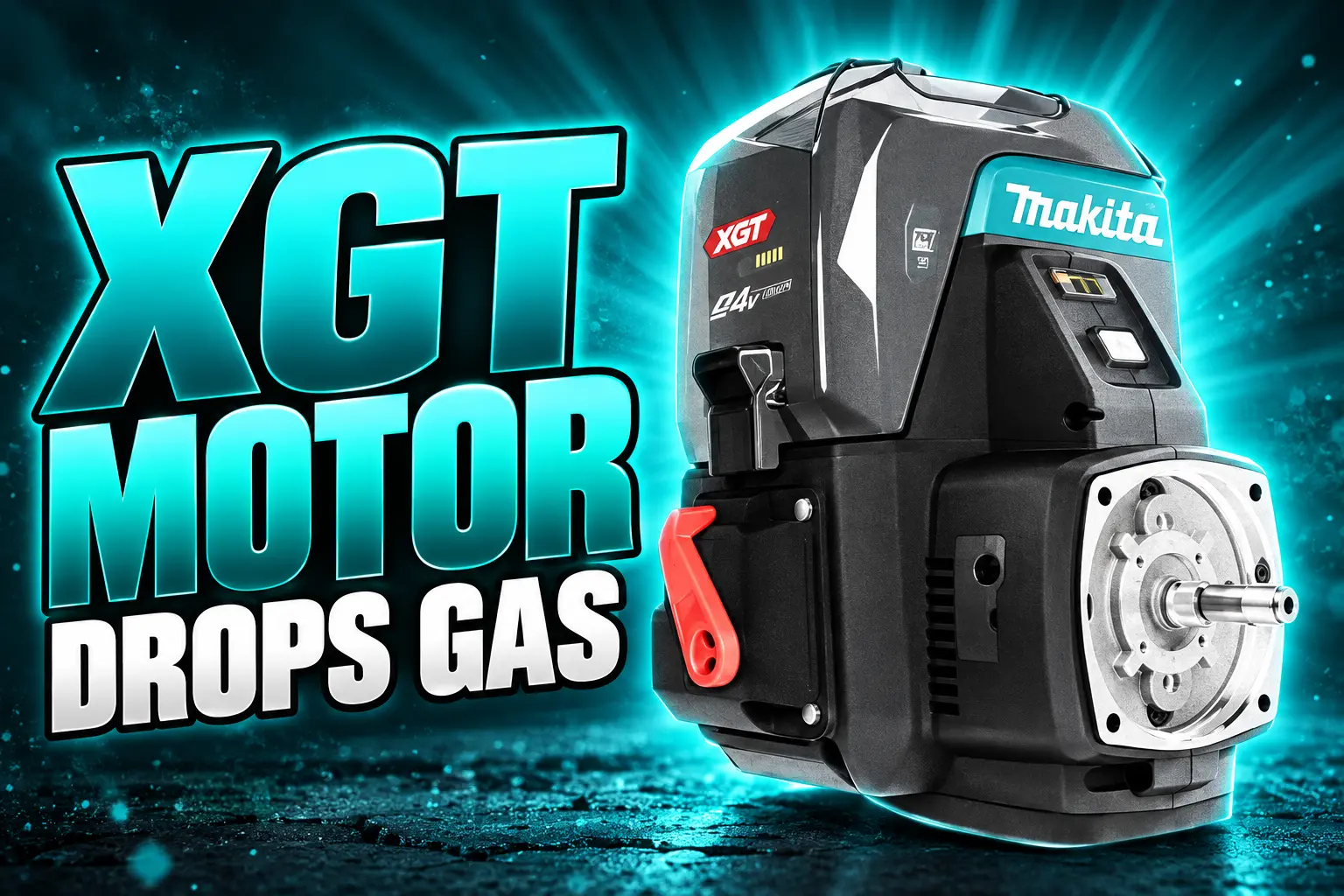
Makita’s XGT Motor Lets Makers Drop Gas Engines
Makita’s 40V XGT motor unit is an OEM part for 25 to 50cc gear, and Marshalltown’s Shockwave E40V is the first machine with a price.

Makita’s 40V max XGT motor unit stands in for 25cc to 50cc gas engines on commercial gear, and it is built for equipment makers. The company unveiled it on January 20, 2026, at World of Concrete in Las Vegas.
Marshalltown is the first maker to put that motor on a finished machine. The Iowa firm lists its Shockwave E40V power screed with batteries, a charger, and a published price, which is how this launch actually reaches a jobsite.
Makita Built This Motor for Equipment Makers
Makita U.S.A. framed the unit as a drop-in electric power plant, not a new trowel or pump designed from a blank sheet. Mario Lopez, director of product, said the company wants original equipment manufacturers to keep building the machines they already know.
We believe in letting OEMs do what they do best: build great equipment. Our role is to provide the motor, battery, and charging innovation to help them get to market faster.
Mario Lopez, director of product, Makita U.S.A.
The January 20 statement said the motor is meant to deliver the performance of 25cc to 50cc gas engines and that makers can set RPM, throttle response, and switch location. It takes three industry shafts: clutch, straight, and threaded spindle. The housing is rated IPX5 for wet work.
That configuration story is why a public kilowatt number still is not on the spec sheet. A single rating would freeze the part. Makers are supposed to tune it. The same statement said North America would get the motor in summer 2026, with other regions following as those makers finish their own integrations.
Makita’s own show video is the cleanest picture of the pitch: a gas engine comes off, the XGT motor goes on, and the frame stays.
See the XGT® Motor in action! A gas engine has been swapped out for the new XGT Motor for clean and quiet operation on the job site! Just think how this XGT® Motor could change your business! #worldofconcreteshow #makitausa #makitatools #makitaxgt #makitalxt #makitawoc2026 pic.twitter.com/m9k6iDHslv
— Makita Tools USA (@MakitaTools) January 21, 2026
Lopez also said Makita would rather replace the engine than design whole machines from scratch the way some rivals have. Crews who already carry 40V max XGT packs then get a screed or pump on the same slide-style battery. The January statement put that catalog at more than 170 tools and machines.
Marshalltown Sells the First XGT Motor Screed
Marshalltown’s Shockwave E40V is the test case. The listing says it matches the vibration and durability of the gas Shockwave 2.0, minus fuel and oil changes. At the Las Vegas booth, Makita staff showed the swap on a Marshalltown screed after a Honda GX35-class engine came off the same mount.
Honda put the GX35 on sale on August 26, 2003, as a 35.8 cc, 360-degree inclinable four-stroke for trimmers and other small gear, including concrete screeds. Dry weight was 3.33 kg. Peak output in that release was 1.2 kW at 7,000 rpm, with a 0.65 L tank. That is the class Makita is hunting, not a 2 kW plate-compactor engine.
Marshalltown’s own manual puts the E40V, without battery or blade, at 24.9 lb (11.3 kg). With an 8.0Ah pack it is 28.9 lb (13.1 kg). Runtime is up to 90 minutes on that 8.0Ah, 288Wh battery with a 4-foot blade. Recharge is 76 minutes. Blades use 9-inch hole spacing. The motor is 36V (40V max) and IPX5. Makita covers the motor and battery for 3 years.
SHOCKWAVE E40V PRICES ON MARSHALLTOWN
| Part | What you get | List price |
|---|---|---|
| SWE40V | Bare screed, no battery or charger | $1,754.69 |
| SWE40V-1B | Screed, 1 battery, 1 charger | $2,177.52 |
| SWE40V-2B | Screed, 2 batteries, 1 charger | $2,681.52 |
| BL4080F | Makita XGT 40V max 8.0Ah battery | $423.00 |
| DC40RA | Makita XGT Rapid Optimum Charger | $162.00 |
The blade is sold separately on every kit. Marshalltown is also advertising a free 12-foot blade on orders, described as worth more than $900. The page calls the screed made in the USA with global materials. The Shockwave E40V with battery and charger is the SKU most crews will actually compare with a gas Shockwave 2.0.
Those figures are for a finished screed, not for the motor as a spare part. Makita has not posted an OEM price for the unit itself. If you already own a gas Shockwave, this listing does not offer a bolt-on kit for that old frame.
The 100cc Band Still Belongs to Honda
Honda has been in this exact wholesale channel since 2021. The eGX is an electric power unit sized for Honda GX100 and GX120 engines, a 100 to 120 cc range, with a 2 kW-class brushless motor. Honda sells an integrated GXE 2.0H and a separated GXE 2.0S so makers can match rammer, trowel, and plate-compactor layouts.
Honda’s own copy is blunt about the buyer. The eGX exists so construction machinery can run indoors, next to houses, and in other places where exhaust and noise cut the workday short. Mounting matches GX engines so an OEM does not have to redraw the deck. Since 2021, Honda says makers have put the original 1.8 kW-class units on rammers and plate compactors.
On June 15, 2026, Honda said it would add three high-output eGX models and start supplying them to OEM customers in fall 2026, first in Japan, then Europe and the United States. GXE4.0D, GXE6.0D, and GXE9.0D are rated at 3.7 kW, 6.0 kW, and 8.7 kW peak, with continuous ratings of 2.1 kW, 3.8 kW, and 7.0 kW. Motor units weigh 12.6 kg, 12.9 kg, and 16.9 kg. The flange and shaft match the GX200. Power comes from Honda’s Mobile Power Pack e:, a 50.26 V, 1,314 Wh, 10.2 kg pack that also fits Honda electric motorcycles.
WHO SELLS WHICH ELECTRIC ENGINE
| Unit | Gas class it replaces | Who buys it | Battery |
|---|---|---|---|
| Makita 40V max XGT motor unit | 25cc to 50cc | Equipment makers, first on a Marshalltown screed | Makita 40V max XGT |
| Honda eGX GXE 2.0H / 2.0S | 100 to 120 cc (GX100 / GX120) | OEMs for rammers, trowels, plate compactors | Honda eGX pack |
| Honda GXE4.0D / 6.0D / 9.0D | GX200-class mounts, higher output | OEMs, supply starting fall 2026 from Japan | Mobile Power Pack e: (1,314 Wh) |
Makita is not picking a fight with those bigger Honda motors. It is occupying the hole Honda left under 50cc, the GX25 and GX35 band that still turns up on screeds, small pumps, and handheld gear. Lopez has said Makita is working on other engine classes if a customer asks. Dual-pack ideas for 100cc-class loads remain a rumor with a runtime problem, not a ship date.
HOW THE SWAP RACE HAS RUN
- August 26, 2003: Honda releases the GX35, a 35.8 cc four-stroke it also sells to other equipment makers.
- 2021: Honda starts supplying the eGX electric unit to OEMs for GX100 and GX120 machines.
- January 20, 2026: Makita unveils the 40V max XGT motor unit at World of Concrete in Las Vegas.
- June 15, 2026: Honda adds the GXE4.0D, GXE6.0D, and GXE9.0D for higher-output OEM gear.
- Summer 2026: Makita’s North America window for the motor; Marshalltown’s E40V moves from show unit to a listed product.
- September 2026: Makita posts its own XGT vibratory screed head, the VL001GZ, as a separate branded tool.
The split is tidy on paper and messy in a rental cage. A yard that already stocks Honda GX engines can electrify a rammer with eGX and leave small screeds on gas. A yard that already lives on Makita 40V packs can flip the small machines first and leave Honda on the heavier iron.
What Fits the XGT Motor Unit
Makita named a short list of commercial machines, all in the small-engine class, and said the motor uses a universal mounting pattern so those frames do not need a full redesign. Marshalltown’s screed is the only named production example so far. Other categories are still recruitment targets, not a catalog.
MACHINES MAKITA PUT ON THE OEM LIST
- Power screeds: Marshalltown’s Shockwave E40V is the first shipped example, using the same 9-inch blade pattern as the gas Shockwave 2.0.
- Backpack vibrators: Handheld concrete vibrators sit in the GX35 class and are loud, fume-heavy work inside forms.
- Power trowels: Walk-behind pans in this displacement band, not ride-on machines that want Honda’s larger eGX output.
- Winches: Small site winches that today share mini four-stroke engines with pumps and sprayers.
- Water pumps: Portable dewatering and mix-water pumps in the 25cc to 50cc range, where a slide-on 40V pack is easier than a fuel can.
Sprayers and similar small gear show up in show coverage, but they are not in Makita’s January list. Until a second OEM puts a model number on a pump or winch, the motor’s public life is a concrete screed and a booth demo.
Indoor Pours Change Who Buys the Engine
Honda’s eGX page is the honest brief for why any of these motors exist. Indoor rooms, work next to houses, and night pours are hard on a carbureted engine. A battery motor starts on a switch, skips oil changes, and keeps exhaust out of a basement slab. Marshalltown adds a concrete-specific claim: the E40V does not sink into the slab at idle the way a gas unit can, and handle vibration is lower.
California’s small-engine rules are a weaker lever on this particular iron than lawn-and-garden talk suggests. The Air Resources Board’s 2021 SORE amendments drive most new small spark engines to zero exhaust for model year 2024, with portable generators following in model year 2028. Federal law still blocks the state from writing those rules onto new engines used in construction equipment or farm equipment under 175 horsepower. Pumps at or above 40 cc, concrete saws, and several other site machines sit outside the current SORE list.
So the XGT motor is not a compliance sticker for a California trowel ban. It is a way for a screed maker to sell quiet, fume-free versions of a frame it already tools, into jobs that gas is losing on comfort and access. Rental houses feel that first. They eat the fuel, the pull-start complaints, and the indoor-job turn-downs. They also eat a second battery platform if every brand of electric screed brings its own pack.
That is why Marshalltown’s “compatible with more than 170 Makita tools” line matters more than a cc chart. A contractor who already owns XGT saws and rotary hammers can park one 8.0Ah pack on the screed at lunch. A rental counter can issue the same charger for a drill kit and a power screed. Honda’s answer is a dedicated eGX pack, and on the new high-output units a motorcycle-share Mobile Power Pack. Different lock, different key.
One Battery Line Now Covers Screeds and Drills
Makita is not waiting for every OEM to call. In September 2026 the company began posting the 40V max XGT Vibratory Screed Power Head, model VL001GZ, for 3-foot, 4.5-foot, or 6-foot bars, at 11,000 vibrations per minute. That is a Makita-badged concrete tool on the same battery as the motor unit, sold through Makita’s own channel rather than through Marshalltown.
Two screed paths on one pack is the strategy in miniature. Makers who want to keep their brand get a motor. Crews who want a Makita-labeled head get VL001GZ. Both spend XGT cells. Neither asks the user to become an engine installer.
XGT MOTOR UNIT, ON THE RECORD
- Gas class: 25cc to 50cc replacement, one 40V max XGT battery.
- Drive options: Clutch shaft, straight shaft, and threaded spindle, with RPM and throttle set per OEM.
- Jobsite rating: IPX5 water resistance on the motor housing.
- Warranty on the first machine: 3 years on the Makita motor and battery as listed by Marshalltown.
Briggs & Stratton’s Vanguard group spent the same January show pushing a 48V swappable pack across a plate compactor, a walk-behind trowel, a saw, and a grinder, and it dangled a giveaway fleet at rental companies. The small-engine aisle at World of Concrete was a battery-platform fight dressed up as product launches. Makita’s twist was to stop designing the whole machine and sell the power plant instead.
Whether more pump, winch, and vibrator brands sign up is the open order book. Marshalltown is already quoting the E40V. Honda is sending larger eGX units to makers this fall. The 25cc to 50cc slot is Makita’s if the next OEM wants a 40V pack its customers already own.

Procuros Raises €20 Million to Own the Trade Data Layer

Ace Combat 8’s Steam Peak Harvests a Seven-Year PC Bet

Finches Raises €2 Million to Spot Tight Harvests Early

Mercedes Built One AMG Cabriolet to Replace Two Cars

Hadrian Raises $40 Million to Turn Pentests Into Software

The Orchard Bug Forced Zcash to Open an Empty Pool

The $5.99 Game That Won Steam’s 2026 Summer Sale

Don Lee Joins Hemsworth as Extraction 3 Starts Shooting

YouTube Shorts Retires Dislikes and Swaps Likes for Hearts

NEURA Robotics Is Spending Its $1.4B on a Machine Stack
-
 NEWS4 months ago
The Orchard Bug Forced Zcash to Open an Empty Pool
-
 GAMING4 months ago
The $5.99 Game That Won Steam’s 2026 Summer Sale
-
 ENTERTAINMENT6 months ago
Don Lee Joins Hemsworth as Extraction 3 Starts Shooting
-
 NEWS4 months ago
YouTube Shorts Retires Dislikes and Swaps Likes for Hearts
-
 NEWS4 months ago
NEURA Robotics Is Spending Its $1.4B on a Machine Stack
-
 AUTO6 months ago
Kawasaki Bets the New Z1100 Against Its Own Supercharger
-
 BUSINESS5 months ago
Norway’s Export Bank Backs Nscale’s $790 Million Narvik Loan
-
 GAMING4 months ago
Game of Thrones Dragonfire Follows Boston’s Conquest Playbook