
BUSINESS
Trump’s One-Month Iran Bet Outlasted Two Carriers
The Ford left the Caribbean to force a one-month Iran deal. Seven months on, the Navy is still on the blockade and Lincoln’s crew logged eight suicide attempts.

President Trump’s February order sending the USS Gerald R. Ford to join the USS Abraham Lincoln off Iran has not produced the nuclear deal he timed to one month.
The Ford is back in Norfolk after 326 days at sea. Two other carriers still work the blockade, and a Navy letter this month put eight suicide attempts on the Lincoln strike group’s ledger.
Trump Gave Iran a Month and Sent a Second Carrier
On February 12, a day after he sat with Israeli Prime Minister Benjamin Netanyahu, Trump told reporters at the White House that Tehran had a short window. “I guess over the next month, something like that,” he said. “They should agree very quickly.”
We have to make a deal, otherwise it’s going to be very traumatic, very traumatic.
Donald Trump, White House remarks, February 12, 2026
He added that Iran “got Midnight Hammer instead” the last time talks failed, and that “phase two will be very tough for them.” Indirect talks had just been held in Oman. Gulf Arab governments were already warning that a strike could spread through a region still raw from Gaza, Lebanon, and Syria.
On February 13 the Ford, then in the Caribbean after the January raid that seized Nicolás Maduro, got new orders. Trump said the second carrier was moving “in case we don’t make a deal” and that “it’ll be leaving very soon.” That February dual-carrier buildup toward Iran was the wager: two decks, one month, a nuclear paper, or what he called a traumatic next phase.
The next day, at Fort Bragg, he said a change of government in Tehran would be “the best thing that could happen.” The deal he was demanding and the collapse he was describing sat in the same week.
THE FEBRUARY CLOCK
- December 28, 2025: Nationwide protests begin in Tehran’s Grand Bazaar after the rial collapses.
- February 12, 2026: Trump sets a roughly one-month timeline and warns of a “very traumatic” outcome if Iran refuses.
- February 13, 2026: The Ford is ordered from the Caribbean to join Lincoln in the Middle East.
- February 28, 2026: The United States and Israel open hostilities under Operation Epic Fury.
- April 13, 2026: U.S. Central Command activates a naval blockade of Iranian ports.
- May 16, 2026: The Ford returns to Norfolk after 326 days.
- August 20, 2026: USS George Washington arrives to relieve Lincoln.
- September 22, 2026: Trump says there is “a lot of momentum” for a deal at the U.N.; the Navy confirms eight suicide attempts in Lincoln’s group.
The month he advertised never got to run in peace. The second carrier was still crossing oceans when the shooting war started.
Fifteen Days Later the Bombs Started
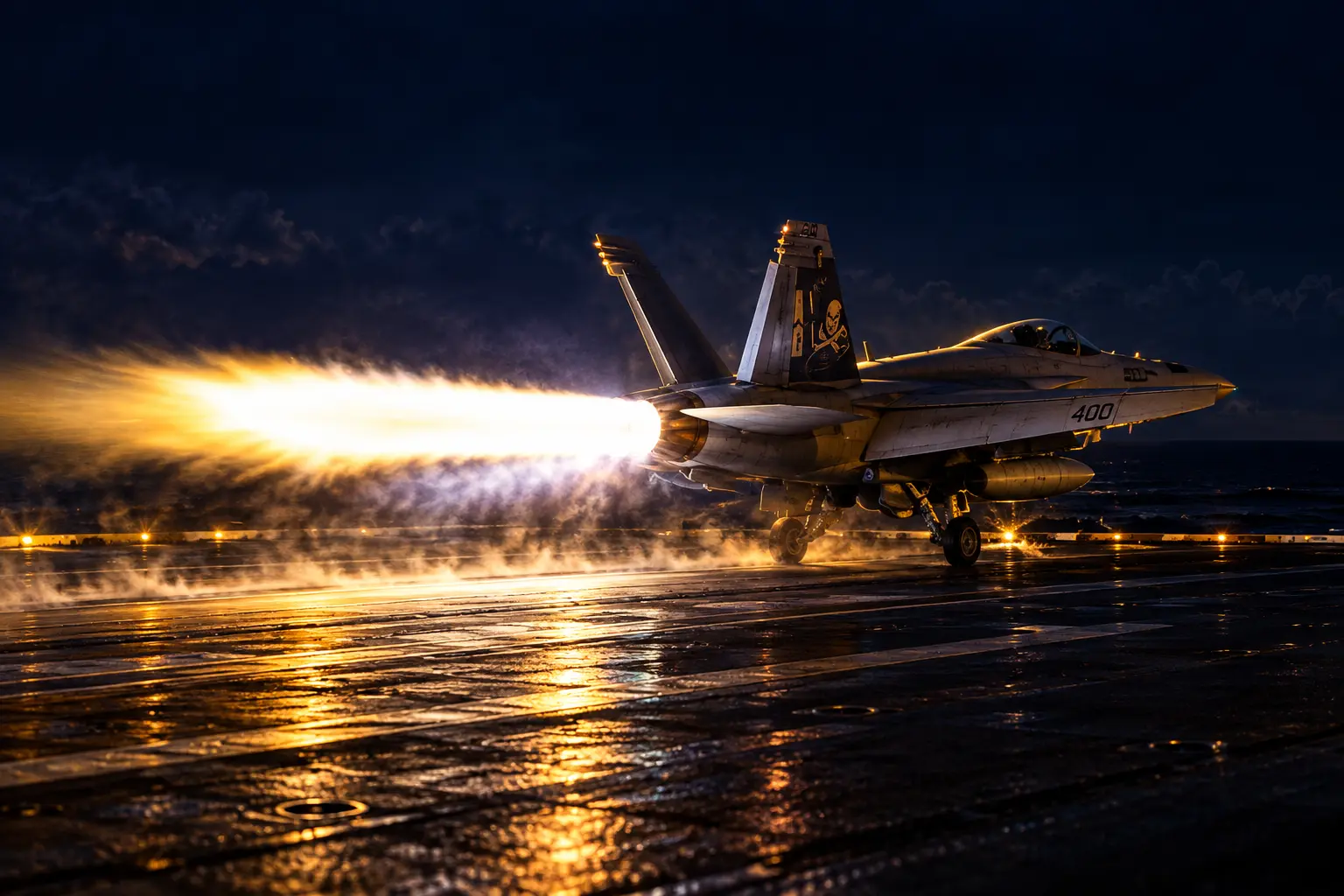
Operation Epic Fury began on February 28, 15 days after the Ford got its orders and well short of the month Trump had floated. The U.N. Independent International Fact-Finding Mission on Iran dates the U.S.-Israeli hostilities to that day and treats them as a separate catastrophe from the winter protest killings.
CENTCOM later put three carriers in the theater at once, the Ford, the Lincoln, and USS George H.W. Bush, and called it the first time in decades. By April the mission was no longer a show of force around a negotiating table. It was a blockade, a strike campaign, and a rotating set of decks that Defense Secretary Pete Hegseth said the Navy could keep in place “indefinitely” by swapping ships.
A June memorandum tried to pause the fighting, reopen the Strait of Hormuz, and open a 60-day lane for a fuller nuclear text. That pause died in a fight over who would run the strait. Through the summer the United States kept diverting traffic away from Iranian ports while claiming to walk commercial oil through Hormuz under escort.
Ford’s 326-Day Run Set a Post-Vietnam Record
The Ford left Norfolk on June 24, 2025, for what Adm. Daryl Caudle, the chief of naval operations, said was supposed to be a seven-month European cruise. It went to the Mediterranean, then the Caribbean, then back across to the Red Sea with Carrier Air Wing 8. The air wing logged 11,800 launches. More than 4,500 sailors were embarked. The ship carries electromagnetic catapults designed for as many as 160 sorties a day and more than 75 aircraft.
It tied up at Norfolk on May 16. Rear Adm. Gavin Duff, commander of Carrier Strike Group 12, said 80 newborn children were held by their fathers that morning, most for the first time. Hegseth presented the Presidential Unit Citation on the pier. The previous post-Vietnam mark had been Lincoln’s 295-day cruise, completed in January 2020.
THE CARRIER ROTATION
| Ship | How it entered the fight | Where it stood by September |
|---|---|---|
| USS Gerald R. Ford | Ordered off the Caribbean on February 13 | Home to Norfolk on May 16 |
| USS Abraham Lincoln | In the Arabian Sea from January | Relieved August 20 after a 286-day stretch |
| USS George H.W. Bush | Entered CENTCOM on April 23 | Still launching jets on the blockade in mid-September |
| USS George Washington | Reached the Arabian Sea on August 20 | Took Lincoln’s station from Japan |
Retired Vice Adm. Robert Murrett, now at Syracuse, has said a normal carrier cruise is closer to six months and includes port visits. Lincoln, he said, had none of that after leaving San Diego.
Eight Suicide Attempts in the Lincoln Strike Group
Lincoln left San Diego on November 21, 2025, and spent 286 days at sea, including more than 200 days of combat, before its crew got ashore in Thailand on September 1. Families had already been describing shortages, no port calls, and sailors going over the side. Trump waved those accounts off and said the cruise had not gone on long enough.
Acting Navy Secretary Hung Cao, writing on September 22 to Sen. Kirsten Gillibrand, a New York Democrat on the Armed Services Committee, put a number on it. He was answering for Hegseth.
WHAT THE NAVY LETTER CONFIRMED
- The count: Eight suicide attempts across the Lincoln strike group, including the air wing, destroyer escorts, and embarked staff, and no deaths by suicide.
- March: Shipmates stopped one sailor from going overboard; that sailor was treated and sent back to home port.
- August: An air-wing sailor went overboard, was recovered by a rescue helicopter, and was moved off the ship for follow-on care.
- The baseline: A U.S. military official said a typical strike-group cruise sees one or two attempts a year.
Gillibrand said the conditions Trump and Hegseth had treated as noise “turned out to be serious and deteriorating.” Cao listed five chaplains, a psychologist, a social worker, and other mental-health staff on board. The letter still reads as an admission that the overtime the February bet required was billed to the crew, not to the negotiating calendar.
The Blockade Now Stands In for a Nuclear Deal
By early September the Navy still had two carriers and 12 destroyers on the Iran station, with about 20 ships and 20,000 sailors and Marines in the wider force. The original nuclear deadline had been replaced by a port closure. CENTCOM said that as of September 17 it had redirected 104 commercial vessels.
THE FORCE STILL ON STATION
- Big decks: Bush was launching Super Hornets on the blockade in mid-September; Washington had taken Lincoln’s hole in the Arabian Sea on August 20.
- The tally: 104 ships turned away from Iranian ports as of September 17.
- The swap: Japan lost its forward-deployed carrier for as long as Washington stays in the Gulf.
CENTCOM posted the launch from Bush the same day it published the 104-ship figure.
An F/A-18F Super Hornet launches from the flight deck of USS George H.W. Bush (CVN 77) as the ship sails in regional waters and continues to support enforcement of the U.S. blockade against Iran. As of Sept. 17, CENTCOM forces have redirected 104 commercial vessels to ensure… pic.twitter.com/XrItyqIYNu
— U.S. Central Command (@CENTCOM) September 17, 2026
Adm. Brad Cooper, the CENTCOM commander, had already framed tanker strikes as a bill for shooting at U.S. ships: hit two of ours, lose three of yours. That is enforcement talk, not treaty talk. The nuclear file Trump said would close in a month had become a shipping schedule.
Iran’s Streets Were Already a Battlefield
Tehran was not a government with spare legitimacy when the Ford turned east. Protests that started on December 28 in the bazaar spread through 203 cities across all 31 provinces, according to HRANA’s 50-day record. Shopkeepers walked out over the currency. The chants turned into a demand to end the Islamic Republic.
Iran Human Rights, in a September report, has 4,219 named dead from the protests, including 420 women and 281 children under 18. Over 3,000 of those named people were killed on January 8 and 9. The state’s own figure, issued by the Supreme Council of National Security, is 3,117. The U.N. mission, which has not been allowed into the country, says the winter crackdown killed five and a half times as many people as the 2022 “Woman, Life, Freedom” repression and that the true toll sits well above the government’s list.
The existing evidence provides a serious basis for investigating these killings within the framework of crimes against humanity, and the perpetrators must be held accountable.
Mahmood Amiry-Moghaddam, director, Iran Human Rights, September 2026 report
From about 8 p.m. on January 8 the government cut the country off the open internet. The U.N. mission calls it the longest nationwide internet shutdown on record. Broad access did not return until May 27. IHRNGO says at least 29 people have been executed in connection with the protests and that more than 100 remain on death row.
A leadership that had just shot its way through a nationwide rising was then asked, under two U.S. carriers, to sign a nuclear climbdown in 30 days. The sequence left almost no face-saving off-ramp at home, which is one reason the “quick” deal never arrived as advertised.
The Hormuz Swap Is Back on the Table
On September 22, on the edges of the U.N. General Assembly, Trump said Steve Witkoff and Jared Kushner had been with Iranian intermediaries and that “there’s a lot of momentum for them to make a deal.” He said Iran’s economy was “in really bad shape.” A day later he posed the choice as reconstruction or ruin: a deal that lets Iran rebuild, “or do I annihilate the Islamic Republic and do it quickly?”
People involved in the contacts said on September 24 that the live text was a phased bargain: Iran reopens Hormuz, the United States lifts the port blockade. That is the same trade the June memorandum already tried to paper over. The first replies on the report asked which sources were talking and treated the leak as a rerun, not a finish line.
Foreign Minister Abbas Araghchi was in the New York mix. Iranian conditions reported by state media still start with lifting the blockade and releasing frozen funds. The Ford is in Virginia. Lincoln’s sailors are finally pointed at San Diego. Bush and Washington are the decks that now hold a bet Trump priced at 30 days in February, and still has not closed.

UPI MDR Delay Hands Traders the Calendar After Paytm Falls

Google Messages Builds Nine In-Chat Games After Samsung’s Exit

Anthropic’s $100 Million Academy Trains the Firms That Bill Both Sides

Toyota’s Electric C-HR Leaves the Cheap Twin to Subaru

Markets Bet the Fed Skips October After Hawkish Minutes

The Orchard Bug Forced Zcash to Open an Empty Pool

The $5.99 Game That Won Steam’s 2026 Summer Sale

Don Lee Joins Hemsworth as Extraction 3 Starts Shooting

YouTube Shorts Retires Dislikes and Swaps Likes for Hearts

NEURA Robotics Is Spending Its $1.4B on a Machine Stack
-
 NEWS5 months ago
The Orchard Bug Forced Zcash to Open an Empty Pool
-
 GAMING5 months ago
The $5.99 Game That Won Steam’s 2026 Summer Sale
-
 ENTERTAINMENT7 months ago
Don Lee Joins Hemsworth as Extraction 3 Starts Shooting
-
 NEWS5 months ago
YouTube Shorts Retires Dislikes and Swaps Likes for Hearts
-
 NEWS4 months ago
NEURA Robotics Is Spending Its $1.4B on a Machine Stack
-
 NEWS5 months ago
Atlantic City Turned WWE’s Return Into a Civic Night
-

 AUTO6 months ago
Kawasaki Bets the New Z1100 Against Its Own Supercharger
-
 BUSINESS5 months ago
Norway’s Export Bank Backs Nscale’s $790 Million Narvik Loan