
AUTO
Kia Bets the EV3 Wind Can Sell Without Tax Credits
The 2027 Kia EV3 Wind FWD is EPA-rated at 321 miles and $34,990, a post-credit bet against Chevrolet’s Equinox EV that falls apart on GT trims.

The 2027 Kia EV3 Wind FWD is EPA-rated at 321 miles and starts at $34,990 before destination. Kia adds a $1,495 destination fee, which puts that Wind at $36,485.
That is the car Kia is actually betting on. The Light’s $29,890 sticker is the ad. The Wind is the product that still works after the $7,500 federal EV credit ended on September 30, 2025, and after Washington eased the fuel-economy rules that had been pushing cheaper battery cars into showrooms.
Kia Is Betting the Wind Trim Still Sells
U.S. sales of the 2027 EV3 started in mid-August 2026. Kia said in early October that about 1,300 units sat in dealer stock after a first full month of 514 sales, and that dealers liked the extra showroom traffic.
The compact SUV already won the 2025 World Car of the Year title overseas, then waited for a North American build. It arrives as Cox Automotive put battery-electric share at 5.8% of U.S. new-vehicle sales in the third quarter of 2026, down from 7.4% in the third quarter of 2025.
THE WAGER IN FOUR FIGURES
- Wind FWD: $34,990 plus $1,495 destination, EPA-rated at 321 miles on the 81.4 kWh pack.
- Light FWD: $29,890 plus destination, EPA-rated at 221 miles on the 58.3 kWh pack.
- Credit gap: the $7,500 federal EV tax credit is gone, so the Wind has to clear on sticker.
- Stock: Kia put about 1,300 U.S. units on the ground by early October 2026.
Honda has already dropped planned electric models, and Ford is recasting the F-150 Lightning as an extended-range hybrid. Kia still spent real money to put this small SUV on U.S. lots, and it has already used a similar undercut on its price-cutting 2026 Sportage Hybrid.
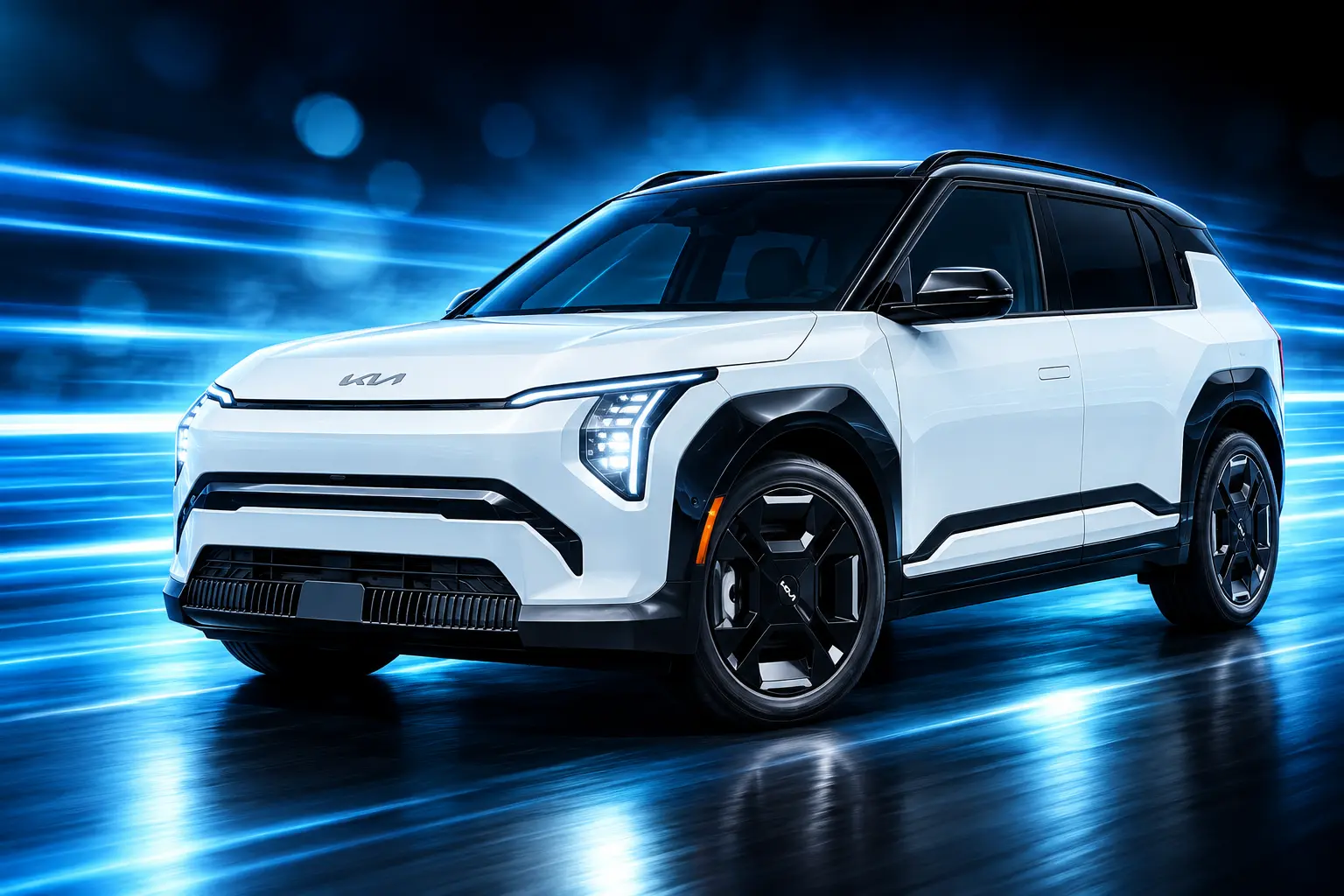
The Longest Range Is a Front-Drive Wind
Kia’s U.S. lineup is five trims: Light, Wind, Land, GT-Line, and GT. Only Light uses the 58.3 kWh battery. Wind, Land, GT-Line, and GT use 81.4 kWh. Front-wheel drive on the bigger pack is the path to 321 miles. Every all-wheel-drive EV3 is EPA-rated at 280 miles, a 41-mile cut for the second motor.
Kia’s own 321-mile driving range (EPA-est.) claim is the Wind and Land FWD configuration, not the GT. Front-drive models make 201 horsepower and 209 pound-feet. Dual-motor AWD on Wind and Land is 261 horsepower and 284 pound-feet. The GT is 288 horsepower and 345 pound-feet.
2027 EV3 U.S. TRIM LADDER
| Trim | Drive | Battery | EPA range | Starting MSRP |
|---|---|---|---|---|
| Light | FWD | 58.3 kWh | 221 miles | $29,890 |
| Wind | FWD | 81.4 kWh | 321 miles | $34,990 |
| Wind | AWD | 81.4 kWh | 280 miles | $38,690 |
| Land | FWD | 81.4 kWh | 321 miles | $38,490 |
| Land | AWD | 81.4 kWh | 280 miles | $41,690 |
| GT-Line | AWD | 81.4 kWh | 280 miles | $43,490 |
| GT | AWD | 81.4 kWh | 280 miles | $45,890 |
Moving from Light to Wind FWD costs $5,100 and adds 100 miles of EPA range, plus heated front seats and the larger pack. Land FWD keeps the 321-mile rating and adds ventilated seats, a sunroof, and surround-view. GT-Line and GT are AWD-only, so the extra power is paid for in miles as well as dollars. Kia’s destination fee of $1,495 sits on top of every row.
A native NACS port is standard, so Superchargers do not need a dongle. Peak DC rates are about 100 kW on the small pack and 127 kW on the large pack, on the 400-volt version of E-GMP, not the 800-volt hardware in EV6 and EV9. Kia quotes 10% to 80% in 29 minutes for Light and 31 minutes for the 81.4 kWh cars, and says that is about 30% quicker than the old Niro EV. Vehicle-to-load, with the external adapter, is packaged on GT-Line; vehicle-to-home is still a later add.
Chevrolet’s 315-Mile Claim Now Has Company
Chevrolet still sells the Equinox EV as America’s cheapest compact SUV with more than 315 miles of range. The company’s own page puts the Equinox EV LT 1 starting at $34,995 with 319 miles EPA-estimated on FWD. The EV3 Wind FWD undercuts that MSRP by $5 and adds 2 miles on the EPA sticker, in a body 169.3 inches long.
The cheapest new EV in the country is still the 2027 Chevrolet Bolt at $28,995 including destination, with 262 miles. The Bolt does not offer AWD. The EV3 Light undercuts almost everyone on MSRP and then loses the range argument to both the Bolt and the Wind. Kia’s previous cheap electric, the Niro EV, started at $39,700 with 253 miles, so the Light is a different kind of entry than the car it replaces.
CHEAP LONG-RANGE SHOPPING LIST
| Model | Price basis | EPA range | AWD |
|---|---|---|---|
| Chevy Bolt | $28,995 including destination | 262 miles | No |
| Kia EV3 Light FWD | $29,890 MSRP | 221 miles | No |
| Kia EV3 Wind FWD | $34,990 MSRP | 321 miles | Optional |
| Chevy Equinox EV LT1 FWD | $34,995 MSRP | 319 miles | Optional |
If the shopper wants 315-plus miles in a new SUV, the live fight is Wind FWD versus Equinox LT1, not Light versus Bolt. Chevrolet’s 315-mile slogan was true until Kia published 321 miles at $34,990. The Equinox is a larger product with a 17.7-inch screen; the EV3 is the smaller box with the longer EPA number on one front-drive trim.
Mexico Started Building the EV3 in August
Kia did not import the U.S. car from the Korean line that filled Europe. It retooled the Pesquería plant in Nuevo León with a $649 million program and started EV3 production on August 4, 2026, the first battery-electric Kia built in Mexico. Mexican officials put the first-year hiring at 500 jobs, with 1,500 more planned through 2030, and local content near 27% at the start.
HOW THE U.S. CAR GOT HERE
- September 30, 2025: The $7,500 federal EV tax credit ends.
- August 4, 2026: EV3 production starts at Pesquería after the $649 million retool.
- Mid-August 2026: U.S. sales of the 2027 EV3 open.
- September 28, 2026: NHTSA finalizes the CAFE reset to 34.9 mpg by model year 2031.
- Early October 2026: Kia says about 1,300 units are in U.S. dealer stock after 514 first-month sales.
That sequence is the wager. Kia funded a Mexican EV line after the credit died, then put a 321-mile compact on U.S. lots nine days before the fuel-economy rollback became final. The plant also builds gasoline K3 and K4 models, so Pesquería is not an EV-only bet, but the EV3 is the first electric product on that floor.
Washington Eased the Rules That Used to Force EVs
On September 28, 2026, the Department of Transportation issued its final reset of CAFE standards under the “Freedom Means Affordable Cars” label. NHTSA estimates a fleet average of 34.9 miles per gallon by model year 2031, up from 30.1 mpg in model year 2024, far below the prior path toward about 50 mpg. Credit trading ends in model year 2028. The department says the rule trims about $1,300 off the average new vehicle and saves $138 billion over five years.
Thanks to President Trump’s leadership, we have finally ended the illegal mandate that forced automakers to produce more expensive electric vehicles that American families didn’t want.
Sean P. Duffy, U.S. Transportation Secretary, Department of Transportation
That is the policy Kia is selling into, not the one the EV3 was drawn under. The compact no longer has to exist so Kia can bank compliance credits, and it no longer gets a $7,500 federal check to shrink the Wind’s $36,485 dest-in price. If it sells, it sells as a car, against the Bolt, the Equinox EV, and whatever gasoline Sportage the same dealer would rather push.
What the Vancouver Island Drive Showed
Kia ran launch drives on Vancouver Island through city streets, highway, and logging roads with frost heaves and truck gulleys. Journalists were handed long-range cars, not the Light. One route used a Wind FWD and a GT-Line AWD. As-tested prices on the cars in that press fleet included $40,185 and $46,730, which is the first clue that the $29,890 ad and the keys on the table are different objects.
The 201-horsepower front-drive car is enough off the line for a compact SUV, and the dual-motor car adds thrust out of slow corners without needing the GT’s 5.4-second 0-60 claim. i-Pedal 3.0 has three regen levels, turned on by pulling and holding the left paddle, and it now stores the last setting so the car does not dump you back into a coasting mode at every restart. In town, the strongest setting will stop the car without a tap on the friction brakes.
WHAT THE PRESS CARS DID WELL
- Highway composure: For a short SUV, it stayed stable over big hits, then bounced and recovered when a hidden gulley got through.
- Cabin tech: Every trim gets the triple-screen board, a 12.3-inch cluster, a 5-inch climate pane, and a 12.3-inch infotainment display, with wireless Apple CarPlay and Android Auto.
- Space: Adults fit behind a 5-foot-9 driver; Kia quotes 26 cubic feet of cargo behind the rear seats, about 56 cubic feet folded, and a 0.9-cubic-foot frunk that is a cable bin, not a second trunk.
- Noise control: Wind and above add acoustic glass on the windshield and front side windows, and every EV3 uses four-wheel independent suspension.
The optional eight-speaker Harman Kardon unit is fine until you push past about 75% volume, where the bass goes hollow. Highway Driving Assist is standard. Drag is 0.275, which is how an 81.4 kWh pack fits a 169.3-inch body and still prints 321 miles on FWD. Compared with the 2027 Bolt on the same kind of road, the EV3 is less eager to snap direction and a little less agile, with steering that is weighted and simple.
The GT Walks the Price Straight Past the Point
Kia’s GT is $45,890, or $47,385 with destination, for 288 horsepower, 280 miles, and a 5.4-second 0-60. That is $10,900 above the dest-in Wind FWD, and 41 fewer EPA miles. GT-Line AWD starts at $43,490 before destination. Early dealer listings have already wrapped the cheap EV3 in markups and accessory packs, which is how a Light-priced car never makes it onto the window sticker a shopper actually sees.
The four official EV3 efficiency ratings make the same point in lab language. Long-range FWD is 117 MPGe combined at 29 kWh per 100 miles. Light FWD is 115 MPGe at the same 29 kWh. Both AWD ratings are 103 MPGe at 33 kWh per 100 miles. The extra motor is a winter and driveway feature, not a range feature, and it is priced like a different car.
If Kia’s bet holds, the floor car is the Wind FWD at $34,990 plus $1,495 destination, 321 miles, heated seats, NACS, and the triple screen, and 1,300 units is enough to test whether anyone still writes a check without a federal coupon. If the lots fill with GT-Line AWD and marked-up Light leftovers, the 321-mile compact will have existed mostly as a press-fleet spec.
Frequently Asked Questions
Does the 2027 Kia EV3 Qualify for the Federal EV Tax Credit?
No. The $7,500 federal clean-vehicle credit ended on September 30, 2025, so a 2027 EV3 bought in the United States does not get that federal reduction; any remaining help would have to come from a state or utility program, which varies by ZIP code and can change without notice.
What Are the Kia EV3 EPA MPGe Ratings by Version?
The EPA rates long-range FWD at 117 MPGe combined (131 city, 104 highway), standard-range FWD at 115 MPGe (127 city, 103 highway), long-range AWD at 103 MPGe (110 city, 96 highway), and the GT AWD at 103 MPGe (112 city, 94 highway), with AWD using 33 kWh per 100 miles against 29 kWh for both FWD packs.
How Much Cargo Space Does the 2027 Kia EV3 Have?
Kia quotes 26 cubic feet behind the rear seats, about 56 cubic feet with those seats folded, and a 0.9-cubic-foot frunk, plus 99.7 cubic feet of passenger volume, which is why a 5-foot-9 driver can sit behind their own seat even though the SUV is only 169.3 inches long.
How Fast Is the 2027 Kia EV3 From 0 to 60 mph?
Kia quotes 7.3 seconds for the Wind and 5.4 seconds for the GT, with the other dual-motor cars landing between those two; the front-drive 201-horsepower cars are the slow ones on paper and still feel like enough in a compact SUV that weighs in as a neighborhood machine, not a highway drag car.

UPI MDR Delay Hands Traders the Calendar After Paytm Falls

Google Messages Builds Nine In-Chat Games After Samsung’s Exit

Anthropic’s $100 Million Academy Trains the Firms That Bill Both Sides

Toyota’s Electric C-HR Leaves the Cheap Twin to Subaru

Markets Bet the Fed Skips October After Hawkish Minutes

The Orchard Bug Forced Zcash to Open an Empty Pool

The $5.99 Game That Won Steam’s 2026 Summer Sale

Don Lee Joins Hemsworth as Extraction 3 Starts Shooting

YouTube Shorts Retires Dislikes and Swaps Likes for Hearts

NEURA Robotics Is Spending Its $1.4B on a Machine Stack
-
 NEWS4 months ago
The Orchard Bug Forced Zcash to Open an Empty Pool
-
 GAMING4 months ago
The $5.99 Game That Won Steam’s 2026 Summer Sale
-
 ENTERTAINMENT6 months ago
Don Lee Joins Hemsworth as Extraction 3 Starts Shooting
-
 NEWS4 months ago
YouTube Shorts Retires Dislikes and Swaps Likes for Hearts
-
 NEWS4 months ago
NEURA Robotics Is Spending Its $1.4B on a Machine Stack
-
 AUTO6 months ago
Kawasaki Bets the New Z1100 Against Its Own Supercharger
-

 BUSINESS5 months ago
Norway’s Export Bank Backs Nscale’s $790 Million Narvik Loan
-

 GAMING4 months ago
Game of Thrones Dragonfire Follows Boston’s Conquest Playbook