
BUSINESS
Chip and Power Owners Collect the AI Boom’s Cash
Memory makers, foundries and Nvidia are banking the AI boom while OpenAI still burns cash and Anthropic only now nears a profit.

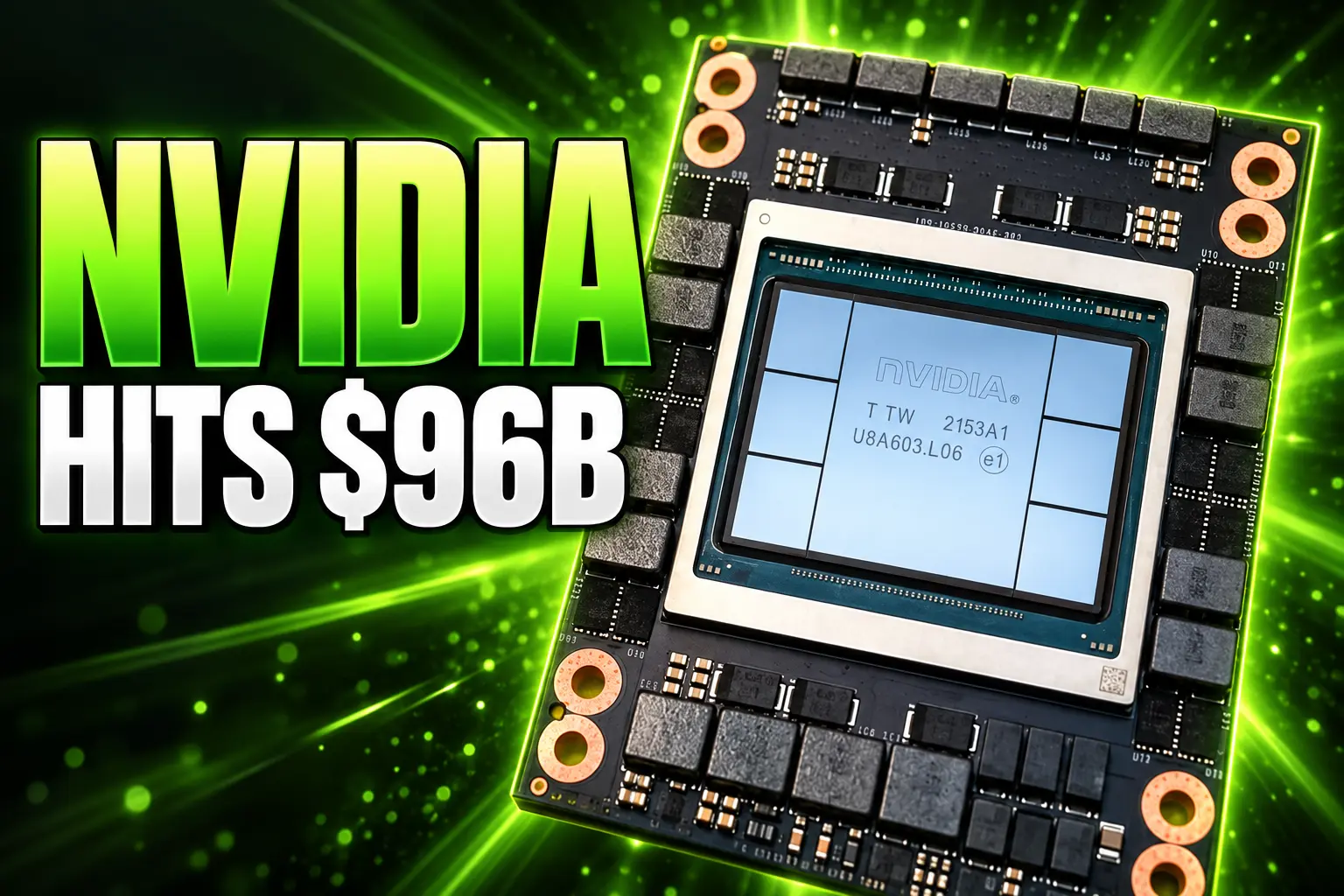
NVIDIA reported revenue of $96.2 billion for the quarter ended July 26, 2026, up 106% from a year earlier. Data-center chips did $89.0 billion of that, up 117%, and GAAP gross margin was 75.0%. That is the clearest print yet of who the AI boom is actually paying.
The famous layer is still the model labs. OpenAI, Anthropic and xAI collect the users and the headlines. The cash is landing with the owners of scarce GPUs, high-bandwidth memory, leading-edge wafers and site power, the bills those labs cannot skip.
A $96 Billion Quarter and a Thin Model Layer
NVIDIA’s fiscal second quarter, reported on August 26, 2026, is a toll booth, not a software story. Operating income was $63.7 billion. Net income was $59.7 billion. The company sent $26.0 billion back to shareholders in buybacks and dividends in the same three months, then told investors to plan for $108.0 billion of revenue in the following quarter, plus or minus 2%, with no China data-center compute in that outlook.
Jensen Huang, NVIDIA’s founder and chief executive, put the split in one line the labs cannot copy.
AI has reached its inflection point. It’s doing useful work. Its tokens are productive and profitable. Now, compute is revenue.
Jensen Huang, founder and CEO, NVIDIA second-quarter fiscal 2027 release
Compute is revenue for the firm that sells the racks. For the firms that rent those racks to write tokens, compute is still the cost line that eats the sale. A year earlier the popular case still treated the labs, the clouds and NVIDIA as three equal places the money could land. The quarter says otherwise.
THE SPEND WAVE BEHIND THE QUARTER
- Big Five capex: Ashmore Group’s May 2026 note put 2026 capital spending at the five largest hyperscalers at about $725 billion, of which about $540 billion is AI-related.
- Global AI capex: The same note put worldwide AI capital spending in 2026 at about $780 billion to $820 billion, with the United States around 60% of the total.
- Site cost: A frontier one-gigawatt AI data center now runs in the ballpark of $50 billion, with memory around 30% of that bill.
- Longer build: Goldman Sachs, as cited by Ashmore, sees about $6 trillion of cumulative AI capex by 2030.
On September 10, 2026, the Bank for International Settlements said the five largest big-tech companies are set to spend over a trillion dollars on AI capex between 2025 and 2026. That money has to stop in a physical stack before it becomes a chatbot reply.
OpenAI Still Loses Money on Every Dollar
PitchBook’s June 2, 2026 note is the hardest public look at OpenAI’s books before any listing. The lab recognized $5.7 billion of revenue in the first quarter of 2026 and still showed nearly $7 billion lost in one quarter on an adjusted operating basis, or about $2.22 spent for each dollar earned. Gross margin was 33%, so 67 cents of each revenue dollar went to compute before research, sales or overhead.
OpenAI’s valuation in that note was $852 billion. Infrastructure obligations across Microsoft Azure, Oracle, Broadcom, NVIDIA, AMD, Amazon Web Services and CoreWeave stood at about $1.2 trillion. Anthropic, by then, was the more valuable private lab.
WHO KEPT THE MONEY
| Company | Snapshot | Top line | Profit picture |
|---|---|---|---|
| NVIDIA | Q2 FY27, ended July 26, 2026 | $96.2 billion revenue | $59.7 billion net income |
| OpenAI | Q1 2026, PitchBook | $5.7 billion revenue | Nearly $7 billion adjusted operating loss |
| Anthropic | May 2026, PitchBook | $47 billion ARR | First profitable quarter projected, about $10.9 billion of Q2 revenue expected |
| TSMC | FY25, Ashmore | $122 billion revenue, up 35% | $55 billion net income, up 40% |
Anthropic closed a $65 billion Series H on May 28, 2026, at a $965 billion post-money valuation, and PitchBook had it leading enterprise LLM spending at 40% against OpenAI’s 27%. ChatGPT’s share of AI web traffic, in the same note, fell from 86.7% to 64.5% in 12 months. The two labs together were worth about $1.8 trillion, which already blows past the sub-$1 trillion combined mark that still held on August 10, 2025, when NVIDIA itself was around $4.5 trillion.
That 2025 arithmetic is also when this site first asked who really profits from the 2025 boom. Anthropic projecting a first profit quarter does not rewrite the stack. It means one lab may stop burning while the wafer, the memory package and the substation keep a much fatter take.
Korean Memory Now Out-Earns the Hyperscalers
The overlooked landlords sit in Taiwan and Korea. TSMC is still the only firm that can make the most advanced AI chips at scale, and its FY25 net income of $55 billion is the foundry rent on other companies’ models. SK Hynix and Samsung sit on high-bandwidth memory, the stacked DRAM that keeps GPU cores fed, and Ashmore put memory operating margins of 73-80% above NVIDIA’s 65% operating margin in that May comparison, and well above Apple at 35% and Google at 32%.
Those 73-80% figures are operating margins as of May 2026, a different cut from NVIDIA’s 75.0% GAAP gross margin in the July quarter. Both can be true at once. Memory still keeps more of each dollar after running the plants.
Nomura, as cited by Ashmore, saw Samsung’s 2027 operating profit at about $258 billion and SK Hynix at about $214 billion. Those are forecasts, not booked years. Even as forecasts they describe a profit pool that no model lab has touched. Ashmore’s line was blunt: the hyperscalers do not have a Western supplier of any scale for the silicon, the memory or the assembled systems, so they have to buy from emerging-market producers.
NVIDIA remains the public face of the boom, and its $59.7 billion quarter is real. The quieter story is that HBM and foundry capacity are scarce in a way that chat apps are not. A new chatbot can be copied in a season. A leading-edge wafer start and a sold-out HBM line cannot.
The Power Queue That Caps Every Cluster
Chips do not run on narrative. They run on electricity, land and cooling, and those inputs now price like scarce goods. Ashmore counted about 100 gigawatts of data centers worldwide and used McKinsey’s range of 125 to 205 gigawatts of extra demand by 2030, mostly from AI. At about $50 billion per frontier gigawatt, the next increment is a power-and-construction cycle as much as a software cycle.
NVIDIA itself is now raising other people’s money for that build. The August release said the firm had struck partnerships with Apollo, BlackRock, Blackstone, Brookfield, Goldman Sachs and KKR to mobilize over $500 billion of third-party capital for AI infrastructure over time, subject to definitive agreements. When the chip vendor is syndicating the power plant, the constraint has moved off the GPU and onto the grid.
WHERE THE BUILD GETS STUCK
- Leading-edge wafers: TSMC still makes the frontier AI chips at scale, which is why FY25 net income of $55 billion is a rent, not a side bet.
- High-bandwidth memory: SK Hynix and Samsung sell the stacked packages that keep those chips busy, at operating margins Ashmore put in the 73-80% band.
- Site power: A frontier campus at about $50 billion per gigawatt is a power station with a computer hall attached.
- The buyer list: About $725 billion of Big Five capex, and $780 billion to $820 billion of global AI capex, has to clear those three gates before it becomes a subscription.
Households will meet this as higher local power bills and slower interconnects, not as a new Sam Altman fortune. The rent is collected by utilities, independent generators and the firms that pour the concrete, then passed through into the cost of every token.
Fiber and Rail Already Taught This Lesson
Ashmore called AI the largest capital-spending cycle since 19th-century railways, and put fibre in the late 1990s next to it. The rhyme is ugly for operators and kind to anyone who sold the picks. Railroad companies overbuilt, then could not earn their cost of capital; more than one later boom left the tracks in place and the equity wiped out. Fibre firms buried glass until long-haul capacity was a glut, then went broke while the cable stayed in the ground.
The people who cashed those booms sold steel, locomotives, rights of way, cable and digging crews. The people who promised to harvest the traffic often did not. AI looks like that stack with better balance sheets at the top. Ashmore’s caveat is that hyperscaler net debt against earnings is still low or negative, unlike the leveraged telecom build, which makes a classic credit bust less likely even if some campuses disappoint.
HOW THE MONEY CHANGED HANDS
- August 10, 2025: The three big labs are still worth less than $1 trillion combined, while NVIDIA is around $4.5 trillion.
- May 20, 2026: SpaceX and xAI file, putting a third listing on the calendar beside the model shops.
- May 28, 2026: Anthropic closes a $65 billion round at $965 billion and becomes the most valuable private lab.
- June 1, 2026: Anthropic files a confidential S-1; PitchBook, the next day, still has OpenAI losing nearly $7 billion in a quarter.
- August 26, 2026: NVIDIA reports $96.2 billion of revenue and $59.7 billion of net income for the quarter ended July 26, 2026.
- September 10, 2026: The BIS puts five big-tech firms on course to spend over a trillion dollars on AI capex across 2025 and 2026.
The pattern in that list is not a lab monopoly. It is a transfer from software dreams to plants, packages and substations, with one lab only now projecting a profit and the chip chain already banking tens of billions in a single quarter.
Why Markets Never Priced the Robot Lords
Stock markets did not assign sci-fi multiples to the idea that a handful of model owners would collect all future income after jobs vanished, because two other facts were already visible. Labs compete, so ChatGPT’s traffic share can fall from 86.7% to 64.5% in a year, and Anthropic can take the enterprise seat. Physical bottlenecks do not compete the same way: there is one leading-edge foundry at scale, a short HBM list, and a power queue measured in gigawatts.
Thomas Piketty’s older claim still hangs over the boom, that inequality rises until war or revolution resets it. The direction of travel does not require a Robot Lord. It only requires that the cash keep pooling in a few GPU, memory, foundry and power balance sheets while wages for routine work come under pressure. Cheap tokens can spread the product and still concentrate the rent.
Paul Kedrosky’s “private sector stimulus program” line was about demand, not about who keeps the residual. Stimulus that buys $50 billion campuses and $89.0 billion of data-center chips in a quarter will plump GDP and still leave the model vendor on a 33% gross margin. The social fight, if it comes, is more likely to be about electricity bills, land use and a handful of East Asian and US chip fortunes than about one man owning the only model.
Lab Listings Could Sell the Winners First
PitchBook’s June note said that if SpaceX and xAI, Anthropic and OpenAI all listed in the fourth quarter, combined primary issuance of $180 billion to $365 billion would exceed US IPO proceeds for all of 2021. OpenAI’s bankers, in that account, were aiming near $1 trillion. That is not a completed deal. It is a calendar that would force funds to find hundreds of billions of dollars without printing them.
The obvious place to raise that cash is the trade that has already paid: NVIDIA, SK Hynix, Micron and the rest of the bottleneck list. Selling a name that just earned $59.7 billion in a quarter to buy a lab that spent $2.22 for each dollar of sales is a swap from booked cash into a story. It can still happen if the listings are large enough, which is why the IPO window is the first real stress test for the people actually collecting the boom.
WHAT WE KNOW
- Anthropic paper: A confidential S-1 was filed on June 1, 2026, after the $965 billion round.
- OpenAI plan: PitchBook’s June 2 note said the firm intended a confidential S-1 toward a fourth-quarter listing near $1 trillion, with Goldman Sachs and Morgan Stanley on the job.
- Third file: SpaceX and xAI filed on May 20, 2026.
WHAT IS UNCONFIRMED
- The print date: Whether all three names list in 2026, and at what size, is still open.
- Microsoft after 2030: PitchBook called the $38 billion revenue-share cap, and a $70 billion to $97 billion saving through 2030, the swing factor for OpenAI cash flow; terms after 2030 were undisclosed.
- Memory versus clouds: Ashmore’s view that memory free cash flow may overtake the hyperscalers in 2026 and 2027 is a forecast, not a filed result.
NVIDIA’s own guide for the next quarter is $108.0 billion, plus or minus 2%. The model labs still have to show they can keep a dollar of the spend that number implies. Until they do, the boom’s residual sits with chips, memory, wafers and power.
Disclaimer: This article is news reporting and analysis of public company results, private-market research notes and institutional speeches. It is for information only and is not investment advice, a recommendation to buy or sell any security, or a forecast of future returns. Readers should consult a licensed financial adviser or other qualified professional who can review their own holdings, time horizon and risk tolerance before acting on any figure or listing plan mentioned here. Valuations, earnings, capex guides and offering timelines reflect the cited sources as of their stated dates and can change with the next filing, round or quarter.

UPI MDR Delay Hands Traders the Calendar After Paytm Falls

Google Messages Builds Nine In-Chat Games After Samsung’s Exit

Anthropic’s $100 Million Academy Trains the Firms That Bill Both Sides

Toyota’s Electric C-HR Leaves the Cheap Twin to Subaru

Markets Bet the Fed Skips October After Hawkish Minutes

The Orchard Bug Forced Zcash to Open an Empty Pool

The $5.99 Game That Won Steam’s 2026 Summer Sale

Don Lee Joins Hemsworth as Extraction 3 Starts Shooting

YouTube Shorts Retires Dislikes and Swaps Likes for Hearts

NEURA Robotics Is Spending Its $1.4B on a Machine Stack
-
 NEWS4 months ago
The Orchard Bug Forced Zcash to Open an Empty Pool
-
 GAMING4 months ago
The $5.99 Game That Won Steam’s 2026 Summer Sale
-
 ENTERTAINMENT6 months ago
Don Lee Joins Hemsworth as Extraction 3 Starts Shooting
-
 NEWS4 months ago
YouTube Shorts Retires Dislikes and Swaps Likes for Hearts
-
 NEWS4 months ago
NEURA Robotics Is Spending Its $1.4B on a Machine Stack
-

 AUTO6 months ago
Kawasaki Bets the New Z1100 Against Its Own Supercharger
-
 BUSINESS5 months ago
Norway’s Export Bank Backs Nscale’s $790 Million Narvik Loan
-

 GAMING4 months ago
Game of Thrones Dragonfire Follows Boston’s Conquest Playbook