
NEWS
Apple’s AI Server Chips Fell Short, So It’s Hunting Startups to Buy
Apple is reportedly courting AI chip startups after its M2 Ultra servers failed to run Google’s Gemini models for the rebuilt Siri, per The Information.

Apple’s in-house AI servers could not run Google’s Gemini models fast enough for the rebuilt Siri, so the company began quietly shopping for chip startups to buy, The Information reported this week. Apple has held talks with investment bankers and approached semiconductor designers about a sale, according to the report.
The search is a break from Apple’s habit of building silicon alone and buying small. It lands just days after Apple committed $30 billion to Broadcom for custom chips, and years before its own answer to Nvidia’s data center hardware is ready.
Apple’s Own Servers Choked on Google’s Gemini
Apple’s Private Cloud Compute system runs on M2 Ultra chips, the same silicon inside its highest-end Macs. Those servers already handle some of Apple Intelligence’s processing. They were never built for the heaviest lifting.
When Apple tried running a version of Google’s Gemini model on those servers to power its rebuilt Siri, the chips could not keep pace, according to The Information’s reporting. Apple ended up routing the toughest queries to Nvidia GPUs hosted inside Google’s own cloud instead of its own data centers.
That fallback reaches far. The arrangement touches an installed base of roughly two billion Apple devices, meaning the most personal interface most people own now leans on hardware built by two of Apple’s biggest rivals.
One analysis, from Crypto Briefing, pegged the M2 Ultra’s throughput at about 31.6 TOPS, a standard AI benchmark meaning trillion operations per second. A single Nvidia RTX 4090 gaming card delivers roughly 1,321 TOPS by the same measure. If that comparison holds, Apple would need dozens of its own chips to match one consumer Nvidia GPU, let alone a data center Blackwell processor.
Apple shares rose more than 4% the morning the acquisition report broke, a sign investors read the hunt for outside help as progress rather than an admission of weakness.
Baltra Slips, and the Fix Is Years Away
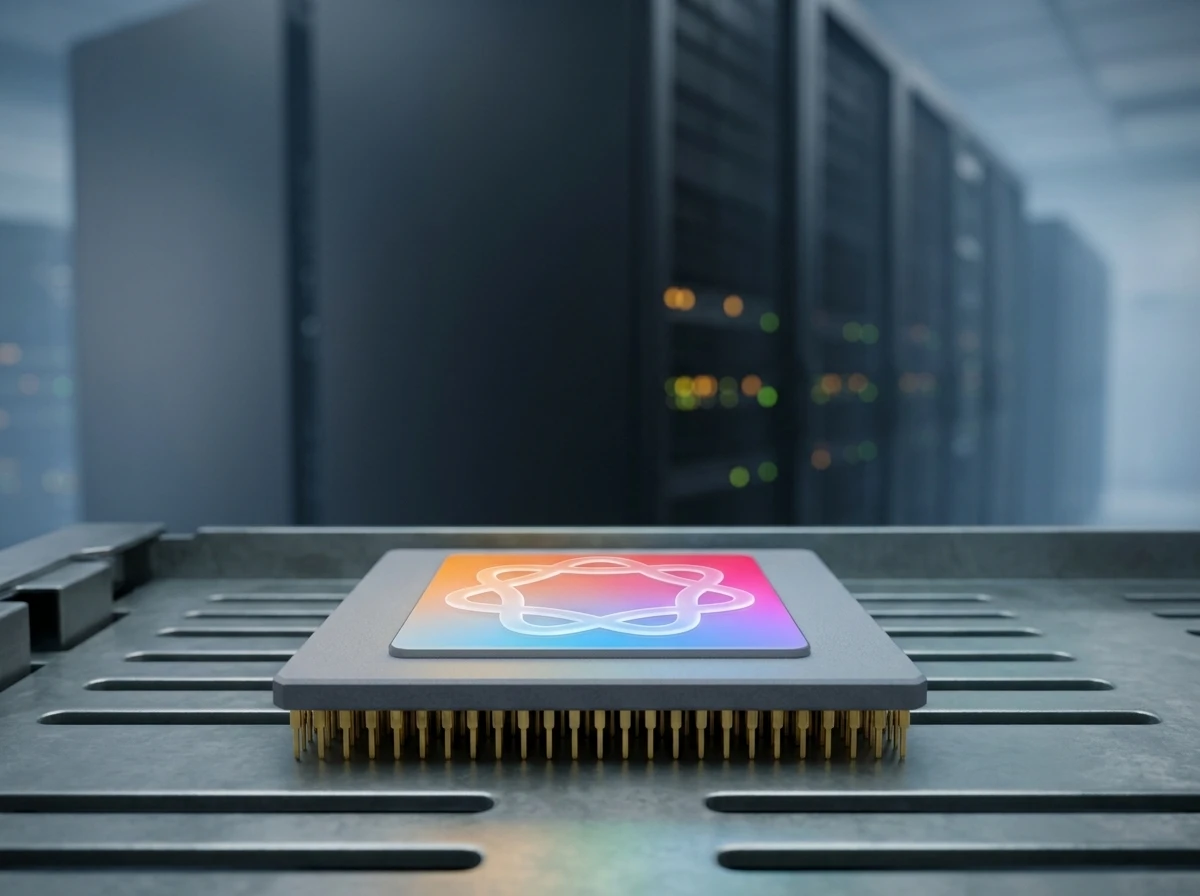
Apple’s answer to the gap was supposed to be Baltra, a purpose-built AI server chip developed with help from Broadcom on networking and interconnect technology. It was slated to ship this year. The project has slipped past that window, and no new date has been given, The Information reported.
In the meantime, Apple is moving its data centers onto newer M5 Ultra-based servers, code-named J246, as a stopgap. A true successor built around the M7 Ultra chip, aimed at pushing performance toward Nvidia’s Blackwell class, is not expected until around 2029, according to Bloomberg’s Mark Gurman.
| Server Chip | Role | Status |
|---|---|---|
| M2 Ultra | Powers Apple’s Private Cloud Compute today | In use, struggles with frontier models like Gemini |
| Baltra | Purpose-built AI server chip co-developed with Broadcom | Missed its 2026 target, no new date given |
| M5 Ultra server (J246) | Stopgap upgrade while a permanent fix is sorted out | Rolling out soon, still Mac-derived silicon |
| M7 Ultra-based server | Long-term fix aimed at Blackwell-class performance | Targeted for around 2029 |
Apple is reshaping its whole Mac lineup around that same AI push. It is skipping the M6 Pro, M6 Max and M6 Ultra chips entirely this cycle, jumping straight to an AI-focused M7 generation, with the M7 Ultra targeting up to 1.5TB of unified memory when it ships in 2028, a year before the server version arrives.
A $30 Billion Broadcom Bet
Apple announced a new multiyear agreement with Broadcom worth more than $30 billion just a week before news of the acquisition hunt broke. Broadcom will design and build custom silicon and wireless connectivity components for Apple through 2031, expanding its Fort Collins, Colorado chip plant with a $1.5 billion investment to help make it happen.
The agreement is part of Apple’s American Manufacturing Program push, and more than 15 billion of the resulting chips are expected to be built in the United States.
Apple and Broadcom have a long history together, and this new phase of our partnership further accelerates our commitment to American manufacturing and innovation.
Tim Cook, Apple’s chief executive, said in a statement announcing the deal.
Broadcom is only one piece of Apple’s chip diversification effort. The company has also been lobbying Washington over blacklisted Chinese memory chips, a separate push to widen its supplier options beyond a handful of firms.
None of that spending buys Apple the one thing it actually needs for AI servers: specialized silicon design expertise it doesn’t yet have in-house.
Apple’s Checkbook Swings Open
Apple’s dealmaking history is famously modest. Its entire chip business began with a small purchase: the $278 million acquisition of PA Semi in 2008, which seeded the team behind every A-series and M-series chip since.
Nothing came close to Apple’s $3 billion purchase of Beats Electronics in 2014 for more than a decade. That changed in January, when Apple paid nearly $2 billion for Q.ai.
- PA Semi, 2008 – $278 million, seeded the team behind Apple’s A-series and M-series chips.
- Beats Electronics, 2014 – $3 billion, still Apple’s largest acquisition on record.
- Q.ai, January 2026 – nearly $2 billion, an Israeli startup reading speech through facial micromovements, now Apple’s second-biggest deal ever.
Apple has also held talks with PrismML, a startup that shrinks large AI models to run directly on iPhones, though no deal has been reported.
Money isn’t the obstacle. Apple carried roughly $45.6 billion in cash and equivalents as of late March, and chief financial officer Kevan Parekh told analysts this year that Apple would stop treating a net cash-neutral balance sheet as a formal goal, a policy shift that frees up room for larger deals.
Apple would also be shopping in a crowded market. Britain has pledged its own £400 million bet on homegrown chip startups staying independent, and the continent’s ten biggest semiconductor funding rounds from the past year show how much capital is already chasing the same engineering talent.
New Leadership, Looser Purse Strings
The timing overlaps with a leadership change at the top. John Ternus, Apple’s hardware engineering chief, is set to succeed Tim Cook as chief executive in September. Johny Srouji, the executive who has run Apple’s chip design group for more than a decade, is taking expanded control over all of Apple’s hardware engineering, semiconductors included.
Neither man has commented publicly on the acquisition search. A hardware-first incoming CEO and an empowered chip chief make a bigger, faster deal easier to picture than it would have been a year ago.
What We Know
- Confirmed talks – Apple has spoken with bankers and approached chip startups about a sale, per The Information’s sourcing.
- Confirmed bottleneck – M2 Ultra based servers could not handle Gemini during Siri’s development, forcing a shift to Nvidia hardware inside Google’s cloud.
- Confirmed delay – Baltra has missed its 2026 target with no new ship date announced.
What’s Unconfirmed
- No named target – which startup or startups Apple is in talks with hasn’t been reported.
- No Apple comment – Apple hasn’t addressed the report publicly.
- No independent confirmation – Reuters said it could not independently verify The Information’s account.
Why Does Siri Now Lean on a Rival’s Cloud?
Apple’s rebuilt Siri sends its hardest queries to Google Cloud, where Nvidia Blackwell B200 chips do the heavy computing, because Apple’s own Private Cloud Compute servers could not run the Gemini model fast enough. Nvidia’s confidential computing feature encrypts that data during processing, which Apple points to as its defense of user privacy despite the outsourcing.
Craig Federighi, Apple’s software engineering chief, said in 2024 that keeping AI processing on Apple’s own servers was essential to privacy and security. Two years later, some of that processing runs on hardware Apple doesn’t own, inside a data center Apple doesn’t operate.
Apple has kept the Private Cloud Compute name even though a portion of its heaviest workloads now run on Google’s infrastructure. Apple maintains that Nvidia’s chip-level encryption keeps individual queries hidden from Google regardless of whose servers they touch.
The Nvidia Moat Apple Just Confirmed
Apple is, by most measures, the industry’s most capable custom-silicon company. Its chips outperform rivals per watt in phones and laptops, year after year. That it still could not run a frontier AI model on its own servers reads as one of the clearest signs yet of how deep Nvidia’s advantage in data center AI actually runs.
Broadcom is riding the same wave from another angle. Its custom AI chip business has grown large enough that the company now ranks as the world’s eighth-most valuable public company, with Apple’s order just one contract among many it is filling for AI hyperscalers.
The hyperscalers Apple is trying to keep pace with aren’t standing still either. Amazon, Google, Microsoft and Meta have collectively poured hundreds of billions of dollars into AI data centers, with Meta alone reportedly planning to spend more than $100 billion this year.
For now, the fastest way around Apple’s gap is the one it is reportedly already taking, an acquisition big enough to buy back the years Baltra cost it.
Frequently Asked Questions
What Is Apple’s Baltra Chip?
Baltra is Apple’s internal code name for a purpose-built AI server processor developed with help from Broadcom on networking and interconnect technology. It was designed to replace the repurposed M2 Ultra chips inside Apple’s Private Cloud Compute data centers and was originally set to ship in 2026, a target it has since missed.
Why Couldn’t the M2 Ultra Handle Apple’s AI Workloads?
The M2 Ultra was designed for battery-powered Macs, not the sustained, round-the-clock demands of data center inference. When Apple tested a version of Google’s Gemini model on M2 Ultra-based servers for its Siri overhaul, the chips processed too slowly to be usable, according to The Information’s reporting.
How Much Has Apple Spent on AI Acquisitions So Far?
Apple paid close to $2 billion for the Israeli startup Q.ai in January 2026, technology that interprets speech through facial micromovements, making it the company’s second-largest acquisition behind the $3 billion Beats deal from 2014. Apple has also held separate talks with PrismML, whose model-shrinking technology has reportedly squeezed Alibaba’s 27-billion-parameter Qwen 3.6 model down to run on an iPhone 17 Pro.
When Will Apple’s Own AI Servers Match Nvidia?
Not soon. Apple is bridging the gap with M5 Ultra-based servers, code-named J246, in the near term, but a server chip built around the more powerful M7 Ultra isn’t expected until around 2029, three years past Baltra’s original target.
Has Apple Confirmed It’s Buying a Chip Startup?
No. Apple hasn’t commented on the report, and Reuters said it could not independently verify The Information’s account, so neither a target company nor a deal size has been confirmed.


The House Cancels September Votes and Strands the CLARITY Act

Ascentiz Recruits Developers Around Its Modular Exoskeleton at IFA

Saylor’s Bitcoin Speech Claim Needs a Statute

Zeit AI Raises €5 Million for the Mid-Market Data Layer

Onwards and Sideways Turns Five Good Years Into a Joke

The Galaxy Watch 9 Splits Samsung’s Watch Update Path

Rightcharge Raises £500,000 as Fleets Drift Onto Public Chargers

Early Payment Discounts Hand Buyers a 37 Percent Return

AI Score Raises $5.4 Million as Security Alumni Watch Agents

Sony’s PlayStation Settlement Pays Users in Store Credit

Walter’s TWG Insists No Fraud as Insurer Probes Force Cleanup

30-Year Yield Hits 5.32% Highest Since 2007 as Debt Supply Locks In Costs

PCE Stays at 3.7% as Gas and Tariffs Outrun Coming Revisions

Evernorth S-4 Clears Path for Active XRP Treasury on Nasdaq

Astute’s $1.2M bet makes B2B creator deals feed AI discovery

Strategy Parks $1.59B Cash While Bitcoin Stack Stays Flat

Instinct Hits $2.5 Billion as AI Agent Access Sparks Trust Fights

Amber’s €7M locks Mittelstand knowledge inside Europe

CLARITY Act Cloture Opens a Door Ethics Still Blocks

SpaceX Stock Rebound Tests Real Demand Before Huge Unlock
-
 FINANCE3 months ago
Zcash Patched a Double-Spend Bug as ZEC Climbed 5%
-
 ENTERTAINMENT3 months ago
Steam Summer Sale 2026 Locks In June 25 to July 9 Dates
-

 FINANCE2 months ago
CLARITY Act Final Text Expected This Weekend as 60-Vote Hurdle Looms
-
 NEWS4 months ago
Meta Adds AI Replies to Threads, But Users Can’t Block It
-
 ENTERTAINMENT5 months ago
Extraction 3 Is Officially Coming to Netflix in 2027
-

 NEWS3 months ago
YouTube Shorts is testing a heart in place of the thumbs-up
-

 NEWS1 month ago
Senators Force Apple Off Chinese Memory as Big Three Cash In
-

 NEWS3 months ago
NEURA Robotics’ $1.4B Series C Redraws Europe’s Physical AI Bet