
NEWS
China’s Justice Mission Drills Practiced a Port Blockade
Justice Mission 2025 put live-fire zones on Keelung and Kaohsiung and practiced holding the east, a blockade aimed at keeping US and Japanese help out.

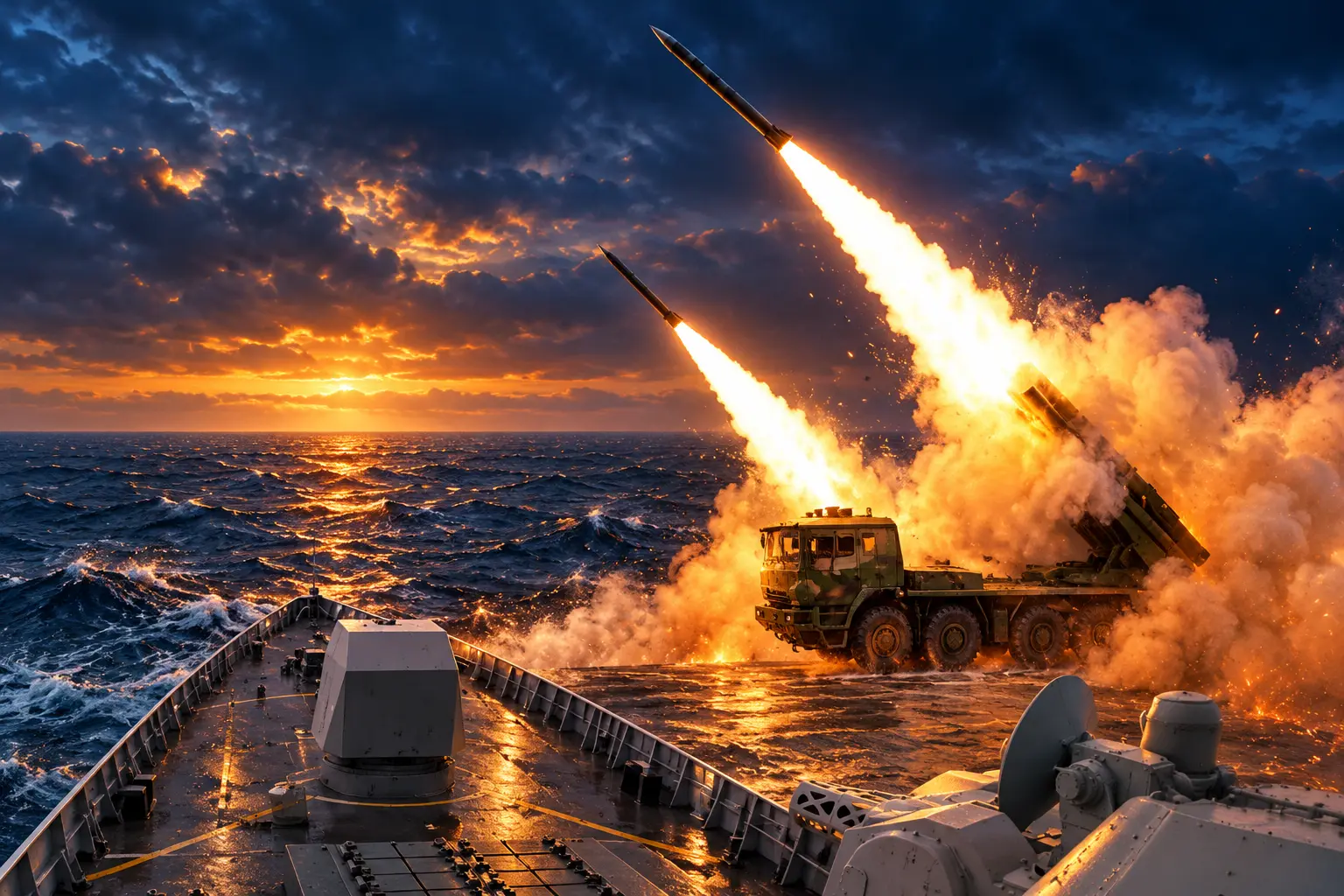
China fired 27 rockets around Taiwan on Dec. 30, 2025, in Justice Mission 2025, a live-fire drill built to blockade Keelung and Kaohsiung.
The Eastern Theater Command also practiced holding the waters east of the island, the path US and Japanese forces would have to use if they tried to help.
Five Zones Sat on Keelung and Kaohsiung
Xinhua announced the exercise at 7:31 a.m. Taipei time on Dec. 29, 2025. Senior Colonel Shi Yi, spokesperson for the Eastern Theater Command, said troops from the army, navy, air force and rocket force would work the Taiwan Strait and waters to the north, southwest, southeast and east of the island.
The command’s own write-up listed the jobs as sea-air patrols, joint seizure of superiority, a blockade on key ports and areas, and all-dimensional deterrence outside the island chain. State television named the ports: Keelung in the north and Kaohsiung, Taiwan’s largest port city, in the south.
It is a stern warning against ‘Taiwan independence’ separatist forces, and it is a legitimate and necessary action to safeguard China’s sovereignty and national unity.
Shi Yi, spokesperson, PLA Eastern Theater Command, China Military Online
Five live-fire boxes were posted first. China’s Maritime Safety Administration added two more, which closed remaining gaps, and Taiwan’s Ministry of National Defense later logged an eighth box east of the island that a Chinese ship declared by radio. Maj. Gen. Meng Xiangqing, a professor at China’s National Defense University, said two boxes sat off Keelung and two off Kaohsiung, along what he called the island’s lifelines.
William Yang, senior analyst for Northeast Asia at the Crisis Group, said the language was now explicit about anti-access and area denial, a strong signal that unofficial partners such as the United States and Japan would be blocked from offering help in a fight. Observers also said this was the first time Beijing had publicly described a Taiwan drill as a tool for deterring foreign military intervention.
27 Rockets Landed Closer Than Before
Taiwan’s afternoon briefing on Dec. 29 counted 89 Chinese aircraft, 14 navy ships and 14 coast guard ships around the island, with 67 aircraft inside Taiwan’s response zones. In the 24 hours from 6 a.m. that Monday, the defense ministry tracked 130 air sorties, 90 of them into the air defense identification zone, plus 14 navy ships and 8 official ships. That ADIZ count was the second-largest of its kind since 2022.
By 3 p.m. on Dec. 30 the ministry had 71 aircraft, 17 navy ships and 15 coast guard ships on the board, and it had counted 27 rocket impacts. Seventeen landed in waters north of Keelung, from PHL-16 launchers of the 72nd Group Army at Pingtan in Fujian. Ten landed west of Tainan, from the 73rd Group Army at Shishi. Taiwan said some of those rounds fell inside the contiguous zone, closer than any previous live-fire drill around the island.
The clips that traveled farthest that week mixed parade-style robot dogs and humanoid machines with the exercise. Replies under those posts called the footage animated. The rounds Taiwan actually logged were the PHL-16 rockets off Keelung and Tainan.
THE TWO-DAY CLOCK
- December 29, 2025: Shi Yi announces Justice Mission 2025 and posts five prohibited boxes for live fire the next day; Taiwan puts forces on high alert and starts rapid-response drills.
- December 30, 2025: Live fire runs from 8 a.m. to 6 p.m. local time, a 10-hour window, while the Type 075 amphibious assault ship Hainan works east of the island on port-seizure and raid tasks.
- December 31, 2025: The command declares the drill complete at 4 p.m., a day after the warning boxes had already expired.
Frigates Baoji and Quzhou and the destroyer Taiyuan opened the naval gun line after 9:30 a.m. on Dec. 30. The Hainan group, working with bombers and anti-ship missile units southeast of Taiwan, was the first time a Type 075 had appeared in a joint exercise around the island. Taiwan’s ministry also said two Chinese military aircraft and 11 ships had been operating around the island in the 24 hours before the announcement, and it posted footage of US-made HIMARS launchers whose roughly 300 km range can reach Fujian.
The Air Routes That Closed for 10 Hours
Taiwan’s Civil Aviation Administration said the live-fire window would hit 857 international flights in the Taipei flight information region: 296 outbound, 265 inbound and 296 transits. It estimated that more than 100,000 international passengers would feel the detours, with about 6,000 domestic passengers caught as well.
Alexander Huang, director-general of Taiwan’s Council on Strategic and Wargaming Studies, said earlier large drills had tried to stay off civil air and sea lanes, and that this one did not. Minister of Transportation Chen Shih-kai protested what he called arrogant and unreasonable actions that would affect the safety of air and sea transport.
THE FLIGHT BILL
- International services: 857 flights were slated to detour through the 10-hour box on Dec. 30, 2025.
- Passenger estimate: More than 100,000 people on international tickets were expected to face delays or reroutes.
- Domestic cut: By midday, 36 flights to Kinmen and Matsu were cancelled, 29 on the Kinmen run and 7 on Matsu, with extra flights promised after the box lifted.
- Ports and boats: Harbor officials expected commercial ships to keep moving if they stayed out of the boxes; Chen Wen-chin, chairman of the Keelung District Fishermen’s Association, said the drill stopped crews from working.
By midday on Dec. 30 the aviation office said no international flight had been cancelled, though some transits were diverted and controllers were flying non-standard routes. Kinmen and Matsu, the outlying islands whose air links sit in the strait, were the ones that went dark. Port authorities warned ships to avoid the Chinese boxes and said they did not expect a halt to commercial traffic in and out of Taiwanese harbors.
Stephanie Huang, an interior designer in Taiwan, said China’s goal is to keep the island, not the people, and that the two sides of the strait are not subordinate to each other. Lin Wei-Ming, a teacher, said the drills were meant to scare residents, and that ordinary people could only do their jobs and live their lives.
Washington’s Package and Tokyo’s November Line
On Dec. 17, 2025, the Defense Security Cooperation Agency told Congress it had certified a possible sale of 82 High Mobility Artillery Rocket Systems to the Taipei Economic and Cultural Representative Office, with 420 ATACMS missiles, 756 M31A2 GMLRS-U pods and 447 M30A2 GMLRS-AW pods, at an estimated $4.05 billion. That notice sat inside an eight-case package worth $11.1 billion, the largest US weapons set ever lined up for the island.
The live-fire drills after the US arms deal opened 12 days later. Beijing had already sanctioned 20 US defense firms and 10 executives. Foreign Ministry spokesperson Lin Jian said external forces trying to use Taiwan to contain China and arm the island would only embolden pro-independence arrogance and push the strait toward war. He also said pro-independence forces were willing to turn Taiwan into a powder keg.
The other fuse was in Tokyo. On Nov. 7, 2025, Japanese Prime Minister Sanae Takaichi told the Diet that a Chinese attack on Taiwan that involved warships and the use of force could be a survival-threatening situation under Japan’s 2015 security law, the threshold for collective self-defense. Chinese officials treated that line, and the arms notices, as the same file. A PLA video from the drill used HIMARS-style mobile launchers as notional targets.
If China sets 2027 as the year to be ready for an invasion of Taiwan, then we have only one choice: to keep raising the difficulty so that China can never meet that standard. Taiwan will naturally remain safe.
William Lai Ching-te, President of Taiwan, Sanli E-Television, Dec. 28, 2025
Lai, in that interview, said the island had to raise the cost of aggression and build more of its own weapons. A presidential office spokesperson urged China not to misjudge the situation and to halt what Taipei called irresponsible provocations. The defense ministry said all members of the armed forces would remain on guard to defend democracy and freedom.
How This Drill Compared With Earlier Named Exercises
Justice Mission 2025 was the second named PLA exercise around Taiwan in 2025, after Strait Thunder-2025A in April. The CSIS ChinaPower project, in a Feb. 5, 2026 note by Bonny Lin, Brian Hart, Leon Li and Truly Tinsley, called the December boxes the largest named exercise by geographic reach around Taiwan in recent years. Several of those boxes cut into the 12-nautical-mile territorial sea on paper, and rockets fell in the contiguous zone.
K. Tristan Tang, writing in the Jamestown Foundation’s China Brief, put the force numbers next to earlier named runs and found they were not a record. Joint Sword-2023 still led on aircraft. What had grown was the area of the boxes, the closeness of the live fire, and the choice to run a large drill in December, when the PLA training year usually winds down.
NAMED PLA EXERCISES AROUND TAIWAN
| Exercise | When | Days | Aircraft sorties | Navy ships |
|---|---|---|---|---|
| Joint Sword-2023 | April 2023 | 3 | 232 | 32 |
| Joint Sword-2024A | May 2024 | 2 | 111 | 46 |
| Joint Sword-2024B | October 2024 | 1 | 153 | 14 |
| Strait Thunder-2025A | April 2025 | 2 | 135 | 38 |
| Justice Mission 2025 | December 2025 | 3 | 210 | 48 |
Tang compiled those figures from Republic of China Ministry of National Defense releases. Strait Thunder-2025A also fired 16 rockets, including shots at mock-ups that resembled the Yongan LNG terminals in Kaohsiung. Justice Mission 2025 fired 27. The December drill’s 210 sorties over three days sat below Joint Sword-2023’s 232, so the jump that mattered was the map, not the daily air count.
The East Side Was Built to Stop Help From Arriving
Shi Yi said Chinese ships and aircraft would approach the island in close proximity from different directions and that several services would join in assaults to test joint operations. The eastern work was the piece aimed at anyone coming from the Philippine Sea.
WHAT THE EAST AND PORT BOXES REHEARSED
- Port seal: Boxes north of Keelung and south of Kaohsiung practiced shutting the island’s main commercial doors.
- Outer line: Destroyers, frigates, fighters and bombers ran anti-submarine and sea-air hunts east of Taiwan, the approach US and Japanese units would use.
- Amphibious raid: The Hainan group drilled vessel-aircraft strikes, long-distance raids and the seizure of key ports, including helicopter-borne landings rather than a simple beach rush.
- Island step: Tang read the heavier joint fires off southwest Taiwan as a rehearsed seizure of the Penghu Islands, a staging point for a later landing on the main island.
Coast guard cutters ran “law enforcement” patrols near Matsu and Wuqiu at the same time, so the military boxes and the civilian-flagged patrols moved together. Taiwan’s coast guard sent large ships of its own and said it was working with the military to limit harm to sea lanes and fishing grounds. A TB-001 drone clip circulated as if it had flown over New Taipei; Taiwan’s defense ministry said no drone entered the island’s airspace.
Ming-Shih Shen of the Prospect Foundation later called the episode a tiger head with a snake tail, arguing that US arms policy and Japan’s Taiwan line did not move, and that Taiwan’s stock market even rose. The map still did something those earlier, quieter drills had not: it charged civilian air traffic a fee for a two-day lesson in how a blockade would feel.
No Second Named Encirclement Came by August
Senior Captain Li Xi said the command had fully tested integrated joint operations and that the drill was over. Australia, France, Germany, Japan, the United Kingdom and the European Union called for restraint. Taiwan’s defense ministry then eased its extra posture.
Through the first eight months of 2026, China did not stage another named encirclement on that scale. Aadil Brar, a China open-source researcher, wrote on Aug. 27, 2026, that no large-scale unilateral drill had run since Justice Mission 2025, and that PLA aircraft sorties near Taiwan in the first half of 2026 had fallen to 1,334. Carrier transits, coast guard patrols east of the island, and Taiwan’s own Han Kuang drills continued. The December map was not repeated under a new name.
The boxes on Keelung and Kaohsiung, and the eastern line behind them, remain the last full script Beijing has published for how it would try to keep help out.
Frequently Asked Questions
Which Taiwan Flight Routes Stayed Open During Justice Mission 2025?
Only three of 14 international routes in the Taipei flight region stayed usable: R595, R583 and M750, all toward Japan. Every other international route was closed for the 10-hour live-fire window, and scheduled links between Taiwan and Kinmen and Matsu were blocked until the boxes lifted.
Did Chinese Warships Enter Taiwan’s 12-Nautical-Mile Territorial Sea?
Five of the eight declared zones overlapped that belt, and one southern boundary ran less than 5 nautical miles from the coast. Taiwan’s logs still showed Chinese ships staying between the territorial sea and the contiguous zone, not crossing the 12-nautical-mile line.
What Else Was in the December 2025 US Arms Package Besides HIMARS?
The same Dec. 17 notices covered 60 M109A7 self-propelled howitzers at about $4.03 billion, Altius air vehicles at $1.1 billion, Javelin and TOW missiles, AH-1W spare parts, Harpoon support, and tactical mission network software, eight cases in all.
How Many PLA Aircraft Entered Taiwan’s ADIZ in 2025?
Taiwan’s defense ministry logged 3,764 ADIZ incursions in 2025, up 22.4 percent from 2024, according to the CSIS ChinaPower tally. Monthly averages from May 2024 through December 2025 ran at 319, more than double the January 2022 to April 2024 average.

UPI MDR Delay Hands Traders the Calendar After Paytm Falls

Google Messages Builds Nine In-Chat Games After Samsung’s Exit

Anthropic’s $100 Million Academy Trains the Firms That Bill Both Sides

Toyota’s Electric C-HR Leaves the Cheap Twin to Subaru

Markets Bet the Fed Skips October After Hawkish Minutes

The Orchard Bug Forced Zcash to Open an Empty Pool

The $5.99 Game That Won Steam’s 2026 Summer Sale

Don Lee Joins Hemsworth as Extraction 3 Starts Shooting

YouTube Shorts Retires Dislikes and Swaps Likes for Hearts

NEURA Robotics Is Spending Its $1.4B on a Machine Stack
-
 NEWS5 months ago
The Orchard Bug Forced Zcash to Open an Empty Pool
-
 GAMING5 months ago
The $5.99 Game That Won Steam’s 2026 Summer Sale
-
 ENTERTAINMENT7 months ago
Don Lee Joins Hemsworth as Extraction 3 Starts Shooting
-
 NEWS4 months ago
YouTube Shorts Retires Dislikes and Swaps Likes for Hearts
-
 NEWS4 months ago
NEURA Robotics Is Spending Its $1.4B on a Machine Stack
-

 NEWS5 months ago
Atlantic City Turned WWE’s Return Into a Civic Night
-
 AUTO6 months ago
Kawasaki Bets the New Z1100 Against Its Own Supercharger
-
 BUSINESS5 months ago
Norway’s Export Bank Backs Nscale’s $790 Million Narvik Loan