
BUSINESS
Coast Guard Icebreakers Kept Heating Oil and Ore Moving
After Winter Storm Fern, Coast Guard icebreakers kept Northeast heating oil moving, while Great Lakes ore boats still lost 82 ship days.

After Winter Storm Fern, U.S. Coast Guard icebreakers had logged 3,245 domestic icebreaking hours by Feb. 4, 2026. Twenty cutters had helped 142 vessel transits and held waterway availability above 98 percent.
Homeland Security Secretary Kristi Noem said freezing temperatures could not slow the service, and that some parts of the country were dealing with the most ice they had seen in a decade. The hours kept climbing into spring. So did the bill for the cargo those tracks were supposed to protect.
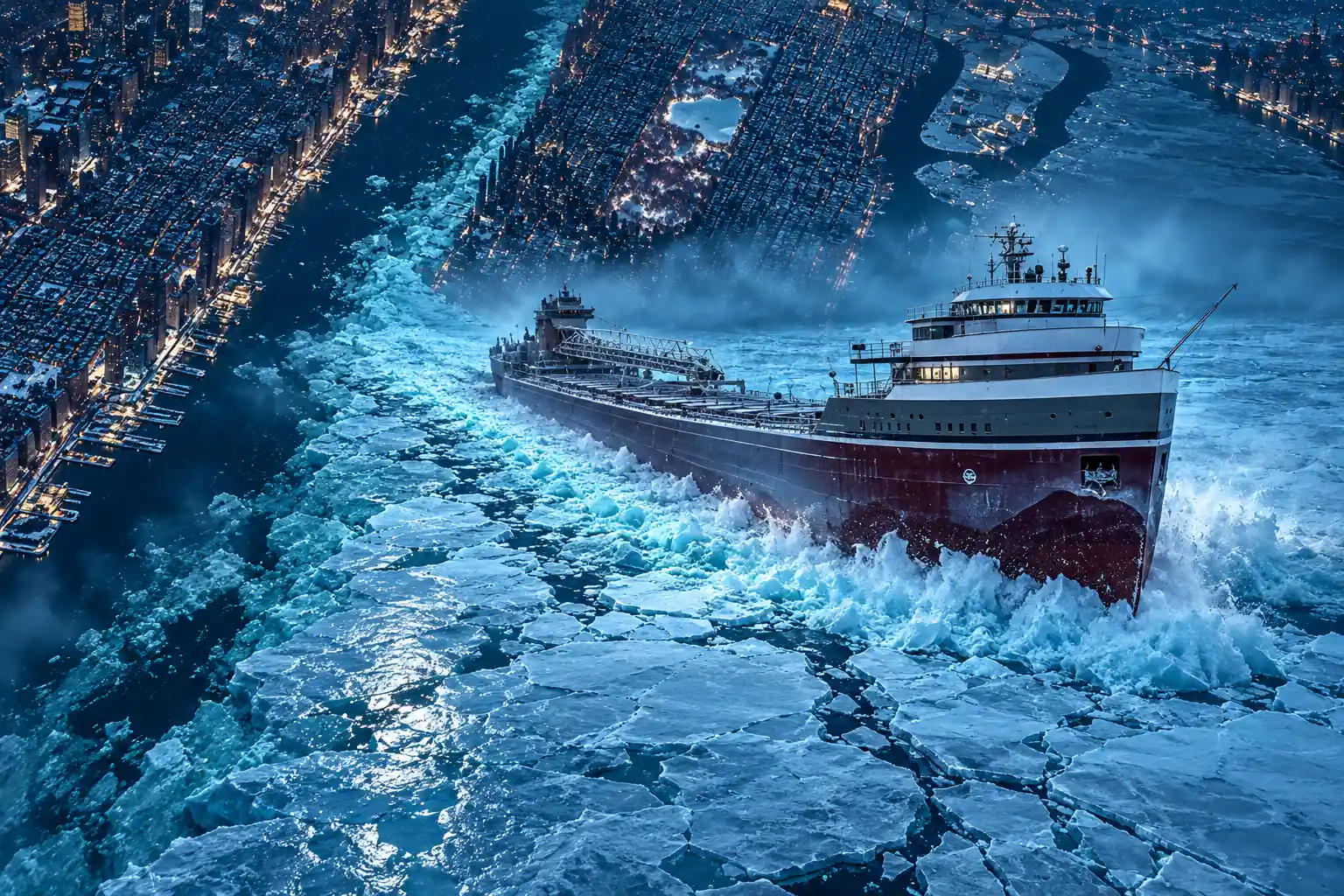
Ice Reached Manhattan After Fern
Fern rolled from Jan. 23 to Jan. 27, 2026. New York City dropped below freezing on Jan. 24 and stayed there for more than a week. A Central Park station recorded nearly 12 inches of snow on Jan. 25.
On Jan. 28, Landsat 8 showed how ice choked the Hudson River along Manhattan’s western shore. The high that day was 23 degrees Fahrenheit (minus 5 Celsius). Ice also showed in the East River, the Jacqueline Kennedy Onassis Reservoir, and New Jersey waterways. NASA Earth Observatory noted that a full freeze around Manhattan is unlikely, and that the last one was in 1888. NYC Ferry still halted service for several days.
Capt. Jonathan Andrechik, commander of Coast Guard Sector New York, said ice was hurting safe navigation, winter fuel deliveries, and public transportation. On Jan. 29 his sector listed icebreaking operations in New York Harbor and up the Hudson, with CGC Penobscot Bay, CGC Sturgeon Bay, and the 65-foot CGC Hawser, all homeported in Bayonne, N.J. A Jan. 28 video showed Hawser working with the buoy tender CGC Katherine Walker on the lower river and the Port of New York and New Jersey.
Those Bayonne hulls were the same Hudson River icebreaking after Fern that kept fuel barges in a cut track instead of against the bank. All ports in the Sector New York area stayed open. Heating oil stocks were reported stable that week. Ferry riders were pointed to service alerts.
The official notice went out the same day.
PRESS RELEASE: The U.S. Coast Guard is actively conducting icebreaking operations in New York Harbor and the Hudson River in response to worsening ice conditions caused by prolonged extreme cold and Winter Storm Fern. View full release here: https://t.co/GIqxtuEM57
— USCG_Tri_State (@USCG_Tri_State) January 29, 2026
A Feb. 9 ice report for the harbor and river showed how fast the sheet thickened once the water left salt and current behind. Plate and brash from Poughkeepsie north sat 4 to 8 inches deep at 100 percent cover. Albany to Troy was 7 to 8 inches of plate. Storm King was brash and plate more than 8 inches thick, fully covered.
HUDSON ICE ON FEB. 9, 2026
| Reach | Ice | Thickness | Cover |
|---|---|---|---|
| George Washington Bridge | Brash | 1-2 inches | 90% |
| Tappan Zee to West Point | Small floe | 3 inches | 80% |
| Poughkeepsie to Kingston | Brash | 4-8 inches | 100% |
| Kingston to Catskill | Plate | 6-8 inches | 100% |
| Catskill to Albany | Plate and brash | 6-8 inches | 100% |
| Albany to Troy | Plate | 7-8 inches | 100% |
| Storm King chokepoint | Brash and plate | 8+ inches | 100% |
The public pictures were of ice hugging Manhattan. The harder ice sat upriver, on the route heating oil and other bulk still use when trucks cannot replace a barge.
Northeast Heating Oil Still Travels by Water
On Jan. 8, Coast Guard Northeast District launched Operation Reliable Energy for Northeast Winters 2026, known as RENEW, from Maine to New Jersey. Rear Adm. Michael E. Platt, the district commander, put heating oil first because several cutters were in maintenance and the district had to pick.
Operation RENEW 2026 is about keeping Northeast communities safe and secure during the toughest winter months. Every year, the Coast Guard works to ensure that heating fuel, food, and medical supplies can reach households and businesses when ice hinders waterways. Eighty-five percent of the nation’s heating oil is used in the Northeast, and most of it travels on waterways we maintain.
Rear Adm. Michael E. Platt, commander, Coast Guard Northeast District, Jan. 8, 2026
The district said the work served more than 33 million residents. It also said the Northeast burns 85 percent of the nation’s heating oil, with 90 percent of that fuel moving on waterways the service keeps open. Cutters Bridle and Tackle were already breaking ice on Penobscot Bay on Jan. 7. CGC Cleat escorted a tug and a 30-foot barge through semi-frozen water on the Connecticut River near Haddam the same day.
DHS later described RENEW as a sea-lane job for home heating oil and other petroleum products. That is a narrow fleet doing a regional energy job, not a polar cruise. When a 65-foot harbor tug is on the Connecticut River in February, someone ashore is waiting on a tank.
Nineteen Ore Boats Waited at the Soo
On the lakes, the named cargo is taconite, the iron-ore pellets that run from mines at the Head of the Lakes to mills on Lake Erie and Lake Michigan. Operation Taconite, run from Sector Northern Great Lakes, is the service’s largest domestic icebreaking job. Operation Coal Shovel, from Sector Detroit, covers southern Lake Huron through the St. Clair-Detroit system into Lake Erie, Lake Ontario, and the St. Lawrence Seaway, with Canadian icebreakers alongside.
On Jan. 21, the 240-foot heavy icebreaker CGC Mackinaw freed the 678-foot bulk carrier Wilfred Sykes on Lake Huron. The 140-foot CGC Neah Bay helped the 1,004-foot American Spirit on Lake Erie. Lt. Cmdr. Jeremy Tyrrell, Neah Bay’s commanding officer, said crews were stretching across the St. Marys River, the Straits of Mackinac, Green Bay, Duluth-Superior, western Lake Erie, and the Detroit and St. Clair rivers.
The Soo Locks at Sault Ste. Marie, Mich., closed on Jan. 15 and opened on March 25. When they opened, the first iron-ore load still needed 96 hours to clear the St. Marys River. The Lake Carriers’ Association, which speaks for the U.S.-flag lakes fleet, said as many as 19 vessels sat stopped in ice near the locks, waiting for a track.
Mackinaw never locked north. A bow-thruster casualty kept the only U.S. heavy icebreaker below the Soo, Eric Peace, the association’s vice president, said. That left CGC Spar, an ice-capable buoy tender, as the constant above the locks. Canadian ships Vincent Massey and Risley helped for a stretch, Peace said, then answered Thunder Bay, Ontario. In late March, Whitefish Bay still held more than 2 feet of ice under about 3 feet of snow in spots, and no downbound cargo had yet left Duluth for the southern mills.
TWO MEASURES OF THE SAME WINTER
- Lake Carriers: U.S.-flag shipping lost 1,953 hours, or 82 ship days, which the group called about a third of the lakes season, in a May 19, 2026 release.
- Coast Guard, lakes: Chief Petty Officer Brandon Giles said that in a 135-day span from Dec. 9 to April 23, crews helped more than 400 vessels, spent about 3,000 hours breaking ice, and recorded zero casualties on assisted transits.
- Coast Guard, national: The May 8 wrap counted about 6,940 domestic hours, more than 30 cutters and boats, and 981 vessels helped across the East and the lakes.
Those figures can all be true at once. Waterway availability is not the same thing as a laker’s clock. Jim Weakley, president of the Lake Carriers’ Association, treated the gap as a national industrial problem, not a regional gripe.
This is a national problem that requires America’s attention.
Jim Weakley, president, Lake Carriers’ Association, May 19, 2026
Peace put it in shorter words. The lakes get nine months of shipping. Steel, he said, builds countries. Of the nine icebreakers and ice-capable tenders stationed on the lakes, only seven were available. One Bay-class tug and one ice-capable buoy tender sat in required maintenance.
Chesapeake Ice, the Most Since 2014
Icebreaking is less common in the Mid-Atlantic. DHS said the cold still forced targeted jobs in places that are not used to long freezes, for ferries, fuel barges, and commercial hulls. Lt. Cdr. Blake Bonifas, an Atlantic Area public affairs officer, said peak ice cover on Chesapeake Bay topped 35 percent, the most since 2014, against a seasonal average of about 10 percent.
Bonifas also said ice touched more than 600 nautical miles on the Detroit River, the St. Marys River, the Straits of Mackinac, the Hudson River, and Chesapeake Bay. On the Delaware River, Sector Delaware Bay brought in the commercial heavy-ice tug Atlantic Salvor to break toward Fairless Hills. Briefing slides from that sector show ice condition 3 north of the Tacony-Palmyra Bridge in early February, with work also noted near Paulsboro, N.J., Eagle Point, and the Baxter water treatment plant. Small tugs and buoy tenders worked Curtis Creek in Maryland and the bay.
The East District job was the tell. When a region that rarely needs icebreakers starts calling for them, the thin fleet is already spoken for on the Hudson and the lakes.
The 140-Foot Tugs Keep Breaking Down
Domestic icebreaking in this winter sat on a short list of old hulls: nine 140-foot Bay-class tugs, a handful of 65-foot harbor tugs, ice-capable buoy tenders, and Mackinaw. The Lake Carriers’ Association said the 140-foot tugs, more than 45 years old in some cases, kept breaking down at the height of need, and that other federal icebreakers also took engineering hits during the season.
HULLS ON THE JANUARY TRACKS
- Hudson and harbor: Penobscot Bay and Sturgeon Bay, both 140-foot Bay-class tugs, plus Hawser, a 65-foot harbor tug, all out of Bayonne, with Katherine Walker assisting on Jan. 28.
- New England oil lanes: Bridle and Tackle on Penobscot Bay, Cleat on the Connecticut River, under RENEW.
- Great Lakes: Mackinaw on the lower lakes after the bow-thruster casualty, Neah Bay on Lake Erie, Spar above the Soo, with two of nine stationed ice ships unavailable.
- Delaware: Atlantic Salvor, a contracted commercial tug, filling a gap in a district that does not keep a heavy icebreaker on the pier.
The service has paper plans for Homeland Security Cutters to replace the Bay-class boats and the 65-foot tugs, and for a second heavy hull to stand with Mackinaw. None of that arrived in time for Fern, the February ice, or the March queue at the Soo. Canadian icebreakers remain part of the lakes bargain, and U.S. ships still pay Canada’s seasonal icebreaking fee when they call Canadian ports, Peace said, even as Canadian lakers use the Soo at no extra charge.
How the Season’s Hours Added Up
The Feb. 4 DHS snapshot was a midpoint, not a finish. Crews were still breaking ice into spring. The service closed domestic icebreaking on the eastern waterways and the lakes on May 8, 2026, once western Great Lakes ice had nearly melted and commercial tracks no longer needed a cutter.
FROM THE FEB. 4 SNAPSHOT TO THE MAY 8 CLOSE
| Measure | Feb. 4, 2026 | Season end, May 8 |
|---|---|---|
| Icebreaking hours | 3,245 | about 6,940 |
| Ships in the work | 20 cutters | more than 30 cutters and boats |
| Traffic helped | 142 vessel transits | 981 vessels |
The later total more than doubled the February hours, and it folded in boats as well as cutters. DHS had already named the cargo: petroleum, heating oil, road salt, and other essentials, plus search and rescue. The May wrap named fuel for mid-Atlantic power plants, iron ore on the lakes, and home heating oil in New England.
THE ICE SEASON, IN ORDER
- Jan. 8, 2026: Northeast District opens Operation RENEW, with heating oil as the top mission.
- Jan. 21, 2026: Mackinaw frees Wilfred Sykes on Lake Huron; Neah Bay helps American Spirit on Lake Erie.
- Jan. 23-27, 2026: Winter Storm Fern. New York stays below freezing from Jan. 24.
- Jan. 28-29, 2026: Landsat shows Hudson ice; Sector New York puts three Bayonne hulls on the river and harbor.
- Feb. 4, 2026: DHS reports 3,245 hours, 20 cutters, 142 transits, and more than 98 percent waterway availability.
- Feb. 9, 2026: Hudson plate ice hits 7 to 8 inches above Albany; Storm King is more than 8 inches at full cover.
- March 25, 2026: Soo Locks open. First iron-ore ship needs 96 hours to clear the St. Marys River.
- May 8, 2026: Domestic icebreaking ends. Season tally: about 6,940 hours, more than 30 cutters and boats, 981 vessels.
The Manhattan ice is what people watched. The ore that sat at the Soo, and the heating oil that still had to move by water, is what the hours were for. Mackinaw remained the only U.S. heavy icebreaker on the lakes, and it spent the season south of the locks.
Frequently Asked Questions
Did New York Harbor Close in the Freeze?
No. On Jan. 29, 2026, Coast Guard Sector New York said every port in its area of responsibility remained open, even as ice spread from the harbor through the Hudson Valley. NYC Ferry did suspend some runs for several days, and the sector pointed riders to the city’s ferry service alerts rather than to a port shutdown.
What Is the Coast Guard Cutter Mackinaw?
Mackinaw (WLBB 30) is a 240-foot heavy icebreaker, the only U.S. hull of that class on the Great Lakes. It was launched on April 2, 2005, and commissioned on June 10, 2006. During the 2025-26 ice season a bow-thruster casualty kept it below the Soo Locks, so it could not work the snow-covered ice in Whitefish Bay where the ore boats needed it.
How Does Icebreaking Limit Flood Risk?
Sector New York said crews were not only cutting tracks for fuel. They were also managing ice formations in rivers to cut the chance of flooding. On the St. Marys River the same idea shows up as ice management: holding ice dams in some stretches and flushing ice toward Lake Huron in others, so moving plates do not shove ships aground.
What Are Bay-Class Icebreaking Tugs?
They are 140-foot icebreaking tugs. Penobscot Bay and Sturgeon Bay, both homeported in Bayonne, were the Bay-class boats on the Hudson in late January. The class was built in the late 1970s and 1980s. The Coast Guard has asked for new Homeland Security Cutter mediums to replace them; those ships were not on the river after Fern.
Whitefish Bay still had more than 2 feet of ice under about 3 feet of snow when the locks opened. Mackinaw was on the wrong side of them, and the 140-foot tugs were the hulls left to finish the year.

UPI MDR Delay Hands Traders the Calendar After Paytm Falls

Google Messages Builds Nine In-Chat Games After Samsung’s Exit

Anthropic’s $100 Million Academy Trains the Firms That Bill Both Sides

Toyota’s Electric C-HR Leaves the Cheap Twin to Subaru

Markets Bet the Fed Skips October After Hawkish Minutes

The Orchard Bug Forced Zcash to Open an Empty Pool

The $5.99 Game That Won Steam’s 2026 Summer Sale

Don Lee Joins Hemsworth as Extraction 3 Starts Shooting

YouTube Shorts Retires Dislikes and Swaps Likes for Hearts

NEURA Robotics Is Spending Its $1.4B on a Machine Stack
-
 NEWS5 months ago
The Orchard Bug Forced Zcash to Open an Empty Pool
-
 GAMING5 months ago
The $5.99 Game That Won Steam’s 2026 Summer Sale
-
 ENTERTAINMENT7 months ago
Don Lee Joins Hemsworth as Extraction 3 Starts Shooting
-
 NEWS5 months ago
YouTube Shorts Retires Dislikes and Swaps Likes for Hearts
-
 NEWS4 months ago
NEURA Robotics Is Spending Its $1.4B on a Machine Stack
-

 NEWS5 months ago
Atlantic City Turned WWE’s Return Into a Civic Night
-

 AUTO6 months ago
Kawasaki Bets the New Z1100 Against Its Own Supercharger
-
 BUSINESS5 months ago
Norway’s Export Bank Backs Nscale’s $790 Million Narvik Loan