
NEWS
Huawei Bets the GT Runner 2 Can Crack Garmin
Huawei’s Watch GT Runner 2, launched in Madrid with Eliud Kipchoge, is a €399 bet on Garmin’s runners, and the GPS tests still split.

Huawei put the Watch GT Runner 2 on a Madrid stage on February 26, 2026, five years after its last dedicated running watch. Two-time Olympic marathon champion Eliud Kipchoge stood as global ambassador, and the recommended price was €399 (£349).
The night was a wager. Huawei already ships more wrist devices than anyone, and it still had to buy its way into the small club of watches that serious runners actually train on.
Madrid Put a Running Watch at the Center of the Night
The event was titled “Now is Your Run,” a spin on the company’s “Now is Yours” line from the year before. The Runner 2 was the headliner. Around it, Huawei also showed the Watch Ultimate 2 in a new Green finish, the Band 11 Series, the Mate 80 Pro, the 8.8-inch MatePad Mini, and FreeBuds Pro 5.
Kipchoge framed the deal as reach, not lap times. Huawei’s own release from Madrid carried his pitch in full.
Running means much more than running fast. I believe that running is the most beautiful activity on every level. Together with Huawei, we can reach millions of runners around the world and hopefully impact their lives in a beautiful and positive way.
Eliud Kipchoge, HUAWEI WATCH GT Runner global ambassador, Madrid launch
He also said he wanted his feedback to improve the watch for elite athletes and for ordinary runners. That is the bet in one sentence: take a volume wearable maker, add a marathon icon, and sell a race computer to people who currently live on Garmin and COROS.
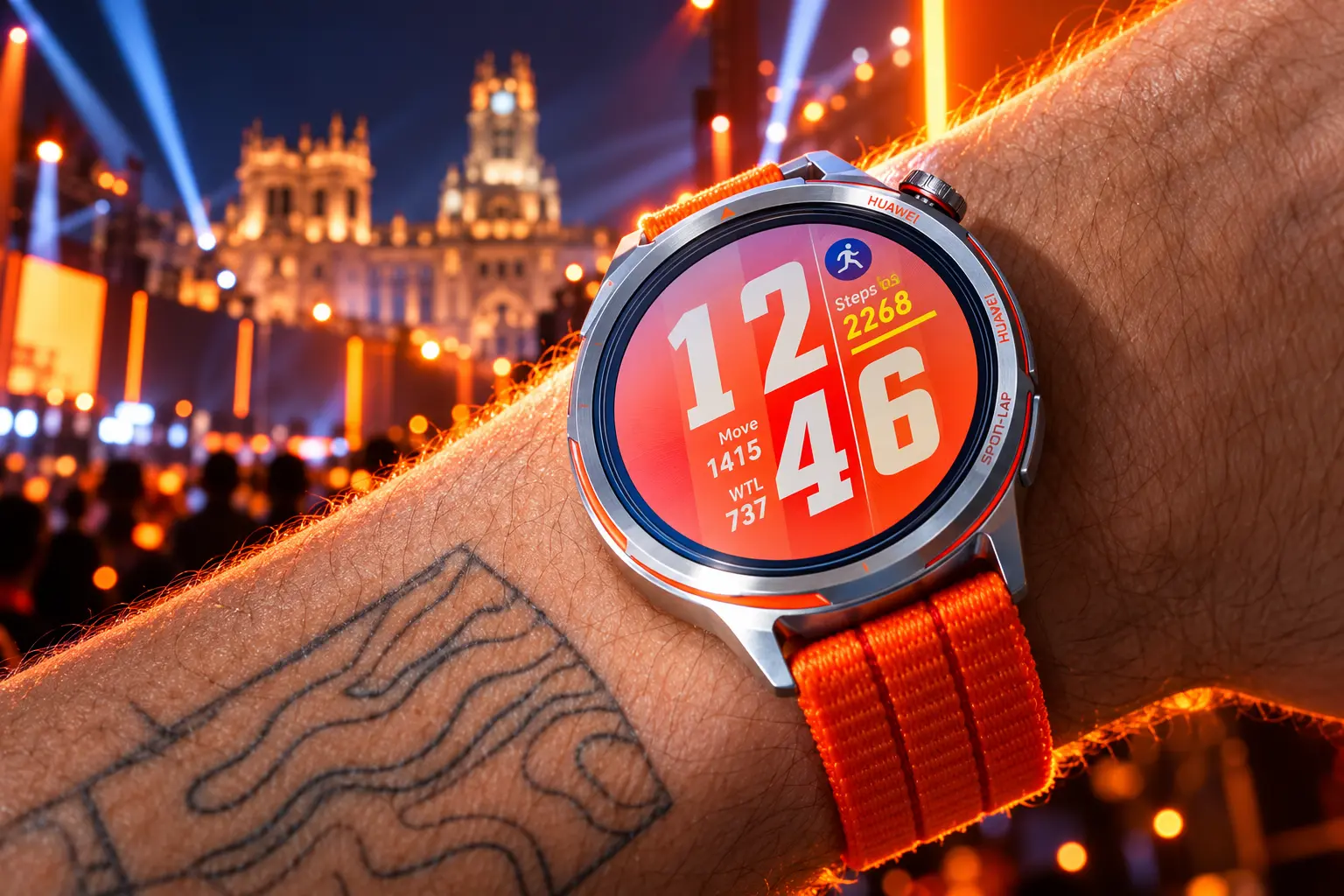
The Case Weighs 34.5 Grams and Splits Its Antenna
The hardware is the chip Huawei put on the table. The case is 43.5 mm across and 10.7 mm thick, in aerospace-grade titanium, at about 34.5 g without a strap. With the 9 g AirDry woven strap it is 43.5 g. The first GT Runner, from 2021, weighed 38.5 g and sold in Europe at €299 with a larger 1.43-inch screen.
This one uses a 1.32-inch AMOLED panel at 466 x 466 pixels (352 ppi) and up to 3,000 nits, under 2nd Gen Kunlun Glass. Huawei rates the battery at up to 32 hours of outdoor workouts with precise positioning on, up to 7 days in typical use, and up to 14 days in light use with auto-detect workouts turned off. Water resistance is 5 ATM, and the briefing also listed free diving to 40 metres. It pairs with Android 9.0 or later and iOS 13.0 or later, with Bluetooth 6.0 and NFC.
The feature Huawei kept pointing at was not the titanium. It was a two-antenna GNSS layout. One antenna sits in the case, the other in the bezel, with an isolation ring so the upper ring stays ungrounded. Huawei calls this a 3D floating antenna and, on the product page, a 20% more accurate positioning claim in streets and tree cover, paired with an algorithm that keeps estimating path and distance when the signal drops. Official specs list dual-band GPS and BeiDou tri-band, plus GLONASS, Galileo, QZSS, and NavIC.
In the Madrid-week briefings, Huawei labeled the Garmin Forerunner 970 as a gold-standard watch and showed city-marathon traces checked against a backpack NovAtel CPT7 survey-grade GNSS receiver. Independent tester Ray Maker, who publishes endurance-device tests, wrote that companies almost never name the rival on those slides.
WHAT HUAWEI PUT IN THE BOX
- Two straps: an AirDry woven band, which Huawei says raises breathability 25%, plus a fluoroelastomer strap.
- Three colours: Dawn Orange, Dusk Blue, and Midnight Black, with a Racing Legend edition tied to Kipchoge on the global site.
- Race tools: smart marathon mode, a virtual pacer, lactate-threshold estimates, running power, a Running Ability Index, offline maps, ECG, and HRV.
Maker’s own always-on GPS run, 2.5 hours with no route loaded, told a less friendly battery story than the 32-hour slide. The Runner 2 went from 85% to 70%, which he estimated at 16.7 hours. A Forerunner 970 forced to multi-band went from 94% to 83%, which he estimated at 23.5 hours.
Kipchoge Left COROS Three Months Before Madrid
The ambassador deal is not a side poster. COROS told its own audience on November 21, 2025, that its run with Kipchoge and the NN Running Team was over. On January 5, 2026, the same elite group, now the dsm-firmenich Running Team, named Huawei as official technology partner. Madrid, seven weeks later, made Kipchoge the face of the watch.
Huawei’s Nordic consumer team said that as of June 2025 the company had shipped more than 200 million wearable devices, a figure it tied to IDC, and that it had led global wearable shipments through the first three quarters of 2025. The same note records Kipchoge’s 1:59:40 marathon. A January briefing also claimed tests with more than 100 runners and race-time predictions above 97% accuracy. Those last two numbers are Huawei’s, not a public lab file.
In the briefing Maker attended, Huawei said it had shipped 55 million-plus Watch GT units and that while China is home base, it often sits around third in other markets. The Runner 2 is sold outside the United States.
HOW THE AMBASSADOR DEAL LINED UP
- November 21, 2025: COROS closes its partnership with Kipchoge and the NN Running Team.
- January 5, 2026: The dsm-firmenich Running Team names Huawei as technology partner and teases a new running watch.
- February 26, 2026: Huawei launches the Watch GT Runner 2 in Madrid at €399 and names Kipchoge global ambassador.
- March 2026: The watch is on Huawei Store and authorized shops including MediaMarkt, Orange, Amazon, and El Corte Inglés, and it is tied to the Movistar Madrid Half Marathon.
- July 1, 2026: Huawei’s official account is still selling Marathon Mode as the way to “run like a professional.”
Poaching the most famous marathoner on earth is how a China-first wearable brand talks to European club runners without asking them to care about phone market share.
Two Maps From the Same GPS Watch
The antenna is the part of the bet that can be checked on a pavement. Two long-running testers took the same watch out in late February and did not get the same map.
WHERE TESTERS DISAGREE
- Ray Maker: He compared the Runner 2 with Garmin, Amazfit, Suunto, and Apple units and wrote, “In short, no, it’s not.” He logged drifts of up to 50 metres on open-sky switchbacks and tracks that locked to the road centre instead of the pavement he was on.
- the5krunner protocol: On a standard test route used for more than a decade, the Runner 2 scored 90%, tied with the Apple Watch Ultra 3 and behind a 92% cluster of the Suunto Vertical, Coros Pace 3, and Forerunner 970. The same outlet called that the second-best score it had ever recorded and later gave the watch an Editor’s Choice mark, which Huawei now prints on the product page.
- Track distance: On repeated 1,600-metre track runs in pure GPS mode, average error was 8.22 m (0.50%) for the Ultra 3, 10.02 m (0.62%) for the Runner 2, 15.02 m (0.92%) for the Forerunner 970, and 46.78 m (2.88%) for the Amazfit Balance 2.
Those two pictures can both be true in different places. The 90% route and the tight track loops are kind to a watch that holds a line through a tunnel or a shop awning. Maker’s suburban switchbacks and London-style street canyons punish a unit that guesses the road. City clubs in Japan that tried the watch after the local launch came away talking about weight and tunnel logging, which matches the tunnel trick Huawei showed: blend GNSS with map data when the sky disappears. Firmware can still move the needle. The Madrid slides treated the antenna as settled science. The traces did not.
Garmin Still Owns the Runners Who Live in Spreadsheets
Huawei’s volume story and the serious-runner story are not the same chart. IDC’s Worldwide Quarterly Wearable Device Tracker for the second quarter of 2026, covering the months after the launch, still has Huawei first in wrist-worn devices. Garmin is the one growing inside that pack.
IDC WRIST-WORN SHIPMENTS, Q2 2026
| Vendor | Shipments | Share | Year on year |
|---|---|---|---|
| Huawei | 9.7 million | 20.3% | -1.9% |
| Xiaomi | 8.5 million | 17.7% | -10.4% |
| Apple | 6.4 million | 13.3% | -13.6% |
| Garmin | 3.3 million | 6.9% | +19.8% |
| BBK | 2.9 million | 6.0% | -2.6% |
| Others | 17.2 million | 35.8% | -2.6% |
| Total | 48.0 million | 100% | -4.3% |
The whole wrist market fell to 48.0 million units from 50.2 million a year earlier. Huawei’s 9.7 million was down from 9.9 million, a smaller drop than Xiaomi or Apple, so its share ticked up. Garmin shipped 3.3 million against 2.8 million, the only major name on that table in a clear climb. Counterpoint Research, which counts smartwatches rather than all wrist devices, put about 80% of Huawei’s smartwatch volume in China in the same quarter. That is a different slice of the pie, and it is the one that matters for Madrid: the Runner 2 is a European-facing product from a brand whose watches still sell mostly at home.
Among people who upload focused GPS training files, the gap is wider. Runalyze’s current maker mix, drawn from athletes on that platform, puts Garmin at 77.9%, COROS at 5.9%, Suunto at 4.0%, Apple at 3.4%, and Polar at 2.4%, with other brands under 1% each. Huawei does not appear as a named slice there. That is the club the Kipchoge watch is trying to enter. Volume leadership on IDC’s wrist ranking does not get you a seat.
Software is the other toll booth. The watch talks to Huawei Health, with AppGallery, App Store, and Galaxy Store listed as app homes, and it can import FIT and TCX files and send data toward tools such as Strava, Komoot, and Intervals.icu. For a runner whose week lives in TrainingPeaks or a Garmin-shaped coaching stack, that is still a translation layer, not a native home. Polish and Spanish shoppers who have been hunting the watch treat it as a Garmin-shaped object at a softer price. People already on an Ultra 3 are not being told to swap. That is how a bet looks in the wild before share numbers move.
What Else Came Off the Madrid Stage?
The running watch had to carry the night because the rest of the slate was a normal Huawei hardware dump, not a running story. The Watch Ultimate 2 kept its dive and trail brief and added golf tools, now in Green. The Band 11 Series was sold on a larger, sun-readable display and daily tracking in a small body. The Mate 80 Pro was the flagship phone back on a global stage, with a True-to-Color camera, a Dual Space Ring design, 2nd Gen Kunlun Glass, and a fresh AI stack. The MatePad Mini is Huawei’s first 8.8-inch tablet, pitched as a pocket screen. FreeBuds Pro 5 were billed as the first buds with dual-engine AI noise cancellation and a dual-drive acoustic set.
That does not change who wins a Sunday long run. It does show why Madrid was staged as a lifestyle show with a marathon champion in the middle: phones, buds, and bands still pay the bills; the Runner 2 is the invitation into a sport Huawei left for five years.
Marathon Mode is the software half of that invitation, built with the dsm-firmenich team. Huawei’s July clip is still the company’s own short version of the pitch.
Want to run like a professional? Turn on Marathon Mode on the Huawei Watch GT Runner 2 and stride to success! pic.twitter.com/PYSGs0gBR2
— Huawei (@Huawei) July 1, 2026
MARATHON MODE ON THE WRIST
- Event assistant: load a major marathon or a custom race and follow it on the watch.
- Plans: training blocks that shift with your body, calendar, and stated goal.
- In-race pacer: pace or heart-rate guidance, a live gap to target, and fuel reminders.
- After: training analysis, shareable posters, and a Training Camp dashboard in the cloud Health tools.
A reply under that official post caught the product idea cleanly: Marathon Mode is for days when a training run should feel like a race. That is also the risk. If the map wanders, a virtual pacer is just a confident wrong number.
Spanish Shops Now Sell the Watch for €299
Huawei’s recommended price on launch day was €399. By September, MediaMarkt in Spain had the same watch listed at €299, a 25% cut on that recommended figure. Discount posts have gone lower still in other channels, which is what a mid-year wearable does when the first wave of Kipchoge buyers has already come through.
A cheaper titanium runner is a sharper problem for COROS, which lost the ambassador and still sits at 5.9% of the Runalyze mix, than it is for Garmin at 77.9%. Garmin’s Q2 wrist shipments were the ones rising. Huawei’s were slightly down, and most of its smartwatch volume, on Counterpoint’s split, still sits in China. The Madrid watch is light, bright, and packed with race screens. The remaining work is the boring work Garmin already won: a track that stays on the path in easy suburbs, a battery line that matches the slide, and a training app that coaches already open on Monday morning.
Until those three things land, the GT Runner 2 is a well-made invitation. The people who log intervals in spreadsheets have not RSVP’d.

UPI MDR Delay Hands Traders the Calendar After Paytm Falls

Google Messages Builds Nine In-Chat Games After Samsung’s Exit

Anthropic’s $100 Million Academy Trains the Firms That Bill Both Sides

Toyota’s Electric C-HR Leaves the Cheap Twin to Subaru

Markets Bet the Fed Skips October After Hawkish Minutes

The Orchard Bug Forced Zcash to Open an Empty Pool

The $5.99 Game That Won Steam’s 2026 Summer Sale

Don Lee Joins Hemsworth as Extraction 3 Starts Shooting

YouTube Shorts Retires Dislikes and Swaps Likes for Hearts

Atlantic City Turned WWE’s Return Into a Civic Night
-
 NEWS5 months ago
The Orchard Bug Forced Zcash to Open an Empty Pool
-
 GAMING5 months ago
The $5.99 Game That Won Steam’s 2026 Summer Sale
-
 ENTERTAINMENT7 months ago
Don Lee Joins Hemsworth as Extraction 3 Starts Shooting
-
 NEWS5 months ago
YouTube Shorts Retires Dislikes and Swaps Likes for Hearts
-
 NEWS5 months ago
Atlantic City Turned WWE’s Return Into a Civic Night
-
 NEWS5 months ago
NEURA Robotics Is Spending Its $1.4B on a Machine Stack
-
 AUTO6 months ago
Kawasaki Bets the New Z1100 Against Its Own Supercharger
-

 BUSINESS5 months ago
Norway’s Export Bank Backs Nscale’s $790 Million Narvik Loan