
NEWS
Lenovo Googlebook Leak Reveals Tablet and AI Mouse Family
Lenovo’s Googlebook renders leak two white laptops, a 2-in-1 tablet and AI mouse, proving Google’s Gemini platform is building a full device family for Fall 2026.

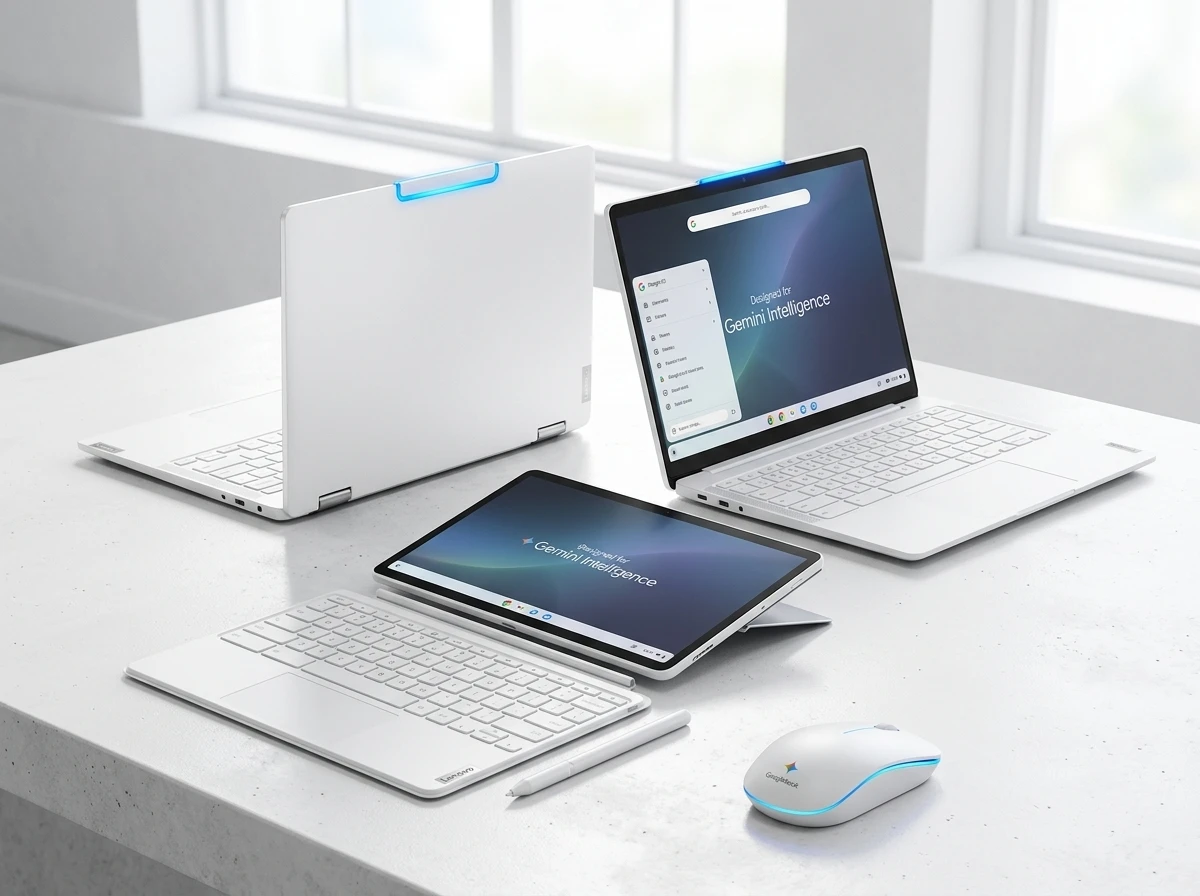
Exclusive renders dropped Friday show Lenovo’s first Googlebooks: two stark white clamshells, a detachable 2-in-1 tablet with stylus, and the AI mouse that surfaced earlier in July. The devices carry Google’s blue glowbar and palm-rest branding, and they head for a Fall 2026 launch with Acer, ASUS, Dell and HP units.
The leak from Android Headlines fills in the hardware picture weeks before expected IFA reveals. It also makes plain that Googlebooks are already stretching past simple laptop replacements. What began as a laptop-category pitch now arrives with multiple body styles and a branded accessory in the same frame.
That breadth matters because the first public images set the mental model for the entire first wave. Lenovo did not drip one hero clamshell. It showed a family.
Two White Clamshells and the Ports That Showed Up
The images capture finished marketing renders, not factory snaps. Both laptops sit in clean white finishes. A top-edge protrusion echoes Lenovo’s recent Chromebook Plus 14. The blue glowbar runs across the lid; the Lenovo logo is the only other cover mark. Googlebook branding lives on the left palm rest instead of the lid.
One machine looks larger and carries more ports. Visible on its right edge: USB-A, USB-C and a light-up power button. The left side shows an audio jack, another USB-C and what may be HDMI or a second USB-A. The smaller unit drops the side speaker grills and keeps a right-side USB-C plus headphone jack.
- Lid glowbar in functional blue, matching Google’s teaser language
- Palm-rest “Googlebook” text rather than lid branding
- No Windows-style key; a G key sits in its place per later close-ups
- Two distinct sizes confirmed by missing grills and port layouts
That variety matches Lenovo’s usual habit of covering every price and size band. Google has said the category will sit premium from the start. The port split between the two bodies already signals how Lenovo plans to hit both the lighter carry case and the docked desk without leaving the same design language.
White finishes and the shared glowbar keep the pair readable as one product line even when the edge layouts diverge. Buyers scanning a shelf will see the family first and the size second.
How Googlebook Merges Android and ChromeOS
Google introduced the platform on May 12 at The Android Show: Google I/O Edition. It fuses Android’s app stack and modern OS with ChromeOS browser strengths, then layers Gemini Intelligence throughout. The result is a new category of laptops built with Gemini at the core, not bolted on.
Magic Pointer turns the cursor into an active Gemini surface. Wiggle it and contextual suggestions appear for whatever sits under the tip. Point at a date to schedule a meeting, or select two images to composite them. Create My Widget builds custom desktop dashboards from a prompt, pulling Gmail, Calendar or web data. Cast My Apps mirrors phone apps onto the laptop without installs. Quick Access treats phone files as local.
| Feature | Googlebook | Traditional Chromebook |
|---|---|---|
| Core OS base | Android + ChromeOS hybrid | ChromeOS |
| AI integration | Gemini Intelligence ground-up (Magic Pointer, widgets) | Optional Gemini add-ons |
| Phone continuity | Cast apps + Quick Access files | Limited or separate |
| Hardware tier | Premium materials, glowbar, strict standards | Often value-focused |
| App model | Full Play Store + desktop flow | Web + Android apps via container |
The official Googlebook platform page puts the difference simply: flagship materials and intelligence features versus Chromebooks built for simplicity and efficiency. Cursor updates even ship through a Play Store app.
That update path is a quiet mechanism shift. Features that once required a full OS image can move on the same cadence as a phone app. Magic Pointer, Create My Widget and the casting tools therefore stay current without waiting for a seasonal system release.
Phone continuity sits at the center of the pitch. Cast My Apps removes the install step that still slows most desktop-to-mobile handoffs. Quick Access folds phone storage into the laptop file view so the two devices stop feeling like separate islands.
Lenovo Spins the Glowbar Across Form Factors
The blue glowbar is more than lid jewelry. It appears on both clamshells and on the tablet’s camera housing, and the AI mouse carries its own RGB light strip along the top edge. The shared light language turns four separate SKUs into one recognizable set before a shopper reads a single spec sheet.
Google’s teaser language already tied the glowbar to the platform identity. Lenovo’s renders simply extend that cue from the lid to the accessory layer. Palm-rest Googlebook text on the laptops and folio branding on the tablet keyboard repeat the same name in the same place a hand rests, so the label stays visible in daily use rather than only on a closed lid.
Consistent lighting and naming lower the teaching cost when a user moves from clamshell to tablet to mouse. The G key that replaces the Windows-style key on the laptops continues the same identity work at the keyboard level.
Lenovo Spins the Tablet Nobody Flagged
The third device is the real expansion play. It is a detachable 2-in-1 tablet with a pill-shaped camera and glowbar housing, dual speaker cutouts per side, magnetic stylus on the top edge, kickstand, and a folio keyboard that carries Googlebook branding plus a full touchpad.
Google’s May materials spoke almost exclusively of laptops. A tablet form factor was not on the public roadmap. Lenovo already ships Chromebook 2-in-1s, so the move is natural for the partner, yet it quietly widens the category into creative and education territories Chromebooks already serve. Close observers on X had been tracking a “Sapphire” code name for months; the leaked unit matches those earlier signals.
That breadth turns Googlebook from a single clamshell bet into a multi-form family on day one of hardware leaks. Partners who ship both styles early own more shelf and mindshare.
The folio keyboard with its full touchpad keeps the tablet inside the same productivity loop as the clamshells. Stylus storage on the top edge and the kickstand point at note-taking and media use without forcing a separate software mode. The platform’s hybrid base already assumes full Play Store apps, so the tablet does not need a stripped interface to stay useful.
The AI Mouse Completes an Accessory Layer
Sitting in the same renders is the Lenovo AI Mouse M830 that Android Authority documented from a technical listing and manual in mid-July. It carries explicit Googlebook branding on the back.
- 59 g (+/- 2 g) ultra-light body, 118.97 × 61.37 × 38.33 mm
- 800 mAh battery, USB-C front charge, Bluetooth
- RGB light strip along the top edge
- Dedicated “AI Key” below the scroll wheel, plus forward/back side buttons
- Bottom dual-device switch, DPI toggle, on/off
- ~20 days continuous use lights off; ~32 hours with breathing LED
The AI Key is widely read as a hardware shortcut for Magic Pointer, skipping the wiggle gesture. Google never teased branded peripherals. The mouse (and the tablet stylus) show partners are already building a locked-in accessory set around the glow aesthetic and Gemini triggers.
Battery life figures split cleanly by lighting state. Lights off stretch toward multi-week desk use; the breathing LED drops runtime into a long workday-plus window. The dual-device switch on the bottom lets one mouse jump between a Googlebook and a second machine without re-pairing rituals.
Weight under 60 g keeps the peripheral from fighting the premium thinness of the white clamshells. The same renders that introduced the laptops therefore also introduced the input device meant to sit beside them on day one.
Premium Specs Meet the Memory Crunch
Google set strict hardware bars for memory, storage, keyboards and build quality so every Googlebook feels consistent. Chips will span Intel, Qualcomm and MediaTek, a multi-vendor chip confirmation for Googlebooks that keeps both x86 and ARM options open. That flexibility helps Lenovo and the others hit different price points inside the premium band.
The timing collides with a global memory shortage. IDC notes PC vendors including Lenovo, Dell, HP, Acer and ASUS have already warned of 15-20% PC price hikes warned as DRAM and NAND costs climb through 2026. Google flagged higher price tags for Googlebooks even before the crunch. The combination means the first wave will sit well above classic Chromebook money.
| Pressure | Source already in view | Effect on first wave |
|---|---|---|
| Platform rules | Google strict bars on memory, storage, keyboards, build | Floor stays premium even before component spikes |
| Component market | IDC 15-20% PC hike warnings for 2026 | DRAM and NAND costs push tags higher still |
| Chip mix | Intel, Qualcomm, MediaTek all confirmed | Partners can still ladder prices inside the premium band |
Whether buyers accept the premium for seamless Android phone pairing and ground-up Gemini will decide how fast the category grows past early adopters. Multi-vendor silicon gives Lenovo room to offer an ARM thin-and-light beside an x86 desk machine without breaking the glowbar family look.
Five Partners, One Fall Window
Acer, ASUS, Dell, HP and Lenovo are the confirmed first-wave makers. Lenovo is first to show actual hardware, and it showed three devices plus a mouse at once. That volume play fits its “laptop for every use-case” approach.
- May 12, 2026, Google announces Googlebook at The Android Show, names the five partners, teases Magic Pointer and glowbar, targets Fall availability.
- May 13 onward, Intel, Qualcomm confirm involvement; Google VP John Maletis adds MediaTek; strict hardware standards detailed.
- July 16, 2026, Lenovo AI Mouse M830 listing and manual leak with Googlebook branding and AI Key.
- July 31, 2026, Android Headlines exclusive renders of two Lenovo clamshells, the 2-in-1 tablet and the mouse.
- Fall 2026, First devices expected; IFA in September is the likely public reveal window for Lenovo and possibly others.
The same week’s coverage from 9to5Google and PhoneArena treated the tablet as the genuine surprise. That reaction tracks: the May materials left the impression of polished clamshells. The leak proves the platform already supports the form factors people already buy from Lenovo.
Roughly two and a half months separate the May stage announcement from the July renders. In that window the accessory layer and the tablet both moved from silence to finished marketing imagery. The remaining runway to Fall now looks like a pricing and configuration race among the five names rather than a form-factor discovery phase.
Why Early Volume Shapes the Shelf
Lenovo’s decision to surface two clamshells, a detachable and a mouse in one leak is a shelf strategy as much as a product one. Retail buyers and reviewers form first impressions from the widest set of units on hand. A partner that can demo phone casting on a tablet, Magic Pointer on a clamshell and the AI Key on a matching mouse owns more of the story than a partner that arrives with a single laptop.
The other four makers still have time before IFA and the Fall window. Nothing in the leak locks them out of tablets or peripherals. It does set a public bar: the category already looks multi-form, so a lone clamshell risks reading as incomplete beside Lenovo’s spread.
- Clamshell pair covers size and port variety inside one finish language
- Detachable 2-in-1 reuses Chromebook-era education and creative habits
- AI mouse and stylus add Gemini triggers outside the keyboard deck
- Shared glow and Googlebook labeling keep the set scannable as one line
Mindshare won in August and September tends to freeze into holiday comparison charts. Lenovo’s early volume raises the cost of a slow follow for everyone else on the partner list.
What the Family Approach Changes
Google’s earlier laptop efforts stayed narrower. Chromebooks won education and value segments with simplicity. Googlebook aims higher and wider at once. Magic Pointer itself grew out of work by the DeepMind team reimagining the pointer, then moved into Chrome and now the new devices. Pairing that with phone casting and full Play apps creates a continuity pitch Windows and macOS still patch together.
Lenovo’s early multi-device showing, documented in the same exclusive that first published the renders, puts it ahead of the other four partners in public mindshare. The original Google’s original Googlebook announcement framed a laptop category. The hardware that just leaked already looks like a platform with clamshells, convertibles and peripherals ready to ship together.
The DeepMind pointer work reaching hardware through Magic Pointer and a dedicated AI Key shows how far the idea has traveled from research demo to daily input. Create My Widget and Cast My Apps extend the same intelligence layer from cursor to desktop layout to phone bridge.
Fall will reveal exact sizes, processors, prices and battery claims. Until then the white machines and their matching mouse make the larger ambition visible: Google wants a full Gemini-native device family, and Lenovo is shipping the first proof of that ambition.


Capital Clusters and the Dual Tracks of European Tech Finance

Microsoft Shrinks Windows 11 Memory for 8GB PCs

XRP Ledger Brings Back Bugged Features Fixed for Institutions

The Shards Trailer Turns Ellis Nightmare Into Murphy Glamour

WhatsApp Folder Hides Business Messages After Hours

Mova LiDAX Ultra 3000 AWD Cracks the Robot Mower Moat

Urban Arrow FamilyNext Turns Costco Runs Into Bike Trips

Reddit Builds Spoken Video Layer to Reclaim Its Own Viral Stories

Nuggit £5m Fund Treats YouTube Channels as Real Businesses

Galaxy Z Fold 8 Makes Foldables Daily Drivers but Drops Flex Mode

CLARITY Act Final Text Expected This Weekend as 60-Vote Hurdle Looms

Kalshi Loses Major NY Prediction Markets Ruling to Judge Torres

Fed Minutes Cite AI Demand as Inflation Risk, Put a 2026 Hike Back on the Map

Marker AI Writing Startup Lands $13M Seed Led by Index Ventures

Dota 2 Esports World Cup 2026: Spirit Defends $2M Title In Paris

Meta’s Muse Spark 1.1 Beats Rivals on Price, Trails on Coding

CS2 Premier Season 5 Lands With Cache and a C4 Damage Rework

Finto Picks Munich Over Silicon Valley After YC, Raises $3.4M

Backrooms Returns to Theaters as the Everything Must Go Edition

ARC Intelligence Closes €4M Seed Round in Roughly a Week
-
 FINANCE2 months ago
Zcash Patched a Double-Spend Bug as ZEC Climbed 5%
-
 ENTERTAINMENT2 months ago
Steam Summer Sale 2026 Locks In June 25 to July 9 Dates
-
 NEWS3 months ago
Meta Adds AI Replies to Threads, But Users Can’t Block It
-
 FINANCE4 weeks ago
CLARITY Act Final Text Expected This Weekend as 60-Vote Hurdle Looms
-
 ENTERTAINMENT2 months ago
‘Widow’s Bay’ Review: Apple TV’s Sleeper Horror-Comedy Earns Its Fog
-
 NEWS5 months ago
U.S. Navy Deploys Solar-Powered Lightfish Drone to Patrol Oceans
-
 NEWS8 months ago
FolderFresh Review: This Free Tool Automates Windows File Organizing
-
 FINANCE3 weeks ago
Kalshi Loses Major NY Prediction Markets Ruling to Judge Torres