
BUSINESS
Nextpower’s $365M Prevalon Deal Targets AI Data Center Power

Nextpower agreed to buy Prevalon Energy for up to $365 million on May 28, the solar-hardware company’s first move into battery storage and its clearest bet yet that the firms building artificial-intelligence data centers will pay for steady, around-the-clock power rather than panels alone. The deal pushes a business known for steel sun-tracking racks straight into power conversion, batteries and the control software that sits between a hyperscaler and the grid.
Read quickly, it looks like another entry in a busy year of energy-storage dealmaking. The more telling part is what it says about who the customer has become. The buyers reshaping the power industry now are data center developers chasing gigawatts they cannot get from utilities fast enough, and they want one supplier to hand them dispatchable electricity, not a parts list.
Nextpower Pays Up to $365 Million for a Storage Backlog
The headline price is staged, not paid all at once. Nextpower, the renamed solar tracker maker that trades on the Nasdaq under the ticker NXT, will pay roughly $150 million in cash when the deal closes, issue $50 million in Class A common stock a year later, and owe up to $165 million more in contingent cash tied to future performance. The structure keeps real money on the table only if Prevalon’s pipeline converts.
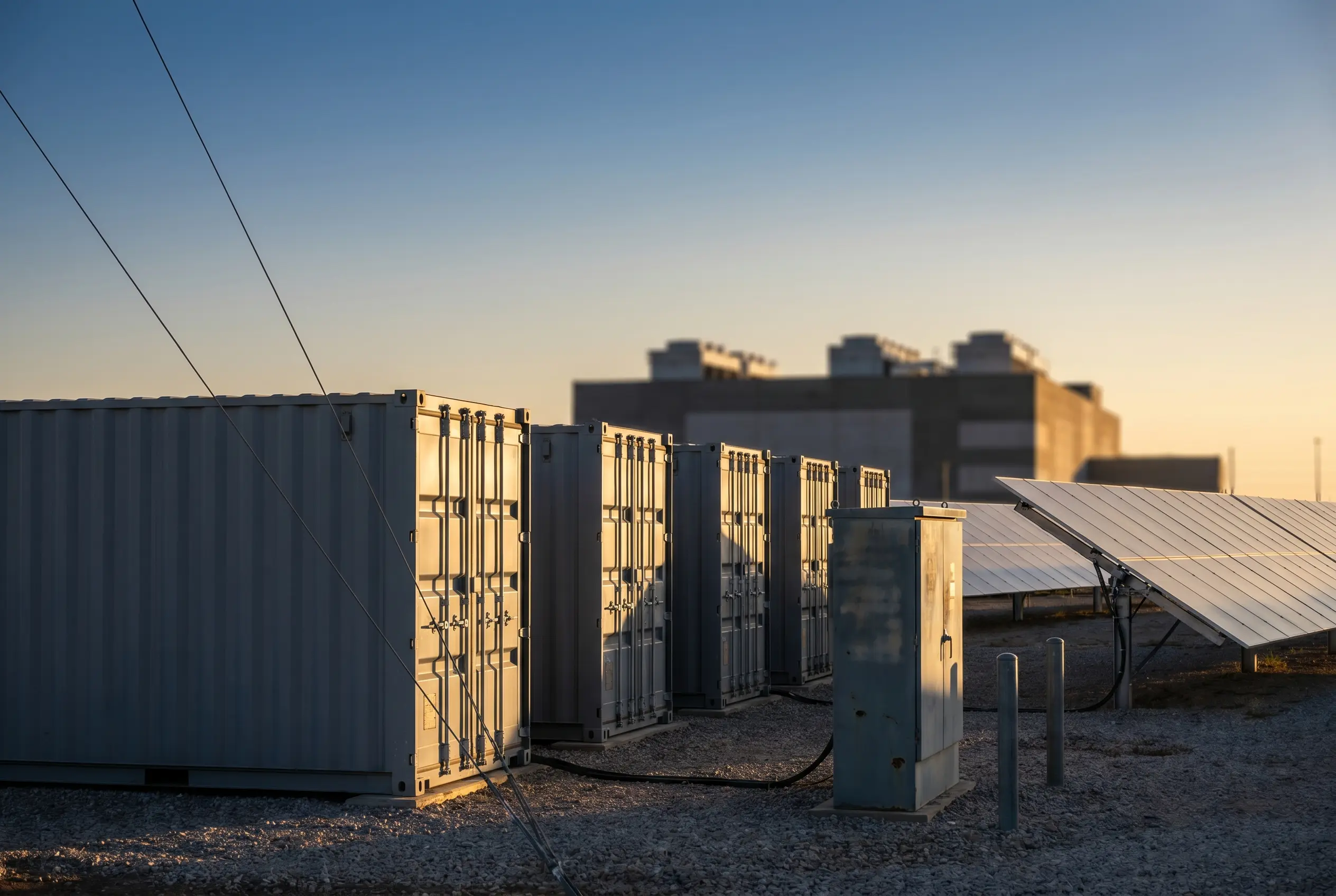
Prevalon Energy is a United States joint venture between Mitsubishi Power Americas and a storage partner, and it brings an installed base that a tracker company could not build from scratch in the time the market is moving. The target has more than 6 GWh of battery energy storage system (BESS, the packaged battery, inverter and software unit utilities buy as one product) deployed worldwide, plus 1.3 GW of firm supply contracts already signed.
The transaction is expected to close in the second quarter of Nextpower’s fiscal 2027, subject to regulatory clearance and customary conditions. Full terms sit in the company’s Form 8-K filing detailing the deal.
| Consideration | Amount | Timing |
|---|---|---|
| Upfront cash | ~$150 million | At closing |
| Class A stock | $50 million | One year after closing |
| Contingent cash | Up to $165 million | On performance milestones |
| Total | Up to $365 million | Staged |
The Rebrand From Nextracker Was the Signal
The clue that this deal was coming arrived months earlier, in the name. In November 2025 the company dropped the Nextracker identity it had carried since spinning out of Flex, and started calling itself Nextpower. A tracker is a piece of steel that tilts solar panels toward the sun. Power is a much wider promise, and the rename told customers and rivals where management intended to compete.
That ambition had been building through a string of smaller deals that stretched the platform beyond racking into electrical balance-of-system gear and software. Buying a storage developer is the largest step in that arc and the first that puts batteries at the center of the offer. It also moves the company onto turf held by Tesla, Fluence and a wave of Chinese system integrators.
Founder and chief executive Dan Shugar framed the move as a response to demand his own customers were voicing. The logic is that a developer who has already bought Nextpower trackers for a solar field would rather add storage and controls from the same vendor than stitch together three suppliers. Whether that bundle holds up against specialists on price is the open question the next few quarters will answer.
The broader pattern is familiar to anyone watching the surge of capital pouring into grid-scale battery storage: hardware suppliers are racing up the value chain toward integrated systems where margins and switching costs are higher.
Why AI Data Centers Rewrote the Order Book
The reason a solar company is suddenly selling firm power comes down to one customer class with a bottomless appetite. Data centers training and running AI models draw electricity in huge, spiky loads, and many cannot wait years for a utility connection. Batteries let a site smooth those swings, ride through grid faults and, in some cases, run partly off its own generation.
That is no longer a niche. The numbers behind the shift explain why Nextpower paid up for a backlog rather than building one.
- 353 GWh of new energy storage capacity is expected to be added globally in 2026, with AI data centers a leading driver, per industry trackers.
- Nearly one-third of planned data center capacity is now designed to source part or all of its power on site rather than from the broader grid.
- The market for batteries serving data centers and industrial sites is forecast to grow roughly fivefold by 2036, according to the data center battery storage forecast through 2036.
Prevalon’s Contracts, Not Its Factories, Drove the Price
What Nextpower really bought is a contracted order book pointed at exactly the customers it wants. Prevalon’s 1.3 GW of firm supply agreements support AI and hyperscaler data center deployments alongside utilities and industrial buyers, which gives the acquirer an immediate position in a market it had no products for a year ago. The 6 GWh already in the ground proves the systems work at scale.
The technical hook is a product Prevalon calls its Hybrid Power Stabilizer, built to handle the rapid load changes a data center throws at a grid connection. That capability, not battery cells, is the scarce thing. Cells are a commodity sourced from Asia; the controls and the customer relationships are not.
Many of our customers have rapidly expanded their storage programs and asked us to extend Nextpower’s platform into power conversion and BESS to deliver fully integrated firm power solutions.
That was Dan Shugar, founder and chief executive of Nextpower, in the company’s deal announcement. Tom Cornell, president and chief executive of Prevalon Energy, said the target shares its new owner’s focus on reliability and customer success. The language on both sides points at the same prize: selling certainty of supply to buyers who cannot tolerate an outage.
A Raised Outlook That Moves the Needle Only Slightly
Alongside the deal, Nextpower nudged up its guidance, and the modesty of the bump is its own data point. Management lifted the fiscal 2027 revenue range to $4.0 billion to $4.4 billion from $3.8 billion to $4.1 billion, and raised the adjusted earnings target to $845 million to $930 million from $825 million to $900 million. Investors welcomed it; the shares climbed sharply on the announcement.
Run the midpoints and the revenue increase works out near 6 percent, with adjusted earnings up closer to 3 percent. These ranges sit above the previous outlook, but the increases are incremental rather than transformative, which fits a deal that closes mid-year and folds in a business still scaling.
| Fiscal 2027 outlook | Previous | Revised |
|---|---|---|
| Revenue | $3.8B to $4.1B | $4.0B to $4.4B |
| Adjusted EBITDA | $825M to $900M | $845M to $930M |
The gap between the strategic story and the financial story is the tension worth holding onto. The narrative is a clean platform expansion into the fastest-growing demand pool in energy. The near-term math is a single-digit lift. The case for the deal rests on the contingent $165 million converting and on storage becoming a much larger slice of revenue after fiscal 2027.
EBITDA, short for earnings before interest, taxes, depreciation and amortization, is the profitability gauge the company steers by, and storage integration historically carries thinner margins than the trackers Nextpower built its name on.
Where the Integration Could Stall
The strategic logic is sound, which is precisely why the execution gets scrutiny. Bolting a storage developer onto a hardware company is the kind of move that looks obvious in a press release and gets hard in the field, where dispatch software, supply chains and two engineering cultures have to actually merge. Several pressure points sit between the announcement and the payoff.
- Margin compression: battery systems compete on price against Tesla, Fluence and low-cost Asian integrators, and the cells themselves are a swinging commodity cost.
- Integration drag: blending Prevalon’s teams, controls and operations without slipping on existing contracts is the first real test.
- Contingent risk: up to $165 million of the price only pays out if the pipeline performs, so a soft year delays the full bill but also signals a miss.
- Policy exposure: market rules, interconnection queues and incentives for storage can change the return math quickly.
None of those is unique to this deal. They are the standing risks across a storage sector drawing fresh capital on both sides of the Atlantic, and they apply to every hardware vendor now chasing the firm-power bundle. The demand is real and documented in U.S. electricity demand growth data from the EIA; converting it into durable profit is the part nobody can yet underwrite.
The same uncertainty runs through the Department of Energy’s outlook on meeting data center power needs, which leans heavily on storage to balance loads that utilities cannot serve on their own timelines.
If the 1.3 GW of contracts convert on schedule and the storage line carries respectable margins, Nextpower will have repriced itself from a solar parts maker into a firm-power supplier to the AI buildout, and the contingent payment will look cheap. If integration drags or cells whipsaw on cost, the market will judge it by that single-digit guidance bump, not the platform story. The first earnings update after the deal closes is where that argument gets settled.
Disclaimer: This article is for informational purposes only and is not investment advice. Securities such as Nextpower (NXT) carry risk, including integration, margin and market risks discussed above. Consult a qualified financial professional before making investment decisions. Figures are accurate as of publication on June 2, 2026.


Orbio Closes $21M From Dawn Capital to Scale AI Frontline Agents

Honda’s Electric Trial Bike Lands in the Top Five at TrialGP Japan

GTA 6’s November Launch Is Reshaping the 2026 Game Calendar

Qorelo Lands $3.5M Seed to Tackle SAP’s 2027 Migration Crunch

Italian Edtech Sirius Game Raises €1.3M to Scale Primary School Play

Bestie Bite Raises €1.5M to Take AI Video Reviews to the US

European Tech’s €2.8B Week Came With a US Acquirer Twist
Rainn Wilson Calls Out Media’s Double Standard on Platner

OnePlus N6 Confirmed for June 30 India Launch as First N-Series Phone

Munich Court: Google Liable for False Answers in AI Overviews

Zcash Patched a Double-Spend Bug as ZEC Climbed 5%

Steam Summer Sale 2026 Locks In June 25 to July 9 Dates

‘Widow’s Bay’ Review: Apple TV’s Sleeper Horror-Comedy Earns Its Fog

Amazon Scraps Its Stargate Revival After a 20-Week Writers Room

Citigroup Says ETF Outflows Drove Bitcoin’s Crash, Not Strategy’s Sale

Coinbase Invests in Ethena, ENA Jumps 10% on Open-Market Buy

CLARITY Act Floor Vote Likely Shifts to August, Lummis Says

Gigaton Lands $26M to Replace Heavy Industry’s Control Stack

London AI Lab Inherent Raises $50m to Reinvent Science
Quobly’s €115M Bet to Scale Silicon Quantum Computing
-
FINANCE2 weeks ago
Zcash Patched a Double-Spend Bug as ZEC Climbed 5%
-
ENTERTAINMENT2 weeks ago
Steam Summer Sale 2026 Locks In June 25 to July 9 Dates
-
 NEWS1 month ago
Meta Adds AI Replies to Threads, But Users Can’t Block It
-
ENTERTAINMENT4 weeks ago
‘Widow’s Bay’ Review: Apple TV’s Sleeper Horror-Comedy Earns Its Fog
-
ENTERTAINMENT2 weeks ago
Amazon Scraps Its Stargate Revival After a 20-Week Writers Room
-
FINANCE2 weeks ago
Citigroup Says ETF Outflows Drove Bitcoin’s Crash, Not Strategy’s Sale
-
FINANCE2 weeks ago
Coinbase Invests in Ethena, ENA Jumps 10% on Open-Market Buy
-
FINANCE2 weeks ago
CLARITY Act Floor Vote Likely Shifts to August, Lummis Says