
BUSINESS
Oklo Stock Jumps 500%: Inside the Nuclear Power Surge

A nuclear energy startup with no commercial reactor running and zero revenue has become one of Wall Street’s hottest stocks. Oklo (NYSE: OKLO) has surged over 559% in the past year, and the momentum shows no sign of stopping. Here is everything driving that jaw-dropping climb and what it could mean for the future of clean energy.
Why Oklo Stock Has Been on Fire
The rise did not happen overnight. Several back-to-back catalysts lit the match, and the market has been pouring fuel on it ever since.
In late 2024, Oklo announced letters of intent from two data center customers to deploy its Aurora powerhouse small modular reactors, promising up to 750 megawatts of capacity nationwide. Shortly after, the company revealed a non-binding agreement to install 12 gigawatts of Aurora projects through 2044 in a partnership with Switch, a major cloud, AI, and enterprise data center supplier.
Then came the political tailwind. When President Donald Trump signed executive orders in May 2025 to revive the US nuclear energy industry, Oklo found itself perfectly positioned at the center of a federal push that had been absent for years. The orders directly streamlined licensing procedures for advanced reactors, cutting through regulatory red tape that had long slowed the sector.
The result: a stock that went from a low of $28.16 to a 52-week high of $193.84, with a current market capitalization of over $13.5 billion.
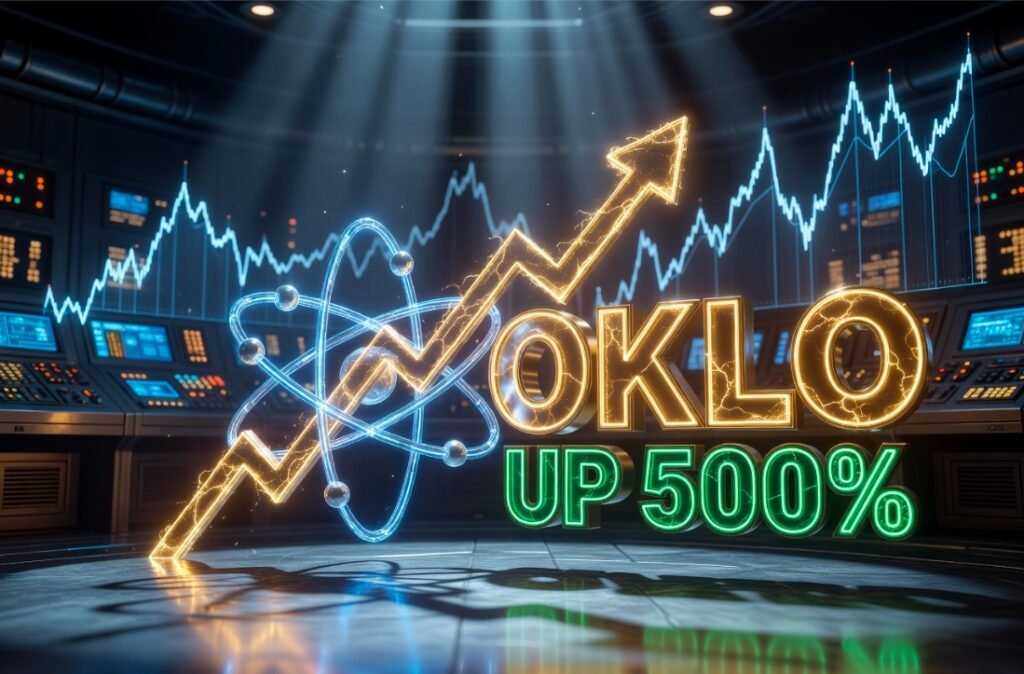
Oklo Aurora small modular reactor nuclear AI data center power
Big Tech Is Betting on Oklo’s Reactors
The real story behind the Oklo rally is who is writing the checks and why.
In January 2026, Oklo announced a landmark deal with Meta Platforms to develop a 1.2 gigawatt nuclear energy campus in Pike County, Ohio. The agreement provides a mechanism for Meta to prepay for power and deliver early funding to advance Oklo’s Aurora powerhouse deployment. Pre-construction and site work are set to begin in 2026, with the first phase targeted to come online as early as 2030.
“Meta’s funding commitment in support of early procurement and development activity is a major step in moving advanced nuclear forward.” – Jacob DeWitte, Oklo CEO and Co-founder
The Meta deal is not just a contract. It is a signal to the entire market. When one of the world’s largest tech companies commits upfront cash to a pre-revenue nuclear startup, other investors take notice.
Oklo’s total customer pipeline has now expanded to approximately 15 gigawatts, including a 12 GW non-binding master power agreement with Switch through 2044 and a 500 MW letter of intent with Equinix backed by a $25 million pre-payment.
Nvidia and the NRC Both Just Backed Oklo
April and May of 2026 delivered two more explosive catalysts that pushed the stock higher.
On April 23, Oklo announced a three-way partnership with Nvidia and Los Alamos National Laboratory. The collaboration combines Oklo’s advanced sodium-fast-reactor platform with Nvidia’s AI infrastructure and the lab’s world-class nuclear fuels expertise. The goal is to build nuclear-powered AI factories, using digital twins, AI modeling, and simulation to accelerate nuclear fuel development.
Oklo stock jumped 6% immediately after the Nvidia announcement.
Then on May 6, the US Nuclear Regulatory Commission approved the Principal Design Criteria topical report for Oklo’s Aurora powerhouse currently under construction in Idaho. The approval was completed on an accelerated review schedule, a direct result of the 2025 executive orders aimed at modernizing licensing for advanced reactors. Texas Capital Securities reiterated a Buy rating and $120 price target following the news, calling it “another incremental step forward” for the company’s licensing path.
The stock climbed nearly 13% on the NRC news alone. The broader nuclear sector moved with it, with NuScale Power and Nano Nuclear also posting gains.
- April 23, 2026: Oklo and Nvidia partnership with Los Alamos National Laboratory announced
- May 6, 2026: NRC approves Principal Design Criteria for Aurora powerhouse in Idaho
- May 11, 2026: JPMorgan initiates OKLO coverage with $83 price target
- May 12, 2026: Q1 2026 financial results released; $2.5B cash position confirmed
What the Numbers Actually Show
Here is where things get real. Oklo is still a pre-revenue company. In Q1 2026, the company reported a net loss of $33.1 million, with an operating loss of $51.2 million driven by rising payroll and R&D costs.
But here is why Wall Street is not walking away.
Oklo ended Q1 2026 with $2.5 billion in cash and marketable securities, after raising $1.2 billion via an at-the-market equity program in the first quarter alone. That cash runway removes a massive near-term financing risk that has haunted other early-stage energy companies.
| Metric | Q1 2026 Figure |
|---|---|
| Net Loss | $33.1 million |
| EPS | -$0.19 (beat estimate of -$0.20) |
| Cash and Marketable Securities | $2.5 billion |
| Customer Pipeline | ~15 GW |
| 52-Week Stock Range | $28.16 to $193.84 |
On the analyst front, 17 Wall Street analysts cover OKLO, with the consensus sitting at a Strong Buy. The average 12-month price target is $100.22. Tigress Financial Partners holds the highest target at $130, while JPMorgan, which initiated coverage on May 11 with a Neutral rating, set a more cautious target of $83. Goldman Sachs and UBS sit at the lower end.
JPMorgan acknowledged Oklo is in the early stages of transitioning from product development to project deployment, noting that converting non-binding master power agreements into firm contracts will be the key milestone to watch.
The Road Ahead Looks Long but Promising
The Aurora powerhouse at Idaho National Laboratory is targeting criticality by July 4, 2026. Commercial operations are being targeted for 2028. If that milestone is hit, it would fundamentally change how the market values the business.
Oklo’s Aurora reactor has also been scaled up. The capacity was increased from 50 MW to 75 MW to meet accelerating demand from large data center customers. The company says this was a “customer-informed design decision” with no added regulatory complexity.
Beyond power generation, Oklo’s subsidiary Atomic Alchemy adds a quieter but significant growth layer. The company is building out commercial radioisotope production, with first isotope revenue expected in 2026. The radioisotope market is projected to grow at a breakneck pace in the years ahead, adding a diversified revenue stream to Oklo’s long-term model.
Bank of America estimates the global nuclear energy sector could expand into a $10 trillion market by 2050, with small modular reactors positioned at the center of that growth. Goldman Sachs projects AI-driven data center power demand to rise 165% by 2030. Both numbers point in the same direction for Oklo.
The risks are real too. Oklo carries no revenue, widening losses, and a history of insider selling. The company’s first licensing application was denied by the NRC back in 2022. And while the pipeline looks strong, most agreements remain non-binding.
What Oklo has done is rare. It has tied itself to three of the biggest trends in the market right now: AI infrastructure, clean energy policy, and the global nuclear renaissance. Whether or not it can convert promises into power plants on time, the story has captured the imagination of the investment world in a way few pre-revenue companies ever do. For a sector that once seemed frozen in time, the lights are very much back on.


Blanche Fund Deal Clears Path as DOJ Power Decides CLARITY Fate

S26 FE Cases Repeat the Silver Frame Playbook From Last Year

One UI 9.5 Hits S27 Ultra Servers as Fold 8 Ships Its First Patch

Capital Clusters and the Dual Tracks of European Tech Finance

Microsoft Shrinks Windows 11 Memory for 8GB PCs

XRP Ledger Brings Back Bugged Features Fixed for Institutions

The Shards Trailer Turns Ellis Nightmare Into Murphy Glamour

WhatsApp Folder Hides Business Messages After Hours

Mova LiDAX Ultra 3000 AWD Cracks the Robot Mower Moat

Urban Arrow FamilyNext Turns Costco Runs Into Bike Trips

Kalshi Loses Major NY Prediction Markets Ruling to Judge Torres

Fed Minutes Cite AI Demand as Inflation Risk, Put a 2026 Hike Back on the Map

Marker AI Writing Startup Lands $13M Seed Led by Index Ventures

Dota 2 Esports World Cup 2026: Spirit Defends $2M Title In Paris

Meta’s Muse Spark 1.1 Beats Rivals on Price, Trails on Coding

CS2 Premier Season 5 Lands With Cache and a C4 Damage Rework

Backrooms Returns to Theaters as the Everything Must Go Edition

ARC Intelligence Closes €4M Seed Round in Roughly a Week

Finto Picks Munich Over Silicon Valley After YC, Raises $3.4M

Trump Calls Iran ‘Islamic Republic of Japan’ as Ceasefire Ends
-
 FINANCE2 months ago
Zcash Patched a Double-Spend Bug as ZEC Climbed 5%
-
 ENTERTAINMENT2 months ago
Steam Summer Sale 2026 Locks In June 25 to July 9 Dates
-

 FINANCE1 month ago
CLARITY Act Final Text Expected This Weekend as 60-Vote Hurdle Looms
-
 NEWS3 months ago
Meta Adds AI Replies to Threads, But Users Can’t Block It
-
 ENTERTAINMENT2 months ago
‘Widow’s Bay’ Review: Apple TV’s Sleeper Horror-Comedy Earns Its Fog
-
 NEWS5 months ago
U.S. Navy Deploys Solar-Powered Lightfish Drone to Patrol Oceans
-
 NEWS8 months ago
FolderFresh Review: This Free Tool Automates Windows File Organizing
-
 FINANCE4 weeks ago
Kalshi Loses Major NY Prediction Markets Ruling to Judge Torres