
BUSINESS
Pacifico Biolabs Raises €7M to Brew Protein in Beer Tanks

Pacifico Biolabs has raised €7 million to turn brewery infrastructure into mycelium protein production, a Series A bet that existing beer tanks can help alternative meat reach scale faster than custom bioreactors. The Germany-based company will use the money for production in Saxony, hiring, and commercial launches in German-speaking and Nordic markets.
The useful read is less about a foodtech start-up finding money in a cautious market. Pacifico is testing whether Europe’s spare fermentation capacity can become a new industrial base for protein, with the capital cost shifted from steel construction to process control.
Why a Brewery Tank Changes the Cost Story
Fermentation start-ups usually meet the same wall: the science can work in a lab, then the factory bill turns brutal. Stainless steel, sterile systems, downstream processing, permitting, operators and quality control all arrive before a single consumer has bought the product.
Pacifico Biolabs, which says it grows animal-free meat from mycelium, is trying a different route. Its first Viando product is a chicken alternative, described on Pacifico’s Viando chicken product page as a 1:1 replacement for poultry, made for food manufacturers, service chains and meat companies that want a cleaner ingredient list and familiar cooking behavior.
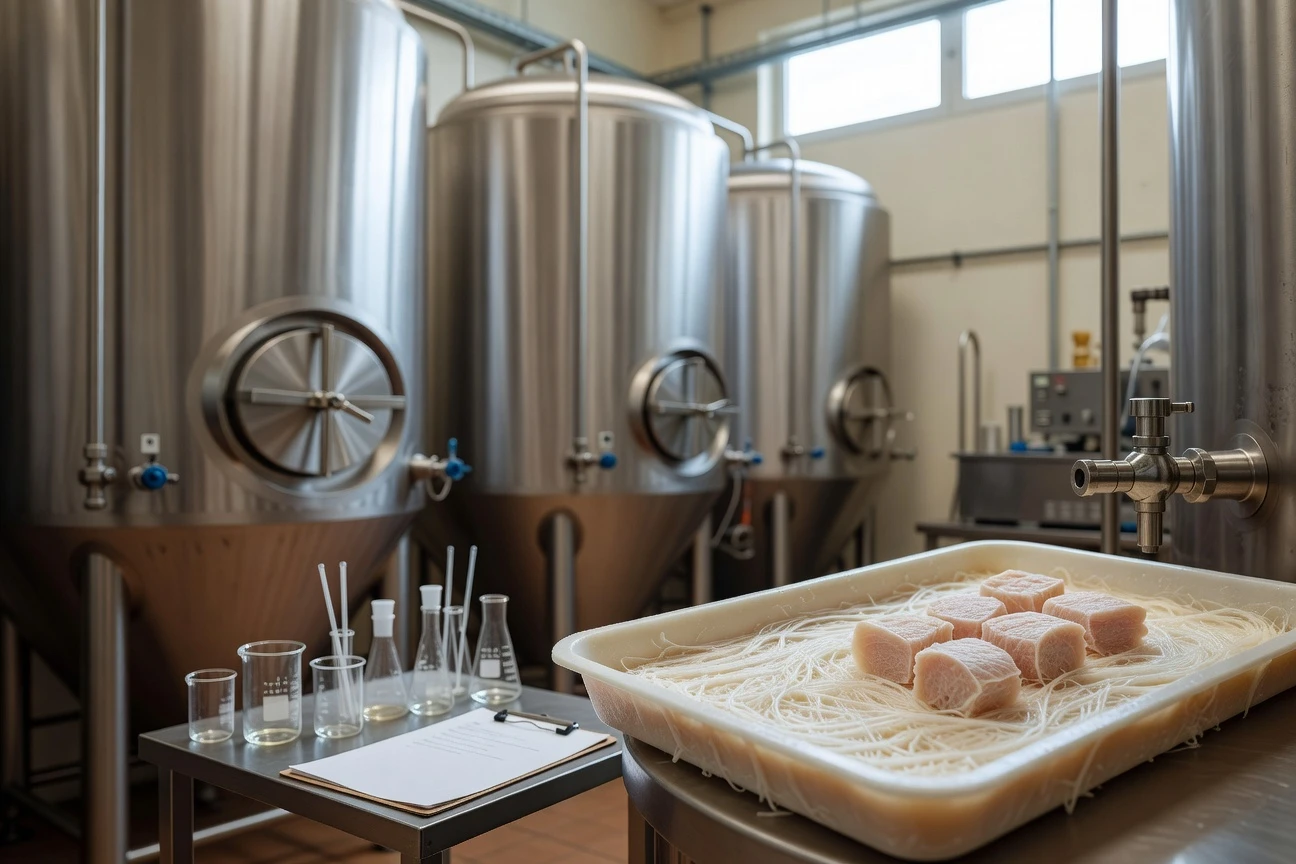
The asset-light wager is simple enough to understand and hard enough to execute. Beer breweries already own large fermentation tanks, trained operators and food-grade routines. Pacifico’s argument is that these assets can be repurposed for fungal biomass, turning brewery underuse into food output without asking investors to fund a greenfield bioreactor campus first.
The Round Buys Scale, Not Just Science
The Series A includes Stray Dog Capital, TGFS, a Saxony technology start-up fund, Sprout & About Ventures, Simon Capital, FoodLabs and a regional brewery partner. That mix matters. A brewery partner gives the round an industrial leg, while Saxony links the company to the region where production is meant to scale.
- €7 million is the new Series A funding Pacifico says it has raised for production scaling, team expansion and launch work.
- 34.7 billion litres of beer were produced across European Union countries in 2024, according to Eurostat, split between 32.7 billion litres above 0.5% alcohol and 2 billion litres below that threshold.
- 66% of the EU’s high-protein feed is imported, the European Commission’s Joint Research Centre reported, with soybean meal import dependence much higher.
The money follows Pacifico’s earlier pre-seed round and public support in Saxony, but the new cheque has a different job. It is meant to take the company from product story to operating proof across Saxony, the DACH region, meaning Germany, Austria and Switzerland, and Nordic Europe.
That is why the timing is useful. The Good Food Institute’s fermentation sector report said fermentation companies raised $357 million in 2025, bringing total sector investment since 2016 to $5.2 billion, but it also flagged cost, regulation and market performance as pressure points. Pacifico is raising into that tougher filter.
A Beer Slowdown Creates Foodtech Space
Breweries are not empty across Europe. Eurostat’s EU beer production data for 2024 showed a slight 0.6% rise in beer above 0.5% alcohol and an 11.1% rise in low and no-alcohol beer versus the previous year. Germany remained the bloc’s largest alcoholic beer producer, with 7.2 billion litres.
The capacity problem shows up better over a longer run and through the sales mix. The Brewers of Europe reported EU beer production of about 346.3 million hectolitres in 2023, down from about 367.4 million hectolitres in 2019, and EU consumption of about 301.5 million hectolitres in 2023, down from about 319.6 million hectolitres in 2019, in its European Beer Trends statistics report.
That does not mean every tank is waiting for fungi. A brewer still needs downtime, compatible cleaning systems, predictable batches and a partner willing to carry foodtech risk. But the macro fit is clear. If beer demand softens in mature markets while alternative protein needs lower capital routes, idle or underused fermentation assets become more valuable than they looked on a brewer’s balance sheet.
Protein Security Gives the Deal a Policy Tailwind
Pacifico is selling a human food product, not feed protein. Still, the European policy story around protein helps explain why investors care. Europe’s meat system depends on imported high-protein inputs even as politicians talk about food security, strategic autonomy and shorter supply chains.
- European Union livestock consumes about 71 million tonnes of crude protein in feed each year, according to the European Commission’s Joint Research Centre.
- About 24% of that crude protein is imported, and the import share rises sharply for high-protein feed.
- Soybean meal, the EU’s main high-protein feed, is 96% sourced from outside the bloc, according to the same JRC protein self-sufficiency analysis.
A chicken alternative made in Saxony will not close that feed gap alone. It works from the other side of the ledger. If consumers and foodservice buyers accept more animal-free protein, demand for animal feed can ease at the margin, and factories closer to consumption points become more important.
That gives Pacifico a policy tailwind, but not a free pass. Systemiq, in an analysis supported by the Good Food Institute Europe, argued that alternative proteins could add €111 billion a year to the EU economy by 2040 if treated as a strategic priority. The same alternative protein economic study also depends on price, taste and scale arriving together.
The European Mycelium Race Has Split Into Models
Pacifico is joining a crowded but uneven European mycelium field. The important split is no longer fungi versus plants. It is factory model versus factory model, and the answer changes depending on whether a company owns plants, rents capacity, upcycles side streams or sells ingredients to other food makers.
| Company | Production Model | Scale Signal | Pacifico’s Different Bet |
|---|---|---|---|
| Pacifico Biolabs | Mycelium grown in repurposed brewery fermentation tanks | €7 million Series A for Saxony scale-up and regional launches | Use existing beer assets before building new plants |
| Infinite Roots | Mycelium cultivated in fermentation tanks using natural side streams such as brewer’s spent grain | $58 million Series B round led by major strategic and public backers | Raise larger growth capital and push a broader mycelium ingredient platform |
| ProteinDistillery | Yeast-based ingredients from industrial side streams, currently brewer’s yeast | ProteinDistillery’s yeast ingredient platform targets food, pet food, animal nutrition and biotechnology | Turn brewery-linked side streams into functional ingredients rather than whole-cut meat analogues |
| Enifer | PEKILO mycoprotein from food industry side streams | Enifer’s €36 million funding package was announced for a food-grade mycoprotein factory in Finland | Build dedicated factory capacity for fungi-based protein ingredients |
The table shows why Pacifico’s round is modest but interesting. It is not trying to win by having the biggest cheque in European mycelium. It is trying to make someone else’s fermentation hardware part of its cost base.
That choice carries its own risk. A dedicated plant can be tuned around one organism and one process. A brewery retrofit must fit around another industry’s assets, schedules and tolerances. The prize is lower capital intensity. The cost is operational negotiation, every batch, every site.
The Retail Test Comes After the Tank Test
The next phase is commercial, not theoretical. Pacifico says the funding will support production scaling in Saxony, expansion of the team and launches across DACH and Nordic Europe before planned retail launches by late 2026. That means the first serious verdict may come from business-to-business buyers before supermarket shoppers see the product.
Foodservice and manufacturers are useful first customers because they can test texture, cooking loss, ingredient lists and supply reliability without asking a consumer to learn a new brand from scratch. They will also be less forgiving on price. A chicken alternative that behaves well but costs too much remains a menu experiment.
Retail raises the bar again. Shelf space forces comparisons with poultry, tofu, seitan, plant-based chicken and private-label meat alternatives. Pacifico’s clean-label and mycelium claims may open the door, but repeat purchases will depend on taste, availability and whether the brewery model can keep costs down as volumes rise.
The foodtech sector has learned that pilot success is cheap compared with market patience. For Pacifico, price parity is the hard test. If brewery tanks can deliver it, the €7 million round will look like early industrial positioning. If they cannot, the company joins a long list of protein start-ups with good biology and difficult unit economics.


Replit Opens Its London Office Inside an AI Crowd

Straight Circle Trailer Lands Without a U.S. Date

Anemo Labs Bets £700,000 on an AI Sense of Smell

Nintendo Prices the Zelda 40th Switch 2 at $519

Copilot Capital Buys the Autopilot Already Running 90 GW

Ground A Raises €9.1 Million for a Pallet Laser

Gibney’s Musk Film Opens in Venice Without Its Subject

Torvalds Blames AI for a Full-Fat Linux 7.3-rc2

Dexter Returns Sharper, Older, and Stuck Between Killers

Meta’s Muse Agent Can Spend Before the Privacy Lock

Walter’s TWG Insists No Fraud as Insurer Probes Force Cleanup

30-Year Yield Hits 5.32% Highest Since 2007 as Debt Supply Locks In Costs

PCE Stays at 3.7% as Gas and Tariffs Outrun Coming Revisions

Evernorth S-4 Clears Path for Active XRP Treasury on Nasdaq

Astute’s $1.2M bet makes B2B creator deals feed AI discovery

Strategy Parks $1.59B Cash While Bitcoin Stack Stays Flat

CLARITY Act Cloture Opens a Door Ethics Still Blocks

Instinct Hits $2.5 Billion as AI Agent Access Sparks Trust Fights

Oracle’s 2.8 GW Bloom Deal Exposes the AI Power Bypass

AI data centers win as RAM kits jump nearly 500 percent
-
 FINANCE3 months ago
Zcash Patched a Double-Spend Bug as ZEC Climbed 5%
-
 ENTERTAINMENT3 months ago
Steam Summer Sale 2026 Locks In June 25 to July 9 Dates
-

 FINANCE2 months ago
CLARITY Act Final Text Expected This Weekend as 60-Vote Hurdle Looms
-
 NEWS4 months ago
Meta Adds AI Replies to Threads, But Users Can’t Block It
-
 ENTERTAINMENT5 months ago
Extraction 3 Is Officially Coming to Netflix in 2027
-

 NEWS3 months ago
YouTube Shorts is testing a heart in place of the thumbs-up
-

 NEWS1 month ago
Senators Force Apple Off Chinese Memory as Big Three Cash In
-

 NEWS3 months ago
NEURA Robotics’ $1.4B Series C Redraws Europe’s Physical AI Bet